
Optimize Your Energy with ISO 50001 – ENMS Certification

ISO 50001 Certification UK: How to Achieve an Effective Energy Management System
ISO 50001 is the international standard for Energy Management Systems (EnMS). It gives organisations a practical, auditable framework to cut energy use, reduce costs and show ongoing improvement. This guide sets out what ISO 50001 requires, how an EnMS works through the Plan‑Do‑Check‑Act (PDCA) cycle, and why UK organisations pursue certification to meet compliance, procurement and net‑zero goals. You’ll find the standard’s core principles, the evidence auditors expect, the certification pathway from readiness review to surveillance, and the main drivers that shape quotes. Practical checklists, comparison tables and step‑by‑step lists make the guidance usable for SMEs and larger sites, and we explain how accredited certification partners can shape tailored audit plans. Keywords such as energy management, iso 50001, enms certification and energy performance indicators (EnPIs) are integrated to improve clarity and search visibility while focusing on actionable priorities for 2025.
Understanding ISO 50001’s wider context — its strengths and limits — is essential for any organisation weighing adoption.
ISO 50001 Implementation: Efficacy, Advantages & Limitations
Published in 2011, ISO 50001 has become one of the fastest‑adopted ISO management standards. Yet questions remain in the literature about how effectively it is implemented and integrated within businesses. This chapter reviews ISO 50001’s relevance to reducing energy consumption, highlighting its advantages, possible weaknesses and factors that influence outcomes. Drawing on existing studies of ISO management standards and energy management, the author finds that ISO 50001 shares many strengths and constraints with other ISO systems. The chapter helps managers and researchers assess likely results and success factors, and clarifies the standard’s relationship with existing energy policies.
Implementing the ISO 50001 system:
A critical review, A Yuriev, 2017
What is ISO 50001 and How Does It Define an Energy Management System?
ISO 50001 describes an Energy Management System (EnMS) as a systematic approach for setting policy, controls and processes to improve energy performance and support continual improvement. It uses the Plan‑Do‑Check‑Act (PDCA) cycle to connect energy policy, planning (including the energy review and baseline), operational controls and management review so organisations can reduce energy intensity over time. The standard aims for measurable results: lower energy consumption, better efficiency and documented improvement shown through EnPIs and monitoring. Framing an EnMS this way makes it both a management discipline and a technical programme that can integrate with existing management systems. The next section outlines the core principles and how leadership converts intent into measurable energy outcomes.
The PDCA cycle is widely recognised as the practical engine that drives continuous improvement in energy management.
PDCA Cycle: Foundation for ISO 50001 Energy Management
ISO management systems are designed to be compatible and can be combined into a single integrated system. The common methodology behind these systems is the PDCA cycle. This paper highlights the PDCA approach for management systems with an emphasis on energy management, showing how it improves energy efficiency, use and consumption. Using a shopping centre heating and cooling system as an example, the phases of the PDCA cycle demonstrate potential energy savings and CO2 reductions from measures such as water‑to‑water heat pumps.
PDCA Cycle as the Foundation of Integrated Management Systems with an Emphasis on the Energy Management System, S Pobrić, 2024
What Are the Core Principles of ISO 50001 for Energy Management?
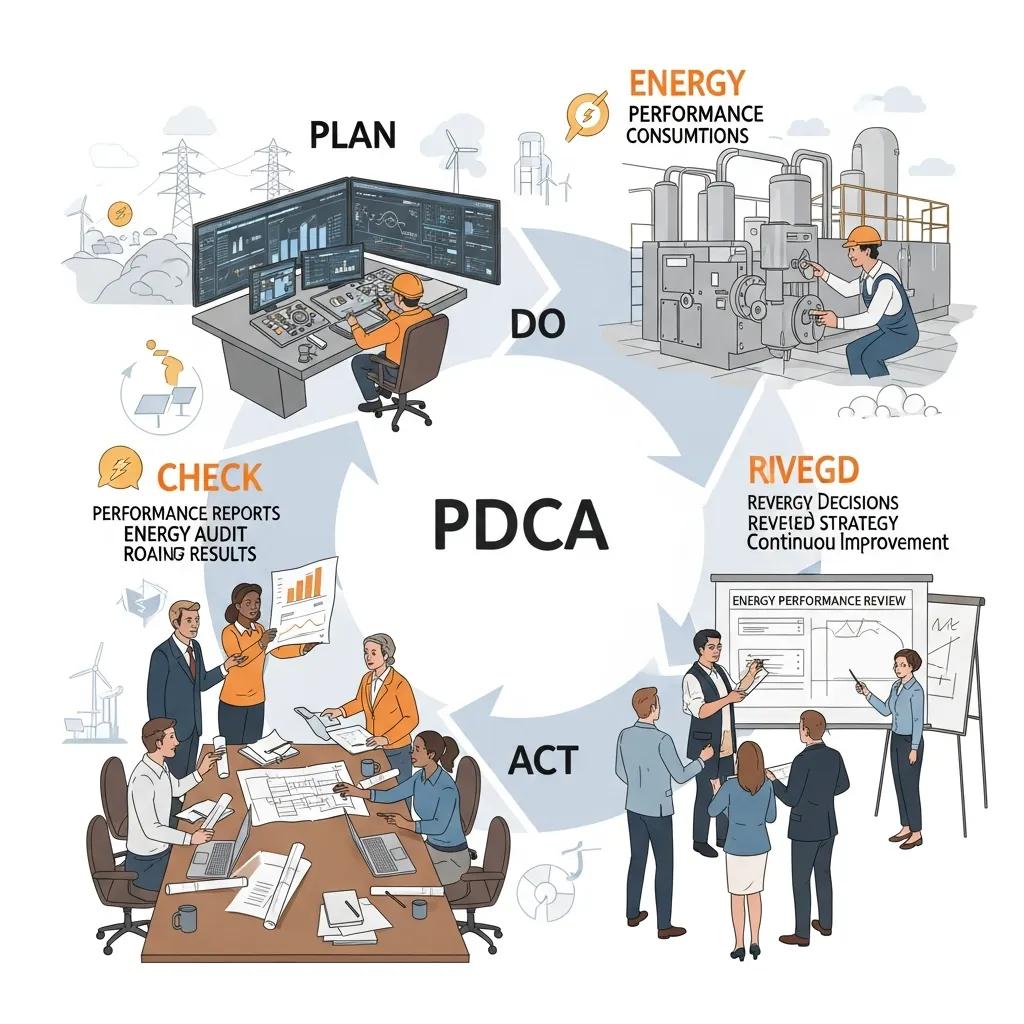
ISO 50001’s core principles are leadership, policy, planning, operational control, monitoring and continual improvement. Leadership sets the energy policy and secures resources, enabling planning activities such as the energy review, baseline setting and selecting EnPIs. Operational control implements procedures and maintenance to reduce waste, while measurement gives the data needed to check performance and trigger corrective actions. Together these elements form a feedback loop: EnPI evidence feeds management review and informs planning, so the EnMS becomes steadily more effective and aligned with business objectives.
How Does an Energy Management System Improve Business Energy Performance?
An EnMS turns metered data into clear insight, highlights highest‑value opportunities and embeds controls so savings last. Energy reviews reveal significant uses and losses; EnPIs and baselines quantify performance and target interventions such as equipment upgrades, process optimisation and behaviour change. Robust operational controls and maintenance reduce variability and prevent backsliding, while management review secures senior oversight and funding for improvement projects. Combined, these practices deliver verifiable energy savings and build a culture of continuous improvement that supports sustainability targets and regulatory expectations.
Achieving ISO 50001 Certification: A Guide to Energy Management
ISO 50001 certification brings direct cost savings and wider strategic value: reduced energy bills, stronger regulatory alignment and greater credibility with customers and supply chains. Certification provides audited evidence of energy performance improvements via EnPIs and documented processes, which supports tenders and sustainability reporting. The standard also surfaces operational efficiencies and maintenance priorities that lower the whole‑life cost of energy‑using assets. The short table below compares typical benefits by stakeholder to make the value proposition clear.
While absolute savings vary, the structural benefits—repeatable measurement, control and continuous improvement—apply across organisation sizes. The next sections explain how those savings are delivered and how certification supports compliance and reputation.
How Does ISO 50001 Certification Drive Energy Cost Savings and Operational Efficiency?
ISO 50001 delivers savings through accurate measurement, prioritised actions and sustained operational control that eliminate waste and optimise processes. With baselines and EnPIs in place, organisations can focus on interventions with the best payback—control tuning, better maintenance and sequence changes—and then verify results through monitoring. Low‑cost operational fixes often give the fastest returns, while capital upgrades are justified by measured performance gains. In short, data‑driven decision making converts ad‑hoc energy efforts into a repeatable efficiency programme.
These approaches are especially important in energy‑intensive sectors, where strategic energy management can materially cut costs and emissions.
ISO 50001 for Sustainable Energy Management & Cost Reduction
The dairy sector is highly energy‑intensive, with major consumption in heating, cooling, homogenisation and drying. Sustainable maintenance and energy efficiency practices are crucial to reduce operating costs and environmental impact. This paper examines energy efficiency opportunities and maintenance strategies for dairy equipment, emphasising preventive, predictive and condition‑based maintenance. Integrating energy measures with advanced maintenance supports the shift to sustainable dairy processing and aligns with standards such as ISO 50001. Case studies show potential energy savings of 20–30% in some plants, highlighting the value of digitalisation, IoT and lifecycle management. The study underlines maintenance engineers’ role in delivering both sustainability and profitability.
ENERGY EFFICIENCY AND SUSTAINABLE MAINTENANCE PRACTICES IN DAIRY INDUSTRY EQUIPMENT, 2025
How Does Certification Support Regulatory Compliance and Enhance Corporate Reputation?
Certification gives independent verification that an organisation follows structured energy management practices, helping to meet disclosure requirements and national net‑zero ambitions. In procurement, a certified EnMS reduces perceived operational risk and signals environmental accountability, which can influence tender decisions and stakeholder trust. External validation also strengthens sustainability claims by aligning them with an internationally recognised standard, helping satisfy customers, investors and regulators. That credibility can unlock new commercial opportunities and support strong corporate governance.
Next, we outline who conducts credible audits and how to prepare for formal assessment.
How to Get ISO 50001 Certified: Understanding the Certification Process with Stratlane

Certification follows a clear audit path: readiness checks, conformity assessment and ongoing surveillance to confirm continual improvement and EnMS effectiveness. Typically you start with a Stage 1 readiness review and documentation check, move to a Stage 2 on‑site audit of implementation and results, then continue with regular surveillance visits. To prepare you’ll need an energy policy, energy review, baselines and EnPIs, plus records of operational controls and management review actions. The list below summarises the audit stages you should expect.
- Stage 1 – Readiness Assessment: Auditor checks scope, documentation and readiness to flag gaps early.
- Stage 2 – Conformity Audit: Auditor verifies implementation, interviews staff and confirms EnPIs and controls.
- Surveillance Audits: Periodic visits confirm continued effectiveness and improvement.
Following this staged approach clarifies responsibilities and timelines and shows how an accredited certification body can support the journey. Use it to prepare evidence, allocate resources and schedule audits effectively.
What Are the Stages of the ISO 50001 Audit and Certification Journey?
Stage 1 reviews documentation and readiness to identify nonconformities early. Stage 2 evaluates the implemented EnMS against ISO 50001 and checks whether the organisation can demonstrate improvement through EnPIs. Surveillance audits—typically annual—ensure the system remains effective; recertification usually happens every three years. Auditors focus on the energy review, chosen EnPIs, operational controls and management review records, so clear evidence and corrective action plans speed the process. Good preparation shortens audit time and helps embed energy management into day‑to‑day operations.
Why Choose Stratlane Certification Ltd. for Your ISO 50001 Audit?
Stratlane Certification Ltd. delivers accredited ISO certification audits with tailored audit plans, local multilingual auditors and a blend of industry experience and AI‑enabled audit tools to improve efficiency and insight. Accreditation ensures certificates are recognised by stakeholders, while our SME programmes and international reach allow audits to be adapted for multi‑site or multi‑jurisdiction needs. If you want a practical route to EnMS certification, request a quote or book a scoping call to discuss scope and timelines. We work with clients to turn ISO 50001 benefits into a clear, measurable programme.
What Are the ISO 50001 Requirements and How to Prepare Your Organisation?
ISO 50001 requires documented elements and operational practices that together form the EnMS: context and scope, energy policy, planning (energy review and baselines), support and competence, operational control, performance evaluation and improvement. Preparing means mapping clauses to concrete actions—carry out an energy review, define EnPIs and baselines, create operational procedures and record management review and corrective actions. The table below maps clauses to practical steps to help teams translate requirements into tasks auditors will check.
This mapping shows how clauses become tangible activities auditors will verify. The next section explains how to produce the core documents auditors expect.
What Are the Essential Clauses and Energy Management System Components?
Key ISO 50001 clauses cover context and scope, leadership and policy, planning, support, operation, performance evaluation and improvement. Each requires documented evidence and assigned responsibilities. Essential records include the energy review report, defined EnPIs and baselines, operating procedures, measurement logs and management review minutes showing decisions and corrective actions. Scoping must capture significant energy uses and any outsourced processes that affect performance so auditors can trace controls and outcomes across the boundary. A clear document set reduces audit friction and demonstrates effective governance.
How to Develop Energy Policies, Reviews, and Performance Indicators?
Write an energy policy committing to continual improvement, legal compliance and adequate resourcing, and get top management approval to anchor the EnMS. Carry out an energy review to identify significant uses, quantify consumption and establish a baseline for EnPIs. Choose EnPIs that are specific, measurable and relevant—examples include energy per unit of production, energy per square metre or kWh per vehicle kilometre—and document calculation and monitoring methods. Regular management review should assess EnPI performance and approve actions, closing the PDCA loop and demonstrating organisational commitment to energy performance.
How Much Does ISO 50001 Certification Cost in the UK and What Influences Pricing?
Certification cost varies because audits are priced by scope, number of sites, process complexity, documentation readiness and required auditor days, so an accurate price needs a tailored quote. Main cost drivers include the organisational boundary, number of locations, process complexity and the volume of corrective actions needed to reach conformity. The table below explains how typical factors affect price and gives examples to set realistic expectations without fixed fees.
Knowing these drivers reduces surprises and helps teams request accurate quotes. The following sections list actionable cost factors and SME support options.
What Factors Affect the Cost of ISO 50001 Certification?
Price depends on the number of sites, complexity of energy systems, maturity of documentation and whether remote or hybrid audits are suitable. Longer audits and specialist technical expertise (for example, for process heating or complex building services) raise costs, while strong internal preparation and concise documentation reduce auditor time. Ask for an itemised quote showing auditor days, travel and reporting so you can compare providers transparently. Understanding these factors helps plan budgets and timelines.
How Can SMEs Access Tailored Certification Programs and Cost Support?
SMEs can lower upfront effort by taking a phased approach—starting with a narrow scope or pilot site—using remote assessment where appropriate and prioritising high‑impact quick wins from the energy review. Many certification bodies offer SME programmes, flexible scheduling and tailored audit plans to reduce disruption and cost. Stratlane Certification Ltd. provides SME‑focused options and staged audit plans to help smaller organisations certify in manageable steps; contact us to discuss a phased approach or request a tailored quote. These routes make EnMS certification realistic for resource‑limited businesses.
Is ISO 50001 Certification Suitable for Your Organisation? Targeting SMEs and Industry Sectors
Suitability depends on energy intensity, regulatory drivers, supply‑chain expectations and strategic sustainability goals. Organisations with significant energy use or procurement pressures typically gain the most from ISO 50001. Use the short checklist below to self‑assess whether certification matches your priorities and capacity. If energy costs affect margins or customers demand supplier energy credentials, ISO 50001 often delivers a clear return.
- Assess Energy Significance: Do energy costs materially affect your operations or margins?
- Check Procurement Drivers: Are customers asking for supplier energy credentials?
- Evaluate Capacity: Can you commit people and time to monitoring and management review?
This checklist helps leaders prioritise certification when benefits outweigh the effort and leads into SME guidance and sector examples.
What Are the Unique Challenges and Benefits for Small to Medium-sized Enterprises?
SMEs face limited resources and competing priorities, but they benefit from simpler energy profiles where quick wins are visible. A scaled EnMS—focusing on the largest energy uses, a small set of EnPIs and short management reviews—keeps effort practical and cost‑effective. Phased certification and remote audits cut disruption, while tailored SME programmes provide appropriate external support. Practical SME tactics include installing meters on major loads, prioritising maintenance fixes and documenting simple, repeatable procedures.
Which Industries Benefit Most from Implementing ISO 50001 Energy Management Systems?
- Manufacturing: process heat, compressed air and electric motors
- Hospitality: HVAC, laundry and kitchen systems
- Logistics & Warehousing: lighting, refrigeration and fleet fuel
These examples show how EnMS work should target the dominant energy uses for each sector, guiding EnPI selection and project prioritisation.
Frequently Asked Questions
What is the role of leadership in ISO 50001 implementation?
Leadership sets the tone and provides the resources an EnMS needs. Senior leaders must approve the energy policy, allocate time and budget, and champion energy awareness across the organisation. Their visible support helps secure engagement, align energy objectives with business goals and ensure measurable improvement.
How can organisations measure the success of their Energy Management System?
Measure success with Energy Performance Indicators (EnPIs) tied to a clear baseline. Regular monitoring and analysis of EnPIs, alongside periodic energy reviews, show trends and validate interventions. Management review should assess EnPI outcomes and confirm corrective actions so the EnMS keeps improving.
What are the common challenges faced during ISO 50001 certification?
Frequent challenges include incomplete documentation, weak employee engagement and unclear baselines or EnPIs. SMEs may struggle with limited resources for controls and maintenance. Overcoming these issues usually requires targeted training, concise documentation and a phased approach that builds capability over time.
How does ISO 50001 certification impact supply chain relationships?
Certification can strengthen supply‑chain relationships by proving a supplier’s commitment to energy management. Verified performance helps customers make lower‑risk procurement decisions and supports long‑term partnerships with organisations that prioritise sustainability.
What support is available for organisations new to ISO 50001?
Support includes consultancy, training and tailored audit plans from accredited bodies. Many providers offer SME‑friendly resources such as phased certification and remote assessments. Industry bodies and government programmes may also provide guidance or funding. Experienced auditors can offer practical insights to speed implementation.
How often should an organisation review its Energy Management System?
Conduct a formal management review at least annually, as required by ISO 50001. The review should evaluate EnPI performance, operational controls and corrective actions. If significant changes occur—new processes, technologies or regulations—carry out reviews more frequently to keep the EnMS effective.
Conclusion
ISO 50001 certification gives UK organisations a repeatable, auditable way to improve energy performance, reduce costs and strengthen sustainability credentials. By building an effective EnMS you create measurable energy savings and better governance. Partnering with an accredited certification body can simplify the journey and tailor the approach to your organisation. Explore tailored solutions to unlock the full potential of your energy management initiatives.