
Ensure Food Safety Excellence with ISO 22000 Certification

ISO 22000 Food Safety Management Certification UK: A Practical Guide to Benefits, Requirements and the Certification Process
ISO 22000 is the international framework for a Food Safety Management System (FSMS). It helps organisations identify and control food-safety hazards across the entire supply chain — from farm to fork — so products reach consumers safely and businesses meet buyer and regulatory expectations. This guide explains ISO 22000:2018 requirements, why the standard matters for UK food businesses, and how a certified FSMS reduces incidents while increasing operational resilience. You’ll find a clear implementation roadmap, comparisons with HACCP and other schemes, typical certification timelines, and the kinds of evidence auditors expect. We also explain how providers like Stratlane Certification Ltd. commonly support UK food businesses using experienced auditors and technology-enabled processes.
What is ISO 22000 and Why is it Essential for UK Food Businesses?
ISO 22000:2018 sets out what organisations must do to plan, implement and continually improve a food-safety management system that controls hazards and delivers safe food. It combines prerequisite programmes (PRPs), HACCP-based hazard control and management-system principles so operations have systematic controls and auditable records. For UK operators this is important because the standard helps align daily practice with food-hygiene regulations and demonstrates due diligence to customers and trading partners. Industry guidance shows that combining management-system discipline with HACCP reduces both the frequency and impact of food-safety incidents — and prepares businesses for the audits that confirm compliance.
ISO 22000 applies across the food chain — to organisations involved in production, processing, storage, transport and sale of food. Its risk-based approach scales to different sizes and complexities: small businesses can apply proportionate controls while larger organisations implement comprehensive FSMS structures. That flexibility explains why many operators adopt ISO 22000 to gain market access or to harmonise multiple sites under a single FSMS.
The standard’s broad scope is a core benefit: it supports robust hazard control at every point from primary production through to the consumer.
UK Food Safety: ISO 22000 Certification & Hazard Control
ISO 22000 certification covers the processes across the food chain involved in production, processing, storage and distribution, recognising the standard’s role in controlling food-safety hazards.
A critical review of ISO management systems certification in the UK agricultural sector, C Bamber, 2005
ISO 22000:2018 — the global framework for food safety
The 2018 revision aligns ISO 22000 with other ISO standards, emphasising leadership, risk-based thinking and clearer interfaces across the food chain while keeping HACCP at its operational core. Organisations typically start with a gap analysis, strengthen PRPs, develop documented HACCP plans and hold management reviews before third-party audit. ISO 22000 is often chosen when businesses need an auditable FSMS that works alongside quality or information-security standards, or when customers and regulators demand recognised, traceable systems.
Because ISO is widely recognised, it supports export activity and multi-site consistency: buyers and auditors understand ISO-based FSMS requirements, which reduces duplicated audits and increases buyer confidence. The next section shows how ISO 22000 embeds HACCP inside a management system.
How ISO 22000 uses HACCP to manage hazards
ISO 22000 incorporates the seven HACCP principles — hazard analysis, CCP identification, critical limits, monitoring, corrective action, verification and recordkeeping — and places them inside an FSMS lifecycle that includes leadership, planning and performance evaluation. In practice, PRPs reduce background contamination and HACCP identifies critical steps (for example heat treatment or metal detection) with measurable limits and routine checks. Documented procedures link PRPs and CCPs so controls are consistent and verifiable.
ISO 22000:2018 clarifies and integrates HACCP and prerequisite programmes within a structured management framework.
ISO 22000:2018 Hazard Analysis & HACCP Integration
The 2018 structure can be integrated with other management systems. Its risk-evaluation approach — informed by Codex HACCP — refines key terms like critical control points and prerequisite programmes, making them clearer and easier to align with standard operating procedures for effective food-safety management.
Food safety management systems based on ISO 22000:2018 — methodology of hazard analysis compared to ISO 22000:2005, 2018
Embedding HACCP in ISO 22000 means auditors assess both the scientific basis of hazard controls and the management records that prove ongoing effectiveness. Auditors therefore expect evidence of technical controls, staff competence, communication and management oversight — all of which contribute to stronger audit outcomes.
What Are the Key Benefits of ISO 22000 Certification for the Food Industry?

ISO 22000 certification delivers measurable improvements and business value by formalising hazard control, clarifying responsibilities and creating auditable evidence of performance. Certification lowers the chance of incidents, supports regulatory compliance and builds confidence with customers and retailers — opening new commercial opportunities. Organisations also gain operational efficiencies from clearer processes and continuous-improvement cycles driven by performance data. Below are the primary benefits and their practical outcomes that procurement and senior teams recognise.
Key strategic benefits:
- Better food-safety performance: Systematic controls reduce contamination and recall risk.
- Improved market access: Certification signals credible controls to retailers and export partners.
- Greater operational efficiency: Standardised processes cut errors and simplify audits.
These benefits show up as fewer corrective actions at audit, lower incident-related costs and stronger commercial relationships. The evidence-based nature of ISO 22000 supports steady reductions in incidents and operational variation over time.
Introductory table: the table below links each benefit to what it affects and the likely business result after certification.
This comparison helps quality and procurement teams focus on the areas that bring the quickest return. The next sections explain how ISO 22000 delivers hazard control across the food chain and how certification supports risk management and market trust.
Strengthening hazard control across the food chain
ISO 22000 raises food-safety control at every stage — from primary production to retail — by pairing PRPs with HACCP-based CCPs and monitoring adapted to each process. PRPs typically include good manufacturing practice, cleaning and sanitation schedules, pest control and supplier verification; these reduce background risk so HACCP controls can work effectively. For example, tighter supplier checks can lower the chance of chemical contamination entering the supply chain, and stronger sanitation in processing reduces microbiological loads before critical controls.
This stage-focused approach helps prevent hazards from spreading, supports traceability and shortens recall response times. In practice you get faster corrective-action cycles and clearer audit trails that show effective food-safety governance.
Improving risk management, consumer trust and market access
Certification connects technical controls with governance and communication processes that buyers and regulators recognise as reliable evidence of competence. ISO 22000 enforces structured risk assessments, documented CCPs and management review, and encourages KPIs such as deviation rates and corrective-action closure times. These measurable indicators back up performance claims when negotiating with retailers or export customers.
Consumer trust grows from demonstrable safety records and transparent communication, protecting brand reputation and supporting sales growth. Many organisations report higher audit pass rates and fewer supplier rejections after adopting ISO 22000, reinforcing the link between a formal FSMS and improved commercial outcomes.
How Does the ISO 22000 Certification Process Work in the UK?
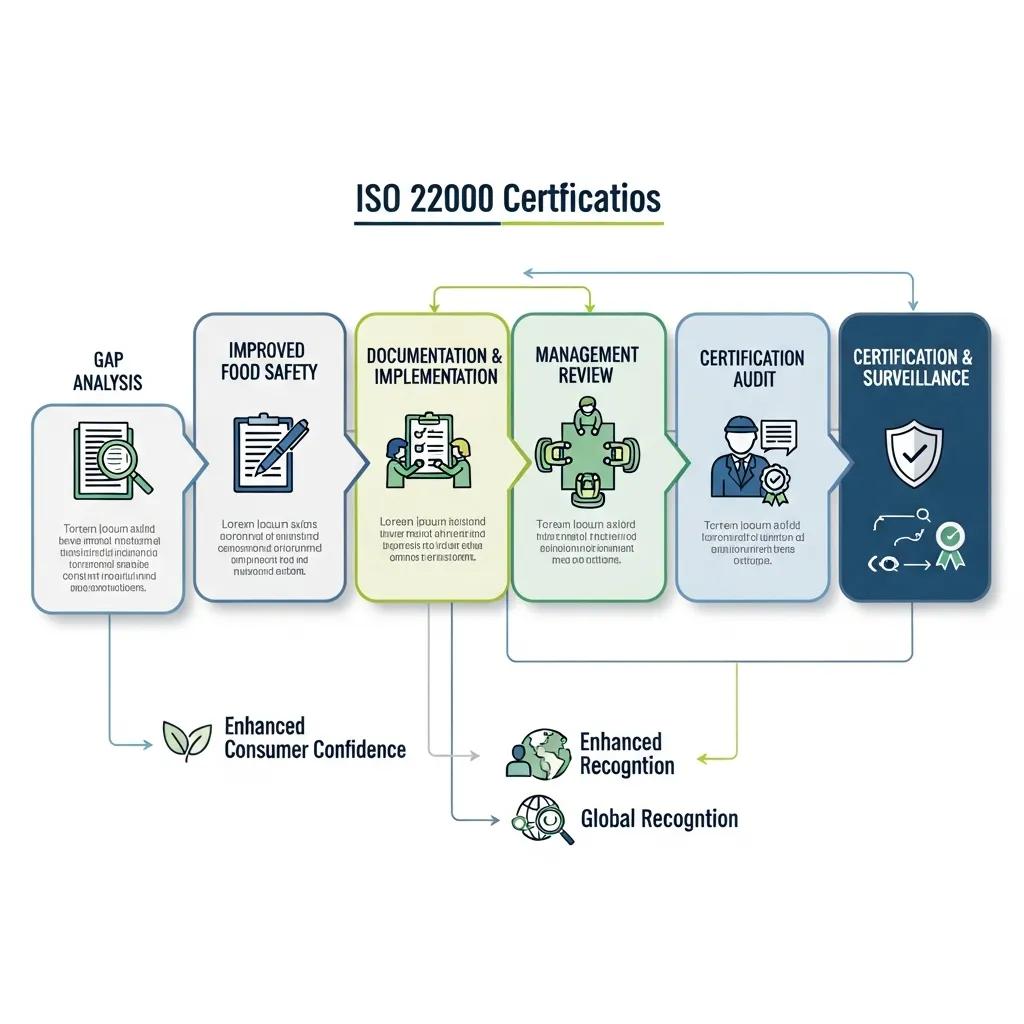
The UK certification pathway is straightforward: gap analysis, FSMS development, internal audits, Stage 1 (document) and Stage 2 (on-site) certification audits, then regular surveillance. Time to certification depends on complexity, but a previously uncertified site often reaches audit readiness in three to six months. Success depends on documented PRPs, validated HACCP plans, clear management commitment and records of monitoring and corrective actions.
Below is a concise, numbered plan to answer the common “how long” and “what steps” questions.
- Carry out an FSMS gap analysis and set an implementation plan — typically 2–6 weeks.
- Put in place PRPs and draft HACCP-based controls — typically 4–8 weeks.
- Implement monitoring, training and record-keeping — typically 2–6 weeks.
- Complete internal audits and management review — typically 1–2 weeks.
- Book Stage 1 (documentation) audit and resolve findings — typically 1–2 weeks.
- Undergo Stage 2 (on-site) certification audit and receive the decision — typically 1–4 weeks.
- Enter surveillance audits annually or as required by your certification body.
Budget for consultancy, implementation and certification fees; costs vary with scale and audit days. Keep records organised and assign clear responsibilities so auditors can verify your FSMS efficiently.
Introductory table: the table below matches certification phases with typical timeframes and deliverables to help you plan.
Use this table as a planning reference and set internal milestones. The following subsections offer a checklist for each phase and explain practical approaches for small and medium-sized businesses, including how certification partners typically help.
Step-by-step: From gap analysis to certification audit
Start with a gap analysis that compares current practice to ISO 22000 clauses and highlights missing documentation, competence gaps and PRP weaknesses. Your gap report should prioritise actions, assign owners and set realistic timelines. Then develop or sharpen PRPs and create HACCP-based process controls, with training and monitoring in place. Internal audits and management review confirm readiness — close internal findings before arranging Stage 1.
Stage 1 reviews your documentation; Stage 2 validates operational effectiveness on-site. Be ready to show monitoring records, verification and corrective-action evidence during Stage 2. Preparing sample records and running mock audits reduces the chance of nonconformities. Clear responsibilities and routine verification make the audit smoother and help lock in durable FSMS practices.
Scaled support for small and medium-sized food businesses
SMBs benefit from proportionate approaches that focus on simple, targeted documentation, lean PRPs and HACCP analyses for the most significant processes. Practical tactics include modular PRP templates, concentrating on key hazards and scheduling audits in quieter production periods. Many certification partners provide pre-audit reviews, template packs and remote support to keep costs manageable while ensuring readiness.
Stratlane Certification Ltd. presents a model that blends experienced auditors with technology-enabled audit tools to streamline evidence capture and shorten on-site time — a cost-effective option for SMBs. Typical support packages prioritise actions that deliver the best risk reduction for the resources available.
What Are the Core Requirements of ISO 22000:2018 for Food Safety Management Systems?
ISO 22000:2018 requires organisations to define context and scope, secure leadership commitment, plan using a risk-based approach, provide support (people and resources), run operations (PRPs and HACCP), evaluate performance and pursue continual improvement. These clauses make hazard control part of an ongoing management lifecycle with clear responsibilities, documented processes and measurable outcomes. Auditors will look for PRP documents, hazard analyses, CCP monitoring logs, internal audit reports and management review minutes as primary evidence.
Below is a practical mapping from requirements to actions and the records you should retain for audits. Use it to translate clauses into audit-ready tasks.
This mapping clarifies what auditors expect and helps teams prioritise the documentation and monitoring work that directly meets clause requirements. The next sections unpack PRPs and interactive communication with performance evaluation in practical terms.
Prerequisite programmes and system management
PRPs form the FSMS foundation and include cleaning and sanitation, supplier approval, allergen control and equipment maintenance. Effective PRPs are process-specific, documented with responsibilities, frequencies and verification steps so auditors can confirm consistent execution. System-management controls — such as change control, document control and corrective-action tracking — ensure PRPs remain effective over time.
Keep clear records: logs, maintenance certificates, supplier approvals and sanitation checklists are primary audit evidence and show operational control. Regular verification through checks and internal audits prevents minor issues from becoming major incidents.
Interactive communication and performance evaluation
ISO 22000 requires interactive communication within your organisation and across the supply chain so you can act quickly on supplier alerts, customer complaints and other upstream or downstream information. Establish clear communication channels to ensure hazard information flows and corrective actions are coordinated. Use KPIs — for example CCP compliance rate, nonconformity trend and corrective-action closure time — to measure FSMS performance and identify improvement opportunities.
Document corrective actions, implement and verify them, and use management review to turn performance data into objectives and resource decisions. Auditors assess these practices as evidence of continual improvement and system maturity.
How Does ISO 22000 Differ from HACCP and Other Food Safety Standards?
HACCP is a hazard-analysis tool focused on operational controls; ISO 22000 is a management-system standard that embeds HACCP inside wider governance, planning and continual-improvement requirements. Scheme-based standards like FSSC 22000 build on ISO 22000 with scheme rules, scope definitions and additional requirements used by some sectors. For organisations wanting integration, ISO 22000 shares a common clause structure with ISO 9001, helping reduce duplication through aligned processes.
Put simply: ISO 22000 is one of several international standards — alongside BRC, IFS and FSSC 22000 — that apply HACCP principles within different certification frameworks.
ISO 22000 vs. Global Food Safety Standards & HACCP
A comparative analysis of international food-safety schemes (BRC, IFS, FSSC 22000, ISO 22000, GlobalGAP, SQF) highlights how each implements HACCP principles and where their main differences lie.
Main requirements for food safety management systems under international standards: BRC, IFS, FSSC 22000, ISO 22000, Global GAP,
SQF, MY Bomba, 2020
Key distinctions:
- HACCP — a technical method for identifying and controlling hazards; often required by law for certain operators.
- ISO 22000 — a management system that formalises HACCP and adds governance, performance evaluation and management oversight.
- FSSC 22000 — builds on ISO 22000 and adds scheme-specific requirements for supply-chain recognition.
These differences help organisations choose the right path for certification and for integrating food-safety work with other management systems.
HACCP legal obligations vs ISO 22000 management requirements
In the UK, HACCP principles are embedded in food-hygiene law and require businesses to identify hazards and apply appropriate controls — a legal demonstration of due diligence. ISO 22000 doesn’t replace legal HACCP duties; it strengthens them by adding documented management processes, leadership involvement and ongoing effectiveness checks. Typically, meeting legal HACCP means you’ll need to add management-level records such as management-review minutes and performance indicators to satisfy ISO 22000 audits.
Bridging the two normally involves mapping existing HACCP documents to ISO 22000 clauses, adding management evidence and introducing KPIs that demonstrate continuous control and improvement. This reduces duplication and creates a single, coherent system that meets both regulatory and certification needs.
Compatibility with ISO 9001 and FSSC 22000
ISO 22000 uses the same high-level structure as ISO 9001, making it easier to integrate quality and food-safety systems through common clauses like leadership, planning and performance evaluation. Integrated systems reduce audit overlap and let you reuse shared processes such as document control and corrective actions. FSSC 22000 extends ISO 22000 with scheme rules and additional PRP detail, which some global buyers prefer.
If you’re considering combined certification, align processes and create joint documentation where possible to save time and give customers clearer assurance.
Why Choose Stratlane for Your ISO 22000 Certification Needs?
Stratlane Certification Ltd. presents itself as a practical certification partner that pairs experienced industry auditors with structured, technology-enabled audit methods to guide organisations through certification and beyond. The company highlights accredited ISO certifications, expert auditors and a clear audit process that supports clients from first enquiry through post-certification. For UK food businesses, Stratlane emphasises efficient evidence capture, sensible audit planning and tailored support for small and medium-sized operators who need cost-aware, practical implementation routes.
Clients can expect help with gap analysis, PRP templates and HACCP alignment as part of a certification pathway. Stratlane’s approach often includes an initial document review, targeted pre-assessments and a staged audit plan to close gaps before formal certification — reducing unexpected nonconformities and speeding the path to certification.
Accredited expertise and a modern audit experience
Stratlane’s value proposition centres on accredited experience and a modern audit experience that uses digital tools to streamline evidence collection. Auditors focus on risk areas, use structured checklists and capture evidence digitally to reduce on-site time and increase consistency. This typically shortens audit durations, clarifies how to resolve nonconformities and supplies clear post-audit guidance for continual improvement.
As part of the client journey, Stratlane commonly supports document readiness, internal-audit training and management-review preparation so organisations can present their FSMS confidently at certification. The emphasis on experienced auditors and consistent processes helps clients prepare and maintain certification standards.
Client outcomes and how to request a certification quote
Organisations that work with structured certification partners often close nonconformities faster, receive clearer audit feedback and transition more smoothly into surveillance cycles, reporting measurable reductions in corrective actions after implementation. To request a quote or book an audit, expect a scoping call to define site scope, number of sites and process complexity — this information is used to produce a tailored proposal and timeline. The formal quote process normally requires scope details, a specialist review and a proposal outlining stages, estimated audit days and next steps.
When preparing to request a quote, have details about your food activities, site complexity and existing FSMS documents ready so the provider can scope the work accurately. After you accept a proposal, agree a timetable for pre-assessment and certification audits and assign an internal project lead to coordinate readiness.
Frequently Asked Questions
What types of organisations can benefit from ISO 22000 certification?
ISO 22000 suits a broad range of organisations in the food supply chain: manufacturers, processors, distributors, retailers and suppliers of raw materials. The standard is scalable, so both small businesses and large corporations can adopt it effectively. Certification strengthens food-safety management, helps meet regulatory requirements and builds trust with customers across markets.
How does ISO 22000 certification impact consumer trust?
Certification shows a public commitment to food safety and gives customers confidence that you manage hazards systematically. Clear, auditable controls and transparent communication enhance consumer trust and can improve brand reputation, loyalty and market performance.
What are the costs associated with obtaining ISO 22000 certification?
Costs vary by organisation size, operational complexity and the level of external support required. Typical expenses include gap analysis, training, documentation and the certification audit itself. SMBs usually face a moderate investment; larger multi-site operations will incur higher costs. Remember to budget for ongoing surveillance audits.
How long does the ISO 22000 certification process take?
If you’re starting from scratch, expect three to six months to reach audit readiness, depending on complexity. This includes gap analysis, FSMS development and internal audits. Larger or multi-site organisations will need more time for alignment and implementation.
What role do internal audits play in the ISO 22000 certification process?
Internal audits are essential. They let you test the FSMS, find improvement areas, close nonconformities and prepare for the external audit. Regular internal audits demonstrate continual improvement and help maintain certification.
Can ISO 22000 certification help with international trade?
Yes. ISO 22000 is an internationally recognised framework that many buyers and regulators respect. Certification can open new export markets, reduce the need for multiple audits and boost your credibility with global partners.
Conclusion
ISO 22000 gives UK food businesses a clear, auditable framework to improve food safety, access markets and run more consistent operations. Implementing a structured FSMS helps you meet regulatory expectations and build trust with customers. If you’re ready to start, Stratlane Certification Ltd. can guide your journey to ISO 22000 with experienced auditors and practical, technology-enabled support.