
Effective Risk Assessment Techniques for Business Success
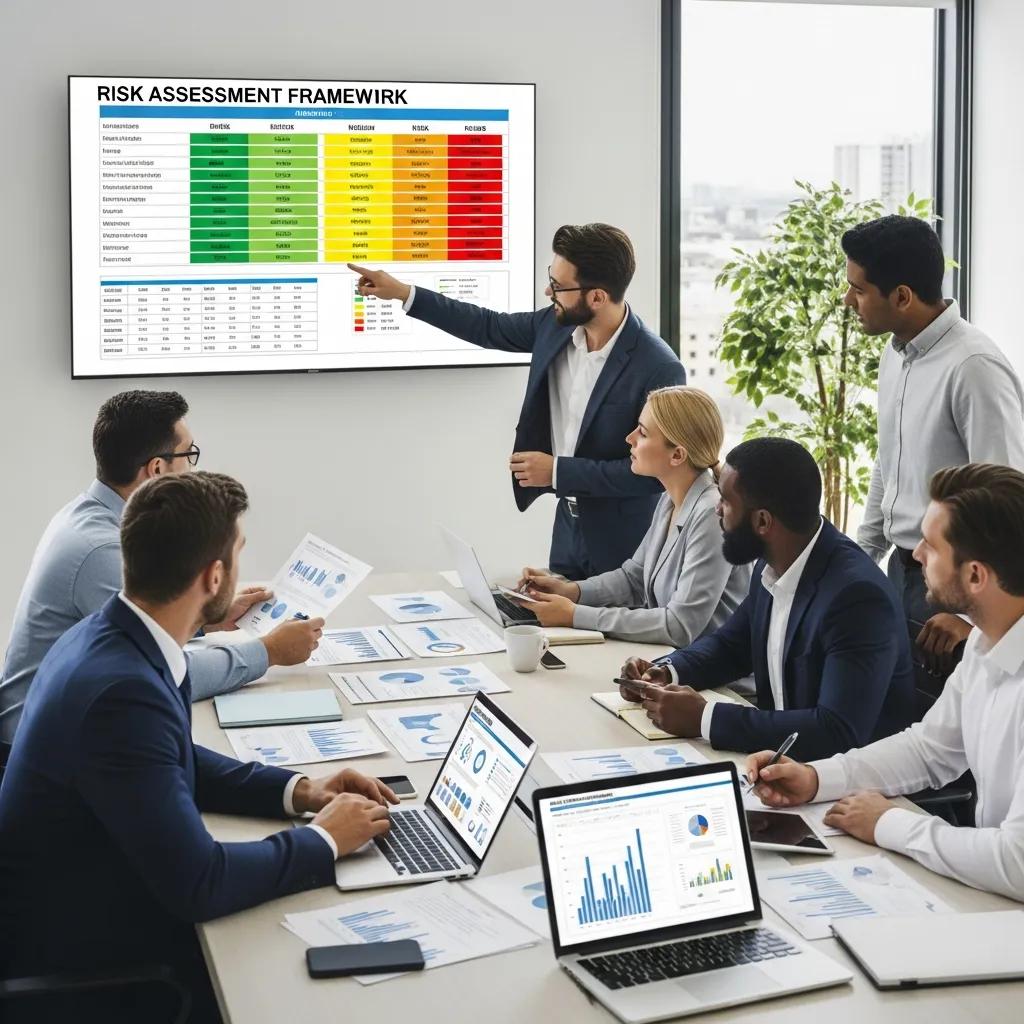
Comprehensive Risk Assessment Methods — a Practical Guide to Frameworks and Techniques
Risk assessment is the systematic process of identifying, analysing and evaluating events that might prevent an organisation meeting its objectives — and of choosing proportionate responses to reduce harm. This guide walks through the core approaches: qualitative tools such as risk matrices, FMEA and HAZOP, and quantitative techniques like Monte Carlo simulation, decision trees and expected monetary value. It also explains how frameworks such as ISO 31000 and related certification standards shape practical application. Many organisations find it hard to pick methods that fit their data, regulatory context and operational complexity; this article sets out simple decision criteria and worked examples to close that gap. You’ll get clear principles, step‑by‑step qualitative and quantitative workflows, industry-specific best practice (including cybersecurity and AI), and guidance on aligning assessments with certification objectives such as ISO 9001.
What are the fundamental principles of risk assessment?
At its core, risk assessment turns uncertainty into actionable insight: define risks, estimate likelihood and consequence, then prioritise responses by impact. The value of a principled approach is consistency and auditability — documented steps and evidence let leaders make informed, repeatable decisions. Principles taken from ISO 31000 — integration, a structured and comprehensive process, and tailoring to context — ensure risk activity is embedded into everyday operations rather than treated as a one-off task. The section below clarifies how risks are commonly defined and categorised so assessments stay focused and comparable across teams.
How is risk defined and categorised in business contexts?
Risk is commonly expressed as the combination of an event’s likelihood and its consequence, which creates a prioritised view of what needs attention and how urgently to act. Organisations typically group risks as strategic, operational, financial, compliance or reputational so owners and controls are clear. For example: a supply‑chain interruption is operational, a new competitor threat is strategic, and a regulatory breach is compliance. Categorising risks helps choose the right method — qualitative approaches for emerging reputational issues, quantitative models for financial exposures — and prevents inconsistent scoring that undermines enterprise reporting. Building a shared taxonomy creates a common language for governance and external audit evidence.
Different categories map to different analysis and treatment choices:
- Strategic risks are well-suited to scenario planning and decision‑tree evaluation.
- Operational hazards are best tackled with FMEA or HAZOP at the process level.
- Financial exposures often need quantitative models such as Monte Carlo simulation.
That mapping flows into the operational stages of the risk management cycle described next.
This table summarises each stage’s intent and the outputs teams should produce so assessment results feed governance and audit processes.
The next section looks at qualitative methods commonly used for initial triage and control selection.
Which qualitative risk assessment approaches work best?
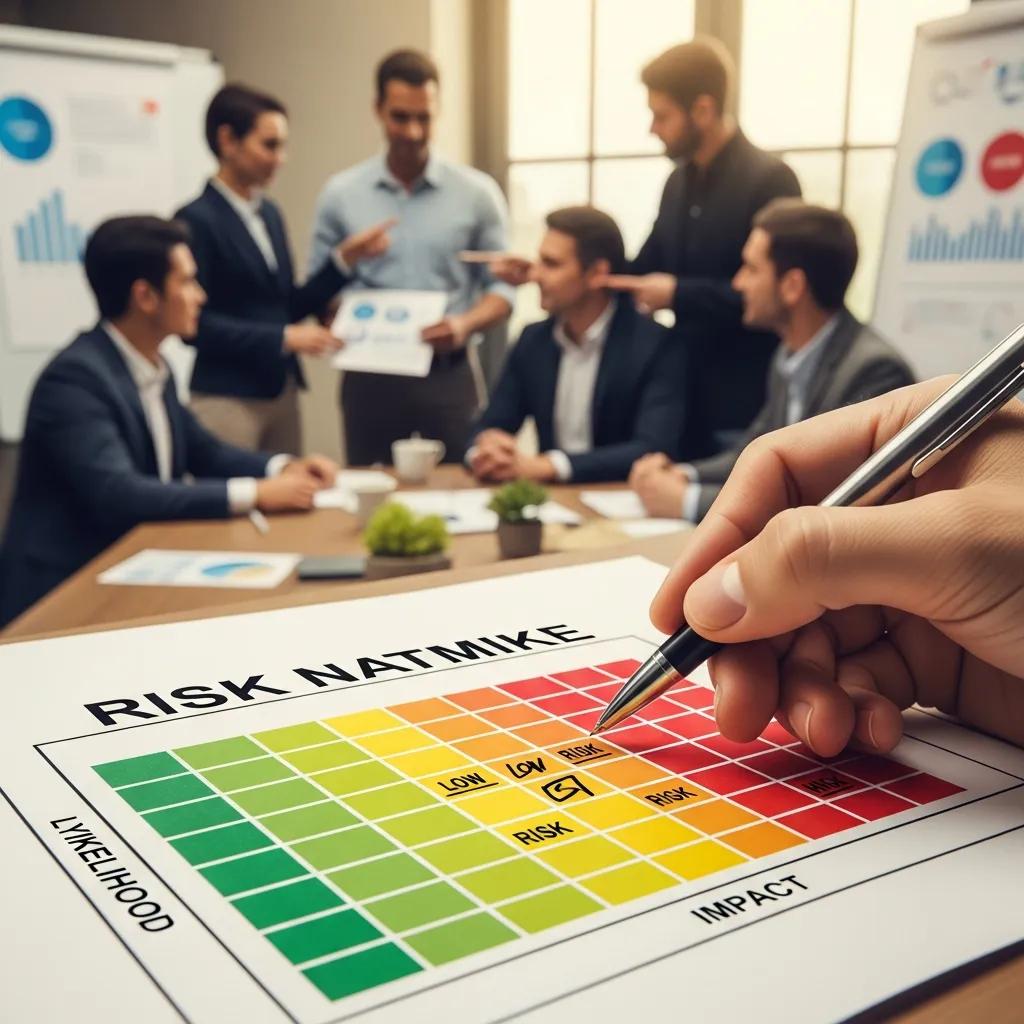
Qualitative methods offer fast, context-rich assessment where hard data are limited. They convert expert judgement into comparable scores and structured narratives, helping teams prioritise, engage stakeholders and take early action without heavy modelling. Common techniques include the risk matrix for visual triage, Failure Mode and Effects Analysis (FMEA) for component‑level failure review, and HAZOP for process deviations in industrial settings. Methods such as brainstorming, the Delphi technique and structured expert judgement support consensus when multiple disciplines must weigh in. Below we outline how to use a risk matrix effectively and how FMEA and HAZOP operate in practice.
Qualitative approaches are often the first step in a staged programme: high‑priority items are later escalated to quantitative analysis where needed.
How does the risk matrix support qualitative evaluation?
A risk matrix plots likelihood against impact on two axes to make priority zones visible and support quick triage without complex data. Typical scales run from 3×3 to 5×5 so teams can mark risks as low, medium or high and decide whether to accept, mitigate or escalate. Common pitfalls are assessor inconsistency, overly granular scales that imply false precision, and undefined scale anchors. Avoid these by documenting precise definitions for each likelihood and impact level and running calibration sessions for assessors. The matrix is ideal for management reviews and audit trails, but it should trigger quantitative work where decisions are financially or safety critical. In short: use the matrix for transparent early prioritisation and a clear hand‑off to deeper analysis.
Next we cover practical operational techniques — FMEA and HAZOP — that dig into failure modes and process deviations.
What do FMEA and HAZOP offer in operational risk assessment?
FMEA (Failure Mode and Effects Analysis) inspects components or process steps to identify failure modes, causes and effects, scoring severity, occurrence and detection to produce a Risk Priority Number (RPN). The outcome directs mitigation toward the highest‑priority failure modes, delivering measurable control changes and audit evidence. HAZOP (Hazard and Operability Study) evaluates process nodes for deviations from design intent using guide‑words to uncover hidden hazards and needed safeguards; it’s especially useful in complex process industries where interactions matter. Practical tips: involve a multidisciplinary team, record assumptions, and update analyses after design or process changes to keep traceability. FMEA is best for component-level improvements; HAZOP is better for process-level redesigns — and both feed the risk register for enterprise oversight.
To help teams adopt these methods quickly:
- Use concise templates to standardise FMEA entries and RPN calculations.
- Follow structured workshop agendas to run effective HAZOP sessions and capture clear actions.
- Provide short calibration training to reduce scoring variance across assessors.
These practical resources make it easier to escalate the most important items to quantitative analysis, which we cover next.
Which quantitative risk analysis techniques give measurable insight?

Quantitative analysis translates uncertainty into numbers — probabilities, percentiles and expected losses — enabling precise decisions when data and stakes justify the effort. Monte Carlo simulation, decision‑tree analysis and expected monetary value (EMV) serve different needs: Monte Carlo gives probabilistic ranges for schedules or costs, decision trees map sequential choices under uncertainty, and EMV provides a single monetary comparator for options. These techniques rely on probability distributions and statistical aggregation to show likely outcomes and confidence intervals, strengthening business cases and capital allocation. Because they need better data, confirm data quality before investing; where data are limited, sensitivity analysis and parameter testing reveal model robustness. The subsections below explain Monte Carlo and decision‑tree use in practice.
How is Monte Carlo simulation used for project risk quantification?
Monte Carlo simulation models inputs as probability distributions rather than single‑point estimates and runs many trials to produce an outcome distribution with percentiles and confidence intervals. Typical inputs are cost, duration and productivity variables defined using triangular, normal or log‑normal distributions. Outputs show the probability of meeting budget or schedule targets and highlight the most influential drivers. For example, modelling task durations with distributions can produce a 90th‑percentile completion date to inform contingency and reserves. Practical application requires verified historical data to define distributions, appropriate software, and the ability to translate probabilistic outputs into contingency and decision thresholds. Monte Carlo delivers transparent, measurable insight into uncertainty to support stronger project governance.
Related research demonstrates Monte Carlo’s value for schedule risk analysis in residential construction projects.
Monte Carlo simulation for schedule risk analysis
A case study applying Monte Carlo simulation to residential construction shows how simulating individual activity durations produces a distribution for total project duration, which helps compare likely completion dates and plan contingencies.
Schedule risk analysis using Monte Carlo simulation for residential projects, KI Wali, 2019
That probabilistic view leads naturally into decision trees, which quantify alternative courses of action.
What role do decision trees and expected monetary value play?
Decision trees lay out sequential choices and chance events as branches with assigned probabilities and payoffs, letting you calculate expected values and compare alternatives. EMV weights each branch outcome by its probability to produce a single monetary metric for decision making, making trade‑offs explicit where uncertainty affects expected returns. For example, a decision tree can compare launching a product now versus delaying for regulatory clarity, showing the EMV for each path and where further data collection would change the recommendation. Decision trees work best when choices are discrete, time‑sequenced and monetisable; for complex, interdependent systems, simulation may be the better tool. Adding sensitivity analysis highlights which probabilities or payoffs most affect the decision and prioritises data collection accordingly.
The next section looks at how organisations adapt these methods across industries, where context and regulation steer method choice.
How are risk assessment methods applied across different industries?
Methods must be tailored to industry context: cybersecurity focuses on asset‑based threat models, manufacturing on FMEA and HAZOP, and AI systems on model governance and controls. The adaptation comes from matching a method’s strengths to the industry risk profile — for example, using quantitative financial models in trading, or qualitative scenario planning for supply‑chain disruption. Best practice includes aligning assessment outputs with management information systems, keeping audit trails for certification, and using multidisciplinary teams to capture domain expertise. Short, anonymised examples show impact: an SME manufacturer used a targeted FMEA to cut critical downtime, while a service provider prioritised cyber controls using asset valuation and threat likelihood matrices. Tailoring methods to operational realities delivers measurable risk reduction and clearer audit evidence.
What are best practices for cybersecurity risk assessment under ISO 27001?
Under ISO/IEC 27001, cybersecurity risk assessment starts with an asset register and business‑aligned valuation so likelihood and impact reflect organisational priorities rather than only technical severity. Combine historical incident data, threat intelligence and expert judgement for likelihood estimates, and map findings to control objectives to keep traceability between risks and safeguards. Documented treatment plans with named owners and review schedules provide the audit trail auditors expect, and periodic reassessment accounts for evolving threats. An asset‑aligned approach supports operational risk reduction and certification readiness.
How does AI risk assessment align with ISO 42001?
AI risk assessment must address AI‑specific issues — bias, explainability, model drift and safety — and apply governance across data, development and monitoring. ISO/IEC 42001 emphasises governance, documentation, performance monitoring and ongoing oversight, so assessments should include dataset checks, model explainability reviews and drift detection plans. Practical tools include model cards, dataset audits and pre‑deployment fairness and robustness tests, supported by governance processes that assign accountability and review cycles. Integrate AI risk checks into existing change control and monitoring workflows so model updates automatically trigger reassessment. Aligning to ISO/IEC 42001 helps build trustworthy, auditable AI systems.
How do ISO standards guide risk assessment practice?
ISO standards set structured expectations for how assessments are designed, evidenced and maintained to meet certification and enterprise needs. ISO 9001 embeds risk‑based thinking into quality systems to prevent nonconformities; ISO/IEC 27001 requires a formal ISMS risk assessment and treatment process linked to the Statement of Applicability; ISO/IEC 42001 targets AI governance across the model lifecycle. ISO 31000 complements these with a holistic ERM framework emphasising principles, a structured process and integration into governance. The practical benefit is coherent audit evidence: mapping assessment outputs to standard clauses gives auditors clear traceability from identified risks to controls and monitoring. The table below summarises standard‑specific requirements and recommended evidence.
This comparison clarifies the outputs auditors expect and helps design assessments that serve operational risk reduction and certification needs.
Stratlane Certification Ltd. supports organisations preparing for ISO‑aligned risk assessment and certification by combining AI‑enabled audit tools with experienced auditors and local teams who guide the certification journey. Our approach focuses on tailored audit plans and sector‑specific evidence for ISO 9001 (QMS), ISO/IEC 27001 (ISMS) and ISO/IEC 42001 (AIMS), helping SMEs and larger organisations translate assessment findings into certifiable controls. For teams preparing for audits, working with a provider that understands both methodology and the certification process can shorten preparation and improve readiness.
How can organisations choose the right risk assessment method?
Selecting a method depends on data availability, decision criticality, resource constraints and regulatory drivers. A simple, practical pathway is: begin with qualitative screening (risk matrix, expert judgement) to identify high‑priority items, then escalate those items to quantitative techniques (Monte Carlo, decision trees, EMV) where numerical precision materially affects decisions. Key considerations are whether outcomes can be monetised, whether historical data exist, and the acceptable time and cost for analysis; high‑impact or safety‑critical choices justify greater investment in quantitative modelling. Pilot methods on a representative process and measure predictive accuracy and actionability to ensure chosen approaches scale across the organisation.
- Data availability: Confirm historical data or credible estimates to support quantitative models.
- Decision criticality: Reserve quantitative techniques for high‑impact financial or safety decisions.
- Resource constraints: Match method complexity to available skills, time and budget.
These factors support a clear decision flow: screen qualitatively, prioritise, then quantify where value justifies the cost. After selection, many organisations benefit from external diagnostic support to validate choices and accelerate implementation.
Which factors influence choosing qualitative vs quantitative techniques?
Primary factors are data quality and quantity, system complexity, regulatory or audit requirements, and available time and budget. When data are sparse or decisions are exploratory, qualitative techniques provide rapid, auditable insight and stakeholder alignment; when outcomes are monetary or tightly constrained, quantitative methods deliver necessary precision and probabilistic evidence. Consider analyst skillsets and tool availability: Monte Carlo and decision‑tree modelling need statistical competence and software, whereas matrices and FMEA require structured facilitation and domain experts. A practical SME example: a small manufacturer uses qualitative FMEA to reduce downtime cost‑effectively, then models a critical capital decision with EMV to justify investment. Assessing these factors helps choose a proportionate, defensible approach.
How does Stratlane Certification Ltd. support tailored risk assessment solutions?
Stratlane Certification Ltd. provides tailored audit and assessment support that blends AI‑assisted analysis with experienced industry auditors and regional teams to guide organisations through ISO‑aligned risk assessment and certification. Our service begins with diagnostic workshops to select the right mix of qualitative and quantitative methods for your context, producing an actionable plan that maps findings to ISO 9001, ISO/IEC 27001 or ISO/IEC 42001 evidence requirements. For SMEs we offer sector‑tailored audit approaches and hands‑on support to produce certification‑ready documentation, while our AI tools speed up data analysis and consistency checks across assessment outputs. Organisations can request a diagnostic engagement to align risk methods with certification goals and operational priorities.
This completes the guidance needed to implement robust, standards‑aligned risk assessment programmes.
Frequently asked questions
What common challenges do organisations face in risk assessment?
Typical challenges include limited or poor‑quality data, complex regulatory requirements, and operational complexity. Organisations also struggle with inconsistent scoring, unclear ownership and weak documentation, which leads to misaligned priorities. Address these issues with a structured approach, clear templates, training and a documented escalation path so assessments are repeatable and auditable.
How often should risk assessments be conducted?
Frequency depends on the organisation, regulatory obligations and how quickly risks change. As a rule, conduct a full review at least annually, increase cadence after major changes (new products, suppliers, incidents) and use lighter touch reviews where risks are stable. Regular reviews keep controls effective and responsive to emerging threats.
What role does stakeholder engagement play in risk assessment?
Stakeholder engagement is essential. Involving people from across the business brings different perspectives on causes, impacts and feasible controls, improves buy‑in for treatments and ensures assessments reflect operational reality. Multidisciplinary workshops and clear communication help turn assessment outputs into owned actions.
How can organisations ensure their risk management framework is effective?
Adopt continuous improvement: review and update methods, capture lessons from incidents, train staff and align with standards such as ISO 31000. Define metrics to track framework performance and use audit findings to refine processes. Clear roles, documented evidence and regular governance reviews keep the framework working.
Why is documentation important in risk assessment?
Documentation creates a record of identified risks, how they were assessed and what decisions were made — essential for accountability, transparency and audit evidence. Good records also support learning over time and make it easier to reassess as context changes.
How can technology improve risk assessment?
Technology automates data collection, analysis and reporting, improves consistency and helps spot patterns that manual methods miss. AI and analytics can prioritise risks, detect trends and speed up evidence collation for audits. However, technology should augment expert judgement and be selected to match the organisation’s data and skills.
Core Risk Assessment Frameworks and Methodologies
Effective risk assessment combines the right mix of qualitative and quantitative techniques, tailored to context and supported by clear governance. That approach delivers better prioritisation, stronger controls and auditable evidence for certification. If you’d like help selecting or implementing a risk assessment programme that aligns with industry standards and your operational needs, our tailored solutions can shorten preparation time and improve audit readiness.