
Defend Against Phishing Scams: Key Tips to Recognize Attacks

Recognising Phishing Attacks: Essential Prevention Strategies for UK Businesses
Phishing is a deliberate form of social engineering where attackers use deceptive messages to steal credentials, payments or sensitive data. Being able to recognise these threats is vital to reducing breach risk across UK businesses. This guide explains how phishing works, outlines the attack types that most commonly target organisations, and gives practical defence steps aligned with UK information-security practice. You’ll learn how to spot email and message red flags, handle links and attachments safely, run evidence-based employee training, and see how standards such as ISO 27001 and ISO 42001 fit into governance. We also cover incident response actions, GDPR notification points and recovery priorities so both security teams and non-technical staff can respond quickly. Read on to move from detection through training to certification and recovery, using checklists, quick-reference tables and recommended metrics to make phishing awareness operational across your organisation.
Recent research reinforces that phishing remains a major internal threat and shows the value of layered defences—training, advanced filtering and multi-factor authentication together reduce exposure significantly.
Phishing Mitigation & Prevention for Internal Staff
Phishing remains one of the primary cybersecurity threats, especially when attackers target internal staff to gain unauthorised access. This paper examines how phishing exploits human factors and details real-world incidents to show the consequences for organisations. It reviews mitigation measures—employee training, improved email filtering and multi-factor authentication (MFA)—and draws on both academic and industry evidence to set out practical prevention steps.
Cybersecurity Threats through Phishing Attacks Targeting Internal Staff,
Mitigation and Prevention, J Andjarwirawan, 2024
Recognising Phishing Attacks: Essential Strategies for UK Businesses
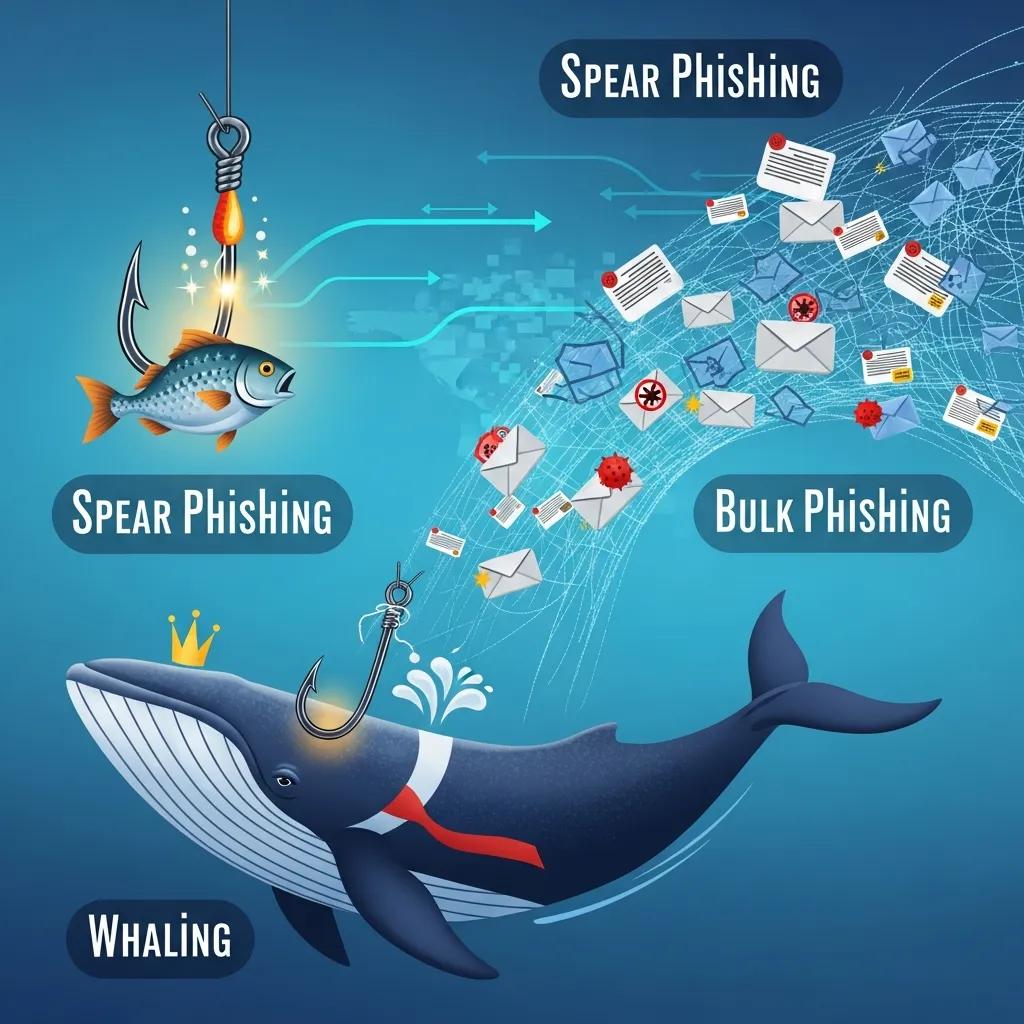
Phishing against UK businesses comes in many forms, differing by scope, target and delivery channel. Knowing the categories helps you prioritise controls. Attackers run large-volume credential-harvest campaigns or highly targeted messages aimed at executives and finance teams — each approach needs different technical and human defences. Below are the most common types with short descriptions for quick recognition.
- Spear phishing: Personalised emails that use specific details to dupe an individual into revealing credentials.
- Whaling: Targeted attacks on senior leaders seeking high-value financial or strategic gain.
- Bulk/phishing: Mass, generic emails that rely on volume to capture credentials or clicks.
- Smishing: Fraudulent SMS messages designed to capture codes or prompt malicious app installs.
- Vishing: Voice-based social engineering that convinces staff to disclose information or approve payments.
- Business Email Compromise (BEC): Fraud that uses compromised or spoofed business accounts to authorise transfers or leak data.
Recognising these categories explains why layered technical controls and role-specific awareness are necessary. Next we compare targeted and bulk approaches in more detail.
How Does Spear Phishing Differ from Bulk Phishing?
Spear phishing relies on reconnaissance and personalisation: attackers research a target, reference colleagues or projects, and craft messages that look credible to a specific person. That contextual detail drives much higher success per message than bulk campaigns. Defences therefore focus on protecting executives and privileged users, strengthening verification workflows and delivering role-specific training. Spotting personalised cues helps staff escalate suspicious messages faster and reduces the window attackers have to steal credentials.
What Are Whaling, Smishing, Vishing, and Business Email Compromise?
Whaling targets senior decision-makers with personalised, urgent financial requests that can cause large losses or reputational damage. Smishing and vishing exploit mobile and voice channels—short formats and perceived authority make technical clues less obvious. BEC blends credential theft, account takeover and invoice manipulation to trick finance teams and typically causes financial and operational harm. Across these types, practical mitigations include MFA, payment-verification controls and targeted mobile-security awareness to interrupt common attacker flows.
How Can UK Businesses Identify Phishing Emails Effectively?
Spotting phishing at scale needs a simple, repeatable checklist for employees plus deeper technical checks for security teams. Front-line staff should scan for sender anomalies, urgency cues, unexpected attachments and requests for credentials. Security teams should examine headers, URLs and attachment behaviour in sandboxes. The table below pairs common indicators with what they usually mean and the recommended action — a quick triage tool for staff and responders.
This EAV-style checklist speeds triage and supports faster escalation to security teams. The following sections cover deeper inspection techniques.
What Are the Key Red Flags in Phishing Emails?
Key red flags include mismatches between the display name and sender domain, odd salutations or generic greetings, and language that creates urgency or anxiety to force immediate action. These are classic social-engineering signals: attackers use emotion rather than technical tricks. Other clues are poor grammar, unexpected attachments and subtle domain typos. Training staff to recognise combinations of these indicators increases reporting and reduces susceptibility. The next section explains safe link and attachment handling in more detail.
How to Scrutinize Links and Attachments to Avoid Phishing Traps?
Safe handling of links and attachments combines simple user behaviours with technical controls: hover to reveal the real URL, check domain reputation with internal tools, open attachments only in controlled sandboxes, and prefer cloud previews that isolate content. Break URLs into hostname, path and query strings to reveal redirects or lookalikes, and check email headers for SPF/DKIM/DMARC alignment to detect spoofing. Enable link rewriting and attachment sandboxing at the gateway, and train staff to verify unexpected files through a separate, validated channel. These steps reduce exposure and feed useful telemetry into detection systems for continuous tuning.
What Are the Best Phishing Awareness Training Practices for UK Employees?

Effective awareness training blends regular, role-focused sessions, simulated phishing that emphasises reporting over punishment, and clear metrics to measure progress — together these create a sustainable human firewall. Align programmes with NCSC guidance, tailor content for functions like finance, HR and executive teams, and reinforce learning with short microlearning and visible leadership support. The table below compares common training methods, their benefits and recommended frequency to help decision-makers design a balanced programme with measurable outcomes.
This comparison helps organisations combine scale with specificity and leads into how training turns staff into an effective line of defence.
How Does Employee Training Build a Human Firewall Against Phishing?
Training builds a human firewall by turning staff into active detectors who spot and report suspicious content, reducing attacker dwell time and limiting lateral movement. Good training changes behaviours—encouraging verification, promoting clear reporting channels and normalising caution without blame. Metrics such as higher report rates and lower click rates show progress. Role-based scenarios keep training relevant for groups like finance and HR, while leadership endorsement and transparent response processes make reporting easy and non‑punitive. As detection improves, simulations can be tuned to close remaining gaps and integrate with technical controls for a layered defence.
What Are Effective Methods for Simulated Phishing and Reporting?
Effective simulations use realistic templates, graduated difficulty, immediate educational feedback and a focus on reporting rather than punishment. Frequency should balance familiarity and challenge—monthly or every two months for high-risk groups, quarterly for general staff—while tracking click-through and reporting metrics to measure behaviour change. Provide concise learning resources after a failed simulation and keep a clear reporting pathway that ties into incident response. Over time, trends from simulations should inform targeted follow-up training and technical tuning to close persistent weak points.
Academic studies consistently show phishing simulations are an effective way to assess and improve security awareness; recency of training and familiarity with attack patterns strongly influence results.
Phishing Simulation for Effective Security Awareness Training
Phishing remains a widespread problem—billions of spam and phishing messages circulate daily—and new methods, including callback phishing, QR-code abuse and smishing, continue to evolve. A multifactor defence is required: technical controls plus training and simulation testing. Research shows simulation testing helps measure training effectiveness, with recent training and repeated exposure improving staff recognition of phishing.
Using phishing simulation testing to analyse and improve efficacy of security awareness training, 2025
How Does ISO 27001 Certification Support Phishing Attack Prevention?
ISO 27001 offers a risk-based Information Security Management System (ISMS) that helps organisations identify phishing as a significant threat, choose proportionate controls and embed continuous monitoring. Its governance framework aligns people, processes and technology to manage information risk, and Annex A controls map directly to phishing mitigations such as awareness, access control and secure communications. The table below links specific ISO 27001 controls to practical roles in phishing prevention so auditors and decision-makers can see how certification supports operational security.
A structured ISMS is detailed in research that outlines how to achieve ISO 27001 compliance and use its controls to strengthen overall security posture.
ISO 27001 Compliance for Enhanced Information Security
This paper describes a framework for achieving ISO 27001:2022 compliance and improving information security practices. It reviews the standard’s role in modern cybersecurity and presents a web-based framework that catalogues the Annex A controls to support gap analysis and compliance evaluation.
Enhancing Information Security Management System using ISO controls-based framework, 2022
Mapping controls in this way shows why certification is more than paperwork: it formalises phishing defences and creates a basis for continuous improvement across the organisation.
For organisations ready to convert improved controls into independent assurance, Stratlne Certification Ltd. provides accredited ISO certification services including ISO 27001 . Stratlne’s audit teams work in multiple languages and support clients across the UK, Ireland, mainland Europe, North America, the Middle East, Africa and Asia. Their approach emphasises accredited certification, SME-focused programmes and AI-enabled audit capability, making Stratlne a practical partner for organisations that want both operational phishing reductions and third‑party assurance. If certification readiness is a priority, you can request a quote or book an audit to formalise phishing prevention measures and demonstrate compliance to customers and regulators.
What Is the Role of the Information Security Management System in Phishing Defence?
An ISMS formalises how you identify phishing risk, select appropriate controls and monitor effectiveness through measurable indicators and continual improvement. The process is risk-driven: assess threats and vulnerabilities, implement controls, then monitor to ensure controls remain effective as attacks evolve. This systemic approach creates accountability and ensures phishing prevention is integrated into business processes and supplier relationships. ISMS governance supports consistent incident handling, training cycles and evidence collection for audits and regulatory inquiries.
Which ISO 27001 Controls Specifically Address Phishing Risks?
Several Annex A controls cut phishing exposure by raising awareness, restricting access and securing communications and operations, while logging and monitoring help detect compromise. For example: awareness controls require training programmes; access controls mandate least privilege and MFA; operational controls enable email filtering and sandboxing; and monitoring supports audit trails for investigations. Mapping these controls into a risk treatment plan gives each phishing vector measurable controls and owners, streamlining internal governance and external audits.
Beyond information security, a robust quality management system supports wider business resilience. Organisations seeking operational excellence and customer satisfaction often pursue ISO 9001 certification, which Stratlne Certification Ltd. also provides.
How Is AI Changing Phishing Threats and How Can ISO 42001 Help?
AI is changing phishing by automating personalised social engineering, generating convincing deepfake content and enabling high-volume, tailored campaigns that scale impersonation quality and shorten detection windows. AI-driven content and targeting raise success rates and make simple heuristics less reliable—this is a particular challenge for SMEs without advanced detection tools. ISO 42001, an AI management standard, helps organisations govern model use, manage model risk and apply oversight that reduces the chance of AI misuse for phishing or of defensive blind spots. Integrating AI governance with information security strengthens defences against automated social engineering.
Stratlne Certification Ltd. offers ISO 42001 certification services to help organisations manage AI-related risks that amplify phishing threats. Their expertise—combined with ISO 27001 alignment—helps structure model risk management, monitoring and human oversight to mitigate AI-enabled phishing. A brief, outcomes-focused engagement with an accredited provider can demonstrate controlled AI governance and reassure customers and regulators.
What Are AI-Powered Phishing Attacks and Their Impact on UK Businesses?
AI-powered phishing uses machine learning to craft personalised messages, pick high-value targets and generate realistic audio or video deepfakes. The key issue is scale: attackers can produce highly credible messages at volume, shortening defenders’ verification time. Impacts for UK businesses include credential theft, financial fraud, reputational harm and regulatory exposure—especially where customer data or payment systems are targeted. Detecting AI-enabled attacks requires new signals, behavioural analytics and stronger process controls to offset the wider attack surface.
How Does ISO 42001 Certification Mitigate AI-Driven Phishing Risks?
ISO 42001 reduces AI-driven phishing risk by requiring governance over model development, deployment and monitoring: documented risk assessments, validation, and human oversight help prevent outputs attackers could exploit. Controls include model provenance, performance monitoring, anomaly detection and access governance around training data and generation tools. Combined with ISO 27001 technical controls—MFA, email filtering, logging—ISO 42001 adds model-level assurance that helps prevent an organisation’s own AI systems becoming a vector or defenders being blind to novel attack patterns.
What Steps Should UK Businesses Take for Incident Response and Recovery from Phishing?
A pragmatic incident response plan for phishing focuses on containment, evidence preservation, clear communication and remediation, with defined workflows for technical teams and non-technical staff. Immediate steps include isolating compromised accounts, capturing logs for forensic analysis, and assessing whether personal data was exposed under GDPR. Communication templates should be factual and ready for internal and external stakeholders, with clear thresholds for ICO notification and customer contact. The checklist below gives a prioritised sequence for the first 24–72 hours to guide response teams and help meet regulatory duties.
- Isolate and contain: Disable or reset compromised credentials and block malicious sender domains.
- Preserve evidence: Collect email headers, logs and system snapshots for forensic review.
- Assess scope: Determine what data was accessed, which systems were affected and the customer impact.
- Communicate: Inform leadership, legal and affected users with clear guidance; prepare ICO reporting if required.
- Remediate: Revoke tokens, enforce MFA, patch systems and update detection rules.
Following these steps limits immediate harm and sets the organisation up for a thorough investigation and recovery. The next section covers post-breach duties and regulatory priorities.
Organisations that want external validation of their incident-response readiness often find certification and audit support helpful; Stratlne Certification Ltd. provides audit assistance that maps response maturity to certification readiness and helps teams prepare for formal assessments. Their accredited services can help document response processes and demonstrate governance during post-incident reviews, turning lessons learned into audit-ready improvements.
How to Report and Contain Phishing Incidents Effectively?
Effective reporting and containment depend on clear internal channels, a single escalation path and technical playbooks that specify account isolation, credential rotation and sandbox analysis of malicious payloads. Non‑technical staff should report via a simple, well-promoted mechanism and avoid further interaction with the suspicious message; responders should capture headers and related artefacts for triage. Containment typically includes resetting affected accounts, invalidating sessions and applying temporary restrictions while the forensic scope is established. Clear communication at each stage reduces confusion and preserves evidence for recovery and any regulatory reporting.
What Are Best Practices for Post-Breach Recovery and GDPR Compliance?
Post-breach recovery focuses on remediation, root-cause analysis, documentation and regulatory obligations: determine whether personal data was compromised, record the incident fully, and assess whether the ICO must be notified within 72 hours. Remediation steps include updating training, patching vulnerabilities, tuning detection and strengthening access controls to prevent recurrence. Keeping a clear evidence trail and demonstrating corrective action supports regulatory defence and customer trust. Embedding these improvements into the ISMS helps convert an incident into lasting resilience; organisations that map recovery steps to certification controls can show auditors measurable governance improvements.
Frequently Asked Questions
What are the signs of a phishing attack?
Typical signs include unexpected messages asking for sensitive information, urgent or pressuring language, and sender addresses that look similar but aren’t exact matches. Other indicators are generic greetings, unexpected attachments, and links that lead to unfamiliar sites. Recognising these signs early helps prevent data loss and financial harm.
How can businesses protect themselves from phishing attacks?
Protect your organisation with multi-factor authentication (MFA), regular employee training and advanced email-filtering solutions. Put clear verification protocols in place for requests involving money or sensitive data, encourage prompt reporting of suspicious messages, and run simulated phishing exercises to keep staff alert to new tactics.
What role does employee training play in phishing prevention?
Employee training is a cornerstone of phishing prevention. Regular, practical sessions and simulations give staff the skills to recognise and report attacks. When employees feel confident and supported, they become an effective first line of defence and help reduce the likelihood of successful breaches.
How often should phishing awareness training be conducted?
Aim for quarterly refreshers for the wider organisation, with more frequent or tailored training for high-risk roles such as finance and IT. Regular simulation and refresher content helps keep awareness current as attacker techniques evolve.
What should a business do after a phishing attack?
After an attack, immediately isolate affected accounts, preserve evidence for forensics, and assess the breach scope. Communicate clearly with stakeholders and notify regulators and affected individuals if required. Then conduct a full investigation, remediate gaps and update training and controls to reduce the chance of recurrence.
How can ISO certifications help in phishing prevention?
ISO standards such as ISO 27001 provide a structured framework to manage information-security risks, including phishing. They help organisations put in place repeatable policies, controls and monitoring that improve resilience and support continuous improvement against phishing and other threats.
What are the emerging trends in phishing attacks?
Emerging trends include AI-generated personalised messages, growing use of social-media and messaging platforms, and deepfake audio/video to impersonate trusted contacts. Staying informed and adapting controls—technical and human—are essential to keeping pace with these evolving tactics.
Conclusion
Recognising and preventing phishing is essential to protect UK businesses from serious security and regulatory risks. Practical steps—targeted training, solid incident-response plans and alignment with standards such as ISO 27001—significantly improve resilience. Start with straightforward controls today and build them into your ISMS so security becomes an everyday habit across your organisation. Explore our resources to sharpen your phishing-defence programme and ensure you’re ready to respond.