
Crafting Your Project Scope: A Guide to Effective Planning

How to write a project plan: a practical, step-by-step guide for effective delivery
A project plan is the single document that turns strategy into day‑to‑day action: it defines objectives, scope, deliverables, schedule and governance so work runs from initiation through to closeout. Writing a clear, step‑by‑step plan matters because it aligns stakeholders, reduces uncertainty and creates auditable evidence — essential for certification programmes such as ISO 9001 projects. This guide shows how to build a practical plan: how to map deliverables and milestones, speed delivery with templates, and choose methodologies that suit compliance and improvement goals. You’ll get concrete steps for defining scope, creating a work breakdown structure, designing a risk register and setting monitoring KPIs so the plan supports efficient delivery and formal audit requirements. Where relevant we use common project terms — project scope, deliverables, milestones, risk register and communication plan — so you produce a plan that’s both operational and evidentiary for ISO pathways.
What are the essential elements of a project plan?

A good project plan pulls strategic intent into executable work. Core elements include objectives and scope to set boundaries; deliverables and milestones for measurable outcomes; resources and roles to assign accountability; a risk register to capture threats and mitigations; and a communication plan to keep stakeholders informed. Together these parts help teams produce audit‑ready outputs and keep traceability between requirements and evidence. Identifying them early shortens planning time and helps the plan map directly to compliance frameworks such as ISO 9001 and ISO/IEC 27001. Below we distil each component and the immediate benefit it brings to planning and certification readiness.
Project plan core components with concise definitions and benefits:
- Objectives and Scope: State what the project will deliver and where work stops so you avoid scope creep and keep everyone aligned.
- Deliverables and Milestones: Define tangible outputs and checkpoints so progress is measurable and evidenceable.
- Work Breakdown Structure (WBS): Break scope into manageable tasks so ownership and dependencies are clear.
- Resource Allocation and Roles: Assign owners and resources to tasks to ensure accountability and timely delivery.
- Risk Register and Mitigation: Record risks, score them and assign mitigations to reduce the chance of non‑conformance at audit.
- Communication Plan and Governance: Set meeting cadences, reporting lines and change control to maintain traceability and stakeholder buy‑in.
These elements form a practical blueprint for execution and verification. The table below links each component with a short definition and an ISO‑focused example so you can see how plan content becomes audit evidence.
This table explains core components, a short definition and a practical ISO‑focused example.
Mapping plan components to ISO evidence makes audits less disruptive and gives you defensible change control. The sections that follow unpack which components matter most and how deliverables and milestones shape outcomes.
Which key components define a successful project plan?
A successful project plan rests on clear objectives, identified stakeholders, a detailed WBS, realistic timelines and a budget baseline — each tied to acceptance criteria that show work is complete. Objectives should be SMART and aligned with organisational priorities to avoid rework; stakeholder registers make it clear who must sign off on deliverables. The WBS turns high‑level scope into assignable tasks and underpins scheduling and resource planning. Represent timelines in a Gantt view to show dependencies and set achievable milestones that lower schedule risk. A simple readiness checklist includes signed scope, assigned owners, a baseline schedule, an initial risk register and documented quality criteria — together these demonstrate audit readiness.
Those components are interdependent and create a traceable path from plan to verification. Clear acceptance criteria for each deliverable make both internal checks and third‑party audits straightforward by showing exactly what evidence satisfies requirements.
How do deliverables and milestones shape project outcomes?
Deliverables and milestones turn plans into verifiable progress: they define what will be produced and when checkpoints happen, supporting management oversight and audit trails. Deliverables should include the artefacts auditors expect — policies, procedures, training records and test reports — and be linked to acceptance criteria that define pass/fail. Milestones such as “Document control established” or “Internal audit completed” create natural review points to capture evidence and correct course before certification assessments. For example, a training‑completion milestone should be backed by attendance registers and competency checks; an internal audit milestone should produce a corrective action log as evidence.
Linking deliverables to milestones and acceptance criteria reduces the risk of missing evidence and speeds certification readiness. The next section outlines a practical, step‑by‑step process to create and run a project plan.
What are the step‑by‑step processes to create a project plan?
A step‑by‑step approach moves the plan from initiation to closeout with clear deliverables, timelines and ownership. Start with initiation to capture objectives and stakeholders; then plan in detail with a WBS, schedule, resource allocation and risk register; move to execution with document control and training; and finish with monitoring, internal audits and formal closure. Each phase produces artefacts — scope statements, WBS, risk registers and communication logs — that serve both delivery and audit needs. Below is a concise process designed to create a plan that supports operational delivery and certification readiness.
- Initiate: Draft objectives, identify stakeholders and write a scope statement aligned to organisational goals.
- Plan: Build a WBS, schedule, budget and a risk register with likelihood and impact scores.
- Assign: Allocate resources and assign owners for each work package with clear due dates.
- Execute: Deliver tasks, maintain document control, run training and collect completion evidence.
- Monitor: Track KPIs, update the risk register, perform internal audits and manage changes.
- Pre‑audit & Close: Run audit‑readiness checks, resolve nonconformities, capture lessons learned and finalise handover.
These steps form a repeatable framework you can scale to project size and complexity. The table below maps each step to tangible deliverables, estimated timeframes and suggested owners to help convert process into a working plan.
Assigning responsibility and setting time expectations early reduces delays and builds audit evidence methodically. If you need extra capacity or independent verification, specialist partners can augment internal capability during planning and audit phases.
From SERP report: Stratlane provides accredited ISO certification services (ISO 9001, ISO/IEC 27001, ISO 42001). Unique value propositions highlighted in search results include accredited certification, use of AI and experienced industry auditors, tailored support for SMEs, and the ability to conduct audits in multiple languages across the UK, Europe, USA, Canada, Middle East, Africa and Asia. Stratlane’s site is organised by ISO standard pages; there is a content gap for a standalone ‘Creating a Project Plan’ resource.
Bringing in external expertise — accredited certification bodies or audit‑readiness consultants — can help organisations that need independent validation or extra capacity. External partners commonly provide audit simulations, checklists mapped to clauses and multilingual audit teams for international rollouts, which plugs gaps the plan may not anticipate. Use outside resources selectively to raise evidence quality while keeping internal ownership of core deliverables.
How to define project objectives and scope effectively?
Start with a concise statement of the intended outcome, measurable success criteria and explicit exclusions to prevent scope creep. Objectives should be SMART — specific, measurable, achievable, relevant and time‑bound — and where relevant mapped to standard clauses (for example, linking a QMS objective to an ISO 9001 requirement). Scope language should state organisational boundaries, included processes and exclusions such as third‑party suppliers or sites outside the project. A practical template sentence is: “This project will implement a Quality Management System covering [processes], within [locations], excluding [items], to achieve [objective] by [date].”
Clear scope and objectives make the WBS easier to build and simplify evidence collection for auditors, because each deliverable can be traced back to a clause or objective with a named owner and acceptance criteria. That clarity reduces rework and accelerates certification reviews.
What are the best practices for risk management in project planning?
Risk management follows four activities: identify, assess, prioritise and mitigate — then monitor continuously. Link every risk to a control action and an owner so closure can be tracked. Use structured techniques like brainstorming, SWOT analysis and likelihood/impact scoring to populate the risk register, and use a prioritisation matrix so high‑likelihood, high‑impact items get immediate attention. Record mitigations with specific actions, deadlines and owners — examples include policy updates, technical controls and targeted training. Review and refresh the register in status meetings and after major milestones to capture emerging risks.
How can you use project management plan templates to speed planning?
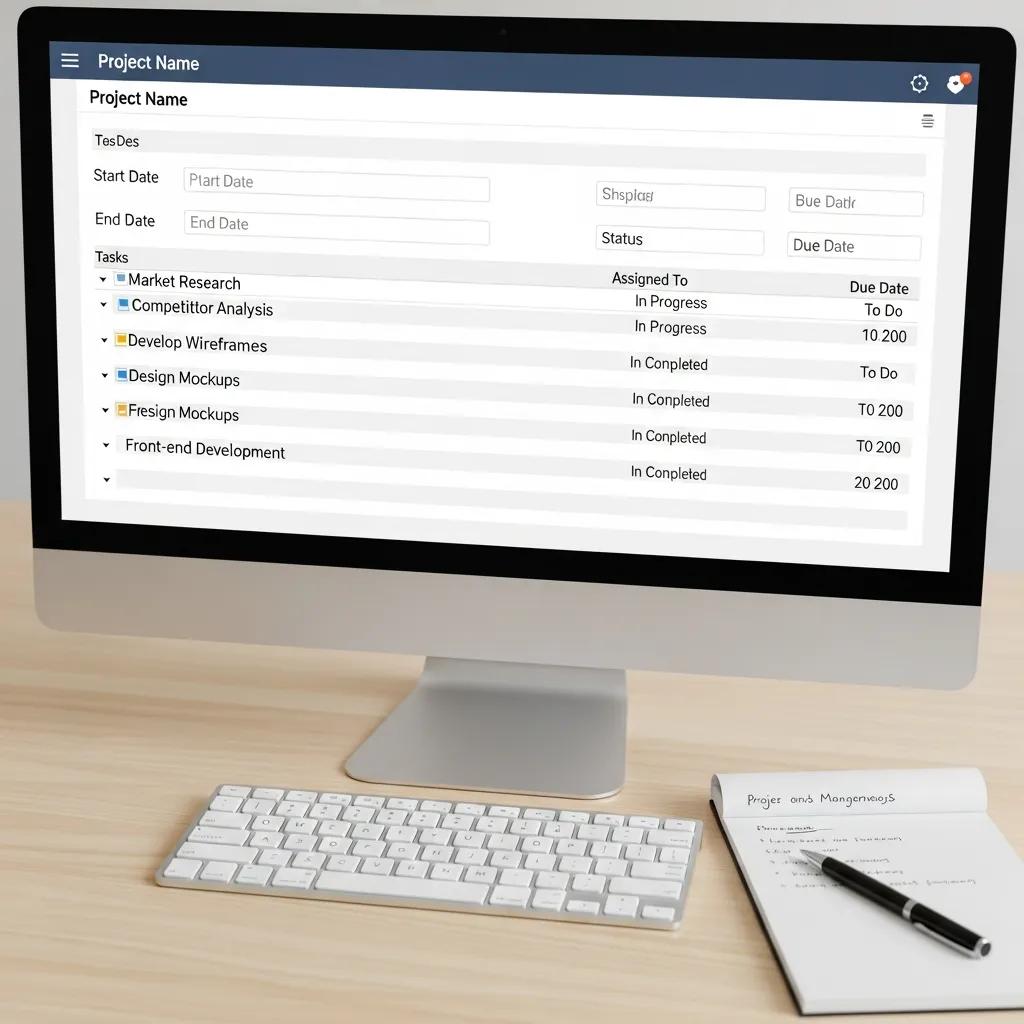
Templates remove repetitive work, enforce consistency and ensure audit‑relevant fields are present from the start. A well‑designed template includes owner, due date, status, acceptance criteria and links to evidence, plus an integrated risk log, change log and version‑control header to show traceability. Templates mapped to ISO clauses simplify audit preparation because each deliverable can be traced back to a requirement and the evidence location is recorded. Below are the essential template features to include before you customise for your implementation.
Essential template features explained:
- Owner, due date and status fields to assign accountability and track progress.
- Acceptance criteria and evidence reference to show how deliverables will be verified.
- Integrated risk register and change log so risks and scope changes remain traceable.
Those features make templates fit for both operational control and audit readiness. The table below compares template types and their ISO‑focused use cases to help you pick the right starting point.
That comparison helps you select templates depending on immediate priorities: overall planning, risk focus or document control for audits. If you prefer ready‑made ISO resources, specialist providers can supply ISO‑aligned templates and audit‑readiness checks to speed preparation.
From SERP report: Stratlane provides accredited ISO certification services (ISO 9001, ISO/IEC 27001, ISO 42001). Unique value propositions highlighted include accredited certification, AI-enabled tools and experienced auditors, tailored SME support, and multi‑language international audits. Stratlane’s site is organised by ISO standard pages; there remains an opportunity to publish a dedicated ‘Creating a Project Plan’ resource.
When customising templates, follow three simple steps: map relevant standard clauses to required deliverables, assign owners and set milestones, and add evidence fields for each deliverable so document collection happens during execution. That creates a single source of truth for delivery teams and auditors.
What features should an effective project plan template include?
An effective template balances structure with flexibility by including required metadata, task fields and evidence references so every action is auditable. Key fields are owner, due date, status, acceptance criteria and evidence links; add a risk column and change‑log entries so modifications remain traceable. Include version control (version number, author, approval date) so the document history is preserved. A small guidance cell explaining how to complete the template reduces variation across teams.
These features make templates more useful for internal governance and external certification because auditors can follow the document timeline and see who approved each change. Next we explain where to find templates and how to tailor them for different ISO standards.
Where to find and how to customise project management templates?
Templates come from industry bodies, software vendors and specialist consultancies; choose a reputable source that matches your industry complexity and scale. Customise templates by mapping clauses to deliverables, assigning owners and setting milestones — a simple three‑step customisation is: Map clauses → Define deliverables → Set milestones and evidence fields. Implement version control and document references so audit trails remain intact.
Good customisation practices include limiting free‑text fields to enforce consistency, adding checkboxes for mandatory artefacts and scheduling periodic reviews so templates stay aligned to evolving audit expectations. These measures help teams capture evidence as part of work rather than retrospectively.
Which project planning methodologies best support your goals?
Methodology choice depends on flexibility needs, regulatory constraints and stakeholder readiness. Waterfall gives predictability and traceable documentation for compliance‑heavy work; Agile supports incremental improvements and fast feedback; and Hybrid blends both to manage documentation‑heavy cores alongside evolving process improvements. Your methodology affects governance, documentation cadence and evidence capture, so choose the option that balances control and adaptability for your ISO implementation. The short comparison below summarises strengths and trade‑offs.
A concise comparison of methodologies:
- Waterfall: Linear milestones and strong documentation — useful where sequential, traceable evidence is required.
- Agile: Iterative delivery with frequent reviews — useful for process improvement and incremental compliance work.
- Hybrid: Waterfall for baseline documentation and Agile for process optimisation — useful when deadlines and evolving scope coexist.
Your methodology will influence WBS design, scheduling and KPI monitoring, which in turn affects audit readiness and ongoing compliance posture.
How do Agile and Waterfall approaches differ in project planning?
Agile favours iterative delivery, short feedback loops and flexible scope; Waterfall follows a sequential, plan‑driven route with upfront design and comprehensive documentation. For ISO projects, Waterfall can simplify mapping deliverables to clauses because documentation and milestones follow a set order; Agile generates evidence iteratively and may need extra traceability measures to show how sprints satisfy clause requirements. Use Waterfall for baseline policy drafting and document control; use Agile for pilot runs and iterative training improvements.
When should you apply hybrid methodologies?
Hybrid approaches work well when you need both rigorous documentation and the ability to respond to change — for example, using Waterfall to create core manuals and procedures while running Agile sprints to refine processes and training. Typical triggers for hybrid use are tight regulatory deadlines with evolving scope, geographically dispersed teams needing rapid feedback, or conflicting stakeholder priorities. Governance for hybrids should specify which elements follow fixed milestones and which use sprint cycles, and maintain a single change log to capture updates across both streams.
Research highlights the practical benefits of hybrid models: they balance rapid innovation with strong governance and risk control when implemented with clear oversight.
Hybrid project methodologies for success
ABSTRACT: Project environments are shifting, and organisations increasingly need delivery methods that combine predictability with adaptability. Waterfall remains valuable for defined scope and structure, while Agile excels in uncertain, iterative settings. Hybrid approaches blend both, allowing organisations to accelerate delivery while maintaining governance and risk control. This research examines hybrid configurations, measurable performance gains, stakeholder effects and practical governance frameworks. Findings show hybrid models can reduce cost overruns, speed delivery and improve business alignment — when supported by clear controls and accountability.
When governed correctly, hybrid models let teams keep the documentation auditors need while benefiting from iterative improvements that raise adoption and quality. Clear governance prevents fragmentation and preserves a coherent audit trail.
How to monitor and adjust your project plan for continuous improvement?
Monitoring and adjustment depend on a small set of meaningful KPIs, regular review cadences and a feedback loop that turns stakeholder input into controlled updates. Build a dashboard with focused KPIs — on‑time completion rate, percentage of deliverables ready, risk closure rate — and set thresholds that trigger corrective action. Schedule weekly stand‑ups for execution teams, monthly steering meetings for governance and pre‑audit checkpoints to validate evidence readiness. A documented change‑control process ensures adjustments are traceable and justifiable to auditors.
These practices create a continuous improvement cycle that keeps the plan aligned to objectives and compliance requirements. The table below lists recommended KPIs and targets to shape a monitoring dashboard.
A concise dashboard simplifies decision‑making and gives auditors clear indicators of readiness and control. The following sections explain KPI selection and how to fold stakeholder feedback into plan updates.
What metrics and KPIs indicate project plan effectiveness?
Pick KPIs that reflect timeliness, readiness and risk management so your dashboard supports both delivery and audit readiness. Useful measures include on‑time completion to track schedule health, percent of deliverables with evidence to measure audit preparedness, and risk closure to show mitigation progress. Set realistic thresholds and assign owners to each KPI; report them at governance meetings so corrective action follows when targets slip. Example targets: 90% on‑time completion and 85% deliverables ready — each KPI needs an owner responsible for remediation.
Clear KPI ownership and thresholds let teams act quickly and produce the artefacts auditors expect. The next subsection explains how to incorporate stakeholder feedback into this monitoring loop.
How to incorporate stakeholder feedback into project plan updates?
Convert feedback into controlled updates with a four‑step loop: gather input via surveys or review meetings; prioritise requests by impact and alignment with objectives; approve changes through change control with an assigned owner; and document the decision and evidence for audit trails. Keep a communication log that records who requested the change, the rationale, impact analysis and approval to preserve traceability. This process keeps the project agile while ensuring every change is auditable and justified.
Documenting feedback and decisions closes the loop between improvement and governance, making it easier to demonstrate continual improvement at audit. Periodically revisit templates and governance to stay aligned with evolving standards and organisational goals.
If you need external audit‑readiness support or certification services to complement your plan and evidence collection, Stratlane Certification Ltd. offers accredited ISO certification services and audit expertise to support internal teams. Their accredited services and specialist auditors can validate that your project plan and deliverables meet certification expectations and can support multi‑language and international rollouts.
Frequently asked questions
What is the importance of stakeholder engagement in project planning?
Stakeholder engagement ensures everyone understands project objectives and their role in delivery. Engaging stakeholders early surfaces needs and expectations, reduces resistance to change and builds buy‑in — all of which improve execution. Regular, focused communication keeps stakeholders informed and aligned, helping you resolve issues before they affect delivery.
How can I ensure my project plan remains flexible to changes?
Build flexibility by using Agile or Hybrid approaches and a clear change‑control process so you can respond quickly while keeping an audit trail. Regularly review progress and stakeholder feedback, keep acceptance criteria and milestones explicit, and allow controlled adjustments as the project evolves. That keeps the plan relevant without losing governance.
What role does a risk register play in project management?
A risk register is the central record of identified risks, their likelihood and impact, and the mitigations in place. It gives teams a structured way to manage issues before they escalate and demonstrates a systematic approach to risk — important for both resilience and audit readiness.
How can I measure the success of my project plan?
Measure success with KPIs tied to project objectives: on‑time completion, percentage of deliverables with evidence and risk‑closure rates are useful examples. Combine these quantitative metrics with stakeholder feedback to get a full picture of performance and areas for improvement.
What are the best practices for documenting project changes?
Use a change log to record every modification including rationale, impact analysis and approval details. Assign an owner for each change and use a consistent format to preserve clarity. Regularly review the log at governance meetings so the audit trail is complete and defensible.
How can I effectively communicate project updates to stakeholders?
Set a communication plan that defines frequency, format and channels. Use a mix of meetings, concise email summaries and dashboards tailored to the audience. Highlight key metrics, milestones and decisions, and invite feedback. Regular, targeted updates build trust and keep stakeholders aligned.
Conclusion
A clear, well‑structured project plan aligns stakeholders, supports compliance and improves delivery outcomes. By focusing on the core components, using templates and choosing the right methodology, teams can speed certification readiness and reduce audit disruption. If you’d like external support, explore our ISO certification services to complement your planning and evidence collection. Start your project planning with confidence today.