
Discover Innovative IoT Applications Transforming Industries

IoT security certification and compliance: ensuring safe applications of IoT
The Internet of Things (IoT) links sensors, edge devices and connected systems to collect, process and act on data across industries — from manufacturing and healthcare to smart cities. IoT brings efficiency and new capabilities, but it also broadens the attack surface and creates complex compliance duties. Certification and formal governance reduce risk and show customers and regulators you take security seriously. This guide lays out the main security challenges in IoT, explains how standards such as ISO 27001 and ISO 42001 apply, and describes audit and certification approaches that strengthen operational safety. You’ll find practical mitigation patterns, mappings from standards to risks, and clear steps for data governance, industrial audit readiness and AI-in-IoT compliance. Keywords like iot applications, iot use cases, IoT device security standards UK and ISO 27001 requirements for IoT data are included to help discovery and relevance.
What are the key security challenges in IoT applications?
IoT systems introduce distinct security and privacy challenges because they combine resource-constrained devices, high-volume telemetry and multi-vendor supply chains into cyber‑physical systems that affect the real world. These factors increase exposure, complicate patching and key management, and make regulatory compliance harder when personal or sensitive data is involved. Addressing them requires device hardening, network segmentation, supplier assurance and organisational processes that map to recognised information security frameworks. The list below summarises the top priorities and the practical remediations that align with standards-based controls.
Key security challenges in IoT deployments include:
- Limited device resources can prevent strong cryptography and frequent updates — secure boot and hardware-backed keys help close that gap.
- Large, heterogeneous fleets and continuous telemetry increase operational complexity — accurate inventory and automated monitoring are essential.
- Data-in-transit and data-at-rest exposures demand encryption and robust key management.
- Supply-chain and firmware integrity risks require supplier assessments and signed firmware.
- Regulatory overlap, for example GDPR for personal data, calls for data-flow mapping and privacy-by-design controls.
Recent research underlines the need for systems that verify IoT devices meet legal and regulatory requirements such as GDPR before they enter service.
IoT regulation compliance & GDPR for connected devices
With more IoT devices from many manufacturers, organisations must ensure devices comply with laws, regulations and standards before they are placed into operation — whether in homes, businesses or organisational networks. This paper outlines an approach to verify regulatory and standards compliance for devices when they attach to a network and begin operating under that network’s authority. A governance framework can consolidate compliance data so devices are verified without constant third‑party checks. The proposed solution is applicable in home environments where a centralised point, such as a BT HomeHub, can act as a single source of truth to ensure connected devices meet legal obligations like the General Data Protection Regulation (GDPR).
Regulation Compliance System for IoT Environments: GDPR Compliance as a Use‑
Case, A Ali, 2024
Those challenges point to concrete mitigations — asset inventories, secure update mechanisms and supplier audits — and lead into a closer look at the device-specific risk factors that create these exposures.
How do IoT devices create unique security risks?
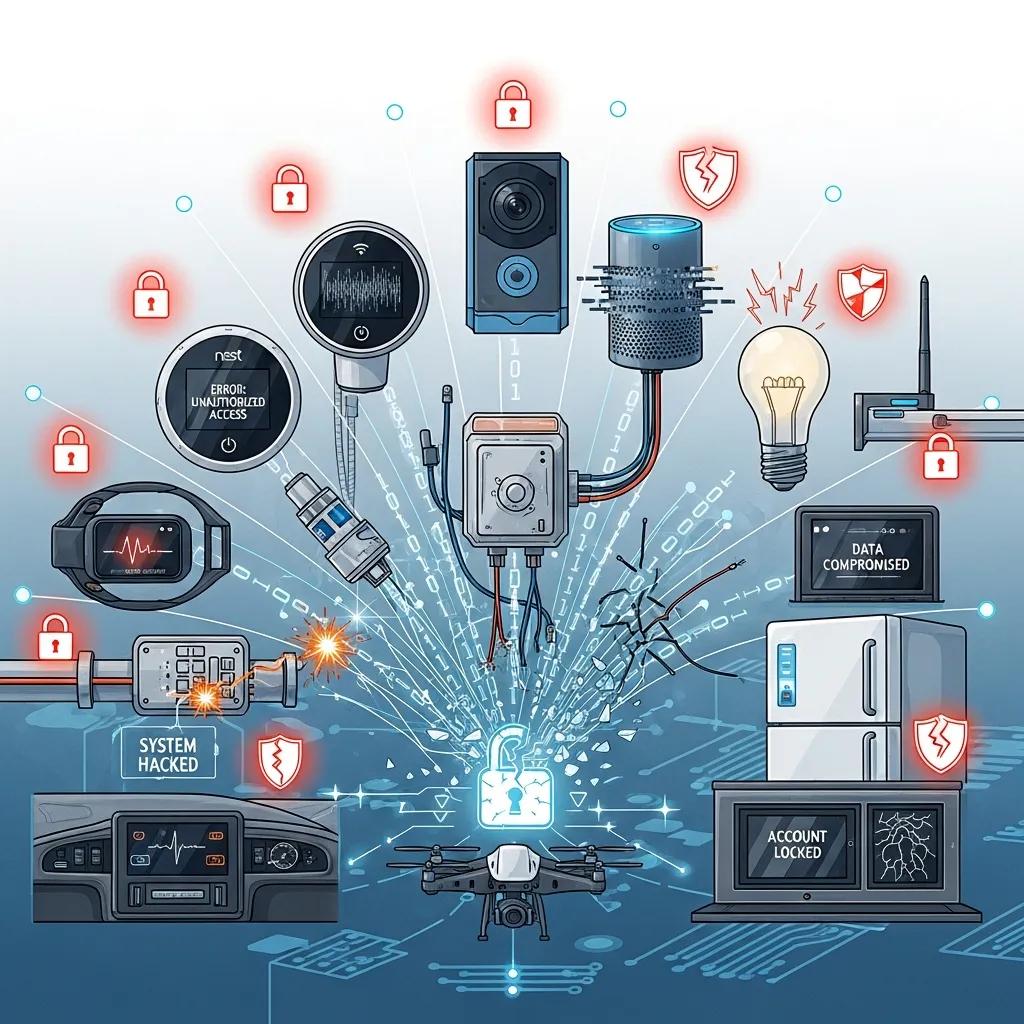
IoT devices often present unique risks because they combine limited processing power, long operational lifecycles and a diverse firmware ecosystem that’s hard to maintain. Constrained processors and small memory can rule out high‑assurance cryptography, increasing reliance on secure elements or gateways. Long lifecycles and inconsistent vendor update policies make patching a persistent operational challenge — one that lifecycle planning and compensating network controls must address. Multiple vendors bring protocol and management differences, so consistent onboarding, inventory and segmentation policies are key to reducing exposure. Recognising these hardware and lifecycle constraints is vital when you define an ISMS scope that includes IoT assets and when you select controls that balance device limits with security goals.
What are the common cybersecurity threats to IoT systems?
Typical threats include large botnets, credential abuse, man‑in‑the‑middle attacks and supply‑chain tampering that targets firmware and update channels. Botnets exploit default or weak credentials and exposed services to conscript devices for DDoS campaigns. Weak authentication and poor access controls allow unauthorised access and lateral movement. Compromised update mechanisms or tampered firmware can introduce persistent backdoors unless integrity checks and signing are enforced. Mitigations map to controls such as access management, network segregation and secure update practices — controls commonly audited under ISO 27001 and OT‑focused frameworks. Understanding these patterns helps to prioritise defensive investment and supports a risk‑based audit approach.
How does ISO 27001 certification protect IoT data and systems?
ISO 27001 defines an Information Security Management System (ISMS) that organises policies, processes and controls to manage risk across connected systems, including devices, gateways and cloud services. Applying ISO 27001 to IoT means scoping IoT assets clearly, carrying out tailored risk assessments for telemetry and device ecosystems, and operationalising controls for asset management, access control and secure configuration. Certification gives demonstrable risk reduction, builds vendor confidence and aligns with regulatory expectations for data protection and incident response.
The table below compares common ISO‑style controls with IoT risks and practical implementation tips.
This mapping shows how ISO 27001 controls become operational safeguards for IoT and why many organisations adopt an ISMS to manage distributed device risk. Proper implementation then improves data protection across the IoT lifecycle.
What are the requirements of ISO 27001 for IoT security?
ISO 27001 asks organisations to define the ISMS scope, perform risk assessments, implement proportionate controls and maintain continual improvement through monitoring and audits — all of which apply to IoT. Scoping must explicitly include sensors, gateways, cloud integrations and third‑party providers so risks aren’t left out. Risk assessments should factor in device constraints, firmware supply chains and physical access to endpoints, producing controls for patching, encryption and logging. Evidence — device inventories, incident logs and supplier contracts — is needed for certification audits and forms the basis for surveillance and ongoing compliance. Applying these requirements in practical terms lets organisations reduce exposure while demonstrating governance to stakeholders.
How does ISO 27001 enhance data protection in IoT ecosystems?
ISO 27001 strengthens data protection through data classification, encryption, retention policies and auditable incident response procedures that matter for telemetry and any personal data collected by IoT devices. Data lifecycle mapping is essential: identify where telemetry is collected, how it’s processed at the edge and in the cloud, and where it’s stored or shared. Encryption at rest and in transit, combined with solid key management and pseudonymisation where needed, lowers breach risk. ISO 27001’s focus on logging, monitoring and incident response helps detect and manage anomalous device behaviour and data exfiltration promptly. These practices deliver measurable improvements and support alignment with privacy rules.
What role does ISO 42001 play in AI and IoT compliance in the UK?

ISO 42001 covers governance and management for trustworthy AI and matters where IoT systems embed machine learning for automation or decision‑making. When IoT drives automated actions — for example predictive maintenance prioritisation or autonomous control loops — ISO 42001 adds requirements for risk management, transparency, documentation and human oversight that complement ISO 27001’s data controls. The standard helps organisations demonstrate ethical AI governance and prepare evidence for regulators focused on algorithmic accountability. Mapping AI capabilities in IoT to ISO 42001 obligations clarifies tasks like lifecycle documentation, explainability and monitoring for model drift.
The table below maps AI‑in‑IoT capabilities to ISO 42001 obligations and compliance benefits.
This mapping shows how ISO 42001 complements information security standards by focusing on algorithmic governance — essential when IoT systems make consequential decisions. Implementing ISO 27001 and ISO 42001 together strengthens compliance for AI‑driven IoT solutions.
How does ISO 42001 govern ethical AI use in IoT applications?
ISO 42001 demands documented AI lifecycles, model behaviour risk assessments, transparency in decision‑making and mechanisms for human oversight where systems interact with people or physical processes. In IoT contexts such as autonomous vehicles or facility controls, that means keeping records of training data provenance, validation results and operational boundaries for automated actions. Explainability and transparency help stakeholders understand why a system acted as it did, supporting incident investigation and regulatory queries. The standard also requires ongoing monitoring so organisations spot model degradation and apply corrective measures — especially important when inputs come from noisy or changing IoT telemetry.
What are the compliance benefits of ISO 42001 for AI‑driven IoT systems?
Adopting ISO 42001 for AI‑driven IoT systems delivers clear benefits: demonstrable governance for regulators, clearer liability allocation and greater stakeholder trust in automated processes. Certification evidence shows alignment with emerging AI rules and helps organisations structure controls that reduce risks from biased or unsafe model behaviour. For clients and partners, documented AI governance smooths procurement and supports contractual assurances around safety and ethics. These gains lower legal and reputational risk and enable more confident automation in IoT use cases.
How can Industrial IoT security audits improve operational safety?
IIoT security audits focus on configuration weaknesses, unsafe operational dependencies and supply‑chain exposures that can cause physical harm or production loss. A structured audit uncovers single points of failure, verifies access controls between IT and OT zones and assesses firmware integrity across controllers and sensors. Audits produce actionable remediation plans and test incident playbooks so teams can respond to real events, which measurably improves safety and resilience. The audit scope and referenced standards should be clear so stakeholders see how findings map to compliance and safety requirements.
A typical IIoT security audit includes these core phases and objectives:
- Scoping and discovery : Identify assets, network topology and critical processes to focus assessment work.
- Vulnerability and configuration testing : Validate device and network settings, patch status and authentication mechanisms.
- Supplier and firmware review : Confirm provenance of firmware and assess supplier security practices.
- Reporting and remediation planning : Produce prioritised actions, timelines and verification criteria.
These phases deliver an asset risk register, a remediation roadmap and verified configurations — all of which reduce the chance of safety incidents and support regulatory compliance.
The table below clarifies audit phases, objectives and typical deliverables for IIoT assessments.
This structure helps organisations plan audits that improve safety outcomes and create evidence suitable for certification and regulatory review. The sections below explain which standards auditors commonly reference.
What are the standards for Industrial IoT security audits?
IIoT audits typically reference a mix of OT‑focused and information security standards such as IEC 62443 for industrial control systems, ISO 27001 for information security across IT/OT boundaries and NIST guidance for cyber‑physical systems. IEC 62443 offers technical and process controls tailored to OT and is common in manufacturing and critical infrastructure. ISO 27001 provides an overarching ISMS to tie policies and evidence across IT and OT, while NIST publications add practical controls and maturity guidance. Choosing the right standard depends on sector rules, asset criticality and your existing governance. Using complementary standards ensures audits cover both technical and managerial aspects of IIoT security.
How do audits mitigate risks in Industrial IoT deployments?
Audits reduce IIoT risk by identifying insecure interfaces, checking patch and firmware management, and validating network segregation between IT and OT to prevent lateral movement. Vulnerability assessments reveal exposed services and misconfigurations that attackers could exploit to disrupt control systems, and supplier reviews lower the chance of compromised firmware entering operations. Effective audits also test incident response and recovery procedures, improving containment and restoration. Measurable outcomes include shorter mean time to remediate vulnerabilities and verified control effectiveness, which together lower operational risk and improve safety metrics.
Which IoT data protection standards should businesses follow?
Adopt a layered approach to IoT data protection that combines foundational information security standards with privacy frameworks and, where relevant, AI governance standards. Primary standards to consider are ISO 27001 for ISMS controls, ISO 27701 for privacy information management and ISO 42001 for AI governance where machine learning is used. Regulatory overlays such as GDPR or the UK Data Protection Act govern personal data handling and require steps like DPIAs for high‑risk processing. Start with asset and data‑flow mapping, then use ISO controls to operationalise encryption, retention and supplier management before demonstrating compliance through audits and documented evidence.
The primary standards and a one‑line rationale for each are:
- ISO 27001 : Establishes an ISMS to manage information security risks across IoT and connected infrastructure.
- ISO 27701 : Extends ISO 27001 with privacy controls to support GDPR and other data protection laws.
- ISO 42001 : Provides governance for AI systems used within IoT solutions, ensuring accountable automated decision‑making.
- GDPR / UK Data Protection Act : Legal frameworks requiring lawful basis, DPIAs for high‑risk processing and robust handling of data‑subject rights.
These standards work together: ISO frameworks operationalise technical and managerial controls while data protection laws set the legal obligations the ISMS must support. After mapping standards, implement best practices for governance and controls.
How do ISO certifications align with data privacy regulations?
ISO certifications align with privacy rules by providing operational controls and documented evidence to support legal obligations such as data minimisation, DPIAs and demonstrable security measures. For example, an ISO 27001 implementation supplies policies, logs and risk assessments that demonstrate appropriate technical and organisational measures under GDPR. ISO 27701 adds privacy management processes, data inventories and consent handling, making it easier to show regulators that privacy‑by‑design is in place. A mini‑DPIA for an IoT telemetry use case will typically document purpose, data categories, risk assessment and mitigations — artifacts that map directly to ISO evidence requirements and regulatory expectations. Using ISO frameworks streamlines compliance through consistent documentation and controls.
What are best practices for IoT data governance and compliance?
Start with a reliable device and data inventory, then define retention policies, minimisation rules, supplier agreements and incident processes tailored to connected devices. Collect only the telemetry you need, enforce retention schedules by data category and anonymise or pseudonymise where practical to reduce privacy risk. Add vendor and firmware governance — SBOMs and security clauses in contracts — to reduce supply‑chain exposure. Finally, maintain incident response plans that include device isolation, forensic capture and notification templates to meet regulatory timelines and contractual obligations. These steps improve compliance readiness and support certification.
- Inventory devices and map their data flows to processing and storage locations.
- Apply data minimisation and retention rules to telemetry streams and logs.
- Implement supplier management and firmware integrity checks during procurement.
- Maintain IoT‑specific incident response plans and test them regularly.
Taken together, these practices form a pragmatic roadmap for ISO readiness and regulatory alignment. Organisations that need help commonly engage qualified certification partners to speed up compliance.
How does Stratlane Certification support IoT security and compliance?
Stratlane Certification Ltd. supports organisations pursuing ISO 27001 and ISO 42001 for IoT systems, combining accredited certification with efficient tools and experienced auditors. We provide tailored support through account managers and lead auditors who help scope your ISMS, run gap analyses and advise on remediation — translating technical IoT controls into audit evidence. Stratlane also offers practical tools such as quote calculators and audit schedulers to reduce administrative friction, and our local audit teams deliver on‑site or remote audits as required. These capabilities minimise disruption while delivering accredited certification stakeholders can trust.
The section below outlines the typical process Stratlane follows to certify IoT‑relevant ISMS scopes and what clients should prepare at each stage.
What is Stratlane’s process for IoT ISO certification?
Stratlane Certification Ltd. follows a clear journey: scoping and quoting, gap analysis and remediation guidance, then certification audits and ongoing surveillance. You start with a scoping call to define which IoT assets, services and supplier relationships are in scope. We provide a quote using our quoting tools and schedule audits via our audit schedulers. The gap analysis phase highlights control shortfalls specific to IoT — for example device inventory and firmware integrity — and our lead auditors offer practical remediation advice. After remediation, the certification audit is carried out by experienced auditors and, on success, surveillance audits keep your certification current. This transparent, tool‑assisted approach aims to streamline certification while keeping audit rigour and accredited outcomes.
Can you see case studies of successful IoT certification with Stratlane?
Stratlane publishes IoT‑focused case studies showing challenge→solution→outcome narratives with measurable results such as reduced time‑to‑certification, documented risk reduction and stronger supplier assurance. Case studies outline the client’s starting point, the ISO controls applied to IoT assets, remediation timelines and outcomes like closed audit findings and surveillance results. For benchmarking, anonymised metrics such as time‑to‑cert and quantified risk‑reduction examples are available. Prospective clients can request case study summaries or references through Stratlane’s account management team during scoping and enquiry to understand sector experience.
Beyond security and AI governance, many organisations pursue wider management system certifications. For those demonstrating quality management, ISO 9001 certification provides a proven framework for continuous improvement and customer satisfaction.
These case studies and process descriptions show how accredited certification, combined with efficient tools and local audit teams, helps organisations achieve robust IoT security and compliance. When you’re ready, Stratlane Certification Ltd. can provide a quote and schedule audit dates to begin the certification journey.
Frequently asked questions
What are the benefits of implementing ISO 27701 alongside ISO 27001 for IoT security?
Implementing ISO 27701 alongside ISO 27001 brings privacy management into your existing ISMS. ISO 27701 extends ISO 27001 with controls for personal data, helping meet GDPR and other data‑protection laws. Together they let organisations manage both security and privacy risks in a single framework and demonstrate a clear commitment to protecting sensitive data collected by IoT devices.
How can organisations ensure ongoing compliance with IoT security standards?
Ongoing compliance requires regular audits, continuous monitoring and timely updates to security policies. Maintain a routine to review and evolve your ISMS as threats and regulations change, train staff on requirements and run periodic risk assessments. Automated monitoring tools for device security and compliance can reduce overhead and keep your estate aligned with relevant standards.
What role does risk assessment play in IoT security compliance?
Risk assessment is central to IoT security compliance: it identifies, evaluates and prioritises risks across devices, telemetry and suppliers. Systematic assessments let organisations apply targeted controls and support ISO 27001 evidence requirements. Conduct them regularly so you stay proactive against emerging threats and can adapt controls to protect sensitive data and meet regulatory obligations.
How do supply chain risks impact IoT security and compliance?
Supply‑chain risks can introduce vulnerabilities via third‑party components and services. Insecure firmware or devices from suppliers can lead to breaches and non‑compliance. Mitigate this by running supplier assessments, requiring security attestations and enforcing firmware integrity checks. A robust supplier management process ensures components meet security standards and reduces the risk of supply‑chain incidents.
What are the implications of GDPR for IoT device manufacturers?
GDPR places clear obligations on IoT device manufacturers for handling personal data. Devices should be designed with privacy in mind: collect only what’s necessary, apply security measures and be transparent about processing. Where required, obtain lawful consent and provide clear user information. Non‑compliance risks fines and reputational harm, so manufacturers should bake GDPR principles into product design and operations.
How can organisations prepare for an IoT security audit?
Prepare for an IoT security audit by reviewing security policies, procedures and evidence. Ensure all devices are inventoried, controls are in place and incident response plans exist. Gather records such as risk assessments, training logs and supplier contracts. Running mock audits helps uncover gaps and improves readiness. Proactive preparation smooths the audit process and shows commitment to IoT security compliance.
Conclusion
Pursuing IoT security certifications such as ISO 27001 and ISO 42001 strengthens data protection and compliance for connected systems. These standards reduce risk and build trust by demonstrating robust governance and ethical AI practices. To improve your organisation’s security posture, consider working with a qualified certification partner for tailored support. Start the path to accredited certification today.