
Boost Decision-Making Using Predictive Modeling Techniques

Predictive analytics for business growth and strategic planning
Predictive analytics turns historical data, statistical methods and machine learning into forward-looking signals that leaders can act on. By modelling past trends and engineering meaningful features, models forecast outcomes — from sales and staffing needs to security incidents — so teams can target resources more accurately. This article explains how forecasting and predictive modelling drive growth, how to make them practical for SMEs, and which techniques support ISO-aligned compliance and risk management. You’ll find implementation steps, recommended tools, method comparisons and the governance auditors expect under standards such as ISO 42001, ISO 27001 and ISO 9001. Each section includes checklists and concise guidance to help operational teams adopt predictive analytics for proactive risk control and performance improvement.
What is predictive analytics and how does it drive business growth?
Predictive analytics applies data analysis and machine learning to spot patterns in historical and real‑time data and turn them into forecasts that guide strategy and commercial decisions. The process combines data collection, feature engineering and model validation to produce predictions with tracked accuracy — inputs leaders use to optimise inventory, target customers and anticipate risks. Organisations that adopt forecasting convert uncertain demand into measurable KPIs, enabling smarter resource allocation and more focused product decisions.
In day‑to‑day operations, good forecasts reduce stockouts, cut churn and enable dynamic pricing — all of which contribute directly to revenue uplift. Understanding how forecasts are produced makes it easier to choose the right model types and evaluate accuracy.
How does predictive analytics forecast future business outcomes?
Forecasting fits statistical or machine learning models to historical time‑series and cross‑sectional data, using features such as seasonality, promotions, external indicators and lagged variables to predict future values. Approaches range from ARIMA and exponential smoothing to gradient‑boosted trees and neural networks; all depend on training and validation datasets and common metrics such as MAE and RMSE to measure performance. Robust pipelines use cross‑validation, backtesting and drift monitoring so predictions remain reliable as conditions change. For example, a sales pipeline might combine POS history, calendar events and web traffic to produce a weekly demand forecast that informs purchasing and staffing decisions. That practical grounding helps teams weigh the strategic benefits of forecasting against implementation effort.
What are the key benefits of predictive analytics for strategic planning?
Predictive analytics delivers clear advantages that raise decision quality and operational efficiency across an organisation.
Research shows predictive analytics can become a strong differentiator — but only when it’s embedded in a mature digital framework that supports action and governance.
Predictive analytics as a route to strategic differentiation
Predictive analytics has strong potential to differentiate a business — provided it’s implemented within a mature digital environment that supports reliable data flows, validation and governance. When those foundations are in place, organisations can turn insights into competitive advantage.
(Leveraging predictive analytics and machine learning for strategic business decision‑making and competitive advantage, OH Olayinka, 2019)
- Forecast‑driven resource allocation: Accurate demand forecasts lower inventory costs and reduce lost sales.
- Proactive risk identification: Early anomaly alerts let you mitigate issues before they escalate.
- Scenario planning and strategy testing: Simulated outcomes support smarter capital allocation and product choices.
- Cost avoidance and efficiency gains: Predictive maintenance and process optimisation extend asset life and cut operating spend.
Those benefits increase organisational agility and create measurable KPIs for growth programmes. The next section covers practical steps to implement predictive analytics effectively.
How to implement predictive analytics effectively in your business?
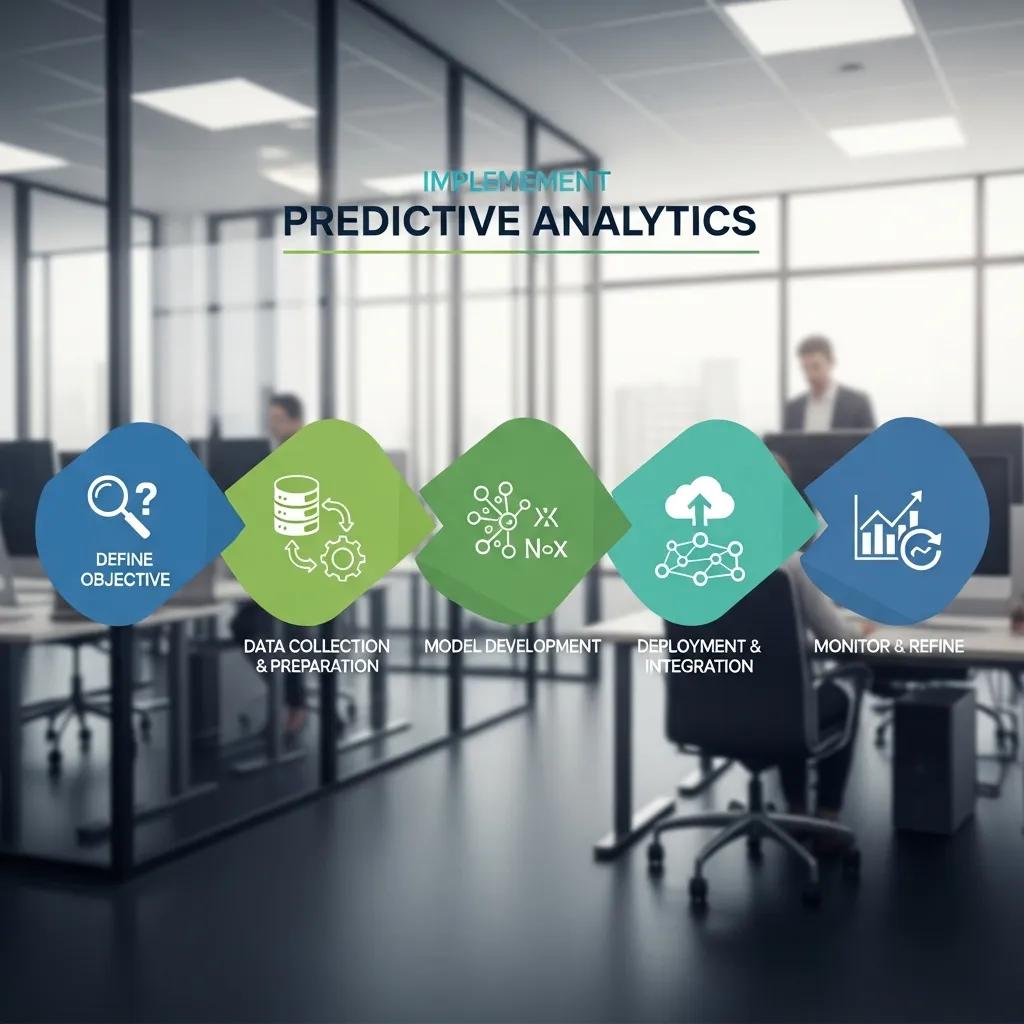
Implementing predictive analytics starts with clear objectives, a data readiness assessment and governance that ensures models deliver trustworthy outputs aligned to business goals. Success requires cross‑functional ownership — data engineers, domain experts and decision‑makers — and a lifecycle that covers collection, modelling, validation, deployment and monitoring. SMEs should favour pilot projects tied to measurable use‑cases, add logging to data pipelines and define KPIs for both model performance and business impact. A practical roadmap helps estimate time and cost and creates a repeatable approach that scales from experiment to production.
For SMEs the path can be challenging, but it’s also essential for staying competitive and unlocking new efficiencies.
Practical value for SMEs and real‑world examples
Predictive analytics is maturing and becoming more accessible in sectors like smart manufacturing. Over the last decade tools and techniques have stabilised, making it easier for smaller firms to embed analytics into high‑value scenarios. While getting started can feel daunting, practical examples and focused guidance make adoption achievable for SMEs.
(Predictive analytics applications for small and medium‑sized enterprises — A mini survey and real‑world use cases, S Bøgh, 2022)
Below is a concise, actionable summary of the core implementation steps.
What are the essential steps in predictive analytics implementation?
Follow a clear, five‑step sequence to turn an idea into a production forecast.
- Define objectives and KPIs: Clarify the business question, success metrics and action thresholds.
- Collect and prepare data: Audit and clean historical and operational data; perform feature engineering.
- Develop and validate models: Train statistical and ML models, then validate with backtesting and cross‑validation.
- Deploy and integrate: Embed models into workflows, add monitoring and ensure outputs feed decision systems.
- Monitor and improve: Detect drift, retrain when required and measure business impact against KPIs.
This checklist gives teams a practical sequence to follow. Next, consider tools and techniques that support these activities — especially important for resource‑constrained SMEs.
Below is a practical roadmap that links each implementation phase to common requirements and typical time/cost expectations.
This roadmap helps SMEs assess readiness and plan budgets. The following section outlines practical tool choices for early projects.
Which tools and techniques support AI predictive modelling?
A practical starter stack blends open‑source libraries, AutoML platforms and cloud services to balance capability and cost for SMEs. Use statsmodels or R for interpretable time‑series baselines, scikit‑learn and XGBoost for tabular regression and classification, and TensorFlow or PyTorch where deep learning is justified. AutoML and cloud offerings speed prototyping, while lightweight MLOps tools provide versioning, monitoring and deployment support. The right mix depends on data maturity and team skills; starting with simple, reproducible pipelines lowers risk and accelerates value.
- Starter stack recommendations: scikit‑learn or statsmodels for baseline modelsAutoML/cloud platforms for rapid prototypingLightweight MLOps frameworks for monitoring and retraining
Tool choices lead naturally into governance and compliance, which matter when aligning predictive analytics with ISO standards.
How we help: Stratlane Certification Ltd. assesses readiness for ISO‑related predictive analytics controls and provides certification and audit services that validate governance, model documentation and monitoring processes. We help organisations prepare evidence packages for audits and confirm that modelling controls meet auditor expectations — working alongside internal analytics teams rather than replacing them.
How can AI predictive modelling enhance ISO certification compliance?
Predictive models can supply monitored evidence for risk assessment, continual improvement and operational control — making them part of documented processes that demonstrate effective governance. Practically, model outputs feed risk registers, change control and management reviews so forecasts inform corrective actions and planning. Applications include model governance under ISO 42001, predictive threat intelligence for an ISMS under ISO 27001, and quality trend forecasting for QMS under ISO 9001. Mapping model artefacts to audit evidence helps auditors verify validation, drift detection and decision thresholds. The table below summarises standards, uses and typical audit evidence.
This mapping shows how predictive outputs become audit‑ready artefacts and leads into specific AI governance expectations under ISO 42001.
What role does predictive analytics play in ISO 42001 AI governance?
Under AI governance frameworks such as ISO 42001, predictive analytics requires documented model governance, validation and explainability to demonstrate reliability and ethical use. Organisations should maintain model cards, versioned validation reports and decision logs that describe inputs, assumptions, performance and limitations. Monitoring for bias, drift and adverse outcomes is part of continuous assurance, and explainability tools support stakeholder review and accountability. Auditors will look for artefacts showing how models were tested, how outputs feed decisions, and how governance reduces harms. Clear traceability in model pipelines prepares teams for compliance assessments and aligns analytics to organisational risk frameworks.
How does predictive analytics support risk management in ISO 27001 and ISO 9001?
Predictive analytics strengthens risk management by converting past incidents and telemetry into forward‑looking risk scores and early warnings that feed ISMS and QMS processes. For ISO 27001, predictive threat intelligence helps prioritise vulnerabilities and enrich risk registers with likelihood estimates so controls can be targeted and incident response accelerated. For ISO 9001, demand forecasting and defect‑rate prediction enable proactive CAPA planning and process changes that reduce nonconformities. Useful monitoring metrics include false positive/negative rates for detection models and lead‑time accuracy for operational forecasts. Integrating these outputs with existing registers and continual improvement cycles demonstrates measurable risk reduction.
With compliance mapped to ISO requirements, organisations can choose forecasting methods that balance interpretability and accuracy — the focus of the next section.
What forecasting techniques are most effective for business decision‑making?

Technique choice depends on data volume, problem type and the need for interpretability versus raw accuracy. Classical statistical models work well with limited data and offer clarity, while machine learning models deliver higher accuracy when you have richer feature sets. Time‑series methods like exponential smoothing and ARIMA handle seasonality and trend decomposition; causal models capture external drivers; and ML methods such as gradient boosting manage non‑linear interactions. Hybrid approaches that decompose series then model residuals with ML often provide a strong balance of accuracy and explainability.
Use the table below to compare strengths and typical use‑cases for each approach.
This comparison helps practitioners select the right method for their use‑case. The next subsection explains how statistical and ML approaches improve forecast accuracy in practice.
How do statistical models and machine learning improve forecast accuracy?
Statistical models explicitly capture trend and seasonality, while machine learning improves accuracy through feature engineering, ensembles and non‑linear pattern detection. Lagged features, rolling averages and external regressors enrich inputs; ensembles such as boosting reduce variance and bias; cross‑validation and backtesting quantify expected performance. Combining statistical decomposition with ML on residuals preserves interpretability and often improves short‑term accuracy. Visualising forecasts against actuals and tracking error metrics keeps models aligned to business value and supports ongoing tuning. These practices form the backbone of reliable forecasting pipelines.
What are practical examples of forecasting in quality and security management?
Forecasting delivers measurable gains in quality and security for SMEs and mid‑sized organisations. In manufacturing, defect‑rate forecasting highlights batches at risk so corrective measures can be scheduled before failures occur. In IT security, anomaly detection models surface unusual login patterns and likely intrusion attempts, enabling preventive controls and faster triage. In supply chains, lead‑time and demand forecasts reduce stockouts and speed supplier engagement. These examples show how time‑series methods suit inventory problems while ML classification supports anomaly detection — all yielding outcomes such as less downtime and fewer defects.
Effective Forecasting Techniques for Data-Driven Decision Making
Common barriers include poor data quality, limited skills, cost constraints and privacy concerns; each is manageable with a phased approach, managed services and solid governance. Fragmented or poorly labelled data hampers training; master data management and focused pilots help create usable datasets. Skills gaps can be bridged with AutoML, partners or consultants. Cost pressure is eased by starting small and scaling after proving value. Privacy and compliance require minimisation, anonymisation and strict access controls to align analytics with regulation. Identifying these challenges early lets teams plan practical mitigation tactics.
How can SMEs overcome data and skill gaps in predictive analytics?
SMEs can get started with high‑value pilots, cloud AutoML and specialist partners that bridge capability gaps while building internal skills. Practical steps include selecting one or two focused use‑cases, assembling a minimum viable dataset and using AutoML to produce baseline models that data teams refine. Training staff in core modelling and MLOps basics builds long‑term independence, while managed services provide fast operational capability and governance. These tactics shorten time‑to‑value and create a scalable learning path for the organisation.
What are best practices for ensuring data privacy and compliance?
Protecting privacy and meeting regulatory obligations means applying data minimisation, anonymisation, role‑based access and detailed audit trails. Practical controls include pseudonymising personal data before modelling, restricting raw data access by role and logging model inputs and outputs for auditability. Model cards and validation reports improve transparency for regulators and auditors, and privacy impact assessments clarify residual risk. Aligning these controls with GDPR and relevant ISO standards keeps analytics programmes defensible and trustworthy.
How does data analytics support strategic planning and operational efficiency?
Data analytics turns forecasts into scenario assessments, KPI projections and operational plans that deliver measurable efficiency gains. Predictive outputs feed strategy cycles by quantifying expected results from investments, highlighting leading indicators and setting intervention thresholds. Operationally, analytics reduces waste through predictive maintenance, improves quality with early defect detection and optimises staffing with demand forecasts. Together, strategic forecasting and operational integration create a feedback loop where model evidence informs management review and continual improvement.
What metrics should businesses monitor using predictive analytics?
Track both model performance metrics and business KPIs so forecasts translate into value. Model measures such as MAE, RMSE and AUC show prediction quality, while business KPIs — forecast bias, downtime reduction and defect rates — show impact. Monitor leading indicators like predicted churn probability, breach likelihood or expected downtime for early warning. Operational health metrics include data freshness, feature drift rates and the percentage of predictions acted upon. Linking technical and business metrics supports continual improvement and provides evidence for managers and auditors.
- Key monitoring metrics: MAE or RMSE to measure forecasting errorForecast bias to spot systematic over‑ or under‑predictionOperational KPIs such as mean time between failures or defect‑rate trends
These metrics make it easier to prioritise interventions and measure ROI from predictive initiatives. The final section shows how predictions feed proactive mitigation.
How can predictive analytics drive proactive risk mitigation?
Predictive analytics turns early warnings into prioritised, traceable actions recorded in risk registers and CAPA processes: predict → prioritise → act → monitor. For example, a forecasted spike in intrusion probability can trigger heightened monitoring and temporary controls; a predicted equipment failure schedules maintenance to avoid downtime. Integrating alerts with ticketing and change‑management systems ensures actions are measurable, and continued monitoring confirms whether mitigations reduced the anticipated risk. This closed‑loop approach aligns predictive outputs to operational controls and management oversight and demonstrates continual improvement to stakeholders and auditors.
When organisations are ready to move from capability to assurance, Stratlane Certification Ltd. acts as a certification partner that combines AI understanding with audit experience to assess compliance with standards such as ISO 9001, ISO 27001 and ISO 42001. We offer global audits in multiple languages, tailored programmes for UK SMEs and tooling support, like audit scheduling, to help organisations validate predictive analytics governance. Contacting a certification partner to request a quote or book an audit is a practical next step to turn predictive maturity into formal assurance and audit‑ready artefacts.
- Start with a pilot: Pick a high‑impact use‑case and set clear KPIs.
- Instrument data pipelines: Ensure logging, provenance and governance from day one.
- Integrate outputs into processes: Feed predictions into risk registers and operational workflows.
These actions bridge analytics work and operational controls, helping organisations realise efficiency gains and lower risk through predictive insights.
If you need external assurance, Stratlane Certification Ltd.’s audit approach emphasises proactive compliance and measurable risk reduction, helping firms show that predictive analytics controls meet auditor expectations. Requesting a quote or scheduling an audit provides a clear route from capability to certification and supports sustainable growth and planning.
Frequently asked questions
What types of businesses can benefit from predictive analytics?
Predictive analytics benefits a wide range of organisations — from SMEs to large enterprises across retail, manufacturing, finance and services. Retailers optimise inventory and personalise offers; manufacturers predict equipment issues and improve quality; financial firms use models for risk scoring and fraud detection. In short, any business that relies on data to make decisions can use predictive analytics to improve efficiency, cut costs and grow.
How can SMEs start using predictive analytics with limited resources?
SMEs should begin with focused, high‑value pilots that minimise upfront cost. Cloud AutoML platforms reduce the need for deep technical expertise, and working on small, well‑scoped datasets lets teams validate value before scaling. Partnerships with consultants or managed services can accelerate delivery while internal capability is developed.
What are the common challenges faced when implementing predictive analytics?
Typical challenges include inconsistent or poor‑quality data, a shortage of relevant skills and organisational resistance to change. Integrating predictions into workflows can also be hard. Mitigation strategies include investing in data governance, targeted training, and starting with use‑cases that clearly demonstrate business value to build momentum.
How does predictive analytics enhance customer experience?
Predictive analytics helps anticipate customer needs and personalise interactions. By analysing behavioural history, businesses can tailor marketing, recommend the right products and optimise service delivery. That proactive approach improves satisfaction, loyalty and retention because customers receive more relevant and timely experiences.
What role does data privacy play in predictive analytics?
Data privacy is central. Organisations must comply with laws such as GDPR and apply techniques like data minimisation and anonymisation to protect individuals. Clear governance — role‑based access, audit trails and documented privacy impact assessments — builds trust and keeps analytics programmes defensible.
How can predictive analytics support supply chain management?
Predictive models improve supply chain resilience by forecasting demand, optimising inventory and flagging risks. Analysing sales history and external signals helps predict future demand so stock levels can be adjusted, reducing stockouts and excess inventory. Models can also surface likely disruptions so contingency plans can be enacted sooner.
What metrics should businesses track to measure the success of predictive analytics initiatives?
Measure both technical and business outcomes. Technical metrics include MAE and RMSE for forecasting accuracy, or AUC for classification. Business metrics might be reduced downtime, higher customer satisfaction or increased sales. Regularly reviewing both sets of measures ensures models deliver real business value and supports continuous improvement.
Conclusion
Predictive analytics can deliver real business benefits: better resource allocation, earlier risk detection and improved operational efficiency. By combining historical data with appropriate modelling techniques and governance, organisations can make more confident decisions that drive growth and strategic planning. Start with a focused pilot that maps to your priorities, and use the guidance here to scale responsibly. Explore our resources and tools to support your predictive analytics journey.