
Enhance Business Success with ISO 9001: Top Benefits

ISO 9001 is the global benchmark for Quality Management Systems (QMS). It provides a clear framework to help organisations deliver reliable products and services while improving efficiency and customer satisfaction. This guide sets out what ISO 9001 certification means for your business, how the standard works in practice, and the tangible benefits UK organisations and exporters typically see after implementing a certified QMS. Where firms often face inconsistent quality, process waste or weak supplier controls, ISO 9001 helps by formalising processes, embedding risk-based thinking and requiring continual improvement. Below we walk through core principles, customer-focused practices, operational gains, market advantages and outcomes such as improved employee engagement and risk control. Practical examples, checklists and comparison tables show measurable results and how UK SMEs can access tailored support, including accredited audits and certification options. Read on to see how ISO 9001 can boost credibility, cut costs and open doors to new contracts while aligning with modern procurement expectations.
What Is ISO 9001 Certification and Why Is It Important for Your Business?
ISO 9001 certification confirms that an organisation’s Quality Management System meets the international ISO 9001:2015 requirements. In short, it shows your processes are designed to meet customer and regulatory needs consistently. The standard combines documented procedures, visible leadership and ongoing measurement to reduce variation and increase predictability — which leads to greater customer trust and fewer quality failures. Certification matters because it turns quality practices into auditable evidence buyers, regulators and stakeholders can rely on, making your operations more transparent and accountable. The sections that follow outline the standard’s core principles, the UK audiences that benefit most and how those principles translate into everyday business practice and procurement readiness.
ISO 9001 is built around seven quality management principles and a set of clear requirements that drive practical operational changes and better outcomes. Knowing these principles helps you target improvements that deliver measurable returns and smoother compliance with buyer specifications.
What Are the Core Principles and Requirements of ISO 9001:2015?
ISO 9001:2015 centres on seven principles that form the backbone of a strong QMS: customer focus, leadership, engagement of people, a process approach, continual improvement, evidence-based decision making and relationship management. These translate into concrete requirements for planning, support, operation and improvement. Organisations must understand their context, involve leadership, plan risk-based actions, support competence and documented information, control operations, monitor performance and drive continual improvement. Putting these clauses into everyday processes reduces surprises and builds supplier and customer confidence through documented controls and regular management reviews.
Applied practically, these principles encourage measurable KPIs, documented procedures and internal audits that spot non-conformities and trigger corrective actions. The next section looks at who in the UK typically benefits from certification.
Who Benefits from ISO 9001 Certification in the UK?
ISO 9001 is deliberately generic and scalable, so it suits a wide range of organisations — manufacturers, distributors, professional services, and public-sector suppliers among them. In the UK, public procurement and many large corporate supply chains often expect ISO 9001 or equivalent quality evidence, so certification can be critical for businesses bidding for tenders or supplying larger buyers. Smaller firms and SMEs gain credibility and internal controls that help them compete against larger rivals, while regulated sectors use ISO 9001 to show consistent compliance and traceability. Practical examples include a manufacturer cutting defects and warranty claims, a consultancy formalising project controls, and a food distributor improving traceability — all showing how the standard adapts to different operations.
With those audiences in mind, we next explain how certification helps drive customer satisfaction and loyalty through structured feedback and consistent delivery.
How Does ISO 9001 Certification Improve Customer Satisfaction and Loyalty?

ISO 9001 improves customer satisfaction by building feedback loops, corrective actions and quality controls into everyday work. Formal complaint handling, measurable satisfaction metrics and corrective-action cycles ensure customer issues are addressed at source rather than fixed as one-offs. The result is fewer repeat complaints, better on-time delivery and stronger trust that encourages repeat business and referrals. The following points summarise the common feedback and control mechanisms that lead to measurable loyalty improvements.
- Customer satisfaction is tracked with surveys, Net Promoter Score (NPS) and targeted follow-up.
- Complaints are handled through a documented corrective-action process with root-cause analysis.
- Performance monitoring links customer feedback to process KPIs and management review cycles.
These controls stop problems recurring and strengthen customer relationships. The next subsection outlines the specific feedback tools and quality checks that drive better experience.
What Feedback Mechanisms and Quality Controls Drive Improved Customer Experience?
ISO 9001 requires you to capture and act on customer feedback using structured methods such as surveys, NPS, interviews and complaint logs. Those inputs feed corrective and preventive actions backed by clear responsibilities, response timelines and measurable outcomes that inform management review. Useful metrics include complaint frequency, average resolution time and customer satisfaction trends — tracked monthly to spot systemic issues early. When feedback triggers corrective actions, you document root causes and verification steps to reduce repeat failures. This closed-loop approach both improves immediate satisfaction and signals to buyers that you actively manage quality.
Strong feedback processes naturally support consistent delivery, which we explain next.
How Does ISO 9001 Support Consistent Product and Service Quality?
ISO 9001 promotes consistency through documented procedures, defined process inputs/outputs and control points that reduce variability and create predictable outcomes. Standard operating procedures, work instructions and acceptance criteria become reference points for teams, while internal audits and sampling checks confirm compliance and uncover improvements. For example, documenting packing checks, responsibilities and exception handling in order fulfilment can cut order errors and returns, improving on-time delivery. By linking controls to objective measures such as defect rate and first-pass yield, organisations turn quality goals into operational targets teams can manage and improve.
Consistent quality then frees up capacity by reducing rework and waste — the subject of the next section on operational improvement.
How Does ISO 9001 Improve Operational Efficiency and Drive Process Improvement?

ISO 9001 boosts efficiency by encouraging process mapping, standardisation and regular improvement cycles (for example, Plan-Do-Check-Act and management reviews). The standard shifts organisations from firefighting to systematic optimisation, using data to find bottlenecks and non-value steps. Typical outcomes include shorter cycle times, lower defect rates and better use of staff and materials — all of which increase throughput and margin. The sections below give examples of waste reduction and explain the role of data-driven decision making, supported by a comparative table showing common measurable impacts.
Streamlining is a measurable activity; the table below compares operational areas and typical improvements after adopting ISO 9001 practices.
| Operational Area | Improvement Focus | Typical Measurable Value |
|---|---|---|
| Production | Defect reduction and first-pass yield | Defect rate reduced by 20–50% |
| Service delivery | Cycle time and response time | Cycle time reduced by 15–35% |
| Administration | Document control and rework | Administrative errors reduced by 30% |
The figures above show where organisations commonly see gains and how those gains convert into measurable business value. Results vary by context but are consistently trackable when teams set KPIs and monitor them as ISO 9001 requires.
How Does Streamlining Processes Reduce Waste and Lower Costs?
Streamlining under ISO 9001 starts with process mapping to spot non-value steps and handoffs, then applying controls and simplifications to remove waste and reduce variation. Lean tools such as value-stream mapping sit well alongside ISO’s process approach to cut unnecessary steps, lowering labour and material costs and shortening lead times. For example, fixing a recurring defect by clarifying inspection points and supplier specs can reduce scrap and warranty costs. Documented procedures also shorten onboarding and reduce error-driven rework, delivering ongoing savings. These efficiencies feed into KPIs and continual improvement cycles, making savings repeatable rather than one-off.
Targeted data collection is essential to prioritise improvements; that topic is covered next.
What Role Does Data-Driven Decision Making Play in a QMS?
Data-driven decision making is core to ISO 9001. Organisations collect KPIs — defect rate, on-time delivery, customer complaints and cycle times — then review trends to prioritise improvement projects and verify corrective actions. Management reviews and internal audits rely on objective evidence to assess process capability and direct resources, turning anecdote into action. Suggested KPIs include defects per million opportunities, percentage on-time delivery and customer satisfaction score, all feeding a leadership scorecard. Statistical process control, where appropriate, detects shifts before they become systemic and supports risk-based thinking by quantifying likelihood and impact. The end result is a steady cycle of measurement, analysis and improvement that raises performance over time.
With efficiency and data control in place, certification also creates market and competitive benefits, explored next.
How Can ISO 9001 Certification Give You a Competitive Edge and Open New Markets?
ISO 9001 certification signals credibility and consistent capability to buyers, opening doors to public tenders, larger B2B contracts and export markets where certification is a recognised procurement criterion. The standard links documented quality practices to buyer confidence: certified organisations present auditable evidence of controls, risk management and continual improvement, reducing buyer due diligence friction. That advantage shows up in tender scoring, preferred-supplier lists and contract negotiations, because certification lowers perceived supplier risk. The subsections that follow explain how to list certification in bids and how it strengthens supplier relationships and brand reputation. A comparative table then shows how certification meets different buyer expectations across market channels.
Research supports that, when used actively, ISO 9001 can be a framework for strategic gains such as revenue growth, stronger customer loyalty and an improved organisational image.
ISO 9001: Strategic Advantages & Business Growth This study examines whether a Quality Management System (QMS) can deliver strategic benefits beyond operational improvements. While ISO 9001 is sometimes criticised as bureaucratic, the research finds QMS can bring notable advantages — but only when organisations use the standard actively and managers drive the effort. With appropriate application, QMS can support profit growth, increased income, stronger customer loyalty and a better organisational reputation.
| Market Channel | Buyer Expectation | How ISO 9001 Addresses It |
|---|---|---|
| Public tenders | Documented quality controls | Provides auditable evidence and management review outputs |
| Export markets | Consistent product/service quality | Reduces variability and supports regulatory traceability |
| B2B contracts | Supplier reliability and risk mitigation | Formal processes, corrective actions and supplier evaluations |
This comparison shows how certification meets channel-specific expectations and why many procurement frameworks treat ISO 9001 as a credibility signal. The next section explains practical ways to reference certification in UK tenders and bids.
How Does Certification Improve Credibility for UK Businesses in Tenders and International Markets?
In UK procurement and international contracts, ISO 9001 provides verifiable proof of quality management via documented policies, audit reports and the certificate itself — items buyers often request during pre-qualification. Practical steps include naming your certificate in tender forms, attaching a short management-system summary that maps clauses to contract requirements, and supplying evidence of recent internal audits and corrective actions. This shows your quality system is active and audited, reducing buyer uncertainty and often improving technical scores in competitive bids. Clearly stating the certificate scope and accredited status helps procurement teams verify relevance quickly, shortening due diligence and improving your chances of award.
What Impact Does ISO 9001 Have on Supplier Relationships and Brand Reputation?
ISO 9001 strengthens supplier relationships by creating transparent evaluation criteria, documented incoming quality controls and collaborative improvement processes that reduce variability across the supply chain. When suppliers and customers share clear quality expectations through formal specifications and audit programmes, supplier-origin faults fall and operations run more smoothly. Brand reputation improves because consistent delivery and formal complaint resolution are visible to customers and partners, building trust and referrals. Over time these effects compound: fewer supply-chain failures lower costs and improve fulfilment, which enhances market perception and can lead to preferred-supplier status with larger buyers.
Many organisations also seek practical support to convert certification into tender wins or market entry; Stratlane Certification’s role in that process is summarised below with a simple call to action.
Stratlane Certification Ltd. is a UKAS-accredited certification body that combines AI-assisted audit tools with local audit teams and SME-focused programmes to help clients demonstrate credibility in tenders and international markets. UKAS accreditation confirms that an audit provider meets ISO/IEC 17021-1 requirements for competence, impartiality and consistency, which is why many public tenders and regulated buyers specifically ask for certification from an accredited body. Stratlane pairs experienced auditors with tools like an audit scheduler and an audit offer calculator to streamline quotations and bookings, helping you produce the auditable evidence procurement teams expect. For organisations preparing bids, this approach aims to reduce administrative friction and deliver clear documentation for buyers.
If your organisation needs to show ISO 9001-based credibility in tenders or contracts, consider requesting a tailored audit quote or scheduling an assessment via Stratlane Certification’s audit tools to secure accredited certification evidence aligned with procurement requirements.
What Organisational Benefits Does ISO 9001 Deliver: Employee Engagement, Risk Management and Continual Improvement?
ISO 9001 brings organisational benefits by clarifying roles and responsibilities, embedding competence frameworks and creating documented processes that cut ambiguity and increase ownership. Linking documented responsibilities and training to measurable performance improves morale and reduces rework caused by unclear expectations.
At the same time, the standard’s focus on risk-based thinking encourages early identification and mitigation of hazards, aligning quality controls with legal and contractual obligations. Together these elements help build a culture of continual improvement where teams iterate on processes using real data and management-review decisions.
How Does ISO 9001 Improve Employee Morale and Clarify Roles?
ISO 9001 improves morale by documenting responsibilities, setting competency requirements and providing structured training paths, which boosts staff confidence and ownership. When people know the procedures, escalation routes and quality expectations, they perform more consistently and are likelier to suggest improvements. Documented role profiles and competence records also support fair performance reviews and targeted development, reducing disputes over responsibilities. Clearer roles cut duplication and rework, lowering frustration and increasing productivity — a positive cycle of clearer expectations and better job satisfaction.
How Does the Standard Support Proactive Risk Identification and Regulatory Compliance?
ISO 9001 embeds risk-based thinking in planning and operations, asking organisations to identify risks to product or service conformity and apply proportionate controls. The standard encourages regular risk assessments, documented controls and monitoring of mitigation effectiveness, which reduces exposure to compliance failures and operational disruption. A simple checklist for risk identification includes mapping process inputs and outputs, listing failure modes, assessing severity and likelihood, and assigning controls and owners. Aligning risk controls with applicable legal and regulatory requirements increases confidence that you remain compliant and can provide documented evidence for inspections or procurement checks.
Documented evidence and compliance are especially important in regulated sectors, where strong data management architectures are needed for secure, traceable and audit-ready operations.
ISO 9001 for Data Management & Compliance in Manufacturing The complexity of regulated manufacturing demands disciplined data management based on international standards. In sectors such as defence and aerospace — where ITAR and ISO 9001 apply — organisations face challenges in creating secure, traceable and audit-ready data streams. Paper-based processes and fragmented systems increase the risk of non-compliance, inefficiency and slow audits. Automated, standards-aligned data flows reduce those risks and support faster, more reliable audits.
Risk Identification Checklist
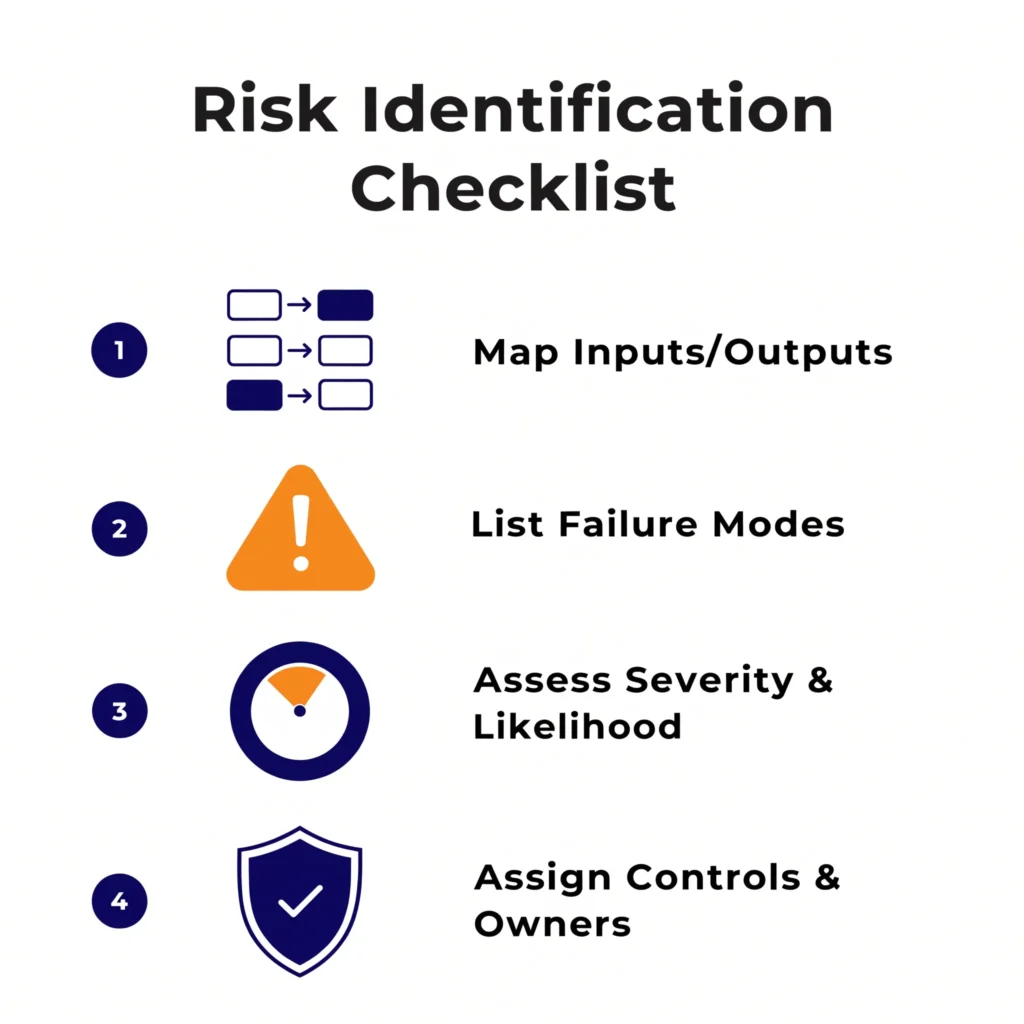
- Map process inputs and outputs: identify each process’s inputs and outputs to pinpoint where failures could originate.
- List failure modes: catalogue the ways each process could fail to meet product or service conformity.
- Assess severity and likelihood: evaluate the potential impact and probability of each identified risk.
- Assign controls and owners: allocate proportionate controls and a responsible owner to monitor and mitigate each risk.
How Do UK SMEs Specifically Benefit from ISO 9001 Certification?
UK SMEs gain from ISO 9001 through stronger tender competitiveness, streamlined processes that scale with growth and access to SME-focused support programmes that lower the barrier to certification. Certification converts day-to-day practices into recognisable evidence buyers trust, letting smaller firms compete on capability rather than size alone. SME-friendly advantages include simplified implementation paths, proportionate scope definition and targeted advisory support to control cost and timelines. The subsections below outline Stratlane Certification’s SME programmes and practical tips for SMEs preparing tenders.
| Support Option | Cost Focus | Typical Timeline / Support Level |
|---|---|---|
| Basic SME scheme | Cost-effective entry route | Shorter timeline, guided templates |
| SME + advisory | Moderate investment, consultancy | Includes coaching, 3–6 month implementation |
| Full audit & certification | Accredited certification package | End-to-end audit scheduling, full documentation support |
The options above range from low-cost entry to full certification; SMEs can pick the level that fits their resources and tender ambitions. The following sections describe Stratlane Certification’s SME tools and offer practical tender tips.
What Support Programs and Cost-Effective Solutions Does Stratlne Offer for SMEs?
Stratlane Certification Ltd. runs SME-focused programmes that combine accredited certification services with practical tools like an audit offer calculator and scheduler to make planning and budgeting easier. Stratlane’s SME pathway reduces complexity with guided templates, local audit teams and scalable audit scopes that reflect a smaller organisation’s processes, helping control cost while ensuring the certificate meets buyer expectations. For startups in emerging governance areas we offer targeted pathways tailored to specialised needs. SMEs using these services typically receive a clear quote and an audit schedule aligned to tender deadlines.
How Does ISO 9001 Help SMEs Win Tenders and Compete with Larger Firms?
ISO 9001 helps SMEs win tenders by providing clear, documented evidence of quality systems that reduce buyer uncertainty and show readiness to meet contract requirements. Practical tips for SMEs:
- Include the certificate scope and accreditation status in your submission.
- Attach a short quality management summary mapping to tender criteria.
- Provide recent internal audit or corrective-action examples that demonstrate effectiveness.
These steps turn a certificate into practical credibility and help SMEs compete on evidence and responsiveness rather than scale.
(Integration note: SMEs needing quotes or scheduling support can use Stratlane Certification’s audit offer calculator and scheduler to get precise quotes and align audits with tender deadlines.)
Frequently Asked Questions
What is the process for obtaining ISO 9001 certification?
To obtain ISO 9001 certification you typically develop and implement a QMS that meets ISO 9001:2015 requirements — documenting processes, running internal audits and demonstrating compliance. Once the QMS is in place, an accredited certification body carries out an external audit to confirm conformity. If successful, you receive certification, usually valid for three years and maintained through periodic surveillance audits to ensure ongoing compliance.
How long does it take to achieve ISO 9001 certification?
Time to certification varies by organisation size and complexity. It can take a few months for smaller, simpler businesses and over a year for larger organisations with complex operations. Engaging experienced advisers or using a guided SME route can shorten the timeline by focusing efforts on the most relevant requirements.
What are the costs associated with ISO 9001 certification?
Costs depend on organisation size, process complexity and the certification body chosen. Typical expenses include consultancy, training, internal audits and the certification audit itself, plus any implementation changes needed. SMEs might expect costs from a few thousand to tens of thousands of pounds, depending on scope and level of support required.
Can ISO 9001 certification be maintained indefinitely?
Certification is not permanent without ongoing compliance. Certificates are normally valid for three years, with regular surveillance audits during that period. A recertification audit is needed at the end of the three-year cycle. To maintain certification you must continually improve the QMS and address any non-conformities found during audits.
How does ISO 9001 certification impact employee engagement?
ISO 9001 can improve engagement by clarifying roles, responsibilities and expectations. The standard promotes continuous improvement and involvement, giving staff structured opportunities to contribute to quality initiatives. Clear procedures and training increase confidence and ownership, often boosting morale and job satisfaction.
What are the common challenges organisations face when implementing ISO 9001?
Common challenges include resistance to change, weak leadership commitment and insufficient staff training. Employees used to informal processes may resist new procedures, and without leadership support it can be hard to allocate resources and embed the necessary cultural shift. Documentation workload and the need for ongoing monitoring can also strain smaller organisations without dedicated quality teams.
Conclusion
ISO 9001 certification delivers clear benefits: improved operational efficiency, stronger customer satisfaction and enhanced market credibility. A structured QMS helps you streamline processes and build a culture of continual improvement, supporting sustainable growth. Beyond compliance, certification positions your business more competitively in procurement and supply chains. To explore how ISO 9001 could benefit your organisation, consider contacting us for a tailored consultation.