
Explore ISO 27001 Controls: Key Insights into Annex A

Annex A of ISO 27001:2022 lists the controls organisations use to treat information security risk and show compliance within an Information Security Management System (ISMS). This guide explains what those controls are, what changed in the 2022 update, and how to apply controls as part of risk treatment and certification evidence. Many teams find mapping risks to controls, keeping audit-ready documentation, and addressing newer topics such as threat intelligence and cloud security challenging. Here you’ll find clear definitions, practical implementation advice and a simple approach to building a Statement of Applicability (SoA). We cover how the 93 Annex A controls map into four themes, which controls are new or merged from 2013, and how to record applicability and justification in your SoA so it stands up in audits. The article follows a logical flow: defining Annex A and its role, comparing 2013→2022 changes, explaining the four themes, detailing physical and technical controls, then finishing with a step-by-step SoA process and useful templates for certification readiness.
What is ISO 27001:2022 Annex A and why it matters
Annex A in ISO 27001:2022 is the normative list of 93 information security controls organisations reference when choosing risk treatment measures for an ISMS. The controls set measurable objectives and typical implementation approaches that map to identified risks and provide the evidence auditors look for during certification. Annex A matters because it standardises control options, helps justify selections in the Statement of Applicability (SoA), and gives auditors a consistent baseline to judge the effectiveness of your risk treatments. Below we outline Annex A’s main purposes and how it fits into the ISMS lifecycle and certification process.
Research and frameworks continue to evolve to help organisations navigate ISO 27001:2022 compliance and implement controls efficiently.
ISO 27001:2022 compliance framework — cataloguing all 93 controls
This paper describes a web-based framework that organises the ISO 27001:2022 controls and supports gap analysis and compliance tracking. It explains the standard’s role in modern cybersecurity and demonstrates how a dynamic tool can help teams evaluate adherence across the full set of controls.
Enhancing Information Security Management System using ISO controls-based framework, 2022
Annex A serves four practical purposes:
- Standardise control options so risk treatment is consistent across teams and audits.
- Give auditors traceable control references to assess compliance.
- Support the SoA by listing applicable and non-applicable controls with clear justification.
- Help organisations design measurable controls that feed continual improvement.
Because Annex A is standardised, mapping a risk assessment to controls becomes repeatable, and the evidence you collect against control objectives strengthens audit claims and drives ISMS maturity.
What Annex A controls are, and how they work in ISO 27001:2022
Annex A controls are outcome-oriented measures grouped by objective: they describe the result you need to achieve rather than prescribing a single technical fix. A control generally includes an objective, suggested implementations and the types of evidence auditors expect (policies, procedures, logs, test records). For example, an access management control requires only authorised users to access sensitive information; common implementations include role-based access, multi-factor authentication and periodic access reviews. When mapping risks to controls, use a simple linkage: Risk → Requires → Control. That alignment makes sure every treatment targets a defined vulnerability or threat.
Controls are applied iteratively within an ISMS: select controls after identifying risks, implement and collect evidence, then monitor and feed findings back into the next risk assessment. This lifecycle helps teams choose controls that are proportionate, implementable and auditable.
How Annex A strengthens an ISMS
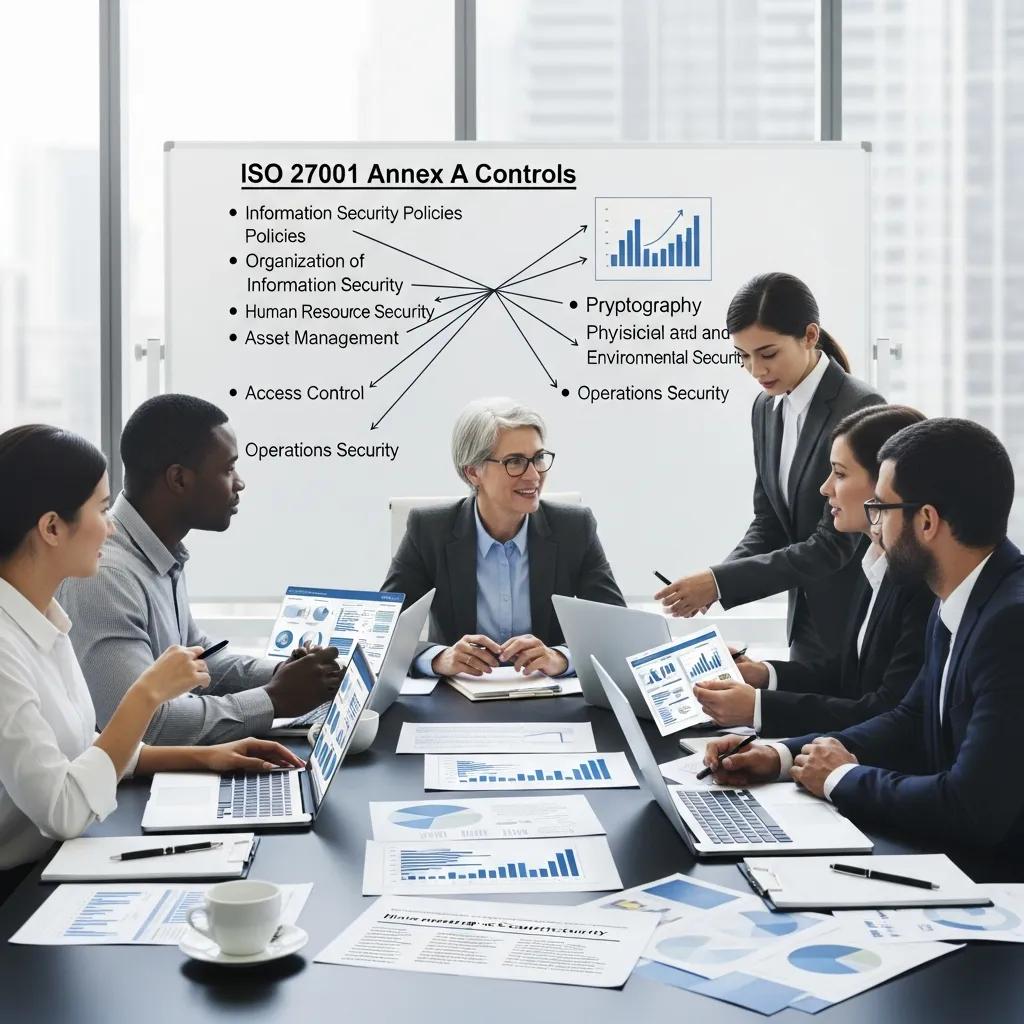
Annex A improves ISMS resilience by providing consistent control objectives that protect confidentiality, integrity and availability across people, processes and technology. Controls generate measurable evidence—incident records, audit logs and supplier contracts—that auditors use to assess effectiveness. For example, incident management controls reduce detection and recovery time, while supplier management controls lower third‑party risks to availability or confidentiality. Controls also create clear criteria for performance monitoring and corrective action, which drives continual improvement.
When controls are selected and recorded in the SoA with implementation notes and evidence references, organisations can show certification bodies that risk treatment is deliberate, traceable and effective. That traceability increases auditor confidence and supports the ongoing improvement cycle that keeps an ISMS effective over time.
If you prefer external support, Stratlane Certification Ltd. positions itself as a modern certification body delivering ISO services, including ISO 27001. Stratlane combines AI tools with industry experts to audit organisations across the UK, Ireland and mainland Europe, and can help with quotes and audit bookings for teams planning Annex A implementations and certification.
What changed in Annex A from ISO 27001:2013 to 2022?
The 2022 revision streamlined Annex A, reducing duplication and shifting organisation from 14 domains and 114 controls (2013) to 93 controls grouped under four themes. The update adds new controls for contemporary risks (for example, threat intelligence and cloud services), merges overlapping items to simplify implementation, and reframes many statements toward outcome-based language. Transition planning therefore requires mapping old control IDs to the new set and reassessing applicability against current technology and business context.
Practical steps include updating your SoA to reference new control identifiers, revising policies and procedures that mention old clauses, and ensuring evidence maps to the reworded objectives. The table below shows representative changes to help with transition planning.
| Control (ID / Name) | Change Type | Implication for Transition |
|---|---|---|
| A.5.7 Threat intelligence | New | Introduce processes to collect and act on threat intelligence; feed findings into monitoring and risk assessments. |
| A.5.23 Information security for use of cloud services | New | Put cloud governance and contractual clauses in place and document shared‑responsibility controls. |
| A.8.x (multiple) Merged asset controls | Merged/Reworded | Consolidate asset registers and handling policies; map legacy items into a single asset lifecycle control. |
Which controls are new in ISO 27001:2022 Annex A?
The 2022 Annex A added several controls to reflect modern risk areas, notably threat intelligence and cloud service security. Each new control requires defining processes, responsibilities and evidence to show effective monitoring and treatment. For SMEs, a sensible approach is to start with lightweight processes that integrate into existing monitoring and procurement workflows, and then scale as capability grows.
Notable new controls include:
- Threat Intelligence (A.5.7): Define sources, analysis and actions so threat data informs your risk assessment.
- Information Security for Use of Cloud Services (A.5.23): Set cloud governance, contractual requirements and shared‑responsibility measures.
- ICT Readiness for Business Continuity (A.5.29): Embed ICT resilience in business continuity planning to protect availability.
How were controls merged or reorganised in 2022?
The 2022 update consolidated overlapping 2013 items, reduced redundancy and favoured intent‑based, outcome‑focused wording that is simpler to audit. Merging grouped controls by purpose rather than by technical domain, making it easier to map them to risks. For transition, build a mapping matrix—old ID → new ID—and update your SoA, policies and evidence index accordingly.
Example mappings include:
- Old A.8.1 and A.8.2 (asset management subitems) → Combined into a single asset lifecycle control with clearer evidence expectations.
- Multiple access and authentication entries → Reorganised under a single access management control covering authorisation, provisioning and review.
Prioritise mapping controls tied to critical services and update procedures that reference reworded objectives to avoid audit gaps.
The four themes of ISO 27001:2022 Annex A controls
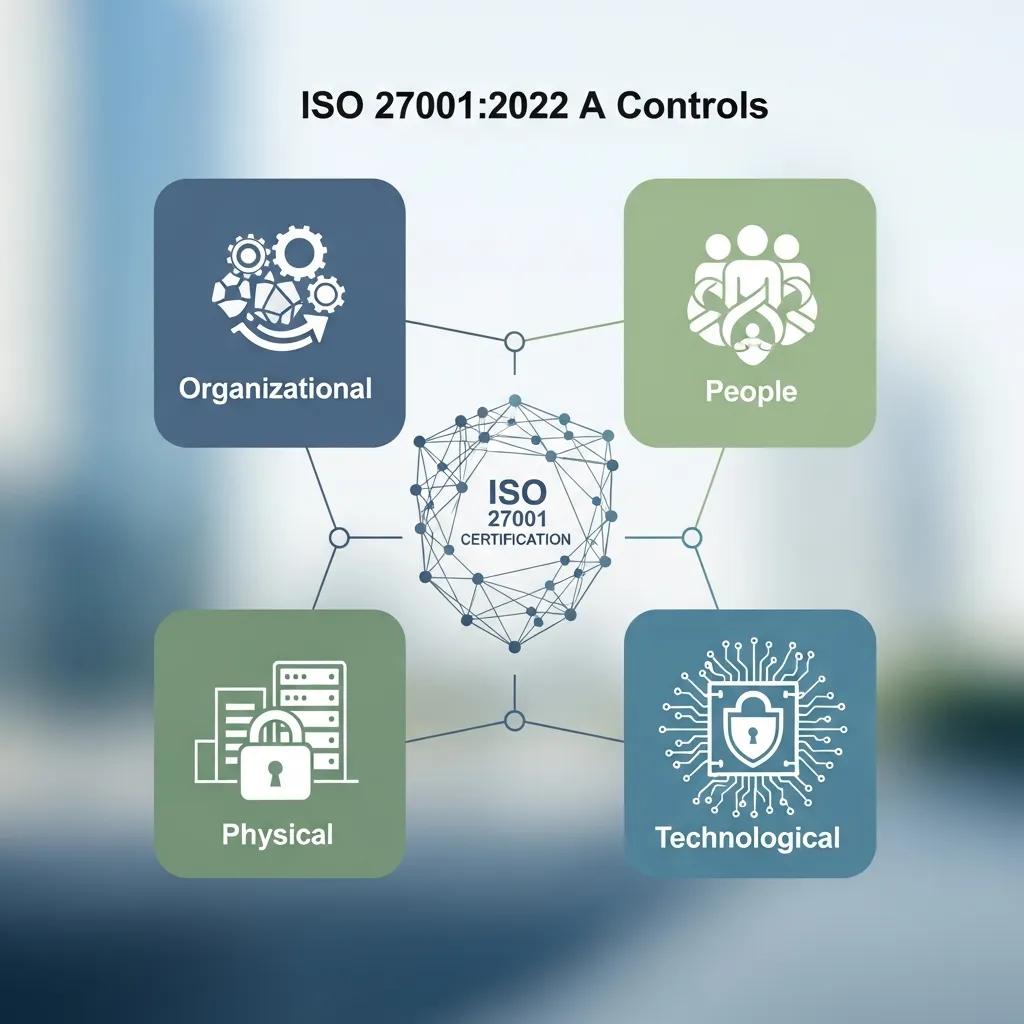
The 93 Annex A controls sit under four themes: Organisational, People, Physical and Technological. Each theme covers a distinct scope of objectives and together they provide full information security coverage. This thematic view—Information security controls → Themes → Specific controls—makes it easier to assign ownership and align controls with organisational structures.
| Theme | Number of Controls | Key Examples and Objectives |
|---|---|---|
| Organisational controls | 37 | Policies, governance, supplier relationships and incident management — ensure risk‑informed decisions. |
| People controls | 8 | Screening, training, roles & responsibilities, remote working — reduce human risk vectors. |
| Physical controls | 14 | Perimeter security, secure areas, equipment protection — safeguard tangible assets and sites. |
| Technological controls | 34 | Network security, cryptography, logging, DLP, secure development — secure systems and data flows. |
What organisational controls cover
Organisational controls cover governance, policies, processes and supplier management that create consistent security behaviours across the business. Typical organisational controls include the information security policy, defined security roles, supplier selection and monitoring, change management and incident response frameworks. Implementing them usually starts with senior‑level commitment, documented policies and procedures that integrate security into procurement and project lifecycles.
For SMEs, practical steps include a concise information security policy, a named security owner for key processes and supplier security questionnaires mapped to Annex A. These actions create traceable evidence for auditors and reduce risks introduced by external parties.
How people controls strengthen awareness and HR processes
People controls tackle the human side of security through background checks, competence and awareness training, clear responsibilities and secure remote working practices. Regular, role‑specific training and tested onboarding/offboarding reduce the chance of social engineering and insider error. Tracking training completion, competence checks and incident‑related behaviour trends provides the evidence auditors expect.
SMEs should start with induction training, periodic refreshers and secure remote work guidance with basic monitoring. Simple metrics—training completion rates and incident trends—help show control effectiveness and continual improvement.
How physical controls protect your organisation’s assets
Physical controls protect tangible assets and operational environments via perimeter security, zoning, secure storage and environmental safeguards. These measures preserve availability and integrity by preventing unauthorised physical access and environmental damage. Physical controls often provide the clearest audit evidence: visitor logs, access authorisations, CCTV records and environmental reports. Designing physical protections requires balancing security and usability, and translating control objectives into practical measures aligned with business needs.
Well‑documented physical controls should link to organisational policy and incident management so that physical events feed risk assessments and mitigation planning.
Key aspects of perimeter security and secure areas
Perimeter and secure area controls define how access is authorised, monitored and restricted for sensitive locations such as data centres or records stores. Core elements include access control lists, visitor management, zoning between public and secure areas, and clear entry/exit procedures. Implementations should include periodic access reviews, documented authorisation chains and testing of physical barriers to provide audit evidence.
A quick checklist for office/data centre environments:
- Clearly defined secure areas with documented access permissions.
- Visitor procedures with ID checks and escorting where required.
- Regular reviews of access rights and retained physical audit trails.
Equipment security and monitoring as risk mitigations
Equipment security covers asset inventory, secure configuration, transport and disposal, supported by monitoring such as alarms and CCTV to deter and detect physical threats. Keep an up‑to‑date asset register, mark sensitive kit, encrypt portable storage and follow secure disposal methods to reduce data leakage across the asset lifecycle. Monitoring systems supply logs and footage that are key during incident investigations and form part of ISMS evidence.
For SMEs, practical baselines include tagged asset lists, encrypted portable drives, retention rules for CCTV and documented disposal procedures to show consistent control application for audits.
Technological controls — their role in cybersecurity
Technological controls secure systems, networks and data through segmentation, endpoint protection, cryptography, logging and secure development practices. They translate organisational risk decisions into technical measures that reduce attack surface, detect anomalies and support investigations. Effective technical controls are measurable—patch rates, detection metrics, encryption coverage and log retention—so they align with auditor expectations and ISMS monitoring goals.
Design technological controls for interoperability and evidence generation so telemetry and configuration records feed your ISMS’s continual improvement and incident processes.
How network and endpoint controls protect information
Network and endpoint controls limit exposure using segmentation, firewalls, secure remote access, endpoint detection and response (EDR) and robust patching. Segmentation limits lateral movement; MFA and VPNs or zero‑trust solutions reduce credential risk. Endpoint controls detect, contain and provide telemetry that feeds monitoring and incident analysis.
Recommended baselines for cloud or hybrid environments include micro‑segmentation for critical workloads, centralised patch orchestration, enforced encryption and endpoint logging with retention adequate for investigation. These measures produce the measurable outcomes auditors will review during certification.
Why cryptography, logging and DLP matter
Cryptography protects confidentiality and integrity by keeping sensitive data unreadable in transit and at rest when using appropriate algorithms and sound key management. Centralised logging and a SIEM enable investigation, trend analysis and continual monitoring. Data Leakage Prevention (DLP) reduces exfiltration risk through policy controls, content inspection and endpoint restrictions.
SMEs should favour industry‑standard encryption libraries, log retention aligned to incident response needs, and pragmatic DLP rules for critical data classes. Record your cryptographic decisions, logging thresholds and DLP scope so you have defensible evidence for auditors and can link technical choices back to risk treatment.
How to build and use the Statement of Applicability (SoA)
The Statement of Applicability (SoA) is a mandatory ISMS document that lists each Annex A control, states whether it applies, and records justification and evidence references. The SoA is the master map connecting risk assessment, treatment decisions and audit evidence and is required for ISO 27001 certification. A good SoA is concise, evidence‑linked and reviewed regularly as part of your ISMS cycle. Building an SoA follows a repeatable sequence: assess risk, select controls proportionate to risk and context, document applicability and justification, and link to policies, procedures and records.
Use this practical checklist to create an auditor‑ready SoA.
- Identify risks and rank them by likelihood and impact.
- Choose Annex A controls that address the highest‑priority risks.
- For each control, record applicability (Yes/No/Compensating), the rationale and evidence references.
- Keep the SoA controlled and review it after major changes or incidents.
The SoA’s role in certification
The SoA shows auditors which Annex A controls the organisation considers necessary and why others are not applicable. It must link risk assessment outcomes to chosen treatments and to evidence of implementation. Typical SoA fields include control identifiers, applicability status, justification statements, evidence references and review dates to show currency.
A robust SoA follows a simple pattern: Control → Applied/Not applied → Rationale/Evidence, so auditors can trace each decision back to risk and proof of implementation, which speeds up assessments.
How to identify and justify applicable Annex A controls
Start by linking each risk to control objectives that address the root causes and consequences. Justifications should explain the risk context, why the control is (or isn’t) applicable and what evidence will demonstrate implementation. Use clear templates, for example: “Applicable — mitigates unauthorised access to customer data through role‑based access control; evidence: access policy, provisioning records and review logs.” Where direct implementation isn’t practical, describe compensating controls and note residual risk.
The simple EAV‑style SoA table below shows how to document applicability, justification and evidence for auditors and reviewers.
| Annex A Control | Applicable? | Justification / Evidence / Implementation Notes |
|---|---|---|
| A.5.7 Threat intelligence | Yes | Applied — Threat feeds are integrated into SOC alerts; evidence: intelligence digests and incident correlation reports. |
| A.5.23 Cloud services security | Yes | Applied — Contract clauses and cloud configuration baselines in place; evidence: supplier SLA and configuration review logs. |
| A.8.x Asset lifecycle | Compensating control | Compensating control — enhanced access reviews and encryption used while central asset tagging is deployed; evidence: review records and encryption certificates. |
Stratlane Certification Ltd. offers support for SoA development and audit readiness, combining expert guidance with AI‑enhanced review and experienced auditors. Organisations can engage Stratlane for tailored SoA templates and pre‑audit advice to streamline certification preparation.
When finalising your SoA, follow these practical tips:
- Keep justifications factual and directly tied to risk assessment results.
- Reference exact evidence locations (procedure names, log types) so auditors can verify quickly.
- Review the SoA after operational changes, vendor updates or significant incidents to keep it current.
Stratlane Certification Ltd. is a modern certification body providing ISO services including ISO 9001, ISO 14001, ISO 27001 and ISO 45001. The company combines AI tools with experienced industry auditors to support organisations across the UK, Ireland and mainland Europe, offering clear pathways to request quotes or book audits.
Ready to move from planning to certification? Request a quote or book an audit with Stratlane Certification Ltd. Their approach pairs AI‑assisted audit processes with experienced auditors to help SMEs progress to certification more efficiently. Contact options include calling the office for an initial enquiry or visiting the business address to discuss audit and quote options; Stratlane focuses on accredited certification, practical innovation and SME support to help organisations implement Annex A controls with confidence and demonstrable audit evidence.
Frequently asked questions
What are the benefits of implementing ISO 27001:2022 Annex A controls?
Implementing Annex A controls improves information security, strengthens risk management and helps meet legal and regulatory requirements. A standardised set of controls creates consistency in how risks are treated, builds stakeholder trust and supports better incident response and recovery. The framework also encourages continuous improvement so organisations can adapt to changing threats.
How can small and medium-sized enterprises (SMEs) effectively implement Annex A controls?
SMEs should begin with a focused risk assessment to identify their key vulnerabilities. Prioritise controls that address those risks and choose practical, scalable solutions. Engage staff through relevant training and awareness, and document processes and evidence in simple, repeatable ways. Regular reviews will keep controls effective as the business changes.
What role does the Statement of Applicability (SoA) play in ISO 27001 certification?
The SoA is a central certification document: it records which Annex A controls apply, why they were chosen and where evidence can be found. It links risk assessments to treatment decisions and implementation records. A clear, well‑maintained SoA shows auditors that the organisation understands its risks and has taken deliberate steps to mitigate them.
How often should organisations review their Annex A controls?
Review controls at least annually and whenever significant changes occur—new processes, technology updates or after security incidents. Regular reviews ensure controls stay relevant and effective. Also reassess controls after major regulatory shifts or changes in the threat landscape.
What are common challenges when transitioning to ISO 27001:2022?
Typical challenges include mapping legacy controls to the new structure, understanding reworded control objectives and ensuring staff are trained on the changes. Maintaining comprehensive documentation and evidence can also be resource‑intensive. Overcome these by planning the transition, training staff and seeking expert help where needed.
How can organisations ensure continuous improvement in their ISMS?
Continuous improvement comes from regular monitoring, audits, risk assessments and control reviews. Encourage reporting and engage employees with awareness training. Use KPIs to measure progress and identify weaknesses, and ensure findings feed back into risk treatment and ISMS updates so the system evolves with changing threats and business needs.
Conclusion
Adopting ISO 27001:2022 Annex A controls strengthens an organisation’s security posture and supports consistent risk management and compliance. By understanding the revised structure and following practical implementation steps—especially when preparing the SoA—businesses can protect their assets and demonstrate a clear commitment to security. If you’re ready to progress to certification, consider engaging Stratlane Certification Ltd. to streamline your journey and achieve effective ISMS compliance.