
ISO Gap Analysis Process Explained: Key Steps for Success

Unlock ISO Certification Readiness with a Gap Analysis
An ISO gap analysis is a crucial assessment that benchmarks your organisation’s current management system against the requirements of a chosen ISO standard. It pinpoints non-conformities, areas for improvement, and weaknesses. This guide will illuminate how a gap analysis accelerates your journey to certification readiness by clearly showing what’s missing, why it’s important, and how to transform these findings into a practical action plan. You’ll discover what a gap analysis entails, the straightforward five-step process to conduct one, the distinctions between gap assessments for ISO 9001, ISO 27001, and ISO 42001, and effective tools for efficient evaluations. Many organisations face delays in certification simply because compliance shortfalls are only uncovered during formal audits. A gap analysis proactively prevents this risk by surfacing issues early and focusing your remediation efforts where they’ll have the most impact. This article covers the core concepts, benefits, step-by-step methodology, a comparison of standards, practical checklists, best practices, and concludes with how Stratlne Certification Ltd. can support your implementation and certification readiness. Throughout, we’ll use key terms like ‘iso gap analysis’, ‘iso certification readiness’, and ‘pre-certification audit’ to guide your practical application and decision-making.
What is an ISO Gap Analysis and Why Does It Matter?
An ISO gap analysis is a structured evaluation that compares your existing policies, processes, and evidence against the specific clauses and controls of an ISO standard. Its purpose is to reveal compliance gaps and opportunities for enhancement. It works by mapping your documented procedures and observed practices to the standard’s requirements, scoring conformance, and prioritising findings based on risk and operational impact. The immediate advantage is a clear roadmap of remediation tasks and assigned owners, significantly reducing the likelihood of failing a certification audit and shortening the path to accredited certification. Understanding how clause-to-evidence mapping functions empowers your teams to allocate resources effectively and prepare documentation well before engaging external auditors, thereby avoiding costly last-minute fixes and audit delays.
How Does ISO Gap Analysis Compare Current Processes to Standards?
A gap analysis compares your processes against standard requirements by establishing a clear traceability link between each ISO clause and your organisation’s evidence. This evidence can include policies, procedures, records, and interview notes. Assessors meticulously review documentation, observe processes in action, and interview stakeholders to confirm whether documented controls are actually implemented and if the evidence supports the claims made against the standard’s clauses. Essentially, it’s a mapping exercise: clause → evidence → gap status. This process generates findings classified by severity and includes recommended remediation steps. This mapping is crucial for prioritisation and creates a transparent connection from each finding to a specific corrective action, enabling teams to track progress towards closure and verification ahead of your certification audit.
What Are the Key Components of an ISO Gap Analysis?
A comprehensive gap analysis consists of several core components that collectively produce actionable outputs and measurable indicators of readiness. These include a thorough documentation review, process walkthroughs, stakeholder interviews, a risk and controls assessment, and a final readiness report complete with an action plan. Each component contributes specific evidence: documents illustrate policy intent, walkthroughs demonstrate operational practice, and interviews reveal organisational awareness and responsibilities. Together, these components paint a complete picture of your certification readiness and ensure that remediation plans effectively address both systemic and evidence-based shortfalls.
- Documentation review: This checks your policies, procedures, and records to ensure they cover all relevant clauses.
- Process walkthroughs: These validate that your documented processes are actually being followed in practice.
- Stakeholder interviews: These confirm roles, responsibilities, and general awareness across the organisation.
- Risk and controls assessment: This links identified gaps to potential business impacts and prioritises mitigation efforts.
These components work in tandem to generate findings that drive your remediation timeline and verification activities for certification.
Why Is Identifying Compliance Gaps Critical for ISO Certification?
Identifying compliance gaps early on significantly reduces the risk of failing your certification audit and helps you avoid costly, reactive remediation efforts during an auditor’s visit. When gaps are discovered late—during the formal certification audit—organisations often face extended audit times, formal non-conformity reports, and delayed certification, which can jeopardise contracts and tender opportunities. A proactive gap analysis allows you to sequence remediation based on risk, assign clear ownership, and verify closure through internal checks, thereby smoothing the path to certification. This proactive approach also strengthens your continual improvement cycles by feeding targeted, factual issues into your management review and risk register for resolution.
What Are the Benefits of Conducting an ISO Gap Analysis?

A gap analysis delivers substantial strategic, operational, and financial advantages by translating standard requirements into a prioritised set of actions directly linked to business risk and efficiency outcomes. It clarifies your certification readiness and supports informed decision-making regarding resource allocation, control strengthening, and audit planning. Operationally, a gap analysis minimises audit surprises and shortens the certification timeline. Strategically, it ensures that management system improvements are aligned with your overarching business objectives and risk treatment strategies. For procurement and commercial teams, documented readiness significantly enhances tender eligibility and client confidence, as accredited certification becomes an achievable milestone rather than an uncertain aspiration.
How Does Gap Analysis Support Strategic Planning and Risk Mitigation?
A gap analysis provides invaluable input for strategic planning by highlighting compliance gaps that directly correlate with organisational risks and objectives. This allows leaders to prioritise controls and investments effectively. By linking identified findings to your risk register, your teams can transform compliance requirements into tangible business risk treatments with clear owners and defined timelines. Consequently, the outputs of a gap analysis directly inform budgeting, resource allocation, and the sequencing of improvement activities. Integrating gap findings into your strategic planning ensures that certification efforts actively support broader business goals, rather than existing as a standalone compliance exercise.
In What Ways Does Gap Analysis Improve Audit Readiness and Cost Efficiency?
Conducting a gap analysis before your formal audit significantly reduces the occurrence of surprise non-conformities, which typically consume the most auditor time and client remediation budget during certification audits. By proactively addressing the highest-risk findings, organisations can anticipate fewer corrective actions during the certification stage and benefit from more efficient audit timelines. This efficiency translates into reduced overall audit-related costs by concentrating efforts on a focused set of improvements and enabling earlier scheduling of certification audits with greater confidence. This increased predictability supports tighter project planning and more accurate cost forecasting for your certification projects.
Before diving into the table, here’s a quick note: The table below summarises how specific benefits of a gap analysis impact cost, risk, and efficiency for various stakeholder priorities.
| Benefit | Impact area | Expected outcome |
|---|---|---|
| Reduced audit surprises | Cost | Lower remediation and re-audit expenses due to fewer non-conformities |
| Prioritised remediation | Risk | Focus on controls that effectively mitigate the highest business risks first |
| Faster certification timelines | Efficiency | A shorter path to accredited certification and quicker operational gains |
| Improved tender readiness | Commercial | Enhanced eligibility for contracts that mandate certified management systems |
This comparison clearly illustrates how a gap analysis translates into measurable advantages across finance, risk, and operations, helping stakeholders prioritise actions that align with their business objectives.
How Does Gap Analysis Drive Continuous Improvement in Management Systems?
A gap analysis identifies opportunities for process enhancements that feed directly into Plan-Do-Check-Act cycles, fostering systematic and measurable improvements in your management systems. The findings become valuable inputs for corrective action plans, internal audit scopes, and management reviews that track progress against key performance indicators (KPIs). Over time, this creates a powerful feedback loop where controls are refined, evidence trails are strengthened, and the organisation embeds compliance into its daily operations. By framing gap findings as improvement initiatives rather than one-off fixes, organisations cultivate greater resilience and sustained certification readiness.
How Does Stratlne’s Innovative Approach Enhance Gap Analysis Outcomes?
Stratlne Certification Ltd. uniquely combines AI-assisted assessment tools with the deep expertise of experienced lead auditors to deliver consistent, scalable gap analysis outcomes that retain essential expert judgment. The AI component enhances consistency in clause mapping and evidence tagging, while our human auditors provide crucial contextual interpretation and pragmatic recommendations specifically tailored to your organisation’s sector. Stratlne’s model supports local audit delivery and languages through geographically dispersed teams, ensuring global standards are translated into locally relevant actions. For SMEs, Stratlne offers bespoke programmes and dedicated account manager support to guide smaller organisations through remediation and certification planning.
What Is the Step-by-Step ISO Gap Analysis Process?
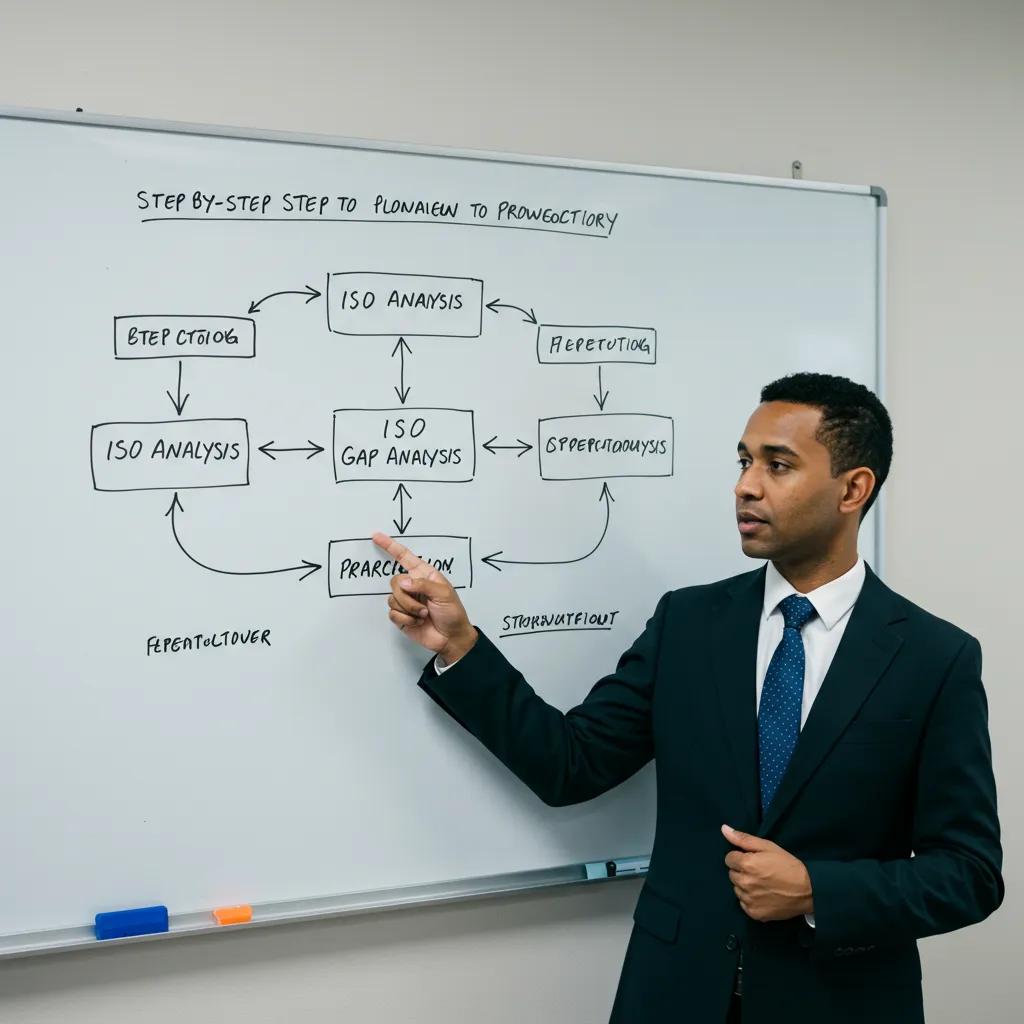
A structured, five-step gap analysis process guides your organisation from initial scoping to verified readiness. This process involves: defining the scope, assessing the current state, documenting identified gaps, reporting findings and creating an action plan, and finally, implementing and monitoring improvements. Each step yields concrete deliverables—a scope statement, an evidence log, a findings register, a remediation plan, and a verification checklist—which enable transparent tracking towards certification readiness. The process operates as a clear ‘how-to’ sequence where each deliverable has an assigned owner and an estimated completion time, allowing for realistic scheduling. Consistently applying this process ensures repeatable readiness outcomes across different standards and sites.
Step 1: How to Define the Scope and Objectives of Your Gap Analysis?
Clearly defining the scope ensures that the gap analysis covers the correct standard(s), sites, processes, and interfaces, while also setting measurable objectives for the readiness assessment. Your scoping checklist should identify the specific standards (e.g., ISO 9001, ISO 27001, ISO 42001), physical locations, business units, and critical processes that will be examined. Successful scoping also involves identifying key stakeholders and defining success criteria—what constitutes acceptable evidence and what thresholds trigger escalations. Precise scoping prevents scope creep and guarantees that the gap analysis effectively addresses the most relevant systems for your certification readiness.
Step 2: How to Assess Your Current State Against ISO Requirements?
The assessment phase combines document review, interviews, process observation, and risk reviews to validate whether controls are in place and functioning effectively in practice. Assessors should maintain a detailed evidence log that links each piece of evidence to the relevant clauses and notes whether the evidence is documentary, observational, or testimonial. Validating controls involves testing samples of records or conducting walkthroughs, rather than simply accepting policies at face value, thereby reducing the risk of evidence gaps during your certification audit. This thorough approach builds a robust and defensible findings register that both auditors and management can rely upon.
Step 3: How to Identify and Document Compliance Gaps?
Findings should be recorded using a clear format that includes a detailed description of the finding, a reference to the supporting evidence, the relevant clause mapping, a severity rating, and recommended remediation steps. Employing a standard finding template ensures consistency across different assessors and sites, and aids in prioritisation based on severity and business impact. Severity scoring converts qualitative observations into prioritised workstreams—typically categorised as critical, high, medium, and low—which guide immediate actions versus longer-term improvements. Well-documented findings accelerate the remediation process by providing owners with the exact evidence and clause that need to be addressed.
Before we move to the next step, here’s a quick overview: The following table clarifies the outputs, assigned owners, and estimated timeframes for each core step of our five-step gap analysis process.
| Step | Deliverable | Owner / Estimated time |
|---|---|---|
| Define scope | Scope statement and objectives | Compliance lead / 1–2 days |
| Assess current state | Evidence log and observations | Assessment team / 3–7 days |
| Document gaps | Findings register with severity | Lead auditor / 2–4 days |
| Report & action plan | Remediation plan and timelines | Project sponsor / 2–3 days |
| Implement & monitor | Verified closures and readiness check | Process owners / ongoing, 2–8 weeks |
This clear mapping of steps to deliverables helps in planning resources, setting realistic expectations for durations, and assigning clear ownership to maintain momentum towards certification readiness.
Step 4: How to Report Findings and Develop an Effective Action Plan?
An effective report includes an executive summary, detailed findings mapped to specific clauses, remediation actions with assigned owners and timelines, and clear verification criteria for closure. Communicating the report to senior management and process owners ensures accountability and the necessary allocation of resources for remediation tasks. The remediation plan should incorporate verification steps—specifying the evidence to be produced and the internal checks to be completed—so that closures are auditable. Clear reporting effectively converts assessment outputs into a projectised plan that aligns with business priorities and audit schedules.
Following Step 4, consider external support: Stratlne Certification Ltd. offers comprehensive ISO certification audit and related consultancy services designed to help you implement your action plan and prepare thoroughly for formal certification audits. Our model pairs dedicated account managers and experienced lead auditors to guide remediation prioritisation, cost estimation, and audit planning, which is particularly beneficial when internal resources are limited.
Step 5: How to Implement and Monitor Improvements for Certification Readiness?
Implementation governance establishes clear ownership, milestones, and KPIs to track remediation progress and verify that implemented controls effectively meet clause requirements. Monitoring involves scheduled status reviews, internal audits, and readiness checks that validate evidence and operational behaviour, not just paperwork. A pre-certification readiness checklist should confirm that all critical findings have been closed, evidence is readily accessible, and internal verification activities demonstrate sustained control. Continuous monitoring ensures that closures are robust, preventing the re-emergence of gaps during your certification audit.
Which ISO Standards Require Gap Analysis and How Do They Differ?
Gap analysis approaches are tailored to the specific focus of each standard. ISO 9001 prioritises process effectiveness and customer requirements, ISO 27001 centres on information risk management and controls, and ISO 42001 focuses on AI governance, transparency, and ethical controls. While the core methodology—mapping clauses to evidence—remains consistent, the types of evidence required and the way risks are framed differ significantly. For instance, ISO 27001 mandates a formal risk assessment and controls mapping (Annex A), whereas ISO 42001 requires governance artefacts that demonstrate oversight, performance monitoring, and ethical risk mitigation. Tailoring the scope to the specific standard ensures that reviewers employ the correct evidence types and assessment perspectives.
What Are the Unique Gap Analysis Considerations for ISO 9001 Quality Management?
For ISO 9001, gap analysis concentrates on process mapping, traceability of customer requirements, and evidence of performance monitoring against quality objectives. Assessors look for evidence of process controls, documented procedures, records of non-conformities and corrective actions, and management review outputs. The emphasis is on how processes consistently deliver customer requirements and how measurement and improvement mechanisms operate. Typical evidence includes process maps, work instructions, performance data, and records demonstrating continual improvement.
How Does ISO 27001 Gap Analysis Address Information Security Risks?
ISO 27001 gap analysis places a strong emphasis on the risk assessment process, treatment plans, and the mapping of controls—particularly those in Annex A—to identified assets and threats. Assessors expect to see a comprehensive asset inventory, a documented risk assessment methodology, evidence of implemented controls, access management procedures, and incident records. The gap analysis must verify that controls are proportionate to the identified risks and that the evidence demonstrates both policy intent and operational effectiveness. This risk-based approach ensures that remediation efforts directly address actual vulnerabilities and effectively protect information assets.
What Are the Key Elements of ISO 42001 AI Management System Gap Analysis?
ISO 42001 gap analysis focuses on AI governance, transparency, performance monitoring, and ethical risk management for AI systems, ensuring that management practices align with technical controls. Assessors look for clearly defined governance structures, established roles and responsibilities for AI lifecycle management, documentation of data governance practices, measures for bias mitigation, and frameworks for monitoring AI model performance. The evidence needs to demonstrate how decisions are made, how risks are assessed, and how stakeholders are informed about AI usage. This standard also encourages alignment with external regulatory frameworks that impact AI deployment.
How Does Gap Analysis Align with Emerging Regulations Like the European AI Act?
A gap analysis can effectively map ISO 42001 controls against regulatory requirements from frameworks like the European AI Act, identifying areas of potential regulatory non-compliance and prioritising remediation efforts. By cross-referencing ISO controls with specific regulatory obligations—such as transparency, risk classification, and data governance—organisations can prioritise actions that address both certification and legal compliance simultaneously. This alignment helps create a comprehensive compliance roadmap that reduces duplicated effort and focuses resources on the highest-impact tasks. Using gap analysis as the initial compliance discovery phase ensures that regulatory readiness is addressed systematically rather than reactively.
Before we continue, here’s a quick comparison: The table below compares the primary focus areas across three key standards and highlights the main gap analysis considerations for each.
| ISO Standard | Focus area | Gap analysis considerations |
|---|---|---|
| ISO 9001 | Quality Management and process effectiveness | Process mapping, customer requirement traceability, performance metrics |
| ISO 27001 | Information Security and risk management | Asset inventory, risk assessment, Annex A controls mapping |
| ISO 42001 | AI governance, ethics and transparency | Governance roles, data governance, bias mitigation, monitoring |
How to Conduct an ISO Gap Analysis: Practical Guidance and Best Practices
Practical guidance is key to ensuring efficient, consistent, and repeatable gap analyses that yield reliable readiness indicators. We recommend using standardised templates for evidence logs and findings, employing digital tools to centralise evidence and manage versions, and implementing a staged engagement plan that prioritises high-risk areas first. Engage stakeholders early to secure cooperation for interviews and evidence access, and maintain a dedicated issues register to track decisions and scope changes. These practices minimise friction and facilitate clear verification during internal or external audits.
What Tools and Checklists Are Essential for Effective Gap Analysis?
Essential tools for an effective gap analysis include a clause-to-evidence template, a comprehensive findings register, a secure evidence repository, and straightforward audit-tracking software to monitor remediation status. Digital evidence repositories make remote assessments practical by centralising documents and version history, while checklist templates ensure consistent coverage of all clauses and controls. Utilise a standard finding template to capture clause references, evidence links, and remediation steps, ensuring that workstreams are actionable. These tools significantly reduce administrative overhead and make the verification process straightforward.
Here are some recommended items:
- Clause-to-evidence checklist to ensure complete coverage.
- Findings register template for consistent and organised documentation.
- Digital evidence repository for secure, auditable storage of all relevant documents.
These tools enhance consistency and speed for both onsite and remote assessments, significantly easing your path toward formal certification.
How to Engage Stakeholders During the Gap Analysis Process?
Effective stakeholder engagement begins with clear communication about the scope and objectives, followed by scheduling interviews with process owners and management to gather evidence and confirm practices. Implement a stakeholder plan that clearly identifies responsibilities, expected inputs, and timelines for remediation tasks; this proactive approach minimises delays in evidence collection and implementation. Present interim findings to management to secure necessary resources for high-priority remediations and to validate the assessor’s interpretations. Ongoing communication fosters a sense of ownership for remediation actions and supports the adoption of sustainable changes in operational behaviour.
What Are Common Challenges and How to Overcome Them?
Common obstacles encountered during gap analyses include incomplete documentation, limited internal resources, and resistance to change from process owners who may perceive assessments as bureaucratic hurdles. Overcome these challenges by focusing on the highest-risk gaps first, using templates to standardise evidence collection, and assigning clear owners with short, achievable milestones. When documentation is sparse, combine interviews and observations with provisional remediation tasks that help create the necessary records. Address resistance by framing the gap analysis as a business improvement tool that actively reduces operational risk and enhances market opportunities.
- Typical challenge: Incomplete documentation.
- Recommended mitigation: Utilise interviews and observations to create provisional evidence and assign specific documentation tasks.
- Typical challenge: Resource constraints.
- Recommended mitigation: Prioritise critical findings and stagger remediation work into manageable sprints.
These strategies ensure that progress continues even when faced with constraints, maintaining essential momentum towards certification readiness.
How to Prepare for Remote Auditing and Digital Gap Assessments?
Remote assessments necessitate secure document sharing capabilities, carefully scheduled virtual interviews, and clearly defined protocols for evidence submission and version control. Employ encrypted repositories and role-based access controls to protect sensitive information while enabling assessors to review materials remotely. Plan virtual walkthroughs with process owners to demonstrate controls in operation, supplementing these with time-stamped records or screen captures where appropriate. Thorough scheduling and pre-briefing of participants minimise delays and enhance the quality of remote evidence, making remote gap analysis an effective alternative to full onsite reviews when required.
Why Choose Stratlne Certification Ltd. for Your ISO Gap Analysis?
Stratlne Certification Ltd. distinguishes itself as an innovative certification body that harnesses the power of AI and the deep expertise of seasoned industry professionals to audit organisations globally. We offer accredited certifications and provide tailored support specifically for SMEs. Our offering highlights AI-assisted assessments for consistent clause mapping, local audit teams for nuanced contextual judgment, and dedicated account managers to guide organisations through remediation and cost estimation. For organisations seeking both assessment and certification services, Stratlne provides accredited ISO certification services, including ISO 9001 (Quality Management Systems), ISO 27001 (Information Security Management Systems), and ISO 42001 (Artificial Intelligence Management Systems). This integrated approach facilitates a seamless transition from gap analysis findings to fully certification-ready systems.
How Does Stratlne Use AI and Expert Auditors to Deliver Accurate Gap Analysis?
Stratlne’s distinctive approach pairs advanced AI tools, which assist with clause mapping and evidence tagging, with lead auditors who apply critical contextual judgment to assessment findings. This synergy ensures both exceptional efficiency and high accuracy. The AI component standardises the initial mapping process and highlights likely areas of coverage, while our experienced auditors meticulously assess the relevance and sufficiency of evidence within the specific organisational context. This hybrid model significantly improves consistency across multiple sites and languages, enabling scalable delivery without compromising specialist insight. The outcome is a pragmatic, prioritised findings register that effectively guides targeted remediation efforts.
What Support Does Stratlne Offer SMEs for ISO Certification Readiness?
Stratlne provides tailored SME programmes featuring dedicated account managers and lead auditors who offer practical guidance on prioritisation, action planning, and cost estimation for achieving certification readiness. These SME-focused services are designed to address resource constraints by creating phased remediation plans and concentrating on the most impactful controls first. Account managers serve as single points of contact to coordinate assessments, clarify scope, and assist with audit planning. This specialised SME support significantly reduces the administrative burden on smaller teams and enhances the likelihood of successful certification outcomes.
How Can You Request a Quote or Book an ISO Gap Analysis Audit with Stratlne?
When you’re ready to request a quote or book an ISO gap analysis audit, please have key information readily available: the standard(s) you intend to assess, the number of sites or business units within scope, and the primary processes to be reviewed. Stratlne’s process typically commences with a detailed scoping discussion to clarify your objectives and subsequently produce a tailored proposal and timeline, supported by your assigned account manager and lead auditor to guide the next steps. Providing these scope details upfront expedites proposal turnaround and enables Stratlne to estimate resources and costs more accurately. You can then decide whether to proceed with the gap analysis independently or include our follow-on certification audit services.
Frequently Asked Questions
What is the difference between a gap analysis and a pre-certification audit?
A gap analysis is a proactive assessment designed to identify compliance gaps between your organisation’s current practices and the requirements of a specific ISO standard. Its primary focus is uncovering areas for improvement before a formal audit. In contrast, a pre-certification audit is a more formal evaluation conducted by an external auditor to determine your organisation’s readiness for certification. While both processes aim to ensure compliance, the gap analysis is typically an internal preparatory exercise, whereas the pre-certification audit is an official review of your readiness.
How often should an organisation conduct an ISO gap analysis?
The frequency of conducting an ISO gap analysis depends on several factors, including changes in regulations, updates to ISO standards, and significant organisational shifts. Generally, it’s advisable to perform a gap analysis annually or whenever substantial changes occur, such as the introduction of new processes, technologies, or management systems. Furthermore, conducting a gap analysis before a scheduled certification audit is highly recommended to ensure your organisation is adequately prepared and compliant with the relevant ISO standards.
Can a gap analysis be conducted remotely?
Absolutely, a gap analysis can be effectively conducted remotely, particularly with the utilisation of digital tools and secure document-sharing platforms. Remote assessments typically involve virtual interviews, online document reviews, and digital evidence collection. While remote gap analyses can be highly effective, it’s crucial to ensure all stakeholders are actively engaged and that the necessary evidence is readily accessible. Proper planning and clear communication are paramount to mitigating any challenges that might arise during remote assessments.
What role do employees play in the gap analysis process?
Employees play an absolutely critical role in the gap analysis process, as they provide invaluable insights into current practices and operational realities. Their involvement is essential during stakeholder interviews, process walkthroughs, and evidence collection. Engaging employees fosters a strong sense of ownership and accountability for compliance efforts. Additionally, their feedback is instrumental in identifying practical challenges and areas for improvement, ensuring that the gap analysis accurately reflects the organisation’s operational landscape.
What are the common pitfalls to avoid during a gap analysis?
Common pitfalls to avoid during a gap analysis include inadequate scoping, insufficient stakeholder engagement, and poor documentation practices. Failing to define the scope clearly can lead to missed areas of assessment. Not involving key stakeholders may result in incomplete evidence and a lack of buy-in for necessary remediation efforts. Furthermore, neglecting to document findings consistently can significantly hinder the effectiveness of the analysis. To avoid these pitfalls, organisations should establish clear objectives, actively engage relevant personnel, and consistently use standardised templates for documentation.
How can organisations ensure continuous improvement after a gap analysis?
To ensure continuous improvement following a gap analysis, organisations should integrate the findings into their management review processes and cultivate a culture of ongoing compliance. This involves regularly monitoring the implementation of remediation actions, conducting follow-up assessments, and updating policies and procedures as needed. Additionally, organisations should actively encourage feedback from employees and stakeholders to identify new areas for improvement. By embedding compliance into daily operations and fostering a proactive approach, organisations can maintain certification readiness and enhance overall performance.
What Is an ISO Gap Analysis in Simple Terms?
An ISO gap analysis is essentially a structured review that identifies precisely where your current management system falls short of a chosen ISO standard’s requirements and what specific changes are needed. It produces a clear findings register and a practical remediation plan, enabling you to address issues effectively before your formal certification audit. The ultimate goal is straightforward: reduce audit risk, allocate resources efficiently, and create a clear, achievable path to certification readiness. This initial discovery phase transforms uncertainty into a series of actionable tasks.
What Are the 5 Key Steps of an ISO Gap Analysis Process?
The five key steps of a gap analysis provide a repeatable and reliable framework, guiding you from initial scoping to verified readiness:
- Define the scope and objectives of your assessment.
- Assess your current state through document review, interviews, and observations.
- Identify and meticulously document compliance gaps, assigning severity ratings.
- Report your findings and develop a comprehensive remediation action plan.
- Implement the necessary improvements and monitor verification for readiness.
These structured steps effectively convert assessment results into a tracked programme of work that strongly supports your certification journey.
How Does Gap Analysis Benefit Small and Medium-Sized Businesses?
For SMEs, a gap analysis is invaluable for prioritising the most impactful improvements, minimising wasteful effort, and significantly increasing the likelihood of passing certification audits on the first attempt. It helps smaller teams focus their limited resources on critical controls and establishes a phased remediation plan that aligns with their business capacity. By clearly outlining what is required for accredited certification, SMEs can plan investments strategically, secure stakeholder buy-in, and leverage certification as a powerful market differentiator. Tailored SME programmes further reduce administrative overhead, making the process more manageable.
How Do You Measure ISO Certification Readiness After Gap Analysis?
Measure your ISO certification readiness by assessing a combination of factors: the percentage of gaps closed, the availability and quality of evidence, the results of internal audits, and confirmations from management reviews. Key indicators include the proportion of critical and high-priority findings that have been closed, the accessibility of evidence in a central repository, successful internal verification activities, and completed corrective action evidence. A final pre-certification internal audit, which simulates the actual certification audit, provides the most practical check on your readiness. These metrics establish objective criteria for confidently scheduling your formal certification audit.
What Is the Typical Cost and Timeline for an ISO Gap Analysis?
The cost and timeline for an ISO gap analysis are influenced by several factors, including the complexity of the scope, the number of sites involved, the specific standard selected, and the maturity of your existing documentation and controls. Broader scopes and multiple sites naturally increase the time and resource requirements. Small, single-site gap analyses can often be completed within days, whereas multi-site or multi-standard assessments may take several weeks, especially when factoring in evidence collection and stakeholder availability. To obtain an accurate estimate, please provide a clear scope and your expectations so we can produce a tailored proposal. For organisations seeking implementation support or audit booking, Stratlne Certification Ltd. offers comprehensive ISO certification audit and related consultancy services to help you plan timelines and estimate costs effectively.
This article has provided a comprehensive overview of what an ISO gap analysis entails, why it’s critically important, the step-by-step process involved, comparative considerations for ISO 9001, ISO 27001, and ISO 42001, practical tools and stakeholder guidance, and how Stratlne Certification Ltd. can support your organisation with accredited certification services and specialised SME-focused programmes.
An ISO Gap Analysis Tool for Compliance and Process Assessment
The combination of conformity and process assessment is attracting increasing interest from business organisations, and the field of IT Service Management (ITSM) is no exception to this trend. We have designed a Gap Analysis tool that enables the translation of identified requirement gaps into a process perspective. The tool is based on the process map from the Process Assessment Model (PAM), which is built on the same set of requirements to provide the process view. Consequently, it establishes correlations and offers interesting complementarities with the related PAM. The Proof of Concept presented in this paper validates the design of such a tool. It paves the way for its application within the IT Service Management field and, in particular, its integration into Tudor’s current IT Process Assessment (TIPA) framework.
Measuring readiness for compliance: A gap analysis tool to complete the TIPA process assessment framework, M Picard, 2016
Conclusion
Undertaking an ISO gap analysis is fundamental for organisations aiming to achieve certification readiness by pinpointing compliance gaps and strategically prioritising remediation efforts. This proactive approach not only mitigates audit risks but also effectively aligns management systems with strategic business objectives, thereby enhancing overall operational efficiency. By leveraging expert guidance and tailored support, organisations can confidently navigate the complexities of certification. Begin your journey towards ISO certification today by exploring our comprehensive services at Stratlne Certification Ltd.