
Mastering External Auditing: Essential Preparation Tips

ISO audit preparation — UK guide: Practical steps to get ready for external audits
External audits are independent checks that confirm whether a management system meets an ISO standard. Outcomes range from initial certification through surveillance findings to recertification decisions. Preparing properly lowers organisational risk, speeds up your certification timeline and improves the chance of a clean auditor report. This guide gives clear, practical steps for preparing for external audits across ISO 9001 (quality), ISO 27001 (information security) and ISO 42001 (AI management). It is written for UK organisations and SMEs that want a straightforward, actionable readiness plan. Stratlane Certification Ltd. delivers accredited certification audits and practical support — the advice here stays focused on evidence-based preparation so you can apply it straight away. Read on for a structured roadmap: what an external audit involves, the core certification steps, standard-specific checklists, what to expect on audit day and how to manage follow-up actions.
What is an external audit, and why does preparation matter?
An external audit is a formal assessment carried out by an independent certification body to check compliance with a named ISO standard and to confirm that documented processes are actually followed. Auditors review evidence — policies, procedures, records and sampled practices — and assess conformity against the standard’s clauses or controls. Good preparation reduces the number and severity of non-conformities, shortens audit time and helps protect contractual or regulatory obligations. It also clarifies internal responsibilities and creates clear evidence trails, which improves day-to-day performance and supports market access or tender requirements.
How does an external audit affect your regulatory and commercial compliance?
An external audit offers independent assurance that your system meets customer, contractual and legal expectations, so audit outcomes can directly affect market access and compliance status. If auditors raise non-conformities, you may face remedial deadlines or temporary procurement restrictions until actions are verified, which makes proactive readiness critical. Audit findings also feed into governance: management review and continual improvement activities must address root causes and resource needs. Seeing the audit as a demonstration of risk management — not a one-off event — helps you prioritise evidence collection and control operation.
What benefits come from preparing well for an ISO external audit?
Thorough preparation pays dividends beyond certification. It reduces audit time and cost by cutting down on clarifications, lowers the number and severity of findings, and smooths surveillance cycles through embedded continual improvement. Preparation also sharpens processes — fewer interruptions, clearer accountabilities — which builds customer confidence and strengthens tender bids. In short, audit readiness becomes a practical improvement exercise for the whole organisation.
- Preparing for an ISO external audit delivers these benefits:
- Stronger compliance and reduced regulatory risk through verified controls and documented evidence.
- Operational efficiency and cost savings from clearer processes, fewer disruptions and shorter audits.
- Greater customer confidence and improved tender competitiveness because independent certification demonstrates assurance.
With this benefits-first perspective in mind, the next section sets out the core certification steps and how to resource readiness work.
Core steps in the ISO certification audit process
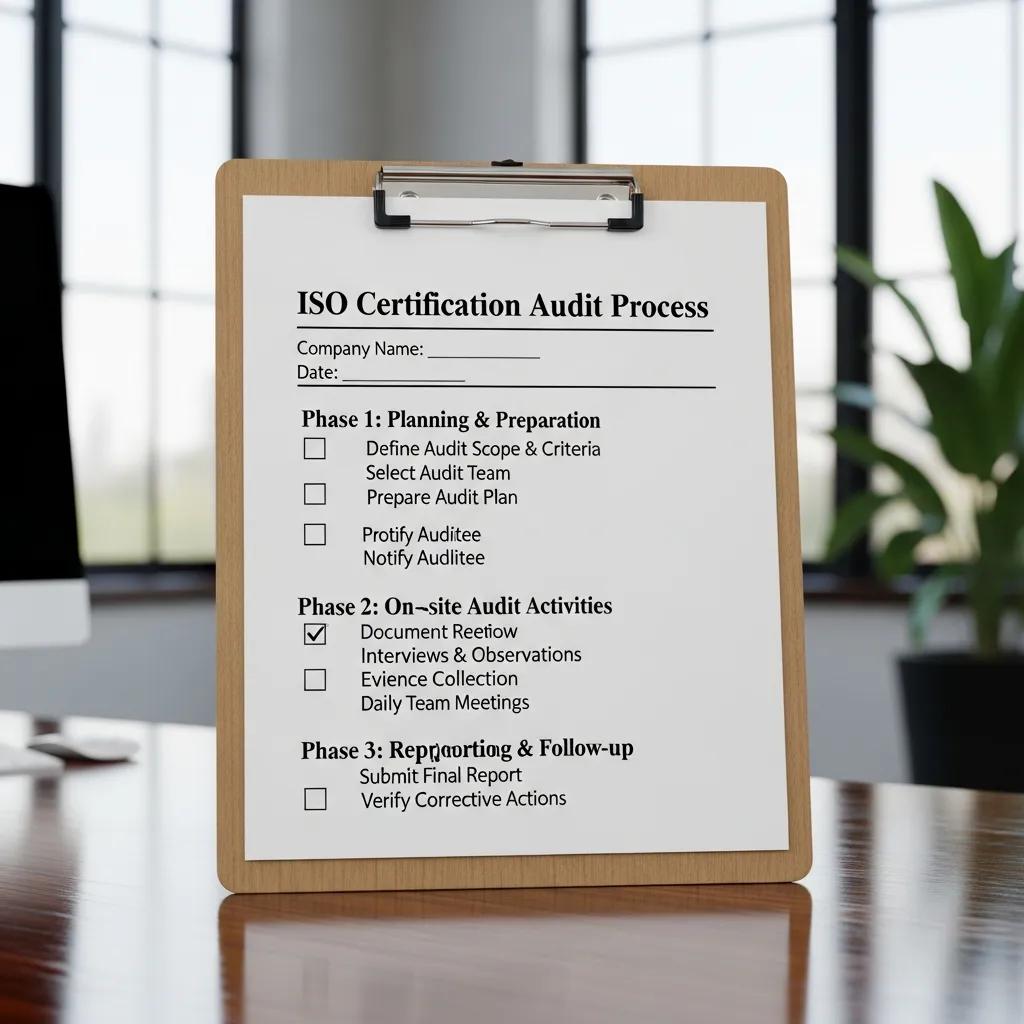
The certification process follows a clear sequence from readiness assessment to ongoing surveillance. Each phase has a specific purpose, expected evidence and a typical duration. Core activities include a gap analysis, remediation planning, internal audits and management review, Stage 1 (document review) and Stage 2 (on-site or remote assessment), followed by the certification decision and periodic surveillance checks. Preparing per milestone ensures auditors find coherent evidence instead of scattered records, which supports a quicker certification decision and fewer findings. Use the checklist below to plan readiness tasks.
- Step 1: Gap analysis — Compare current practice against the standard’s clauses or controls and record where you fall short.
- Step 2: Remediation planning — Prioritise corrective actions, assign owners and set realistic deadlines.
- Step 3: Internal audits and management review — Test controls in practice, log non-conformities and confirm top management commitment.
- Step 4: Stage 1 document review — Submit core documentation for the auditor to check and answer any clarifications.
- Step 5: Stage 2 assessment — Facilitate evidence collection and on-site verification of implemented controls.
- Step 6: Certification decision and surveillance — Receive the outcome and schedule periodic surveillance audits to maintain certification.
This approach makes roles and resources clear so remediation is completed before external verification.
Before Stage 1 some teams find a compact comparison table helpful. The table below summarises each phase and the typical evidence auditors expect, to help allocate responsibilities.
This comparison helps teams collect the right evidence before inviting external assessment. For SMEs wanting extra help, Stratlane Certification Ltd. provides tailored audit plans and quotation support to accelerate readiness with targeted resourcing and scheduling advice.
How to run a gap analysis for ISO audit readiness
A gap analysis maps your current processes and evidence against the relevant ISO clauses or Annex controls to highlight compliance shortfalls and prioritise fixes. Start by defining the management system scope and boundaries, then complete a clause-by-clause checklist to score conformity and note the evidence needed; scoring can be binary or weighted by risk. Convert findings into a prioritised remediation plan with owners, deadlines and verification tests so actions are auditable. For example, a small IT service provider might prioritise access control and incident records for ISO 27001 while scheduling lower-risk document updates later.
This structured method gives a clear path from diagnosis to verification and frames internal audits that will test whether remediation is effective before the external assessment.
Documentation required for ISO 9001, ISO 27001 and ISO 42001 audits
Documentation varies by standard but shares common building blocks — scope, policies, procedures, records and evidence of monitoring and review — that auditors expect to trace back to operational practice. The table below maps each standard to the mandatory and recommended documents, giving SMEs a compact checklist for document collection.
This documentation map helps teams divide drafting and evidence collection tasks so documents clearly link to operational records and control performance that auditors will sample during Stage 2.
Preparing for ISO 9001: Quality Management System readiness
A focused ISO 9001 readiness programme makes sure your Quality Management System (QMS) meets the standard’s clauses on context, leadership, planning, operation, performance evaluation and improvement. Start with a concise scope, a clear quality policy and measurable objectives tied to process-level records — these are the backbone of auditor enquiries. Use simple process flows and practical record-keeping so evidence is easy to find and shows controls working in practice. Schedule internal audits that sample representative processes rather than attempting exhaustive coverage. Align performance indicators with objectives in management review to demonstrate top-management oversight and continual improvement.
Keeping processes simple and evidence traceable reduces the audit burden and makes the external review a verification of effective operations rather than a paperwork exercise.
ISO 9001 audit preparation steps for SMEs
SMEs should be pragmatic: set a manageable QMS scope, document only essential processes, keep records lean and run targeted internal audits that mirror external sampling. A practical SME checklist includes a concise quality policy, mapped customer-facing processes, defined performance indicators, a small set of core procedures and three to six months of key records for sampling. Assign process owners, schedule internal audits and ensure management review minutes reflect performance and improvement priorities. Timeframes typically range from a few weeks for document preparation to several months for corrective implementations, depending on the scope of remedial work.
This prioritised approach helps SMEs demonstrate conformity quickly while building a QMS that scales with the business.
Internal audits and staff training for ISO 9001

Internal audits check that processes run as documented and reveal issues before the external assessment; staff training ensures people are confident and can present evidence during interviews. Create an internal audit schedule that samples processes across the scope, use checklist-based audits to standardise findings and record evidence with clear links to procedures and records. Training should cover roles and responsibilities, key steps in processes and how to present evidence to auditors; short, role-based briefings work well for SMEs. Feed internal audit findings into corrective action plans and use management review to confirm closure before Stage 1 and Stage 2.
Both internal and external quality audits, together with robust non‑conformance management, are essential to achieve and sustain ISO 9001 certification.
ISO 9001 external audit & certification: QMS and non‑conformance
This paper outlines internal and external quality audit procedures under ISO 9001 and explains how regular audits and effective non‑conformance handling support a functioning Quality Management System. Routine quality audits — carried out by internal teams or external auditors — help organisations identify weaknesses, act on corrective measures and reduce recurring errors. Clear audit routines, timely corrective actions and documented follow‑up improve customer satisfaction and support organisational growth.
This mapping shows what auditors expect and how to present documents consistently.
Preparing for ISO 27001: ISMS readiness
ISO 27001 readiness centres on defining an ISMS scope, identifying assets, running a risk assessment and applying Annex A controls proportionate to risk. Ensure the ISMS scope reflects your business processes and asset boundaries so auditors can sample sensibly and scope choices are defensible. Key evidence items include the risk register, treatment plan and Statement of Applicability — auditors will expect clear traceability from identified risks to selected controls. Prioritise controls that address the highest risks and keep configuration records, access logs and incident response evidence available for sampling.
A disciplined risk-to-control workflow shows auditors that information security is managed systematically — the central expectation for ISO 27001 assessments.
The role of risk assessment in ISO 27001 audit preparation
Risk assessment identifies assets and threats, analyses likelihood and impact, and prioritises treatment actions that justify the controls recorded in the Statement of Applicability. A practical workflow includes asset identification, threat/vulnerability mapping, risk scoring, control selection and documenting residual risk after treatment. Provide auditors with a dated risk register showing owners and treatment status so they can verify decisions. For SMEs, quick wins such as multi‑factor authentication and regular account reviews for critical admin accounts address high‑probability, high‑impact risks early.
Present your risk assessment as a reproducible process with owners and verification steps to help auditors confirm deliberate, documented security decisions.
Which Annex A controls are commonly sampled by auditors?
Auditors frequently sample Annex A controls that protect core outcomes: access control, asset management, cryptography, physical security and incident management. For each control, provide demonstrable evidence such as access control lists, an asset inventory, encryption policy excerpts, physical access logs and incident response records. Prioritise controls by residual risk and apply proportionate measures for smaller organisations — for example, role‑based access and documented backup procedures. Auditors look for both policy‑level decisions and operational records showing controls are working.
Focusing on a short list of high‑impact controls with clear operational evidence helps SMEs defend their most valuable assets effectively.
Use this table to link controls to auditable evidence and to plan what to collect before Stage 2.
Preparing for ISO 42001: AI management system compliance
ISO 42001 readiness requires an AI management system covering governance, lifecycle controls, documentation and transparency so AI systems are developed and deployed responsibly. Core elements include an AI policy, a governance structure with defined roles, lifecycle risk assessments, validation and monitoring procedures, and records that support explainability and accountability. Integrate testing and evaluation evidence into model development pipelines and document decisions about data sets, performance thresholds and human oversight. Linking these practices to risk assessments and governance minutes provides auditors a clear trail from policy to tested outcomes.
Because AI risks can relate to model performance and potential harm, auditors expect evidence that governance decisions are operationalised and that monitoring detects drift or unexpected behaviour.
Steps to implement AI governance for ISO 42001
Begin with an AI policy and a governance body that defines roles, responsibilities and acceptance criteria. Carry out system‑specific AI risk assessments, set testing and validation plans, document data lineage and label provenance, and put monitoring and incident response in place for deployed models. Create templates for decision logs and validation reports so evidence is consistent and traceable, and run regular performance audits and reviews. For SMEs, apply proportionate governance: focus detailed controls on high‑risk systems and use lighter controls where risks are lower.
A phased rollout from policy to verified monitoring lets you demonstrate an auditable AI lifecycle during an external assessment.
How ISO 42001 maps to the European AI Act
ISO 42001 and the European AI Act share aims around risk management, transparency and accountability. The AI Act sets legal obligations for certain high‑risk systems; ISO 42001 offers a management‑system framework to operationalise those obligations. Mapping ISO clauses to AI Act requirements highlights where risk assessments, governance records and transparency measures satisfy legal expectations and where additional regulatory filings or conformity assessments may be needed. Using ISO 42001 to structure governance creates artefacts that feed into AI Act compliance workflows, reducing duplicated work and easing evidence requests from regulators or auditors.
A clear compliance map helps management system records serve both certification and regulatory needs.
This table illustrates the artefacts auditors will expect when assessing AI management system readiness against ISO 42001.
What to expect on audit day and how to manage post‑audit actions
Audit day usually follows a predictable pattern: Stage 1 focuses on documentation and readiness, Stage 2 verifies implementation by sampling and observation, and post‑audit work centres on closing non‑conformities through root cause analysis and corrective actions. Auditors will interview staff, review records and observe processes — being organised, presenting clear evidence and assigning knowledgeable process owners for interviews reduces friction. If non‑conformities arise, classify them by severity, run root cause analysis, produce corrective actions with owners and verification steps, and record closure evidence for the auditor’s follow‑up. Good post‑audit handling ties corrective actions into management review and continual improvement so your organisation benefits from the audit rather than just fixing isolated issues.
- Typical auditor activities on the day include:
- Reviewing documents and cross‑referencing procedures with records.
- Interviewing process owners and sampled staff.
- Observing controls in operation and sampling records.
- Compiling findings and holding a closing meeting to outline any non‑conformities.
These steps flow into the post‑audit phase where structured remediation and verification close the compliance loop.
What happens during Stage 1 and Stage 2 of an external ISO audit?
Stage 1 (document review) checks that required documentation exists and that the organisation understands its scope and key processes; auditors typically review policies, scope statements, risk registers and Statements of Applicability where relevant. Stage 2 is the substantive assessment: auditors sample processes, interview staff and examine records to confirm the system is implemented and effective. Duration depends on size and complexity — Stage 1 may take a day or two (often remote), while Stage 2 can span multiple days for larger or multi‑site organisations. Deliverables include a report with observations, any non‑conformities and recommended corrective actions and, if all is satisfactory, a certification decision.
Being ready with clear evidence trails and scheduling knowledgeable staff for interviews reduces audit time and improves outcomes.
How to address non‑conformities and embed continuous improvement
Start by triaging findings: classify the non‑conformity, assess its impact and assign an owner to lead root cause analysis and corrective actions with defined verification steps. Use a standard corrective action template to capture root cause, actions, dates and evidence required for verification; ensure management review signs off closure evidence. After verification, update processes and training so the issue does not recur and record lessons learned in an improvement register. Link corrective cycles to performance indicators and management review so audit results feed organisational learning rather than being one‑off fixes.
- Recommended post‑audit improvement steps:
- Classify the non‑conformity and assign an owner accountable for root cause analysis.
- Implement corrective actions with clear verification steps and evidence requirements.
- Verify effectiveness through targeted internal audits and update management review records.
- Capture lessons learned to prevent recurrence and inform continual improvement plans.
Following these steps helps strengthen the management system and reduces the chance of the same findings appearing at surveillance.
Frequently asked questions
What is the difference between Stage 1 and Stage 2 audits?
Stage 1 focuses on documentation: the auditor confirms that policies, procedures and records exist and that the organisation understands its scope. It is often remote and may last one to two days. Stage 2 is the on‑site (or remote) assessment where auditors sample processes, interview staff and observe operations to verify the documented system is implemented effectively. Stage 2 normally takes longer, depending on complexity and number of sites.
How can organisations ensure staff are prepared for the audit?
Prepare staff with short, role‑based briefings that explain responsibilities, key process steps and how to present evidence during interviews. Run mock interviews or internal audits to build familiarity and confidence. Clear communication about the audit purpose and what will be expected helps staff perform well on the day.
What are common non‑conformities found during ISO audits?
Common findings include incomplete documentation, lack of evidence that procedures are followed, insufficient risk assessments, incomplete training records and weak management review practices. Regular internal reviews and keeping records up to date reduce the risk of these common issues.
How often should internal audits be conducted before an external audit?
Internal audits should be scheduled at least annually, but frequency should reflect your organisation’s size, complexity and past audit results. For organisations approaching an external audit, run internal audits nearer the audit date to identify and correct issues in time for verification.
What role does management review play in audit preparation?
Management review is vital: it shows top management is engaged and provides evidence of oversight over the management system. Reviews cover performance indicators, audit findings and improvement priorities, supporting resource decisions and corrective actions — all of which auditors expect to see.
How can organisations maintain compliance after receiving ISO certification?
Maintain compliance through ongoing monitoring: conduct regular internal audits, management reviews and surveillance activities required by your certification body. Keep abreast of standard updates and embed continual improvement based on audit findings and performance metrics. Regular training and staff engagement help sustain a culture of compliance.
What should organisations do if they receive a non‑conformity report?
Classify the finding by severity, assign a responsible person to investigate root cause, and develop a corrective action plan with clear steps, deadlines and verification methods. Document the entire process, obtain management review endorsement of closure evidence and update processes and training to prevent recurrence. Capture lessons learned for future improvement.
Conclusion
Careful preparation for an ISO external audit improves compliance and strengthens operational performance and customer confidence. By following a structured approach and keeping documentation clear and traceable, organisations can reduce the risk of non‑conformities and make the audit process smoother. Treat audit readiness as a strategic opportunity for continual improvement. Start your certification journey with our practical audit preparation resources and targeted support.