
Mastering GDPR: A Clear Guide to Data Protection Regulations

Navigating UK Data Protection: Compliance and ISO Certification
UK data protection law defines how organisations must collect, store and process personal data — and it has real consequences for commercial risk, fines and customer trust. This guide lays out the core duties under UK GDPR and the Data Protection Act 2018, explains how recognised management standards such as ISO 27001 and ISO 42001 help turn legal obligations into auditable controls, and offers practical steps that businesses — especially SMEs — can use to evidence strong information governance. Many organisations struggle with lawful bases, data subject rights and appropriate technical and organisational measures; a standards-led Information Security Management System or AI management system translates those requirements into repeatable processes you can show to auditors and customers. We cover the seven GDPR principles, UK-specific DPA points and ICO enforcement, then map ISO controls to data protection duties and look at AI governance via ISO 42001. Finally, we outline SME-friendly actions and explain how Stratlane Certification Ltd. helps organisations pursue ISO certification and compliance verification.
What Are the Key Principles of UK GDPR Compliance for Businesses?
UK GDPR sets out core principles that shape lawful, accountable processing of personal data — in short, they explain why privacy must be designed into everyday operations. When policies and technical controls align to these principles, organisations reduce unlawful processing, cut incident risk and limit regulatory exposure. Following the principles also simplifies audits and strengthens customer confidence, which can help in procurement and insurance conversations. Below we list the seven principles and show how each translates into practical actions for your organisation.
The seven principles sit at the heart of GDPR and reflect the broader European effort to harmonise data protection standards.
GDPR 2018: EU Data Protection Rules for Businesses
From May 2018 the General Data Protection Regulation created a single, strengthened set of data protection rules for organisations operating across the EU. The reform gave people more control over their personal data and placed clearer obligations on businesses, replacing the older Directive 95/46/EC.
2018 reform of eu data protection rules, R Viorescu, 2018
What Are the Seven Core Principles of UK GDPR?
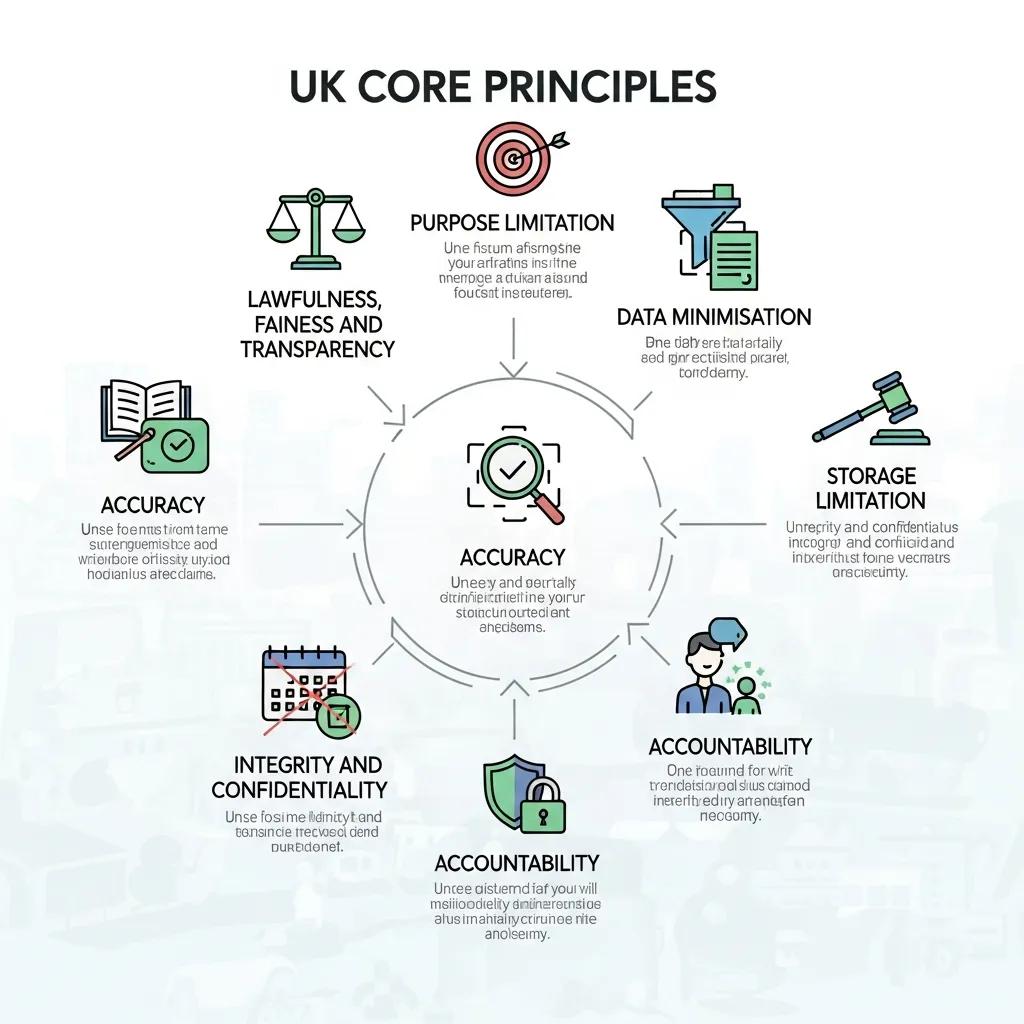
The seven principles form the legal baseline for compliant processing and set expectations for demonstrable accountability. Each principle implies specific records, policies or controls you should be able to produce during an audit. Below is a concise list with business-focused definitions designed for clarity.
- Lawfulness, fairness and transparency: You must have a valid legal basis for processing, treat people fairly and explain processing clearly in privacy information.
- Purpose limitation: Collect data only for specified, legitimate purposes and avoid incompatible reuse.
- Data minimisation: Only capture and keep the personal data you actually need for the stated purpose.
- Accuracy: Take reasonable steps to keep personal data accurate and up to date.
- Storage limitation: Retain data only as long as necessary, then delete or anonymise it securely.
- Integrity and confidentiality: Apply suitable technical and organisational measures to protect data from unauthorised access or loss.
- Accountability: Be able to show how you comply — through records, DPIAs and governance arrangements.
These principles guide risk registers, retention schedules and access control rules; applying them consistently prepares you for handling data subject requests and regulatory scrutiny.
How Do Data Subject Rights Impact Business Obligations?
Data subject rights mean businesses must put reliable processes in place to handle requests within statutory timeframes. Rights such as access, rectification, erasure and portability require searchable inventories, verification steps and workflows to make changes. Practically, this means logged request handling, named handlers (or an outsourced DPO), and integration with incident or change management so replies are timely and auditable. Useful measures include a standard request form, SLAs aligned to legal deadlines, and a clear audit trail of decisions — all of which strengthen ISMS evidence during audits.
How Does the Data Protection Act 2018 Complement UK GDPR?
The Data Protection Act 2018 (DPA 2018) provides UK-specific detail that works with UK GDPR to govern processing, enforcement and certain exemptions. It adapts GDPR principles into UK law, clarifies criminal and law-enforcement processing, and sets rules for areas such as national security, research and employment data. Knowing these UK-specific provisions helps you apply exemptions correctly and create defensible records for auditors and regulators. Key DPA 2018 points to consider when building your compliance programme are below.
- Exemptions and derogations: The DPA defines where rights may be limited for law enforcement, national security or parliamentary privilege.
- Criminal offence provisions: Some unlawful data handling can trigger criminal liability in addition to administrative fines.
- Law enforcement and national security processing: Separate safeguards apply to this type of processing compared with civil contexts.
- Age and parental consent rules: The Act clarifies age thresholds and consent rules for online services and minors.
These UK-specific rules affect risk assessments, contractual clauses and data-sharing arrangements — and they point to the ICO as the practical source of guidance and enforcement.
What Specific Provisions Does the Data Protection Act 2018 Include?
The DPA 2018 contains several targeted provisions that change how GDPR operates in the UK. Examples include exemptions for journalism and certain research in the public interest, extra safeguards for criminal-offence data, and specific rules for automated decision-making in sensitive contexts. Businesses should map these provisions to their processing activities to identify where legal advice or extra controls are needed. Implementing DPA-aware policies typically means updating retention schedules, amending contract clauses and adding DPIA controls for higher-risk processing.
What Is the Role of the Information Commissioner’s Office in Enforcement?
The Information Commissioner’s Office (ICO) is the UK regulator: it investigates breaches, issues fines and publishes guidance. The ICO’s enforcement options range from advisory notices to monetary penalties and undertakings. Investigations usually start from breach reports, complaints or audit findings. To reduce enforcement risk, maintain an incident response plan, report breaches promptly and keep records showing the steps you took to comply. Following ICO guidance and carrying out DPIAs for high-risk projects lowers the chance of escalated enforcement and improves audit readiness.
How Can ISO 27001 Certification Enhance Information Security Management?
ISO 27001 sets out an Information Security Management System (ISMS) framework that brings together policies, risk assessment, controls and continual improvement to protect information and personal data. Implementing ISO 27001 helps organisations convert legal obligations like UK GDPR and the DPA into auditable controls and repeatable processes. The main benefits are a stronger security posture, demonstrable compliance and a risk-based approach to prioritising resources — all of which reduce breach likelihood and simplify regulator engagement. Below we summarise the requirements and benefits, then map common ISO controls to GDPR duties.
ISO 27001 drives three practical outcomes for data protection:
- Better security controls: A defined set of technical and organisational measures reduces unauthorised access and data loss.
- Clear evidence of compliance: Policies, records and audit trails demonstrate obligations are being met to customers and regulators.
- Risk-based management: Ongoing risk assessment and treatment focus effort where it matters most.
Next is a simple mapping that shows how specific controls support GDPR requirements.
This mapping clarifies how ISO controls deliver evidence for GDPR compliance; the following section covers key ISO 27001 requirements and the benefits they bring.
What Are the Requirements and Benefits of ISO 27001 for Data Protection?
ISO 27001 asks for leadership commitment, a defined scope, risk assessment and treatment, an Annex A control inventory and a continual improvement cycle supported by monitoring and internal audits. These elements make sure organisations assess processing risks, apply proportionate controls and keep evidence current — the things regulators expect to see. Benefits include stronger customer confidence, better positioning in procurement and often improved insurance discussions because you can show structured protection. Practical examples are role-based access to personal data, encrypted backups and supplier clauses that require processors to meet security standards.
How Does ISO 27001 Support Risk Management and Data Breach Prevention?
ISO 27001 embeds a lifecycle for risk: identify assets and threats, assess likelihood and impact, select controls, monitor effectiveness and update treatments. That cycle reduces breach probability by prioritising controls for high-risk scenarios such as credential compromise, unpatched systems or weak supplier practices. Controls like multi-factor authentication, secure configuration and logging help defend common attack vectors, while a defined incident response process speeds containment and notification. Tying the ISMS to business continuity and disaster recovery ensures you can restore services and meet regulatory reporting timelines if an incident happens.
What Is ISO 42001 and Its Role in AI Data Privacy Regulations in the UK?
ISO 42001 sets management-system requirements for Artificial Intelligence Management Systems (AIMS), focusing on governance, risk assessment and ethical safeguards across the AI lifecycle. The standard helps organisations manage AI-specific risks that touch personal data — for example discrimination, opaque decision-making and unintended profiling. By embedding governance structures and impact-assessment processes, ISO 42001 supports lawful, transparent AI processing and aligns with modern regulatory expectations. The sections below describe governance elements and how ISO 42001 maps to UK data protection law and the European AI Act.
Effectively implementing ISO 42001 depends on understanding how its processes interact across the AI lifecycle.
ISO 42001 Process Model for AI Management Systems
This paper outlines a process model to clarify the inputs and outputs of ISO 42001 processes and to show how those processes interact across an AI management system.
The Process Approach in Artificial Intelligence Management Systems, T Gueorguiev, 2024
ISO 42001 delivers three practical alignment benefits for AI governance and data protection:
- It creates clear governance and accountability for AI systems, lowering regulatory and reputational risk.
- It requires risk and impact assessments that mirror DPIA concepts under GDPR.
- It encourages transparency and explainability practices that support data subject rights and auditability.
Those points make ISO 42001 a useful route for organisations that process personal data with AI models; below we map governance components to regulatory roles.
This table shows how ISO 42001 produces auditable evidence that aligns with regulatory expectations.
How Does ISO 42001 Address AI Governance and Ethical AI Development?
ISO 42001 requires governance frameworks, clear ownership, documented risk assessments and operational controls to manage AI lifecycle risks such as bias, safety and data protection. Governance typically assigns model owners, schedules fairness testing and sets up monitoring to detect drift or unexpected outcomes — measures that reduce harm and regulatory exposure. Practical steps include maintaining model cards describing data sources and limits, running routine bias audits, and integrating explainability tools into production. These processes help demonstrate ethical intent and operational control to auditors and partners.
How Does ISO 42001 Align with UK Data Protection Laws and the European AI Act?
ISO 42001 aligns with UK GDPR and the European AI Act through shared expectations: prior impact assessments, accountability structures and transparency obligations that map to DPIAs, documentation and governance duties. While GDPR concentrates on personal data and individual rights, ISO 42001 adds a management-system layer for AI development, monitoring and lifecycle governance. Treat ISO 42001 as complementary — it provides practical processes and evidence to help meet data protection and sectoral AI rules, but legal review is still needed for nuanced regulatory interpretation. Implementing ISO 42001 helps teams operationalise DPIAs, automate monitoring and retain the records regulators expect.
What Are the Practical Data Protection Challenges and Solutions for UK SMEs?
SMEs commonly face tight budgets, limited specialist skills and pressure to deliver services quickly while staying compliant. Those constraints create risks around documentation, consistent access control and supplier oversight. Proportionate, practical solutions include prioritised risk assessments, phased control rollouts and external advisory or managed services to fill skills gaps. Adopting standards such as ISO 27001 and ISO 42001 incrementally helps SMEs convert legal duties into manageable actions and can improve procurement outcomes when tendering. The paragraphs below list common obstacles and show how ISO-based approaches and third-party audit support can help.
Many SMEs can address common issues with targeted steps:
- Limited resources: Use outsourced specialists and automated tooling for inventories and monitoring.
- Unclear ownership: Appoint a named senior lead or an external DPO to centralise accountability.
- Documentation burden: Adopt templated policies and document in phases aligned to business priorities.
- Legacy systems: Apply compensating controls while planning staged upgrades.
A short checklist of immediate actions can help SMEs make measurable progress toward compliance and certification.
What Are Common Compliance Obstacles Faced by Small to Medium-sized Businesses?
Typical SME pain points include limited budgets for security, a lack of in-house privacy expertise and fragmented IT estates that make inventory and access controls hard to maintain. These factors often lead to undocumented processing, reactive incident responses and challenges proving accountability to partners or regulators. Practical first steps are a basic risk assessment, appointing an accountable person (internally or outsourced), prioritising high-impact controls like access management and backups, and putting in place a simple incident response plan. Those actions lay the groundwork for certification and reduce the chance of disruptive breaches.
This comparison shows how focused, ISO-aligned measures map to SME constraints and deliver measurable improvements in compliance posture.
How Can ISO Certification Provide Competitive Advantages for SMEs?

ISO certification signals to customers and procurement teams that an SME follows recognised information security and AI governance practices. That can open tender opportunities, reduce perceived vendor risk and strengthen insurance conversations by documenting controls and incident history — sometimes leading to more favourable terms. Examples include higher success rates in public-sector bids, smoother partner integrations and improved customer retention due to trust in data handling. For SMEs, certification is both a defensive measure (risk reduction) and a commercial differentiator.
How Does Stratlane Certification Ltd. Support Businesses in Achieving Data Protection Compliance?
Stratlane Certification Ltd. operates as a certification body offering ISO audits — including ISO 27001 and ISO 42001 — that blend AI-assisted audit tools with experienced industry auditors to speed certification workflows. We focus on producing practical, auditable evidence that links ISO controls to data protection duties, helping organisations demonstrate compliance to regulators and customers. Stratlane’s global auditor network and relevant accreditations back our proposition, and our services suit both SMEs and larger enterprises seeking information security and AI management-system certification. The sections that follow describe our typical certification process and how to get a quote or book an audit.
Audit practice has evolved with AI-driven tools that enhance risk assessment and evidence collection.
AI-Driven Audit Tools for Enhanced Risk Assessment
With the growth of machine learning and big data analytics, AI-enabled audit tools have become more common, improving risk detection and anomaly identification in audit work.
AI-driven and data-intensive auditing: Enhancing sustainability and intelligent assurance, O Senturk, 2025
What Is the Stratlane ISO Certification Process for UK Businesses?
Our certification process starts with scoping and a readiness check, followed by risk-focused documentation alignment, a stage 1 (initial) audit, a stage 2 (full) certification audit and ongoing surveillance audits to maintain certification. We use AI-assisted tools to streamline evidence collection and map controls to policy documents, while auditors validate implementation and effectiveness. Deliverables include a clear findings report, agreed remediation actions if required, and certification once the audit is passed; surveillance audits then confirm continued conformity. To help the process, businesses supply scope details, core policies and system access as needed, which shortens time-to-certification.
How Can Businesses Request a Quote and Book an Audit with Stratlane?
To request a quote or schedule an audit, prepare a short scope summary (systems in scope, approximate headcount and locations, main processing activities) and note any existing certifications or controls. We use that information to propose a tailored audit plan, timeline and readiness advice. Include key stakeholders in the initial briefing to ensure accurate scoping and efficient evidence preparation. Our model supports SMEs and larger organisations alike by combining AI-assisted audit tools with experienced auditors across jurisdictions, helping you convert legal obligations into certified management systems.
- Prepare scope information: List assets, processing types and locations.
- Request tailored proposal: Share current controls and any previous certification history.
- Agree audit plan: Confirm dates, documentation needs and auditor access.
- Complete readiness work: Remediate issues and collate evidence before the stage 2 audit.
Following these steps reduces audit time and increases the chance of passing certification on the first attempt, letting you demonstrate compliance to regulators and customers more quickly.
Frequently Asked Questions
What are the consequences of non-compliance with UK data protection laws?
Failing to comply with UK GDPR and the Data Protection Act 2018 can lead to significant penalties and other harms. Financial penalties can reach up to £17.5 million or 4% of global annual turnover (whichever is higher). Beyond fines, organisations risk reputational damage, loss of customer trust and potential legal claims from individuals. Robust compliance measures help reduce these risks and protect business continuity.
How can businesses ensure they are compliant with data protection laws?
Start with a data audit to identify what personal data you hold, how it’s processed and where it’s stored. Implementing an ISMS such as ISO 27001 helps translate legal requirements into documented policies and controls. Regular staff training, clear documentation and conducting DPIAs for high-risk processing are essential steps to demonstrate accountability and ongoing compliance.
What role does employee training play in data protection compliance?
Employee training is fundamental: it ensures staff understand responsibilities for handling personal data, recognise potential breaches and follow prescribed procedures. Regular, role-appropriate training reduces human error — a common cause of incidents — and helps embed a culture of data protection across the organisation.
What are the benefits of ISO certification for data protection?
ISO certification, such as ISO 27001, provides a structured framework for protecting information and managing risk. Certification shows customers and partners that you take data protection seriously, improving trust and competitiveness. It can also streamline procurement, increase operational resilience and reduce the chance and impact of data breaches.
How can SMEs effectively manage data protection with limited resources?
SMEs should prioritise risks and adopt pragmatic, phased controls. Outsourcing specialist tasks (for example an external DPO) and using automated tools for inventories and monitoring can bridge skill gaps. Standardised templates and staged documentation make compliance achievable without overwhelming internal teams.
What should businesses do in the event of a data breach?
Respond quickly: contain the breach, secure affected systems and limit further data loss. Assess the scope and whether individuals’ rights and freedoms are at risk. If required, notify the ICO within 72 hours and inform affected people when there’s a high risk. Document the incident, actions taken and any lessons learned to support compliance and prevention.
How does the UK GDPR differ from the EU GDPR?
The UK GDPR is based on the EU GDPR but has been adapted for the UK legal framework post-Brexit. Core principles and rights remain similar, but there are UK-specific differences — for example in the ICO’s role and rules for transfers outside the UK. Organisations operating across both jurisdictions should ensure they meet the requirements of each regime, particularly for international data transfers.
Conclusion
Complying with UK data protection law is essential to reduce risk and maintain customer trust. Standards like ISO 27001 and ISO 42001 help organisations operationalise their obligations, improve resilience and produce the evidence regulators and customers expect. Taking practical, proportionate steps toward certification strengthens both your compliance posture and market position. If you’re ready to start, explore our certification services to see how we can support your journey.