
Understand the Accreditation Process: Key Steps Explained

Understanding Accreditation: a practical guide to ISO certification and UKAS
Accreditation is the formal confirmation that a certification body acts with competence, impartiality and consistency. ISO certification, meanwhile, is how an organisation proves it meets a particular management‑system standard.
This guide shows how accreditation and certification fit together, why UK businesses often choose accredited certificates, and what the certification journey usually looks like. Many organisations find it hard to pick between providers or to understand audit stages, surveillance and the commercial value of certification. We cut through that complexity with clear explanations and practical checklists to help you prepare for audits. Read on to understand what accreditation means for procurement and tendering, the audit stages from pre‑assessment to recertification, the realistic benefits for SMEs, and how to evaluate UKAS‑accredited certification bodies. We also use simple relationships between concepts—management system standards (broad categories), specific certifications like ISO 9001 and ISO 27001 (examples), and audit stages (components)—to give you a structured, actionable overview for next steps.
What is ISO accreditation and why it matters
Accreditation is a third‑party confirmation that a certification body (CAB) is competent to perform specific conformity assessments, usually judged against ISO/IEC 17000‑series criteria. Accreditation looks at a CAB’s processes, auditor competence and impartiality so that certificates issued by that CAB are trusted by regulators, buyers and international partners. For UK businesses, the practical upside is clearer supplier credentials, fewer procurement hurdles and easier recognition overseas—because accreditation links a certificate to a recognised conformity assessment framework. That link explains why many tenders ask for accredited certification and why market access can depend on certificates from an accredited CAB.
Stratlane Certification Ltd. is an example of an accredited provider in this space. Their core service related to this guide is delivering accredited ISO certification audits for management systems—supporting organisations from initial quotes through to audit bookings and certificate issue. This example shows how accreditation creates a dependable route from assessment to certificate for organisations seeking recognised credentials.
In short, accreditation reduces uncertainty: buyers can trace a certificate back to an accreditation decision, and regulators can rely on consistent competence checks. The next section breaks the accreditation lifecycle into clear stages so you can plan time, evidence and resources for certification.
Key takeaways about accreditation:
- Third‑party assurance: Accreditation confirms a CAB’s technical competence and impartiality.
- Recognition: Accredited certificates are more readily trusted by buyers and regulators.
- Market access: Accreditation lowers barriers for cross‑border trade and public procurement.
What does ISO accreditation mean for UK businesses?
When a business uses a CAB that’s accredited, the resulting certificate carries broader recognition because the CAB’s audit and certification processes meet international conformity‑assessment norms. This matters in procurement: many public and private tenders specifically require accredited certification as proof of a robust management system, which affects supplier shortlisting and contract awards. For SMEs, accreditation acts as a credible trust signal that can level the playing field with larger competitors by demonstrating consistent controls and third‑party verification. Market trends show buyers increasingly demand verified evidence of risk management and information security—accredited certification addresses those expectations directly.
Accreditation also helps with cross‑border contracts. Many mutual recognition arrangements use accredited conformity assessment as the baseline for equivalence, so an accredited certificate is usually more portable for businesses pursuing export opportunities. Knowing how procurement and recognition work lets organisations choose the right certification path and align internal improvements to expected audit evidence.
How does accreditation differ from certification?
Accreditation and certification are connected but different. Accreditation evaluates the certification body; certification is the certificate issued to an organisation that has demonstrated conformity. Accreditation bodies assess CABs against standards such as the ISO/IEC 17000‑series, checking auditor competence, impartiality safeguards and management controls. Certification bodies carry out audits—pre‑assessment, stage 1, stage 2 and surveillance—against standards like ISO 9001 or ISO 27001, and then issue certificates based on evidence of conformity.
Quick differences:
- Role: Accreditation body → assesses CAB competence; Certification body → audits clients.
- Scope: Accreditation reviews CAB processes and auditors; Certification inspects an organisation’s management system.
- Impact: Accreditation builds trust in certificates; Certification shows an organisation conforms to a standard.
Key steps in the ISO accreditation process
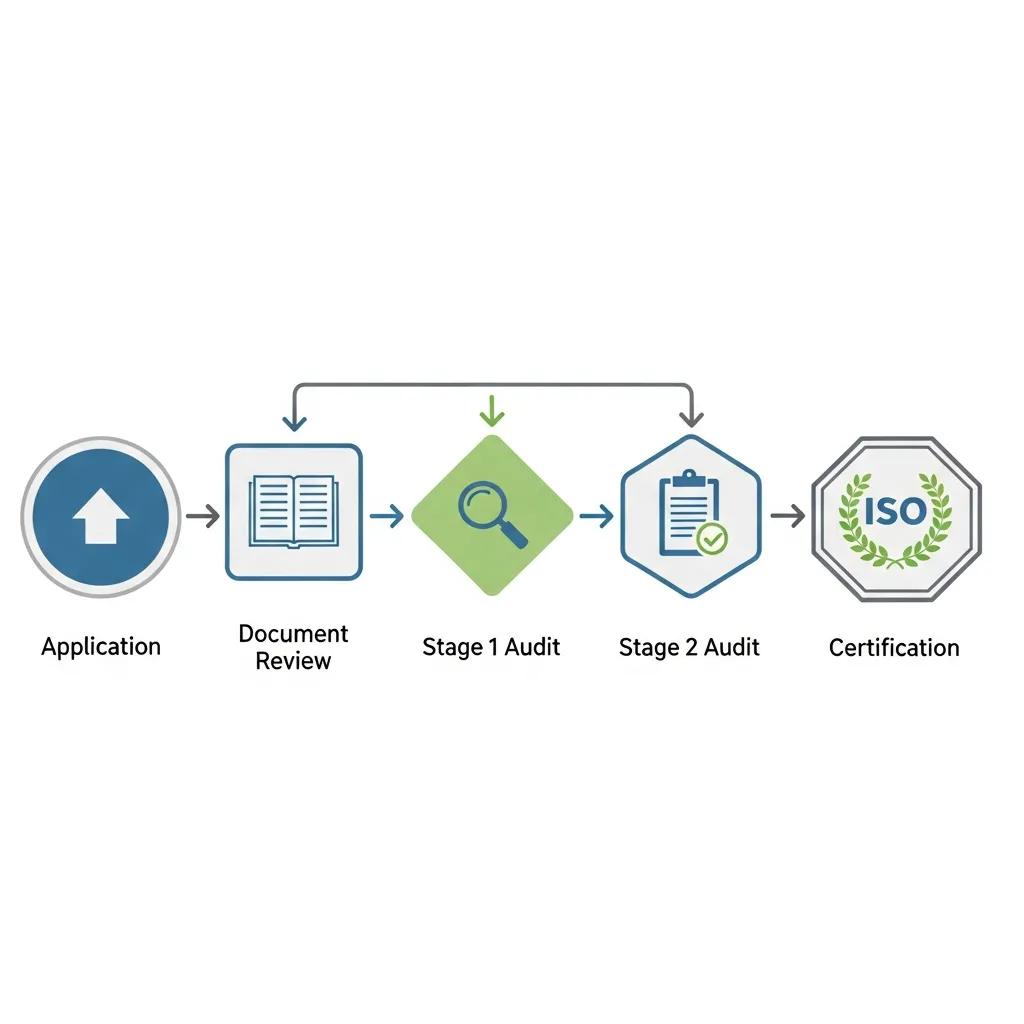
The certification journey typically follows a clear sequence: application, optional pre‑assessment (gap analysis), stage 1 and stage 2 audits, certificate issue, periodic surveillance audits and eventual recertification. Each step has a purpose: check scope and readiness; verify documented systems; confirm implemented controls; maintain ongoing conformity; and reassess the system at recertification. Knowing typical durations and evidence needs at each stage helps you plan resources and avoid delays caused by nonconformities.
- Application and quote: Provide scope details and get a quotation; align the scope with your processes and any regulatory requirements.
- Pre‑assessment / gap analysis: Optional review to identify missing controls and documentation; typically 1–3 days.
- Stage 1 audit: Documentation and readiness check; confirms scope and prepares for stage 2; typically 1–2 days.
- Stage 2 audit: On‑site or remote verification of implementation and effectiveness; duration depends on scope, often several days.
- Certificate issuance: After closure of major nonconformities, the CAB issues the certificate; certificates are commonly valid for 3 years.
- Surveillance audits: Regular checks (typically annual) to confirm ongoing conformity.
- Recertification: Full reassessment before expiry to renew certification for the next cycle.
This sequence highlights where internal preparation matters most and what evidence auditors focus on. The table below matches audit stages with typical durations and the evidence you should have ready.
Introductory note: The table summarises common audit stages, what auditors check and likely outcomes so you can list the right documents and timings.
How to prepare for an ISO certification audit
Start with a structured readiness review and align your documentation: define scope, gather procedures, map key processes and make sure internal audits and management reviews are up to date. Internal audits prove controls work as intended and generate objective evidence; any corrective actions from those audits should be closed or clearly tracked before a stage 1 assessment. Assign document owners, use version control for procedures and keep records easy for auditors to access—auditors prize traceable links from policy to practice.
A practical checklist to focus your effort and avoid last‑minute rushes:
- Documented scope and policy that match your activities
- Internal audit reports and management review minutes
- Risk assessments and treatment plans (where applicable)
- Training records and evidence of staff competence
- Recent performance data and improvement actions
Working through this checklist improves readiness and reduces the chance of major nonconformities at stage 2. The next section explains what auditors do on site and how nonconformities are managed.
What happens during the ISO audit and certification stages?
In stage 1 auditors review your documented system to confirm scope, applicability and readiness; they typically review policies, procedures and records and then set out a clear plan for stage 2. Stage 2 verifies implementation and effectiveness through interviews, observation, sampling of records and checks of controls—auditors look for objective evidence that processes deliver consistent results. If nonconformities appear, auditors classify them as minor or major, require corrective action plans and set deadlines for closure—major nonconformities normally prevent certification until resolved.
After satisfactory closure of any required actions, the CAB makes a certification decision and issues the certificate. Annual surveillance audits then confirm ongoing conformity, and a recertification audit is scheduled before expiry to renew the certificate. Understanding these mechanics helps organisations respond constructively to findings and keep the controls that underpin certified systems.
Benefits of ISO certification for UK businesses

ISO certification delivers practical strategic and operational gains: it strengthens credibility with customers and tender panels, improves internal processes through standardised management practices, reduces risks by formalising controls, and can open doors to new markets. Certification signals that you use recognised standards for quality, security or AI governance, which helps buyers and shortens procurement checks. For operations teams, clearer processes and better performance monitoring typically mean fewer incidents, higher customer satisfaction and a sustained focus on improvement.
Common, tangible benefits and how they translate into business outcomes:
- Market access and tender readiness: Accredited certification meets many procurement requirements and is often needed to bid.
- Credibility and trust: Third‑party verification reduces due diligence time and builds buyer confidence.
- Operational efficiency: Standardised processes and clear KPIs save time and reduce costs.
- Risk reduction and compliance: Formal controls lower incident rates and show regulatory alignment.
To build a business case, SMEs should map benefits to measurable outcomes such as tender win rates, incident reductions and time saved onboarding clients. The table below links stakeholder groups to primary benefits and example outcomes to help quantify ROI for different audiences.
Introductory note: The following table connects stakeholder groups to main benefits and sample outcomes so you can present ROI to decision‑makers.
How ISO certification improves credibility and market access
Certification gives independent proof that your management system meets an established international standard—procurement teams and large customers treat that as reliable evidence of capability. In many public and private procurements, accredited certificates speed up supplier assessments and meet prequalification criteria, directly affecting your ability to compete. Certification also signals a culture of continual improvement and control, which partners use as a proxy for operational maturity and risk management.
When certification is paired with performance metrics and case examples of improved delivery or reduced risk, it becomes much easier to turn certification into commercial advantage and new business.
What ROI can SMEs expect from ISO certification?
SMEs typically see ROI in several areas: new contracts won because of tender eligibility, operational cost savings from process improvements, and fewer incidents or rework that reduce direct costs. A straightforward ROI approach compares incremental revenue and cost savings against certification fees and internal effort. Track metrics such as tender success rate, customer complaints, process cycle time and incident frequency before and after certification to demonstrate impact.
Research also highlights differing payback timelines and factors that affect ROI for ISO 9001 certification.
ISO 9001 Certification: return on investment analysis
This study surveyed 426 Portuguese firms certified to ISO 9000 series standards to estimate the return on investment in quality management system certification. With a 61.03% response rate, the analysis showed that sector, company size and international exposure influence how quickly firms recover their investment. The authors also found that time taken to obtain certification does not directly predict economic payback. Around 58.9% of firms recovered their investment within three years, while 35.5% had not yet recouped their initial costs at the time of the survey.
Presenting ROI with simple, measurable KPIs and conservative assumptions helps decision‑makers view certification as a strategic investment rather than just a compliance cost.
Who are UKAS‑accredited certification bodies and why choose them?
UKAS is the UK’s national accreditation body and it oversees certification bodies by assessing them against internationally agreed criteria to ensure consistent competence and impartiality. UKAS accreditation gives confidence that a CAB follows recognised technical standards and that certificates from accredited CABs are more likely to be accepted by buyers and regulators. Checking a CAB’s accreditation status and scope is an essential step when selecting a provider because accreditation ties the CAB to documented competence checks and ongoing oversight.
Picking an accredited CAB reduces risk for both certificate holders and certificate users; the next section outlines UKAS’s technical role.
Selection checklist for CABs:
- Check accreditation scope: Confirm the CAB is accredited for the standard and activities you need.
- Assess sector experience: Choose auditors with relevant industry knowledge.
- Review audit approach: Get clarity on remote versus on‑site audits, sampling and reporting style.
These criteria align procurement needs with audit competence and lead into UKAS’s technical responsibilities.
What role does UKAS play in ensuring certification competence?
UKAS assesses CABs through documented audits, witness assessments of auditor performance and evaluations of management‑system controls within CABs to ensure impartiality and technical competence. Accreditation isn’t a one‑off: UKAS carries out periodic reassessments and surveillance to confirm ongoing compliance with accreditation criteria and maintain confidence in the certificates CABs issue. This oversight covers auditor qualifications, quality control of certification decisions and checks on complaint handling and impartiality safeguards.
Because UKAS regularly assesses CABs themselves, choosing a UKAS‑accredited CAB gives your certificate an extra layer of third‑party assurance that supports international recognition and trust.
Why choose Stratlane’s AI‑driven audit services?
Stratlane Certification Ltd. is an example of an accredited CAB that combines AI‑driven audit tools with experienced auditors to boost efficiency and consistency. These tools help focus audits on high‑risk areas, streamline evidence sampling and standardise reporting, while human auditors interpret findings and advise on corrective actions. For smaller organisations, tailored SME schemes reduce administrative burden and provide audit plans that save time without compromising rigour.
Their primary service related to this guide is delivering accredited ISO certification audits for management systems—helping businesses from initial quote to audit scheduling and certificate issue. It’s a practical illustration of how accredited oversight, auditor expertise and modern tools can shorten timelines and clarify next steps for organisations preparing for certification.
This example shows how accreditation, competent auditors and technology can combine to deliver timely, credible certification outcomes.
Main ISO management system standards for UK businesses
Several ISO management system standards are widely used by UK organisations, each covering a specific area of organisational risk and performance. ISO 9001 focuses on quality management systems, ISO 27001 on information security management systems (ISMS), and ISO 42001 on AI management and governance for organisations building or using AI. These standards sit under the broader category of management system standards and can be applied individually or integrated to cover overlapping controls and objectives.
Introductory note: The comparison below helps you choose standards that match your core risks and business drivers.
This comparison should help you see which standard fits your primary business needs and where controls overlap. The sections below give focused summaries for ISO 9001 and for the way ISO 27001 and ISO 42001 work together.
What is ISO 9001 and how it improves quality management
ISO 9001 provides a practical framework to manage and improve the processes that determine product and service quality. Its clauses cover context, leadership, planning, support, operation and performance evaluation. Implementing ISO 9001 encourages organisations to clarify customer requirements, measure process performance and embed continual improvement—steps that reduce defects and raise customer satisfaction. Key clauses like management review and corrective action ensure systematic follow‑through on performance gaps.
In practice, organisations that adopt ISO 9001 typically see better process control, clearer roles and responsibilities, and a stronger focus on meeting customer needs—which supports stronger commercial relationships and repeat business.
How ISO 27001 and ISO 42001 address information security and AI governance
ISO 27001 establishes an ISMS to identify information risks, apply controls that protect confidentiality, integrity and availability, and monitor effectiveness through measurement and incident response. ISO 42001 complements this by focusing on AI governance: it recommends controls for ethical use, AI‑specific risk assessment and lifecycle oversight from design to deployment. Together these standards form a coherent governance layer where ISMS controls secure the data environment and AI governance manages algorithmic risk, transparency and accountability.
Implementing both is especially relevant for organisations deploying AI that handles sensitive data: ISO 27001 secures the underlying environment while ISO 42001 ensures responsible model governance aligned with evolving expectations.
Their primary service related to this guide is accredited ISO certification audits for management systems—helping organisations from quote to certificate issue.
Practical checklist to choose which standard to pursue:
- Assess your primary business risk (quality, security, AI governance)
- Map existing controls against the relevant standard clauses
- Prioritise the standard with the most immediate commercial or regulatory impact
Their primary service related to this guide is accredited ISO certification audits for management systems—guiding businesses from initial quote through to audit bookings and certificate issuance.
Frequently asked questions
What are the costs associated with ISO certification?
Certification costs vary by organisation size, process complexity and the chosen standard. Typical charges include application and audit fees, plus any training or consultancy you use. Smaller organisations often face lower absolute costs, while larger organisations may see higher fees because of wider scope. We recommend getting quotes from several UKAS‑accredited certification bodies to compare services and pricing.
How long does the ISO certification process take?
Timelines vary based on readiness and the standard chosen. The process can take a few months for well‑prepared organisations, or more than a year for those starting from scratch. Key factors are the complexity of your management system, how complete your documentation is, and audit scheduling. Organisations with established systems typically move faster than those building controls and records from the ground up.
What happens if a nonconformity is found during an audit?
If auditors find a nonconformity, they’ll classify it as minor or major. Minor nonconformities usually require a documented corrective action within an agreed timeframe. Major nonconformities can prevent certification until they are resolved. You’ll need to submit a corrective action plan, implement it and provide evidence to the auditor. This process ensures the organisation meets the required standard before certification is awarded.
Can an organisation hold multiple ISO certifications?
Yes. Many organisations hold multiple ISO certificates—such as ISO 9001 for quality and ISO 27001 for information security—to cover different business needs. Holding several certifications can strengthen credibility, but it’s important to integrate management systems effectively to avoid duplication and keep processes efficient.
How can SMEs benefit from ISO certification?
SMEs gain several advantages from certification: stronger credibility in tenders, improved operational efficiency, and greater market access. Certification is an independent verification of your commitment to quality and compliance—especially useful in competitive procurement. The structured approach also reduces waste and clarifies processes, supporting growth and profitability.
What role does employee training play in the ISO certification process?
Training is essential. It ensures staff understand the management system and their roles within it, which builds a culture of quality and compliance. Well‑trained employees contribute to continuous improvement and help maintain the controls needed to keep certification. Investing in training is therefore a key part of successful certification and ongoing compliance.
Conclusion
Understanding ISO accreditation and certification helps UK businesses strengthen credibility, improve operations and access new markets. Choosing a UKAS‑accredited certification body ensures your certificate aligns with international standards, reducing procurement friction and increasing stakeholder trust. The structured certification process not only streamlines internal controls but also positions organisations for long‑term success. When you’re ready, explore our accredited services to take the next step towards certification.