
Unlocking Potential: ISO and Automation in Digital Business

Unlocking Digital Transformation with ISO Certification
ISO certification for digital businesses is a formal, third‑party confirmation that an organisation’s management systems, processes and controls meet internationally recognised standards designed for digital operations, security and AI governance. This guide shows how standards such as ISO 9001, ISO 27001 and ISO 42001 align with digital transformation goals, lower risk and open market access for cloud, SaaS and AI products. You’ll learn how these standards boost product quality, safeguard data in cloud environments, govern AI risks and how automation and AI can speed up certification and ongoing compliance. We map standards to practical controls, include comparison tables for quality and security, and point to where UK businesses can access tailored certification services. Practical lists and tables explain how to prepare for audits, pick tools for continuous compliance and evaluate vendor support. The focus is actionable guidance for SMEs and tech firms pursuing ISO certification as part of their digital transformation, with clear signposts for organisations ready to request a quote or book an audit.
What Is ISO Certification for Digital Transformation and Why Does It Matter?
ISO certification for digital transformation is a formal attestation that an organisation’s management systems meet standards focused on consistent quality, information security and responsible AI governance. The standards work by codifying repeatable processes, risk controls and governance so digital services deliver predictable outcomes and measurable improvement. Key benefits include stronger customer trust, demonstrable contractual readiness and reduced operational risk during scale‑up and cloud adoption. Those outcomes make certification a strategic enabler for partnerships, procurement and regulatory alignment — especially where digital supply chains and data processing are involved. With that foundation in place, it becomes easier to see how individual standards support growth and which to prioritise for specific digital use cases.
How Does ISO Support Digital Business Growth and Innovation?
ISO standards help digital businesses grow by creating repeatable, auditable processes that cut variability and make scaling predictable. Governance, process control and risk management under ISO give partners and customers confidence, which often speeds procurement and unlocks new commercial opportunities. For tech firms this can mean fewer onboarding hurdles with enterprise customers and clearer routes into regulated clients; internally it produces faster release cycles and measurable quality KPIs. The standards also embed continuous improvement, turning one‑off innovation into a sustainable capability that supports product iteration and regulatory resilience. That progression — from control to capability — is the practical starting point for choosing the right standards on your transformation roadmap.
Which ISO Standards Are Essential for Digital Transformation?
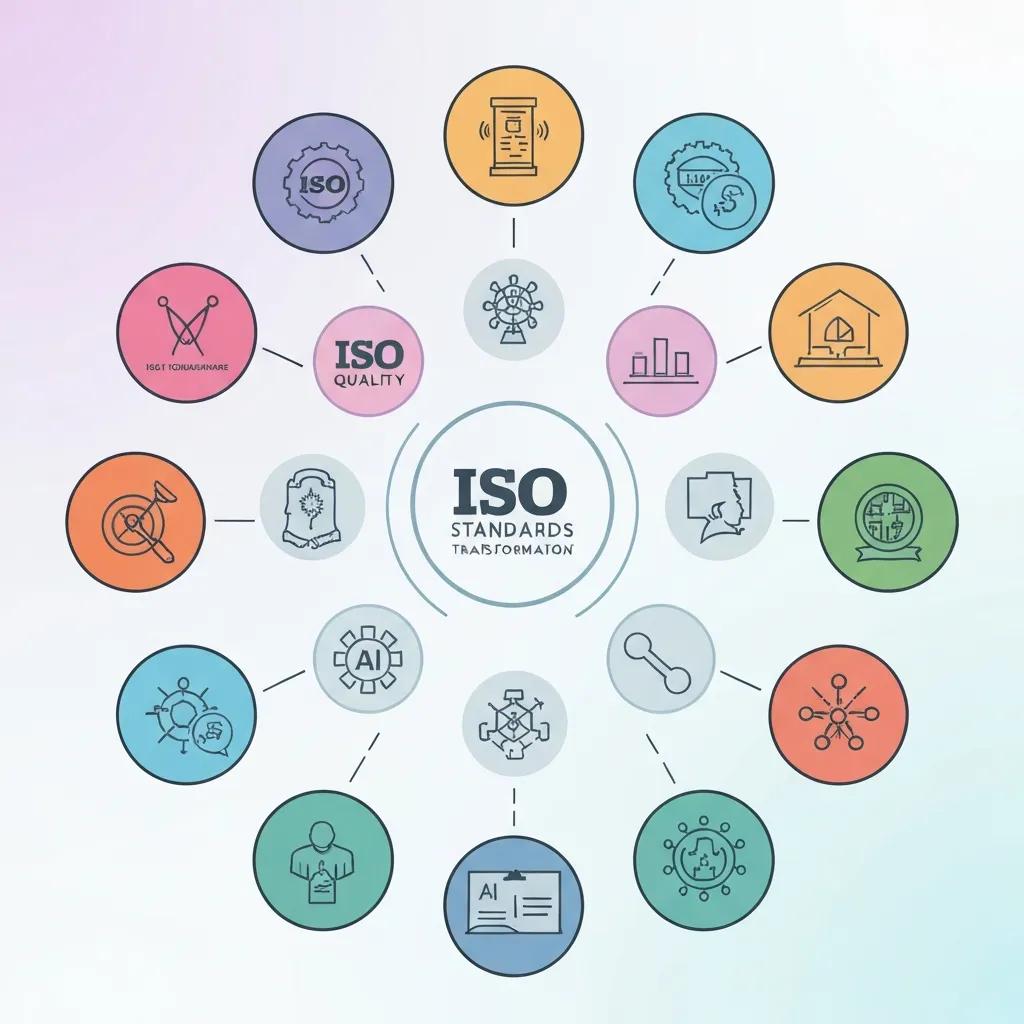
Digital transformation typically relies on a compact set of standards that together cover quality, security, AI governance and service management. The most relevant are ISO 9001, ISO 27001 and ISO 42001, supported where needed by standards for IT service management, continuity and privacy. The right mix depends on product scope, cloud dependence and AI usage; integrating standards into a single management system reduces duplicate controls and lowers audit overhead. Below is a concise list of the core standards and when to prioritise them.
- ISO 9001: Prioritise when you need consistent digital process quality, reliable release management and a better customer experience.
- ISO 27001: Prioritise for data security, cloud protection and to meet contractual or regulatory data requirements.
- ISO 42001: Prioritise where AI systems make significant decisions or present ethical, safety or bias risks.
These standards can be combined into an Integrated Management System (IMS) to reduce audit friction and support coordinated improvements across quality, security and AI governance.
Stratlane Certification Ltd. provides tailored ISO certification services that bridge strategy to action — request a fixed‑fee quote or book an audit to begin the certification process.
How Does ISO 9001 Enhance Digital Quality Management for Tech Companies?
ISO 9001 strengthens digital quality management by requiring documented, measurable processes for design, delivery and continual improvement that reduce defects and improve user outcomes. QMS principles — process approach, evidence‑based decision making and continual improvement — map directly onto software lifecycle activities such as version control, release gates and incident triage. For tech teams this translates to faster mean time to recovery, fewer regressions in production and clearer ownership of quality. The outcome is higher customer satisfaction and lower operational cost from fewer reworks and escalations. The table below shows specific digital quality mechanisms alongside their primary benefits and business impact.
| Mechanism | Benefit | Business Outcome |
|---|---|---|
| Process Automation (CI/CD) | Reduced cycle time and repeatability | Faster, safer releases with fewer human errors |
| Version & Configuration Control | Traceability of changes | Quicker rollback and clearer audit trails |
| Incident & Change Management | Controlled remediation and learning | Lower MTTR and fewer repeat incidents |
The table demonstrates how practical QMS elements map to measurable outcomes for digital products and teams, helping you decide which processes to formalise first.
What Are the Key Requirements of ISO 9001 for Digital Processes?
ISO 9001 asks organisations to define processes, assign responsibilities, measure performance and drive improvement with evidence and leadership commitment. In digital contexts this maps to documented release procedures, acceptance criteria, version control, supplier oversight for cloud services and competence records for technical staff. Implementing clause‑level practices — for example documented change control and performance metrics — surfaces bottlenecks and creates data for continuous improvement. For small teams, lightweight artefacts that satisfy clause intent (checklists, automated pipelines, runbooks) balance compliance with agility. These practical mappings let teams meet certification goals without sacrificing iterative delivery.
How Can ISO 9001 Improve Customer Experience in Digital Services?
ISO 9001 improves customer experience by standardising how feedback is captured, analysed and turned into product changes, creating a repeatable loop from issue to improvement. Mechanisms such as requirements traceability, SLA measurement and corrective action ensure user complaints become tracked inputs to development and support workflows. Metrics like defect rate, uptime and response time become management inputs rather than ad‑hoc KPIs, aligning teams on outcomes that matter to customers. Using customer data in improvement cycles reduces churn and builds reputation, which supports new contract wins and long‑term product viability. This customer focus naturally leads into why information security is essential for digital trust.
Why Is ISO 27001 Critical for Digital Security and Cloud Protection?

ISO 27001 establishes an Information Security Management System (ISMS) that identifies information risks, implements controls and ensures ongoing monitoring and improvement to protect digital assets. The approach combines risk assessment, leadership commitment and a control set tailored to your organisation’s context, making it suitable for cloud, remote work and third‑party service models. Key benefits include demonstrable contractual security, a measurable reduction in breach likelihood and alignment with national cyber guidance buyers expect. Mapping common cloud risks to controls clarifies investment priorities and simplifies audits, which reduces time spent defending security posture during procurement and incident response. The table below maps controls to mitigated cloud risks and typical outcomes.
| Control Area | Risk Mitigated | Typical Outcome |
|---|---|---|
| Access Control & Identity | Unauthorised access | Reduced lateral movement and credential misuse |
| Encryption & Key Management | Data exposure in transit/at rest | Lower risk of data leakage and regulatory fines |
| Backup & Recovery | Service/data loss | Faster recovery and demonstrable business continuity |
These mappings help organisations prioritise controls that directly reduce their highest cloud risks and provide clear audit evidence for certification.
How Does ISO 27001 Safeguard Digital Assets and Data Privacy?
ISO 27001 protects assets through a structured risk assessment that identifies critical information, evaluates threats and prescribes proportionate controls. Practical safeguards — least privilege access, encryption, logging and incident response — limit exposure and show due care to customers and regulators. For data privacy, this means mapping data flows and ensuring controls protect personally identifiable information across cloud services and processors. The ISMS also enforces supplier due diligence for cloud providers, reducing third‑party risk and clarifying contractual responsibilities. That control‑to‑outcome mapping is crucial for SMEs bidding into regulated markets and underpins the commercial benefits below.
What Are the Benefits of ISO 27001 Certification for SMEs in the UK?
For UK SMEs, ISO 27001 certification delivers a clear commercial edge by simplifying supplier validation, meeting buyer assurances and easing procurement friction. Certification signals a structured security posture aligned with national guidance, making it easier to win contracts with larger firms and public bodies. Operationally, an ISMS reduces incident frequency and severity via proactive controls and monitoring, which can lower insurance premiums and reputational risk. The governance framework also provides evidence for data protection compliance and helps standardise security practices across distributed teams and cloud services. These advantages make a strong case for SMEs to develop ISMS maturity alongside product work.
What Is ISO 42001 and How Does It Govern AI Ethics and Risk Management?
ISO 42001 defines an Artificial Intelligence Management System (AIMS) to introduce governance, risk assessment and controls specific to AI development and deployment. The standard focuses on accountability, risk identification, documentation and monitoring so AI systems operate safely, transparently and ethically. Its main aims are to reduce harm from biased or unsafe AI, demonstrate governance to regulators or partners, and provide a framework for ongoing risk management as models and data evolve. Because ISO 42001 maps well to emerging AI regulation, it functions as a practical compliance tool for organisations wanting to evidence responsible development practices and align with frameworks such as the European AI Act.
ISO/IEC 42001: La norme de gouvernance de l’IA
L’essor de la gouvernance de l’IA : décryptage de l’ISO/IEC 42001 — The rise of AI governance: unpacking ISO/IEC 42001, 2024
How Does ISO 42001 Ensure Responsible AI Development and Compliance?
ISO 42001 requires documented policies, risk assessments, defined roles and performance monitoring that match each stage of the AI lifecycle. Governance structures assign accountability for model outcomes while risk assessments uncover harms — bias, safety failures or privacy impacts — and map them to mitigation controls. Practical controls include dataset governance, explainability measures, drift monitoring and incident handling for AI‑specific failures. Documentation and metrics create an audit trail to demonstrate due diligence to partners and regulators. Embedded in development workflows, these processes reduce surprises and support safer, more ethical product deployment.
What Are the Implications of the European AI Act for ISO 42001 Certification?
The European AI Act introduces risk‑based legal obligations that raise compliance requirements for high‑risk AI systems in regulated contexts; ISO 42001 provides a structured management system that helps organisations show conformity with those obligations. Practically, organisations can use AIMS documentation to evidence governance, risk assessments and mitigation measures required by the Act, simplifying regulatory reporting and inspections. For UK businesses with EU exposure, adopting ISO 42001 strengthens cross‑border trust and eases supplier assurance to EU partners. Practical next steps include mapping AI Act obligations to AIMS controls, updating documentation and setting up monitoring that captures evidence for both certification and regulation.
How Can Automation and AI Improve ISO Certification and Compliance Efficiency?
Automation and AI can materially improve certification and ongoing compliance by speeding evidence collection, enabling continuous monitoring and surfacing anomalies that reduce risk. AI helps auditors and practitioners by aggregating logs, correlating change histories and flagging deviations from defined processes — cutting down manual evidence gathering and shortening audit days. Automation embeds continuous checks into deployment pipelines and cloud monitoring, producing near‑real‑time metrics that feed ISMS and QMS indicators. The tangible benefits are fewer audit hours, more accurate evidence and earlier detection of control failures. These gains make certification less disruptive and more cost‑effective for digital organisations.
Stratlane Certification Ltd. operates as a modern certification body that combines AI‑assisted evidence collection and automation with local audit teams and industry experts to improve audit efficiency and accuracy for clients.
What Role Does AI Play in Streamlining ISO Audits and Digital Compliance?
AI streamlines audits by automating evidence aggregation, spotting patterns that indicate control failures and prioritising audit focus areas based on historical incidents and live telemetry. For example, machine learning can detect unusual change patterns in source control or anomalous access trends in cloud logs, surfacing the highest‑risk items for auditors. AI also supports audit planning by estimating sample sizes and highlighting documentation gaps, reducing time spent on low‑value checks. That lets human auditors focus on judgement and context rather than repetitive evidence collection, producing faster, more consistent certification that scales with digital complexity.
Which Automation Tools Support Continuous ISO Monitoring for Digital Businesses?
Continuous monitoring tools fall into a few categories that integrate with common digital stacks: RPA and workflow automation for evidence capture, SIEM and log analytics for security monitoring, and compliance platforms that orchestrate controls and documentation. RPA automates routine tasks like collecting configuration snapshots; SIEM correlates events for ISO 27001 evidence; compliance platforms record controls, assign actions and generate audit artefacts. Together these tools form a continuous compliance pipeline where controls are measured in near‑real‑time, reducing audit burden and raising control maturity. The right mix depends on your existing tooling, cloud footprint and the standards you’re certifying against.
Where Can UK Businesses Access Tailored ISO Certification Services for Digital Transformation?
Choosing the right certification partner means checking accreditation, local expertise, service model and support for digital standards such as ISO 9001, ISO 27001 and ISO 42001. The best partners combine accredited certificates with practical audit teams across jurisdictions, tailored audit plans and transparent pricing so SMEs can budget accurately. Service features that affect the buyer experience include dedicated account management, fixed‑fee quotes that reduce financial uncertainty, customised audit plans that reflect cloud and AI environments, and SME‑specific programmes that simplify participation. The table below compares common service features to help UK digital businesses prioritise what matters most.
| Service Element | What it includes | Who benefits |
|---|---|---|
| Account Manager | Single point of contact coordinating audits and queries | SMEs seeking guided support |
| Fixed-fee Quotes | Transparent pricing for certification activities | Organisations needing budget certainty |
| Customised Audit Plans | Audit scope tailored to cloud, AI and multi‑site operations | Digital firms with complex tech stacks |
| Accredited Certification | Certificates bearing certification body and accreditation logos | Customers requiring formal assurance for tenders |
This comparison helps procurement teams prioritise features that reduce cost, complexity and time to certification, enabling clearer vendor selection.
How Does Stratlne Certification Ltd. Support SMEs with Customised ISO Audit Plans?
Stratlane Certification Ltd. supports SMEs with dedicated account managers, fixed‑fee quotes and customised audit plans that account for cloud operations, remote teams and AI governance. Their approach pairs AI‑assisted audit tooling with experienced industry experts and local audit teams, enabling efficient evidence collection and pragmatic assessments for smaller organisations. SME programmes are designed to simplify scope definition, lower administrative burden and provide a clear, step‑by‑step route to certification, with account managers coordinating pre‑audit gap analysis and scheduling. This mix of tailored planning, transparent pricing and local expertise helps SMEs move from readiness to certified status with predictable effort and cost.
What Are the Typical Costs and Support Options for ISO Certification in the UK?
Costs for ISO certification depend mainly on scope, number of sites, technical complexity and how many standards you’re certifying against — these are the primary cost drivers to consider. Common support options include gap assessments to gauge readiness, targeted training for staff, documentation support and ongoing surveillance audits to maintain certification. Many organisations follow a phased approach: readiness review, implementation support (process and tooling), initial certification audit and scheduled surveillance.
- Major cost drivers: scope, number of staff/sites, technical complexity.
- Common support services: gap analysis, staff training, documentation templates.
- Phased approach: readiness → implementation → certification → surveillance.
These considerations help procurement and planning teams budget appropriately and choose support that matches their risk profile and resource constraints.
Frequently Asked Questions
What is the process for obtaining ISO certification for digital businesses?
The typical process starts with a gap analysis to compare current practices against the chosen ISO standard(s). Next you implement required changes, then run internal audits to confirm compliance. When ready, you apply to an accredited certification body for an external audit. If the audit is successful, you receive certification, which is maintained through regular surveillance audits.
How often do businesses need to renew their ISO certification?
ISO certificates are normally issued for a three‑year cycle. During that period, surveillance audits — usually annual — check ongoing compliance. At the end of the three years a recertification audit is required to renew the certificate for the next cycle, assuming your management system continues to meet the standard’s requirements.
What are the common challenges faced during the ISO certification process?
Common challenges include resistance to change, limited understanding of the standards and insufficient resources for implementation. Teams can struggle with documentation and keeping compliance consistent across departments. To overcome these issues, secure leadership buy‑in, provide focused training and allocate realistic time and resources for the certification journey.
How can small businesses benefit from ISO certification?
Small businesses gain credibility and competitive advantage from ISO certification. It demonstrates commitment to quality and security, helping to attract customers and partners and making it easier to bid for contracts that require supplier assurance. Certification also streamlines processes, reduces operational risk and can open doors to new markets and opportunities.
What role does employee training play in achieving ISO certification?
Employee training is essential: it ensures staff understand the standards and their roles in maintaining compliance. Training builds a culture of quality and continuous improvement, equips teams to follow documented procedures and keeps everyone up to date on changes to processes or standards — all crucial for sustaining certification.
How can technology assist in the ISO certification process?
Technology can reduce administrative load by automating documentation, monitoring compliance and improving team communication. Compliance platforms, log analytics and automation tools help track adherence to standards, manage audits and maintain records. Data analytics also surface performance trends and highlight improvement opportunities, letting teams focus on value‑adding work.
What are the implications of non-compliance with ISO standards?
Non‑compliance can lead to loss of certification, reputational damage and potential commercial consequences. Without certification, organisations may miss contract opportunities, especially in regulated sectors. Non‑compliance can also increase operational risk and, in some cases, expose the organisation to penalties. Maintaining certification demonstrates ongoing commitment to quality and compliance.
Conclusion
Achieving ISO certification for digital businesses strengthens operational efficiency and builds trust with customers and partners by demonstrating compliance with international standards. Implementing ISO 9001, ISO 27001 and ISO 42001 helps ensure quality, security and ethical governance throughout your digital transformation. Taking the first step towards certification can improve market position and open new growth opportunities. Explore our tailored ISO certification services today to start your journey.