
Enhance Privacy Management with ISO 27701 Certification

Understanding ISO 27701: Privacy Information Management Certification
ISO 27701 is the international extension to ISO 27001 that sets out requirements for a Privacy Information Management System (PIMS). It gives organisations a structured way to manage personal data and privacy risk, and to produce auditable evidence of good practice. This article breaks down what ISO 27701 covers, how it builds on ISO 27001, the essential PIMS components, and why certification matters to customers and regulators. You’ll find practical UK-focused guidance on certification pathways, common audit pitfalls and fixes, how certification delivers commercial benefits, alignment with GDPR and other standards, and maintenance best practice. Where relevant we call out concrete actions — data mapping, DPIAs, supplier controls and internal audits — and provide checklists and concise tables to help teams prepare evidence and governance artefacts for assessors.
What is ISO 27701 and Why is it Essential for Privacy Information Management?
ISO 27701 defines how to extend an information security management system into a privacy-focused PIMS that protects personal data. The standard translates legal, contractual and stakeholder privacy obligations into governance, processes and operational controls that reduce risk and create auditable evidence of compliance. Organisations adopt ISO 27701 to bridge the gap between security and privacy, showing customers and regulators that data handling is systematic and accountable. By aligning technical controls, documentation and roles to privacy objectives, a PIMS clarifies responsibilities and improves incident readiness and supplier oversight. The section that follows unpacks the PIMS architecture and core building blocks so teams can visualise how policies, inventories and DPIAs fit together.
Understanding the Privacy Information Management System Framework
A PIMS brings privacy requirements together as policies, governance roles, operational processes and evidential artefacts such as data inventories and DPIAs. Core components include a clear privacy policy and scope statement, a data inventory with flow diagrams, controller/processor role definitions, DPIA procedures, supplier management rules and monitoring metrics. These pieces interact: data flows inform DPIAs, DPIAs feed risk registers, and policies govern access and retention. Practical examples include mapped customer data flows for marketing, template DPIAs for product changes, and supplier checklists that capture processor obligations. Grasping this framework helps teams assemble the documents and evidence auditors expect during certification.
How ISO 27701 Extends ISO 27001 for Enhanced Data Privacy
ISO 27701 builds on ISO 27001 by adding privacy-specific controls and guidance that map onto an existing information security structure to form a cohesive PIMS. The extension provides control mappings and annexes that clarify controller and processor obligations alongside established security controls such as access management and encryption. In practice, organisations already certified to ISO 27001 can layer on privacy measures — data minimisation, purpose limitation, DPIAs and subject-rights processes — without reworking governance from scratch. The main changes are adding privacy-focused documentation, updating supplier contracts, and showing how security controls support privacy outcomes. This alignment reduces duplicate audit work and makes the privacy case clearer.
What are the Key ISO 27701 Requirements for Compliance?
ISO 27701 requires organisations to implement privacy controls across governance, operations and supplier relationships, to maintain documented evidence, and to show ongoing monitoring and improvement. The standard focuses on clearly defined controller/processor roles, comprehensive data inventories and flow maps, integration of DPIAs into change processes, and supplier contract clauses that allocate privacy responsibilities. Assessors typically prioritise supplier oversight, consistent DPIA practice, and accurate retention and deletion records. Teams should concentrate on data mapping, role clarity, retention schedules and audit trails to meet assessor expectations. The list below summarises the core requirement areas you’ll need to address.
The following list outlines the primary requirement areas and the evidence assessors typically expect:
- Privacy governance: Documented PIMS scope, appointed roles and management review records.
- Data inventory and flows: Comprehensive mapping of personal data sources, uses and transfers.
- DPIA processes: Standardised DPIA templates, approval records and mitigation logs.
- Supplier management: Contracts with processor obligations and audit rights.
- Operational controls: Access management, data minimisation, retention and secure disposal.
- Monitoring and improvement: KPIs, incident records and internal audit cycles.
These clusters guide remediation work; the compact table below maps each area to practical organisational actions you can take.
Introductory table summarising key requirement areas, purpose and expected organisational actions:
This concise mapping shows how each requirement becomes a concrete task and what auditors will look for as evidence.
Core Controls and Obligations for Privacy Information Management
Core controls include access control, data minimisation, purpose limitation, appropriate encryption, retention schedules and documented DPIAs that evidence risk assessment and mitigation. Auditors typically expect artefacts such as access logs, minimisation policies, DPIA records, supplier contract excerpts and retention schedules with disposal records. Remediation often starts with a gap analysis to prioritise high-risk data flows, followed by technical controls and contractual updates. Implementing these controls reduces breach likelihood and makes responses to data subject requests faster and more reliable.
Introductory EAV-style table for core controls mapped to evidence and actions:
This table helps teams identify the artefacts to collect and the process changes that create the strongest audit evidence.
Preparing Your Organisation for Upcoming ISO 27701 Updates
To prepare for standard updates, set a regular review cadence for the PIMS, appoint someone to monitor standards changes, and run impact assessments when requirements evolve. A practical roadmap starts with an annual gap analysis, quarterly internal audits focused on high-risk areas, and a change-control process that triggers DPIAs where needed. Useful tools include version-controlled documentation, automation for retention and deletion, and templated DPIA forms. Clear ownership for each control area ensures updates are implemented consistently and evidence is captured for future audits.
As technology advances, new standards appear to cover emerging domains. For example, organisations are increasingly looking at frameworks like ISO 42001 to manage AI systems responsibly and embed privacy and ethics from design to deployment.
How to Obtain ISO 27701 Certification in the UK: Step-by-Step Guide
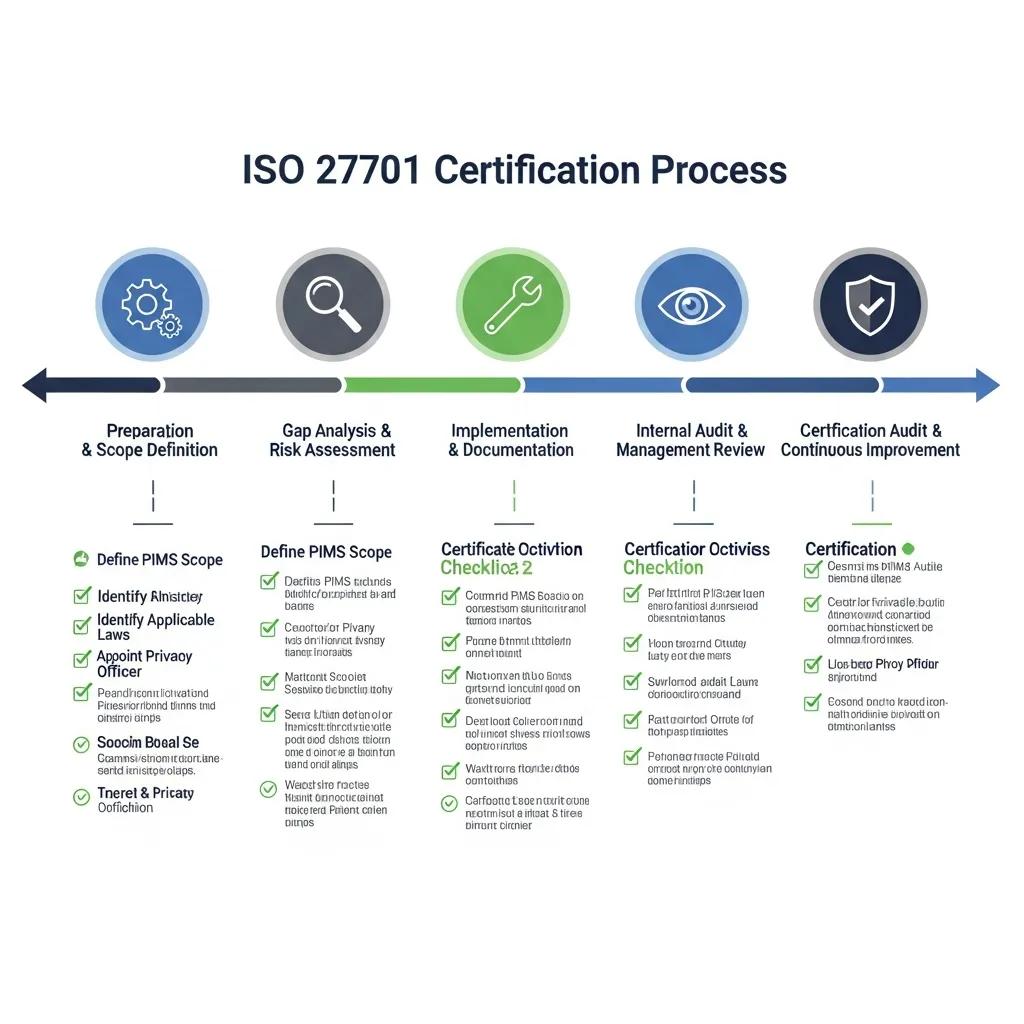
Certification in the UK typically follows a staged approach: scoping, gap analysis, implementation, pre-audit readiness, the certification audit and ongoing surveillance. Each stage produces tangible outputs — scope statements, risk registers, DPIAs, supplier agreements and audit evidence — that a certification body will review. Timelines vary with scope and complexity, so plan clear project milestones, stakeholder engagement and evidence collection. The numbered steps below give a practical roadmap to prepare teams and set leadership expectations for resources and time.
Follow these practical numbered steps to prepare for certification:
- Define scope and roles: Agree PIMS scope and appoint accountable privacy owners.
- Gap analysis: Assess current controls against ISO 27701 and prioritise gaps.
- Remediation and implementation: Apply technical controls, run DPIAs and update supplier contracts.
- Pre-audit readiness: Conduct internal audits and a management review to validate evidence.
- Certification audit: Complete Stage 1 (documentation review) and Stage 2 (operational evidence) audits.
- Surveillance: Keep compliance through periodic surveillance audits and continual improvement.
These steps form the backbone of certification planning. The table below compares stages with typical duration drivers and expected outputs to help with budgeting and scheduling.
Introductory certification-stage comparison table illustrating stages, duration drivers and outputs:
This stage comparison helps teams estimate effort and align resources for a smooth certification timeline.
Choosing the right certification body depends on accreditation, sector experience and fit with your scope. Ask potential certification bodies about their accreditation status, experience with privacy extensions, sample audit plans and sector references. Expect Stage 1 to focus on documentation and Stage 2 to verify operational controls and evidence; clear scoping and scheduling reduce surprises. When requesting quotes, favour concise proposals that list deliverables, timelines and assessor activities so you can compare options effectively.
If you’re ready to proceed, request a quote or book an audit with an accredited provider to get tailored pricing and timing for your PIMS certification project. That step converts readiness into a concrete plan and secures auditor availability.
Choosing the Right Certification Body and Audit Process
Pick a certification body after checking accreditation, impartiality, scope alignment and sector familiarity — this ensures audit findings carry weight with customers and procurement teams. Prioritise assessors who know privacy extensions and the UK data protection context, and ask for sample audit criteria and timelines. Useful questions include how they handle multi-site certification, remote evidence review and non-conformity grading. Being prepared with a clear scope and documentation reduces audit time and cost and helps you address findings quickly.
Common Challenges During ISO 27701 Audits and How to Overcome Them
Common non-conformities are incomplete data inventories, inconsistent DPIA records, weak supplier clauses and insufficient retention evidence. Address these by focusing on high-risk data flows, standardising DPIA templates, negotiating essential contract clauses with processors, and automating retention where possible. Auditors want to see controls applied consistently; showing policies are operational through logs, approvals and remediation records lowers the risk of major findings. Running mock audits and assembling a readiness pack of artefacts smooths the formal certification process.
What are the Business Benefits of ISO 27701 Certification?

ISO 27701 certification delivers measurable business benefits: stronger customer trust, clearer regulatory alignment, reduced incident impact and competitive advantage in procurement. Certification signals that privacy is managed systematically, which can speed contract negotiations and meet tender criteria. Operationally, a PIMS shortens detection and response times and clarifies supplier responsibilities, reducing overall exposure. The table below maps these benefits to business metrics and examples to help decision-makers prioritise investment.
Introductory table mapping benefits to business metrics and examples:
This mapping supports commercial business cases and clarifies which artefacts demonstrate value to customers and regulators.
Enhancing Customer Trust and Regulatory Compliance
Certification shows privacy governance is formalised and verifiable — something many buyers now require in supplier assessments and tenders. Evidence such as the PIMS scope, recent DPIAs, supplier audits and incident response records reassures customers and regulators that personal data is handled responsibly. In procurement, certification can reduce time spent on due diligence and simplify contract negotiation. When responding to customer enquiries, surface concise evidence packages — data inventory summaries, recent DPIAs and supplier assessment outcomes — to convert certification into commercial advantage.
Introductory benefits list illustrating how certification supports customer and regulatory outcomes:
- Faster supplier onboarding: Certification satisfies many initial assurance checks.
- Tender competitiveness: Demonstrable privacy governance strengthens bids.
- Regulator confidence: Structured evidence eases regulator enquiries.
In short: publishing the right certification evidence in customer-facing materials turns technical compliance into a measurable commercial benefit.
Reducing Privacy Risks and Improving Data Governance
Implementing ISO 27701 reduces privacy risk by clarifying responsibilities, standardising DPIAs and tightening supplier oversight — all of which lower incident frequency and impact. Track metrics such as DPIA completion rates, time to resolve subject access requests, percentage of contracts with required privacy clauses, and mean time to detect and contain incidents. Examples of reduced exposure include fewer third-party incidents due to stronger contractual controls and faster breach response because roles and runbooks are documented. Monitoring these metrics drives continuous improvement and feeds management review cycles.
How Does ISO 27701 Integrate with Other Privacy Regulations and Standards?
ISO 27701 maps closely to GDPR and UK data protection laws by turning legal obligations — lawful basis, DPIAs, data subject rights — into management-system requirements and auditable controls. The standard includes mappings that help organisations demonstrate how PIMS controls meet regulatory articles, making compliance evidence easier to assemble. It also integrates with other management standards such as ISO 27001 and ISO 9001, allowing shared documentation and processes to reduce duplication. The following subsections offer practical alignment points to harmonise policies across standards.
Aligning ISO 27701 with GDPR and UK Data Protection Laws
ISO 27701 supports GDPR by formalising processes for lawful-basis records, DPIAs, data subject rights handling and breach notifications. Mapping ISO 27701 clauses to GDPR requirements creates evidence bundles that show regulatory alignment — for example, linking DPIA templates to Article 35 and retention schedules to storage limitation principles. Operational changes include updating privacy notices, running regular DPIAs for high-risk processing and ensuring processor contracts include mandatory clauses. Together these artefacts simplify regulator responses and compliance audits.
Synergies Between ISO 27701 and Other Management System Standards
Integrating ISO 27701 with ISO 27001 and ISO 9001 reduces audit burden and increases operational efficiency by reusing risk assessments, management-review outputs and control evidence. Overlaps include risk methodology, internal audit processes and document control; structuring an integrated management system with common policies and role descriptions avoids duplication. Benefits include consolidated audits, consistent reporting and lower ongoing certification costs, which strengthens governance across the organisation.
What are Best Practices for Maintaining and Improving Your Privacy Information Management System?
Maintaining a PIMS requires continuous monitoring, regular internal audits, targeted training and a culture that treats privacy as a business enabler. Best practices include setting KPIs for DPIA completion, retention compliance and incident response; scheduling internal audits quarterly or semi-annually for high-risk areas; and using management reviews to prioritise improvements. Training should be role-based with annual refreshers and short updates for high-change teams. Together these practices keep the PIMS current with evolving risks and regulatory expectations while embedding privacy-aware behaviours across the organisation.
The list below summarises essential maintenance practices for sustained compliance:
- Regular monitoring and KPIs: Track DPIA timeliness, retention adherence and incident metrics.
- Internal audit cadence: Run audits focused on critical processes and supplier controls.
- Role-based training: Deliver targeted training for data handlers, developers and leaders.
- Management review & continuous improvement: Use findings to focus resources and remediate gaps.
In practice, these routines turn audit findings into improvement actions and keep privacy controls effective through business change.
Continuous Monitoring and Internal Audits for ISO 27701
Continuous monitoring should blend quantitative KPIs with qualitative audit insights to give a rounded view of PIMS health. Suggested KPIs include the percentage of processing activities with completed DPIAs, time to resolve subject access requests, percentage of suppliers reviewed and number of privacy incidents contained within SLAs. Internal audits should follow a risk-based plan, produce corrective action plans and verify remediation. Feeding audit outcomes into management review gives leadership visibility and prioritises improvements ahead of surveillance audits.
Introductory EAV-style table for monitoring and audit practices:
This table clarifies measurable targets to track PIMS performance and supports evidence collection for auditors.Training and Awareness to Sustain Privacy Culture
Effective training programmes are role-specific, practical and repeated to embed privacy-aware behaviours across the organisation. Core modules should cover DPIA basics for product teams, secure handling and access control for IT, and incident response for operations. Mix e-learning for baseline knowledge with short workshops and scenario exercises for role-based practice. Measure effectiveness through post-training assessments, completion rates and reductions in human-error findings. Ongoing awareness campaigns that share recent learnings help keep privacy visible and actionable.
For organisations that need implementation support — advisory work, readiness assessments or audit bookings — request a quote or book an audit to access tailored assistance that aligns resource planning with certification milestones. That next step turns readiness into a committed plan and provides precise scoping and cost estimates.
- Advisory: Gap analysis and remediation roadmaps tailored to your scope.
- Readiness assessments: Mock audits and evidence packs to validate preparedness.
- Audit bookings: Schedule certification or surveillance audits once ready.
Targeted support services help close resource gaps, speed remediation and build confidence ahead of formal audits; request a quote or book an audit to secure capacity and timelines.
Understanding ISO 27701: Privacy Information Management Certification
Frequently Asked Questions
What are the costs associated with obtaining ISO 27701 certification?
Costs vary depending on organisation size, scope complexity and the chosen certification body. Typical items to budget for are certification-body fees, internal resource time for preparation, and any consultancy support for gap analysis and remediation. Don’t forget ongoing surveillance audit costs, usually paid annually. We recommend getting multiple quotes and checking what each proposal includes so you can compare like for like.
How long does the ISO 27701 certification process take?
Timing depends on how ready you are and how broad the scope is. For some organisations it takes a few months; for others, more than a year. Key stages are scoping, gap analysis, implementation of controls, and the certification audit. Build a project plan with milestones and leave time for evidence collection and stakeholder engagement to avoid delays.
Can ISO 27701 certification be integrated with other certifications?
Yes. ISO 27701 is designed to extend ISO 27001 and can be integrated with other management standards such as ISO 9001. Integration reduces duplication by reusing risk assessments, management review outputs and control evidence, which simplifies audits and lowers the cost of maintaining multiple certifications.
What are the common pitfalls during the ISO 27701 certification process?
Common pitfalls include incomplete documentation, patchy data inventories, and inadequate staff training on privacy responsibilities. Organisations also stumble with inconsistent control application or weak supplier contracts. Avoid these by conducting a thorough gap analysis, standardising templates and evidence, running mock audits and ensuring stakeholder engagement across teams.
How can organisations ensure ongoing compliance with ISO 27701?
Ongoing compliance depends on continuous improvement: set KPIs, run regular internal audits, keep documentation current and maintain a management review process. Role-based training and periodic refreshers keep teams aware of obligations. Use audit findings to prioritise remediation and update controls as risks change.
What role do Data Protection Impact Assessments (DPIAs) play in ISO 27701?
DPIAs are central to ISO 27701. They identify privacy risks for processing activities and document mitigation decisions. DPIAs are required for high-risk processing and should be integrated into change and project processes. Regularly review DPIAs so they remain current and continue to demonstrate how you manage privacy risks.
Conclusion
ISO 27701 certification strengthens privacy governance, builds customer confidence and helps demonstrate regulatory compliance. Implementing a robust PIMS reduces privacy risk and improves resilience, while also creating commercial advantages in procurement and contracting. If you’re aiming for certification, targeted support — advisory, readiness assessments or audit bookings — can accelerate the journey and ensure your evidence and timelines are in order. Explore our tailored services to confirm your readiness for ISO 27701 certification.