
Effective Risk Mitigation Strategies for Business Success

How ISO Certification Reduces Risk in the UK — Practical Risk Management for SMEs and Enterprises
Every business faces events or conditions that can stop it reaching its objectives. ISO management systems give you a repeatable way to spot, control and check those threats. This guide explains how established standards — ISO 9001, ISO 27001 — and the emerging ISO 42001 embed risk-based processes, tighten governance and deliver measurable reductions in risk for UK SMEs and larger organisations. You’ll find concrete mitigation tactics, simple assessment methods and prioritisation techniques that work with limited resources. The article maps each standard to the risks it best covers, summarises ISMS and QMS components, and outlines AI governance controls likely to matter under upcoming legislation. Practical steps, comparison tables and example templates help leaders turn policy into everyday controls, and we show how an accredited certification partner can support delivery while keeping the emphasis on pragmatic, standards-led risk reduction.
What Are the Core Strategies for Reducing Business Risk with ISO Certification?
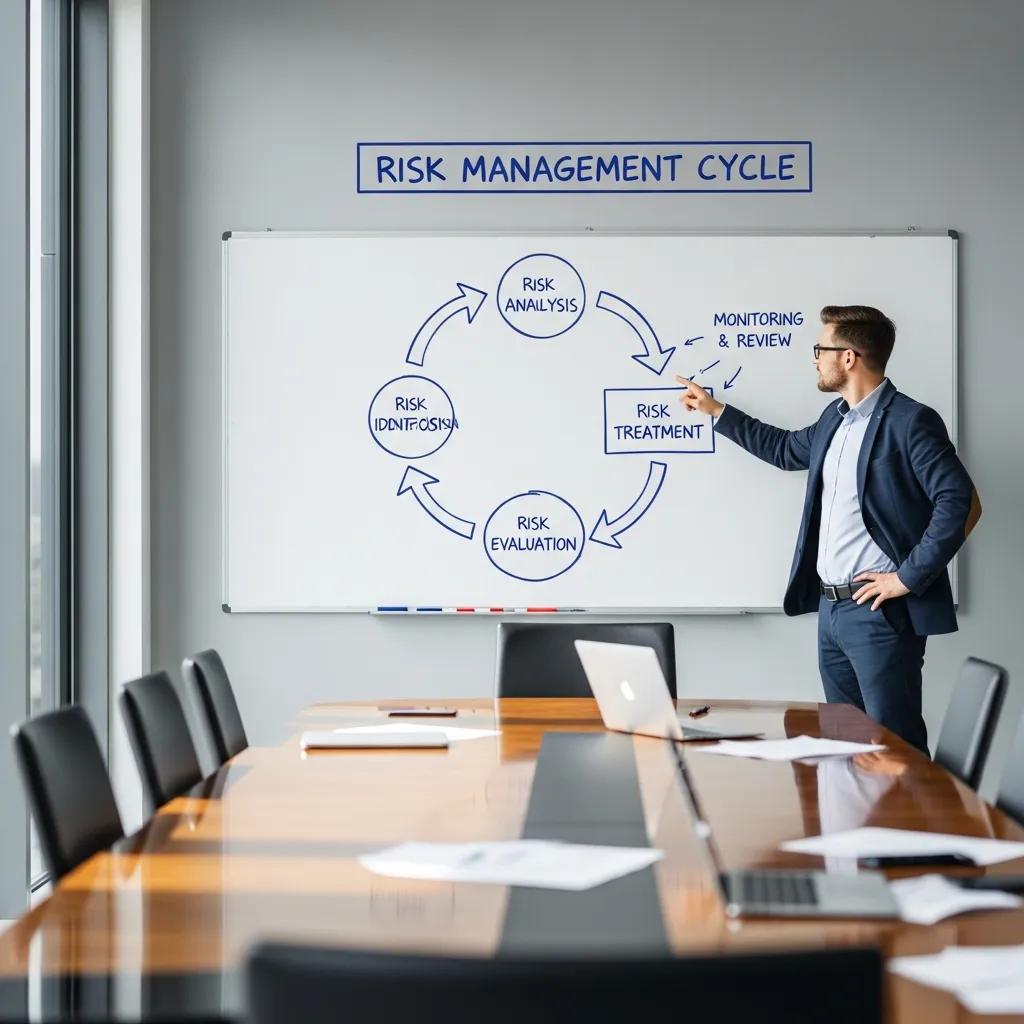
At their simplest, ISO-based strategies turn ad-hoc risk responses into documented, measurable routines. That means embedding continual improvement, clarifying policy and roles, and linking risk assessments to treatment plans. The net effect is fewer surprises, clearer accountability and better governance: risks are spotted earlier, treated with proportionate controls, and monitored through management reviews and performance indicators. Those changes reduce incident frequency and severity and make compliance easier to demonstrate to customers and regulators.
The practical risk-mitigation steps commonly used are:
- Structured risk cycle: identify risks, assess likelihood and impact, apply controls, and monitor outcomes.
- Risk-based processes: design processes that prevent failures rather than only reacting to them.
- Policy and role clarity: set responsibilities and escalation routes so issues get resolved quickly.
- Continual improvement: use audits and reviews to tighten controls in response to new threats.
These elements create a steady operational rhythm that converts isolated incidents into managed outcomes and show how ISO standards provide the supporting framework.
Different ISO standards focus on different risk areas; the table below summarises where each standard is most effective and the types of risk it reduces.
That comparison makes it clear: most organisations benefit from complementary standards mapped to the risks that matter most to their objectives.
How Does ISO Certification Provide a Framework for Risk Management?
ISO gives you a consistent structure — policy, objectives, roles, documented processes and the Plan–Do–Check–Act (PDCA) cycle — that turns strategy into operational controls. PDCA converts objectives into plans, implements controls, measures performance and feeds findings back into improvements. The standard’s requirements for risk registers, acceptance criteria and routine management review reduce ambiguity and improve decisions under uncertainty. Clear governance and audit trails also help demonstrate due diligence to customers and regulators. Once you understand this structure, it’s easier to match standards to the risk categories you need to manage.
Which Types of Risks Can ISO Standards Help Mitigate?
ISO standards target different risk categories with focused controls. ISO 9001 reduces operational and quality risks through process controls and supplier management. ISO 27001 tackles information risks — unauthorised access, data loss and incident response. ISO 42001 addresses AI-specific risks such as bias, reliability and lack of oversight by prescribing governance, validation and monitoring for models and datasets. Mapping risks to standards helps you prioritise certifications and allocate resources to the controls that matter most.
How Does ISO 9001 Enhance Quality Management to Reduce Operational Risks?
ISO 9001 drives quality by requiring risk-based thinking across processes and measurable controls that reduce variability, defects and supplier failures. Clause 6.1 asks organisations to consider risks and opportunities, which shifts the emphasis from reactive fixes to preventive design. By standardising workflows, defining acceptance criteria and tracking KPIs, ISO 9001 lowers operational uncertainty and the cost of nonconformity. It also strengthens supplier controls and traceability, reducing the chance of cascading failures through your value chain. These features help SMEs deliver consistently while building capability to scale.
Note: ISO 9001:2015 encourages risk-based thinking but does not mandate specific advanced risk-management tools or techniques.
ISO 9001:2015 — Risk-Based Thinking in Practice
ISO 9001:2015 promotes risk-based thinking as a guiding principle. Organisations choose the methods and tools that fit their context; the standard requires a risk-aware approach but not particular techniques.
Concrete steps to embed risk-based thinking under ISO 9001 include:
- Maintain a risk register linked to processes and outputs, reviewed regularly.
- Set process controls and acceptance criteria with measurable KPIs.
- Introduce supplier evaluation and incoming inspection where relevant.
- Use internal audits to spot nonconformities and inform preventive actions.
These actions build a repeatable system that cuts defects and operational disruption and show how risk-based thinking becomes part of day-to-day work.
What Is Risk-Based Thinking in ISO 9001 and How Does It Improve Processes?
Risk-based thinking means spotting where processes can fail, rating likelihood and impact, and designing controls to reduce probability or consequence. Teams map workflows, list failure points in a register and attach mitigations such as checklists, inspections or automated alerts. For SMEs, simple process maps and lightweight registers are often enough to make risks visible and manageable without heavy bureaucracy. Aligning KPIs to controls ensures monitoring flags emerging issues and that improvements are informed by data. The result is fewer surprises and more predictable delivery.
How Does ISO 9001 Certification Benefit SMEs in Managing Quality Risks?
For SMEs, ISO 9001 introduces scalable process discipline that improves consistency, strengthens supplier assurance and boosts market credibility. Certification signals documented quality systems to customers and partners, helping with contract wins and reducing negotiations tied to perceived risk. Internally, a QMS cuts rework and firefighting by standardising responses to common failures. The cost avoidance from fewer defects and better throughput typically delivers an ROI that outweighs implementation effort, and it lays the groundwork for integrating further standards as the business grows.
How Does ISO 27001 Support Cybersecurity Risk Mitigation in UK Businesses?

ISO 27001 reduces cyber risk by establishing an Information Security Management System (ISMS) that aligns controls with your organisation’s risk profile and confidentiality, integrity and availability (CIA) goals. An ISMS covers asset inventories, risk assessments, control selection, incident response and continuous monitoring to lower breach likelihood and impact. This structured approach demonstrates due diligence against UK data protection and cyber resilience expectations and produces auditable evidence of controls. ISMS practices also integrate with privacy impact assessments and regulatory requirements, strengthening your ability to withstand and recover from security incidents.
Strong IT governance and documented security practices are now essential as cyber threats and regulatory scrutiny increase.
ISO 27001: IT Governance for Cyber Security
High-profile breaches and data protection failures have damaged reputations across sectors. Robust governance, backed by standards like ISO 27001, reduces that exposure.
Core ISMS components that reduce cyber risk include:
- Governance and policy: clear security policies and leadership accountability.
- Risk assessment and controls: asset-based risk assessments with mapped controls.
- Monitoring and response: detection, incident response procedures and lessons-learned reviews.
These components form an operational backbone for cybersecurity and feed directly into how organisations meet UK regulatory expectations.
Stratlne Certification Ltd. provides accredited ISO 27001 audits and blends AI-assisted analysis with experienced auditors to deliver local UK and international support. Their approach focuses on practical, proportionate measures for SMEs and larger organisations, helping translate ISMS findings into clear treatment plans. For audit quotes, scoping or timing discussions, Stratlne Certification Ltd. can offer tailored guidance aligned to your risk profile and compliance needs.
What Are the Key Components of an Information Security Management System?
An ISMS combines policies, an asset inventory, risk assessment, controls, incident response and continual improvement to manage information risk. Asset inventories identify what needs protecting; risk assessments evaluate threats and vulnerabilities; selected controls reduce exposure to match your risk appetite. Incident response plans ensure quick containment and recovery, while monitoring and measurement prove control effectiveness and highlight trends. Regular internal audits and management reviews close the loop, allowing you to adapt controls as threats and business needs change.
How Does ISO 27001 Ensure Compliance with UK Data Protection Regulations?
ISO 27001 supports UK data protection compliance by documenting technical and organisational controls that underpin lawful processing, data minimisation and security-by-design. Measures like access controls, encryption policies, retention rules and DPIA-aligned risk assessments create evidence your processing meets regulatory expectations. Audit trails, incident logs and corrective-action records support regulatory reporting and demonstrate governance. Aligning ISMS practices with privacy workstreams reduces friction when responding to regulators and shows a proactive security posture.
Why Is ISO 42001 Essential for AI Risk Governance and Ethical AI Management?
ISO 42001 is an emerging standard (ISO/IEC JTC 1/SC 42) for Artificial Intelligence Management Systems (AIMS). It targets governance, validation and monitoring of AI systems to cut risks such as bias, unreliable models and weak explainability. The standard sets out dataset governance, model evaluation, risk assessment and human oversight processes that reduce harmful outcomes and reputational exposure. Implementing ISO 42001 helps organisations show rigorous development and deployment practices, eases auditability and aligns activity with anticipated regulation across Europe and the UK. These controls build stakeholder trust and give you a defensible position if your AI systems face scrutiny.
Key benefits of ISO 42001 for AI programmes include:
- Improved reliability: systematic validation and monitoring reduce unexpected failures.
- Bias mitigation: dataset governance and fairness checks lower discriminatory outcomes.
- Regulatory readiness: documented governance simplifies alignment with AI rules.
These advantages explain why an AIMS becomes a priority as AI moves from experiments into core business systems and set the scene for practical controls in daily operations.
How Does ISO 42001 Address AI System Reliability and Bias Mitigation?
ISO 42001 tackles reliability and bias with controls for dataset provenance, model validation, performance monitoring and change management. Dataset governance captures origin, representativeness and preprocessing. Validation tests models across segments to reveal performance gaps. Continuous monitoring detects drift and triggers retraining or rollback when performance drops below thresholds. Human oversight ensures material decisions receive appropriate review and explainability measures provide traceability. Together, these controls reduce operational AI risk and provide evidence for auditors and stakeholders.
What Are the Compliance Benefits of ISO 42001 under Emerging AI Legislation?
Adopting ISO 42001 delivers practical compliance benefits: documented risk assessments, governance records and testing evidence that map to common regulatory demands like transparency, human oversight and impact assessments. Organisations can cross-reference AIMS activities with regulatory checklists to show controls were in place before any audit. That readiness shortens remediation, lowers the chance of fines and strengthens public trust. As AI regulation matures, ISO 42001 offers a usable framework to translate high-level obligations into auditable practice.
What Practical Risk Assessment Methodologies Can SMEs Use to Identify and Prioritise Risks?
SMEs can use lightweight, effective methods — risk matrices, heatmaps, checklists, SWOT and bow-tie analyses — to identify, assess and prioritise risks quickly and without heavy investment. A risk matrix pairs impact and likelihood to produce a ranked list; bow-tie analysis links causes to consequences and highlights controls. Choose a method based on complexity and resources: many smaller businesses get fast value from a checklist plus matrix approach that yields actionable treatment plans within days. Using templates and simple tools helps embed the risk register into everyday management.
A straightforward four-step risk assessment SMEs can use is:
- Identify: list assets and processes and capture potential failure modes.
- Assess: score likelihood and impact using a simple 1–5 scale.
- Prioritise: rank risks by combined score and check they sit inside your risk appetite.
- Treat: pick proportionate controls, assign owners and set review dates.
This approach produces a manageable register teams can act on immediately and connects naturally to vulnerability discovery techniques.
Below is a practical comparison of common SME-friendly methodologies to help choose an approach.
Most SMEs can start with low-cost approaches and scale to more detailed techniques as capability grows; the priority is an actionable register, not a perfect model.
How Can SMEs Effectively Identify Business Vulnerabilities?
Quick vulnerability discovery combines an asset inventory, process maps and short stakeholder interviews to surface known failure modes and near-misses. Begin by listing critical assets (data, systems, key people, suppliers) and map processes to spot handoffs and dependencies. Interview process owners and frontline staff to capture tacit knowledge and past incidents that may not be in formal records. Reviewing recent incidents, customer complaints and supplier performance often highlights preventable weaknesses. These steps produce a focused list of candidate risks ready for scoring and treatment.
What Techniques Help SMEs Prioritise Risks and Opportunities?
To prioritise, use impact × likelihood scoring, layer in cost‑effort estimates and apply your risk appetite to focus resources on the highest-return interventions. A simple rule: treat high-impact, moderate-to-high likelihood risks first and look for quick wins where small effort delivers large risk reduction. A cost‑effort versus risk‑reduction matrix helps decide which treatments to fund now and which to monitor. Assign owners and short review cycles so prioritisation leads to action and you can re-prioritise as conditions change.
What Are the Comprehensive Benefits of ISO Certification for Risk Reduction in UK Enterprises?
ISO certification strengthens resilience, boosts stakeholder confidence and drives operational efficiencies that reduce both the chance and impact of adverse events. Certification signals repeatable, auditable processes and a holistic view of risk across quality, information security and AI governance. Operationally, standards cut waste, rework and supplier disruption, lowering cost and exposure at the same time. For larger organisations, fewer incidents, documented evidence of controls and stronger procurement credibility often translate into competitive advantage and smoother regulatory engagement.
The table below summarises typical outcomes by standard and how certification translates into risk reduction.
Targeted certification choices deliver measurable outcomes that map directly to business objectives, and benefits grow when standards are integrated across the organisation.
How Does ISO Certification Enhance Organisational Resilience and Stakeholder Trust?
Certification improves resilience by ensuring preparedness, defined response procedures and recovery steps that shorten downtime and reduce impact. Documented incident response and business-continuity measures lower mean time to recover (MTTR) and provide insurers, partners and customers with evidence of active risk management. Third-party certification signals reliability to customers and regulators, easing market access and procurement. Tracking metrics such as incident frequency, MTTR and defect rates gives you a measurable way to show resilience improvements and build stakeholder confidence over time.
What Operational Efficiencies Result from Implementing ISO Risk Management Standards?
Operational gains come from clearer process ownership, less rework, better supplier selection and consistent quality controls — all of which cut unit costs and speed delivery. Standardised processes reduce handoff friction and set clearer supplier expectations, improving on-time performance and lowering inspection overhead. Measurable ROI drivers include fewer defects, faster incident resolution and lower audit remediation costs. By monitoring efficiency metrics after certification, organisations can quantify improvements and reinvest savings into higher-value risk treatments.
Stratlne Certification Ltd. provides accredited certification and audit support across ISO 9001, ISO 27001 and ISO 42001, combining AI-assisted analysis with industry experts to help UK and international clients translate standards into practical controls. Their programmes include SME-focused guidance and scalable audit options that align with business risk profiles, helping organisations achieve and maintain certification. If you’re considering certification or need a scoped proposal, Stratlne Certification Ltd. can provide a quote and implementation roadmap tailored to your needs.
Stratlne Certification Ltd., based in London with a presence in Amsterdam, acts as an information and lead-generation hub that supports certification journeys through accredited audits, expert guidance and practical SME programmes. Their approach emphasises demonstrable risk reduction, pragmatic controls and readiness for evolving regulation.
Frequently Asked Questions
What is the process for obtaining ISO certification in the UK?
Getting ISO certified in the UK typically follows a clear sequence. First, choose the standard that best matches your objectives and risk profile. Implement the required management systems and processes, then run an internal audit to spot gaps. When you’re ready, engage an accredited certification body for an external audit. If the audit is successful you’ll receive certification, which you keep through regular surveillance audits and continuous improvement.
How often do ISO certifications need to be renewed?
ISO certificates are normally renewed every three years, with annual surveillance audits in between to check ongoing compliance. These audits confirm your system continues to meet the standard. Significant organisational or process changes can trigger additional evaluations. Continuous improvement and documented controls are key to successful renewal.
What are the costs associated with ISO certification?
Certification costs vary by organisation size, operational complexity and the standard chosen. Typical expenses include training, consultancy (if used), internal audit time and the certification audit fees. You should also budget for ongoing costs like surveillance audits and continuous improvement activities. A scoped quote from an accredited provider will give the best estimate for your situation.
Can small businesses benefit from ISO certification?
Absolutely. Small businesses gain structure, improved efficiency and stronger product or service quality from certification. It can boost credibility with customers and partners, help win contracts and make market entry easier. The discipline of meeting a standard often reduces waste and operational costs, delivering a positive return on investment for many SMEs.
What role does employee training play in ISO certification?
Training is essential. Staff need to understand processes, policies and their responsibilities within the management system. Effective training builds a culture of quality and compliance, enabling employees to spot risks and support continuous improvement. Training should be role-specific so each person has the knowledge needed to uphold the standard.
How can organisations measure the effectiveness of their ISO management systems?
Measure effectiveness with KPIs and regular audits. Useful KPIs include incident frequency, customer satisfaction, process efficiency and compliance rates. Internal audits and management reviews reveal whether systems work as intended and where to improve. Feedback from employees and stakeholders also adds practical insight to guide continuous improvement.
Conclusion
Adopting ISO certification gives UK businesses a practical framework for managing risk, boosting resilience and strengthening stakeholder trust. Standards such as ISO 9001, ISO 27001 and ISO 42001 help organisations reduce operational failures, secure information and govern AI responsibly. The structured approach not only mitigates threats but also embeds continuous improvement. If you want help planning certification or understanding the next steps, Stratlne Certification Ltd. can support your journey and help you meet your risk-management goals.