
Unlock Your Potential with Effective Mentoring Programs

ISO certification mentoring — UK guidance and hands-on implementation coaching for business success
ISO certification mentoring is a structured, mentor-led programme that helps organisations build the skills and systems needed to design, implement and sustain management systems in line with ISO standards. It combines a gap analysis, practical implementation coaching and audit-readiness preparation to reduce risk, accelerate certification and embed continual improvement across the business. In this guide you’ll find what mentoring looks like in practice, how it differs from consultancy and training, the business benefits across ISO 9001, ISO 27001 and ISO 42001, and clear steps tailored for SMEs and UK organisations. We map a step-by-step mentoring journey, include checklists and comparison tables, and explain who gains most from ISO mentoring programmes. Throughout we use terms such as mentoring programs, mentoring relationships, ISO certification mentoring and SME ISO mentoring to keep the content practical and search-focused.
What is ISO certification mentoring and how does it support businesses?
ISO certification mentoring is a relationship-led support model where an experienced mentor works with internal teams to build compliant management systems and prepare for certification. Mentors review current systems, explain how risk is reduced, and coach staff on documentation and evidence so the organisation can demonstrate conformity at audit. The key advantage is capability transfer: mentoring helps teams own the system and sustain improvements after certification, rather than relying on one-off consultant deliverables. Mentoring supports compliance, internal audits, continual improvement and audit readiness in a way that builds resilience and reduces dependence on external contractors. The following sections explain how mentoring helps meet compliance requirements and how it compares with coaching and consultancy.
How does ISO mentoring help with compliance and certification?
Mentoring improves compliance by starting with a structured initial assessment and gap analysis that surfaces non-conformities and turns them into a prioritised, actionable roadmap. Mentors guide the creation of required documentation, help define scope and appropriate controls, and coach teams on gathering evidence so records meet auditor expectations. This hands-on support often includes mock internal audits and role-based training to prepare staff for certification interviews and demonstrations. For example, a mentor might help a small IT team map ISMS processes, capture control objectives and run a mock audit that reduces likely non-conformities by sharpening evidence collection. These activities create a repeatable cycle of improvement that flows into implementation and pre-audit readiness.
What are the key differences between mentoring, coaching, and consultancy?
Mentoring, coaching and consultancy each help organisations adopt ISO standards, but they differ in focus and outcomes. Mentoring prioritises knowledge transfer and long-term capability so internal teams can maintain the system. Coaching concentrates on skill development and behaviour change through guided practice and feedback. Consultancy typically delivers specific outputs directly—writing procedures or implementing controls—often without the same emphasis on internal capability building. Choose mentoring when you want sustainable capability, coaching for targeted behavioural change, and consultancy when you need fast delivery of complex artefacts. Many organisations combine approaches to achieve the right balance for certification readiness.
What are the benefits of ISO implementation coaching for UK businesses?

ISO implementation coaching delivers measurable benefits across quality, security and AI governance by aligning processes, reducing risk and strengthening market trust. Coaching improves operational efficiency through process mapping and KPI setting, raises security posture by prioritising risk treatment and controls, and readies organisations for emerging regulatory requirements around AI governance. Framed as a pathway to accredited certification and ongoing improvement, mentoring helps businesses win a competitive edge, increase customer confidence and clarify performance metrics. The list below summarises the main business benefits that implementation coaching delivers across standards.
ISO implementation coaching offers these key business benefits:
- Operational efficiency: Standardised processes and clear KPIs cut waste and boost productivity.
- Improved security posture: Risk assessment and practical controls reduce incident likelihood.
- Regulatory preparedness: Governance artefacts and policies help align with evolving AI and data rules.
- Commercial credibility: Accredited certification supports bids, supplier checks and customer trust.
These benefits show up as fewer audit findings, faster incident response and an evidence-driven improvement cycle that links to strategic goals.
Intro to comparative benefits table: The table below compares common benefits and business impacts that mentoring and implementation coaching deliver across ISO 9001, ISO 27001 and ISO 42001 to help UK organisations decide where to focus effort.
This comparison shows how the mentoring approach produces different outcomes for each standard while using the same mentoring relationship to deliver organisational value.
How does mentoring improve quality management with ISO 9001?
Mentoring strengthens quality management by helping teams map processes, set measurable quality objectives and embed continual improvement into day-to-day work. Mentors work with process owners to create simplified templates and realistic KPIs that demonstrate product or service quality. Typical interventions include root-cause workshops to reduce non-conformances and introducing documented control points that track defect reduction. Quick wins for SMEs can be a single, simplified process map, a consolidated quality manual and a short internal audit programme to validate improvements. These steps build a culture of improvement that supports certification and better business performance.
How does ISO 27001 mentoring enhance information security?
ISO 27001 mentoring strengthens information security by guiding organisations through systematic risk assessment, scope definition and appropriate control selection tied to business risk. Mentors help teams define an ISMS scope, create risk treatment plans and compile the evidence auditors expect—control implementation records, incident logs and similar artefacts. A mentor-led checklist typically covers asset inventories, access control records and an incident response playbook, together reducing breach risk and demonstrating due diligence. Integrating GDPR considerations and recognised good practice helps UK organisations present a robust evidence base during external audits, improving resilience and stakeholder confidence.
What role does mentoring play in ISO 42001 AI governance compliance?
Mentoring helps organisations translate ISO 42001’s high-level AI governance requirements into practical artefacts like AI risk registers, impact assessments and governance policies. Mentors work with teams to identify AI use cases, map data flows and specify ethical controls that sit alongside the European AI Act and other regulatory trends. Deliverables often include templates for model risk assessment, decision-logging protocols and a governance framework that clarifies roles and responsibilities. This coaching ensures organisations can show considered, documented AI risk management during assessment and stay aligned as rules evolve, improving accountability and reducing regulatory exposure.
How does Stratlne tailor mentoring programmes for SMEs and UK businesses?
Stratlne Certification Ltd. designs mentoring programmes to meet SME needs by pairing AI-enabled assessment tools with hands-on mentor support from local audit teams. The approach balances efficiency with capability transfer, offering simplified templates, focused coaching sessions and flexible delivery—remote, on-site or blended—to suit constrained resources. For very small local businesses, Stratlne runs a specialist ISO 27001 programme for organisations with fewer than 15 employees, emphasising pragmatic scoping and proportionate controls. The model focuses on achieving accredited certification while keeping cost and disruption low for small teams. The table below compares SME package types to set expectations for support and typical timeframes.
Intro to SME package comparison: This table summarises SME-oriented mentoring packages, their support styles and likely duration to help small businesses choose the most suitable pathway.
Summary: Packaging mentoring into focused, time-bound pathways helps small UK organisations access ISO certification without unnecessary overhead while keeping audit readiness on track.
What support is available for small and medium-sized enterprises?
SME-focused mentoring typically includes simplified documentation, prioritised roadmaps and targeted coaching that reflect limited time and resources. Mentors supply concise templates, practical process maps and short workshops that build competence quickly and avoid unnecessary bureaucracy. Local audit teams can provide on-site evidence review and final-audit support, reducing travel and coordination for small businesses. The aim is to deliver certification readiness in a way that fits operational capacity while transferring knowledge so the SME can run the system independently. These adjustments make ISO mentoring accessible and pragmatic for small teams.
How does flexible delivery benefit businesses?
Flexible delivery—remote, on-site or blended—lets organisations pick the most cost-effective format for each mentoring activity and keep momentum through regular check-ins. Remote sessions suit documentation reviews and progress meetings, while on-site workshops work best for process mapping and staff training that need hands-on facilitation. Blended approaches combine both, allowing mentors to use digital tools for evidence collection while local audit teams provide operational context. Flexibility reduces downtime, keeps budgets predictable and ensures mentoring matches the organisation’s pace of change. Choosing the right mix optimises outcomes and supports sustained certification readiness.
What is the step-by-step ISO mentoring journey with Stratlne?
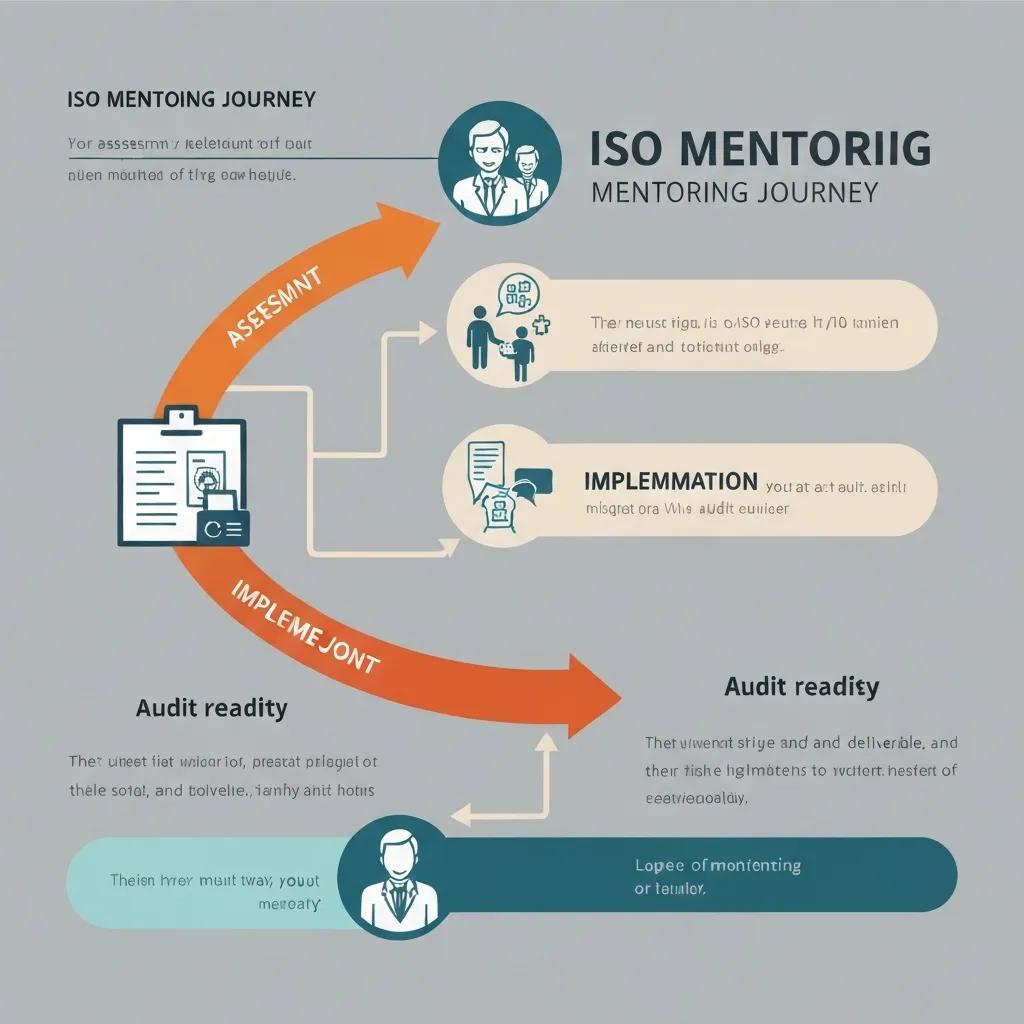
A typical ISO mentoring journey follows clear stages: initial assessment and gap analysis, implementation coaching, pre-audit review and post-certification support. Each stage produces specific artefacts and readiness milestones. Mentors start by evaluating documentation and processes, then turn findings into a prioritised roadmap aligned to business risk and available resources. During implementation, mentor-led workshops and coaching convert roadmap items into policies, procedures and measurable KPIs. Pre-audit reviews include mock audits and evidence checks that produce a readiness report to reduce non-conformities on audit day. Stratlne’s process combines AI-enabled assessment with local audit teams to streamline readiness and support accredited certification outcomes.
Intro to steps table: The table below outlines the mentoring steps, typical deliverables and expected outcomes or timeframes so organisations know what to expect from a structured mentoring journey.
This process table shows how each mentoring stage delivers concrete outputs that move an organisation from assessment to a certified, sustainable management system.
How is the initial assessment and gap analysis conducted?
The initial assessment combines a document review, stakeholder interviews and process observation to establish the current state and gaps against the standard. Mentors use structured checklists and risk-based sampling to identify critical non-conformities and dependencies that affect certification readiness. The result is a gap analysis report that prioritises actions by risk and effort and becomes the basis for a time-bound roadmap. This stage often uses automated analysis to speed evidence collection while mentors interpret findings against business objectives. A well-scoped initial assessment reduces rework later and sets a clear, practical path forward.
What happens during implementation support and coaching?
During implementation, mentors run workshops, help draft documents and assign practical tasks to internal teams so controls and procedures are embedded into daily work. Sessions typically include role-based training, sample evidence templates and small-group coaching to reinforce behavioural change and accountability. Mentors track progress against the roadmap, reprioritise where needed and help teams clear blockers that could delay certification. Regular progress reviews keep everyone aligned and maintain momentum toward the pre-audit stage. This hands-on coaching builds the competence teams need to sustain the system after certification.
How does pre-audit review ensure certification readiness?
Pre-audit review combines evidence verification, mock audits and auditor-style interviews to simulate certification and surface any remaining non-conformities. Mentors review sampled records, check control implementation and produce a readiness report with a score and prioritised remediation actions. Mock audits reveal procedural weak points and give teams practice in demonstrating compliance under assessment conditions. The final readiness report helps organisations decide when to book the certification audit and what last-minute actions will reduce findings on audit day. This step materially increases the chance of a smooth certification outcome.
What post-certification support does Stratlne provide?
Post-certification support centres on surveillance audit preparation, continuous improvement coaching and system updates when standards change, ensuring certification continues to deliver business value. Mentors help schedule management reviews, refine KPIs and run periodic health checks that prevent drift and keep systems aligned to objectives. Ongoing coaching keeps teams engaged with improvement cycles and provides a forum to address incidents, corrective actions and optimisation. This ongoing relationship treats certification as a living system rather than a one-off event, preserving credibility with customers and regulators. Stratlne positions these services to reinforce accredited certification and long-term performance gains.
Who can benefit most from ISO certification mentoring programmes?
ISO mentoring fits a wide range of organisations, with benefits varying by maturity, resources and strategic aims. New-to-ISO organisations, resource-constrained SMEs and established firms seeking optimisation each gain different advantages. New adopters benefit from structured onboarding and capability transfer that shortens the learning curve. SMEs value simplified templates and tight timelines that limit disruption. Established organisations use mentoring to optimise systems, reduce recurring audit findings and prepare for additional standards or scope expansions. Identifying the right audience helps match mentoring programmes to expected outcomes and plan for cost, time and internal involvement.
Why are new-to-ISO organisations ideal candidates?
New-to-ISO organisations gain most from mentoring because mentors supply foundational training, a clear roadmap and oversight that reduce common first-time pitfalls. Mentors teach practical skills—process mapping, evidence collection and facilitation of management reviews—so internal teams can take ownership. A simple three-step starter checklist for new organisations is: define scope and objectives, complete a focused gap analysis, and run an internal mock audit to test readiness. This progression shortens time-to-certification and builds confidence so teams can manage the system after the mentor steps back.
How do established businesses optimise existing management systems?
Established businesses use mentoring to refine processes, align KPIs with strategic goals and cut recurring non-conformities seen in audits. Mentors run targeted gap analyses to reveal optimisation opportunities such as redundant steps, misaligned objectives or weak evidence trails. Outcomes include fewer audit findings, stronger supplier assurance and clearer management information for decision-making. Mentoring also helps scale systems when adding standards or expanding scope, ensuring new requirements integrate smoothly with existing controls. This targeted optimisation supports better audit results and measurable business improvements.
What are the most common questions about ISO mentoring services?
Organisations commonly ask about cost, SME access and how to request mentoring; clear answers set expectations and point to next steps for certification readiness. Cost is driven by scope, the chosen standard (for example, ISO 27001 often needs more extensive risk treatment), delivery mode and organisational size. Small businesses frequently ask whether mentoring can be adapted to limited budgets and staffing; the answer is yes when programmes use simplified templates and focused coaching. Finally, providers typically request basic scope details to produce a tailored quote, so a short checklist and next-step summary are helpful.
Common questions and short answers:
- How much does mentoring cost?: Costs vary by scope, standard complexity and delivery mode, so expect a tailored quote based on those factors.
- Can small businesses access tailored guidance?: Yes — SME packages include simplified templates, focused sessions and local audit team support to match capacity.
- How do I request a quote or book mentoring?: Provide the standards, estimated scope, desired timeline and preferred delivery mode so providers can prepare a targeted proposal.
How much does ISO consultant mentoring cost in the UK?
Pricing for ISO consultant mentoring in the UK depends on the standard’s complexity, organisational size and delivery choices rather than fixed rates; providers generally assess scope before quoting. Cost increases with wider ISMS or AIMS scope, multiple sites, frequent on-site workshops and significant evidence remediation. Remote mentoring and template-led approaches usually lower costs compared with repeated on-site work, making blended delivery a common, cost-effective compromise. Request a tailored quote that outlines scope, milestones and deliverables to understand the full investment needed for certification readiness.
Can small businesses access tailored ISO compliance guidance?
Small businesses can access tailored compliance guidance through packages that prioritise essential controls, provide simplified templates and break work into phased deliverables. Mentors calibrate scope to organisational risk and use proportionate controls to avoid over-burdening small teams while keeping the system auditable. Local audit teams and remote coaching reduce travel and coordination time, and concise workshops build internal capacity efficiently. This approach enables SMEs to achieve accredited certification with pragmatic effort and ongoing mentor support to sustain the system.
How do I request a quote or book an ISO mentoring session?
When requesting a quote, provide the standards you want to certify against, an outline of scope (locations, teams affected), your preferred timeline and whether you want remote, on-site or blended delivery. Providers will respond with a proposed scope of work, a roadmap and suggested milestones leading to a pre-audit review and certification booking. Expect follow-up questions to clarify specific risks, evidence readiness and scheduling for workshops or mock audits. For organisations ready to act, requesting a quote or booking an audit-readiness review is the practical next step to turn interest into a structured plan.
Stratlne-specific conversion note: For organisations seeking a tailored mentoring partner, Stratlne Certification Ltd. combines AI-assisted assessment with local audit teams and SME-focused packages; request a quote or an audit-readiness consultation to discuss scope and timelines.
- Prepare standard(s) and scope details: This helps the provider scope effort accurately.
- Request roadmap and deliverables: Ensure milestones include a pre-audit review and evidence verification.
- Book an initial readiness consultation: A short review clarifies timeline and expected outcomes.
- Request a quote or book an audit readiness review: Provide the standard, scope and timeline to start the process.
- Review proposed roadmap and agree milestones: Confirm deliverables such as gap analysis, implementation coaching and a pre-audit mock.
- Schedule pre-audit review and certification booking: Use the readiness report to choose the audit window with confidence.
For organisations that prioritise accredited certification, capability transfer and SME-friendly pathways, requesting a tailored quote or booking an audit-readiness consultation is the recommended next step to achieve ISO certification with confidence.
Frequently asked questions
What types of organisations benefit most from ISO certification mentoring?
ISO certification mentoring helps a wide range of organisations: new-to-ISO businesses, resource-constrained SMEs and established firms aiming to optimise systems. New adopters get structured onboarding and practical roadmaps, SMEs gain simplified templates and tight timelines that limit disruption, and established organisations can refine processes and align KPIs to strategic goals. Tailoring the programme to each organisation’s needs delivers maximum value and clearer audit outcomes.
How can ISO mentoring support continuous improvement after certification?
Mentoring supports continuous improvement post-certification by providing ongoing coaching and practical support. Mentors help set up regular management reviews, refine KPIs and run periodic health checks to ensure the system stays aligned with business objectives. Ongoing coaching encourages teams to treat certification as a living system—addressing incidents, managing corrective actions and optimising processes so accredited status continues to deliver value.
What is the typical duration of an ISO mentoring programme?
Duration varies with size, complexity and needs. Initial assessments and gap analyses commonly take 2–4 weeks, implementation support typically runs 8–16 weeks, and pre-audit reviews usually occur 1–2 weeks before the certification audit. Overall, expect a structured mentoring journey spanning several weeks to a few months, depending on the chosen package and how quickly internal teams progress.
How does Stratlne ensure the mentoring process is tailored for SMEs?
Stratlne tailors mentoring for SMEs by offering simplified documentation, prioritised roadmaps and flexible delivery that fits limited resources. Programmes include concise templates and focused coaching to build competence without overwhelming small teams. Local audit team support for on-site tasks further reduces coordination effort. This pragmatic approach helps small businesses achieve certification efficiently while remaining audit-ready.
What are the key components of the initial assessment in ISO mentoring?
The initial assessment includes a document review, stakeholder interviews and process observation to identify gaps against the standard. Mentors use structured checklists and risk-based sampling to pinpoint critical non-conformities and dependencies. The outcome is a gap analysis report that prioritises actions by risk and effort and forms the foundation of a time-bound roadmap. This thorough assessment sets a clear path forward for certification.
How does mentoring differ from traditional training in the context of ISO certification?
Mentoring differs from traditional training by focusing on long-term capability rather than single knowledge transfers. Training delivers specific skills or knowledge, while mentoring is a relationship where an experienced mentor guides teams through the whole certification process—supporting documentation, evidence collection and compliance practices so teams can take ownership. The emphasis on capability transfer ensures improvements are sustained after certification.
What role does technology play in the ISO mentoring process?
Technology increases efficiency and clarity in the mentoring process. Stratlne uses AI-enabled assessment tools to speed the initial evaluation and gap analysis, and digital platforms support remote coaching, document review and progress tracking. Technology also helps generate templates and manage evidence, making it easier for organisations to maintain compliance and prepare for audits. This integration keeps mentoring responsive and scalable.
Conclusion
ISO certification mentoring gives organisations structured, practical support to achieve compliance and improve operational performance. By building internal capability and promoting continuous improvement, mentoring helps teams navigate ISO standards with greater confidence and less disruption. A tailored mentoring programme can materially reduce the time and resource needed for certification. If you’re ready to move forward, explore our mentoring options and request an audit-readiness consultation to start the process.