
Understanding ISO 9001:2015 — Practical Requirements & Clauses for Better Quality Management

ISO 9001:2015 is the global standard for Quality Management Systems (QMS). It sets out what organisations must do to reliably meet customer and regulatory requirements. This guide breaks down the standard’s core clauses, shows how they structure a QMS, and explains the business benefits—better product quality, less rework and stronger tender submissions. You’ll find a plain-English summary of Clauses 4–10, practical steps for planning and risk-based thinking, what operational controls and documented information auditors expect, and a UK-focused view of certification and cost. The content maps clauses to everyday tasks, offers compact lookup tables for quick reference, and gives SME-friendly tips so small and medium-sized organisations can judge readiness and focus on changes that deliver measurable quality gains.
What are the key clauses of ISO 9001:2015 and their purposes?
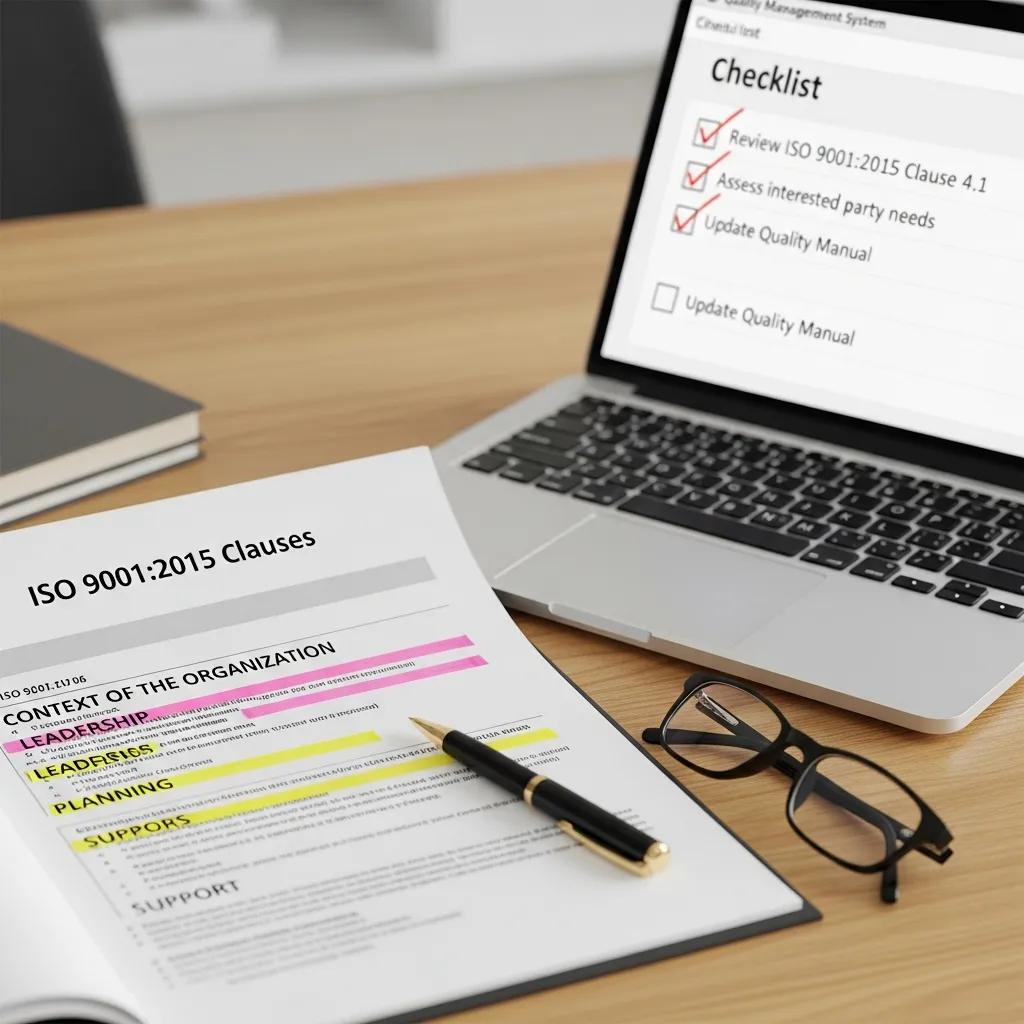
Clauses 4–10 form the operational structure of ISO 9001:2015, taking you from context and leadership through to continual improvement. Each clause describes responsibilities and the evidence auditors typically look for, allowing you to scale the QMS to your organisation’s size and risk profile. Viewing the clauses in sequence—context, leadership, planning, support, operation, performance evaluation, improvement—helps teams align policy, objectives and controls with business goals. The compact table below is designed as a quick, decision-focused reference.
The table summarises each clause with a clear, practical action so you can translate requirements into concrete workstreams.
| Clause | Purpose | Practical action |
|---|---|---|
| Clause 4: Context of the organisation | Set the QMS boundaries and understand internal/external influences | List stakeholders, map core processes, record the QMS scope |
| Clause 5: Leadership | Show top management commitment and align policy with strategy | Publish a quality policy, assign authorities and run regular reviews |
| Clause 6: Planning | Define objectives and address risks and opportunities | Set SMART objectives, keep a risk register and agree action plans |
| Clause 7: Support | Provide resources, competence and controlled documented information | Plan training, control documents and keep key records |
| Clause 8: Operation | Control delivery of products/services and outsourced activities | Define operational controls, acceptance criteria and supplier checks |
| Clause 9: Performance evaluation | Measure, analyse and audit the QMS | Track KPIs, schedule internal audits and complete management reviews |
| Clause 10: Improvement | Handle nonconformities and drive continual improvement | Run corrective actions and prioritise improvement projects |
This clause map helps teams locate requirements and understand the typical evidence auditors expect, so you can prioritise the most impactful improvements before an external assessment.
How does Clause 4 define the Context of the Organisation?
Clause 4 asks organisations to capture the internal and external issues that affect their QMS and to identify relevant interested parties and the scope of the system. In practice this means running a structured review—SWOT, PESTLE or similar—to record market, legal, technical and cultural drivers, and listing stakeholders such as customers, regulators and suppliers. Auditors commonly expect a written scope statement, an issues register, stakeholder analysis notes and process maps that show where controls are applied. For a UK SME, internal issues might include limited staffing and seasonal demand, while external issues could include regulatory change or supplier instability. Recording these links strategy directly to your quality objectives and risk treatments.
What leadership responsibilities are outlined in Clause 5?
Clause 5 requires visible leadership: top management must set a quality policy, assign responsibilities and promote continual improvement. You should show how leaders communicate the importance of quality, align objectives with business strategy and provide the resources needed. Auditors will look for an approved policy, role descriptions with responsibilities, and evidence of communication such as meeting minutes or internal announcements. A short checklist helps ensure coverage: publish the policy, define roles, communicate objectives and keep a regular management review schedule. Strong leadership ties strategic goals to measurable quality targets and builds a culture where staff know their part in delivering quality.
How does ISO 9001:2015 address planning and risk management in a QMS?
Clause 6 embeds planning and risk-based thinking: you must set quality objectives, plan how to achieve them, and consider risks and opportunities that could affect outcomes. Planning is more than listing objectives—it includes resources, ownership, integrating risk treatments into processes and setting measurable indicators. The standard doesn’t force a specific risk method, but it expects a systematic, proportionate approach suited to your organisation’s context. The short workflow below outlines a pragmatic method SMEs can use to blend planning into day-to-day operations.
This section includes a simple risk assessment workflow and a concise checklist for planning.
- Identify objectives and the processes that deliver them.
- Assess risks and opportunities using a simple likelihood–impact matrix.
- Assign owners and actions for each risk, with measurable indicators.
- Review effectiveness and update plans during management review.
Following these steps ensures objectives are realistic, risks are treated, and actions are monitored with measurable results. The next sections explain specific planning requirements and practical approaches to risk-based thinking.
What are the planning requirements in Clause 6?
Clause 6 requires you to set quality objectives at relevant functions and levels, and to plan actions to meet them, including how those actions are integrated into business processes. Objectives should be SMART—specific, measurable, achievable, relevant and time-bound—and tied to performance indicators that support continual improvement. Planning should also cover resources, responsibilities, success criteria and monitoring arrangements. Finally, you must plan for changes to the QMS so changes are controlled and do not harm outcomes. This disciplined approach turns strategic aims into assignable tasks that can be reviewed in management meetings and internal audits.
How is risk-based thinking integrated into the planning process?
Risk-based thinking means identifying risks and opportunities that could affect conformity of products and services and taking proportionate actions. A simple SME-friendly matrix with three levels for likelihood and impact gives priority scores to guide treatment. Steps include mapping likely failure modes, assigning risk owners, choosing mitigation measures and scheduling reviews to test effectiveness. Linking risks to quality objectives explains why controls are needed and provides traceability for auditors. By including risk registers in regular reviews you turn abstract threats into specific actions that protect customer requirements and operational continuity.
Embedding risk-based thinking has been a practical focus for many SMEs since the 2015 revision.
ISO 9001:2015 Risk-Based Thinking for SMEs Since early drafts of ISO 9001:2015, the risk-based thinking requirement has been a central change. Research has explored how European manufacturing SMEs identify and manage the risk sources outlined in the standard.
What support and operational controls are required under ISO 9001:2015?
Clauses 7 and 8 cover the support functions and operational controls needed to deliver consistent quality. Clause 7 deals with resources, competence, awareness and documented information; Clause 8 focuses on planning and controlling processes that create and deliver products or services. Together they require evidence that you have the right people, infrastructure and controls to meet customer and regulatory expectations. The list below summarises common support and operational control areas organisations should be ready to evidence.
- Resource allocation and infrastructure maintenance.
- Competence records, training plans and defined roles.
- Documented information control and records retention.
- Operational controls, acceptance criteria and release procedures.
- Supplier selection, monitoring and outsourced process governance.
These elements form the operational backbone of conformity and feed directly into monitoring and improvement activities covered later in the standard.
What resources and support does Clause 7 mandate?
Clause 7 requires organisations to identify and provide the resources needed for the QMS: competent people, suitable infrastructure, a safe work environment, measuring resources and organisational knowledge. Evidence of competence can include job descriptions, training plans and records showing staff meet role requirements. Documented information under Clause 7.5 must be controlled for availability, protection and versioning; however, ISO 9001:2015 supports a proportionate documentation approach rather than prescriptive manuals. For SMEs, concise records—competence logs, calibration certificates and controlled procedures—usually satisfy auditors while keeping admin manageable.
How does Clause 8 govern operational planning and control?
Clause 8 asks organisations to plan, implement and control the processes needed to meet product and service requirements—defining acceptance criteria, managing changes and controlling release of outputs. Operational control covers design and development where relevant, production/service provision and controls for externally provided processes and products. Practical measures include work instructions, inspection points, supplier performance monitoring and nonconforming product procedures. For service businesses, controls often centre on specifications, SLAs and handover criteria; manufacturers will emphasise production controls and test records. Clear acceptance criteria and supplier governance reduce variability and nonconformity.
How is performance evaluation and continual improvement structured in ISO 9001:2015?
Clauses 9 and 10 provide the mechanisms for measuring QMS effectiveness and driving continual improvement. Clause 9 covers monitoring, measurement, analysis, internal audits and management review; Clause 10 requires action on nonconformities and corrective actions that deliver measurable improvement. The standard expects you to define relevant performance indicators, plan internal audits, record audit outcomes and run management reviews that lead to decisions and actions. Common performance metrics and their purposes are listed below.
Common performance indicators include:
- Process conformity and product/service nonconformity rates.
- Customer satisfaction scores and complaint trends.
- On-time delivery and supplier performance measures.
- Internal audit finding closure rates and corrective action effectiveness.
These metrics give management the evidence needed for review and to prioritise improvements; the next sections look at monitoring needs and structuring corrective actions to support continual improvement.
What does Clause 9 require for monitoring, measurement, and internal audits?
Clause 9 asks organisations to determine what to monitor and measure, the methods and frequency, and who is responsible for analysis and reporting. Typical measures include process performance indicators, product conformity checks and customer satisfaction data. Internal audits should be planned based on risk and process importance, produce objective evidence and drive corrective actions. Management review inputs commonly include audit results, customer feedback, process performance and resource sufficiency; outputs should include improvement decisions and any required QMS changes. A well-run internal audit programme links findings to action and demonstrates ongoing oversight.
How does Clause 10 promote continual improvement?
Clause 10 requires organisations to respond to nonconformities with a corrective action process that identifies root causes and implements controls to prevent recurrence. Corrective actions should be proportionate to the issue and documented, with follow-up to verify effectiveness. The clause also encourages using monitoring and audit data to spot improvement opportunities, prioritise projects and measure results. Low-cost improvements for SMEs might include process standardisation, short Kaizen events to cut waste and working with suppliers to reduce defects. When corrective-action loops are effective, incidents become sources of lasting improvement.
What is the ISO 9001 certification process and cost considerations for UK businesses?

Certification usually follows a staged path: gap analysis and system implementation, internal audits and management review, Stage 1 (documentation/readiness) audit, Stage 2 (conformity) audit, then ongoing surveillance. Costs depend on audit days, system complexity, number of sites and QMS maturity. Defining a clear scope and having documentation ready reduces auditor time and cost. The table below summarises each audit stage, what happens there, and the typical deliverables and main cost drivers—use it to plan realistically for UK businesses.
| Audit stage | What happens | Typical deliverable / cost driver |
|---|---|---|
| Gap analysis / pre-assessment | Compare current practices against ISO requirements | Gap report; consultancy days (cost driver: consultant rates) |
| Implementation & internal audit | Develop processes, collect records and run internal checks | Internal audit reports; staff training (cost driver: internal effort) |
| Stage 1 audit | Assessor checks documentation and readiness | Stage 1 report; identification of major gaps (cost driver: auditor days) |
| Stage 2 audit | Full assessment of the implemented QMS | Certification decision and certificate issue (cost driver: audit days, sites) |
| Surveillance audits | Periodic checks to maintain certification | Surveillance reports (cost driver: annual audit frequency) |
This breakdown highlights where effort and cost are concentrated so you can invest in readiness activities that reduce external audit time.
What are the steps involved in obtaining ISO 9001 certification?
The certification pathway is a clear sequence: run a gap analysis, document or update processes, carry out internal audits and close corrective actions, book Stage 1 and Stage 2 audits with a certification body, and then maintain the system via surveillance audits. Deliverables include gap reports, documented procedures, internal audit records and management review minutes. Preparing evidence in advance—process maps, competence records and controlled documents—shortens auditor time on site. Assign clear responsibilities and a realistic timeline to improve the chance of a smooth Stage 2 audit and timely certificate issue.
When planning audits many UK organisations prefer certification providers that offer easy quoting and booking, experienced auditors and clear accreditation information. Stratlane Certification Ltd. positions itself as an option for organisations looking for an efficient path to ISO 9001: they combine AI-assisted audit preparation with experienced industry auditors, deliver accredited certificates and deploy local audit teams across markets, with programmes tailored to small businesses. Once you understand the required deliverables, requesting a quote or discussing timing is a sensible next step.
- Gap analysis: compare current practices against ISO 9001:2015 requirements and produce a gap report.
- Documentation: develop or update processes, procedures and records needed to close identified gaps.
- Internal audits: run internal audits across key processes and close out any corrective actions found.
- Stage 1 audit: the certification body’s assessor reviews documentation and overall readiness.
- Stage 2 audit: the certification body carries out a full assessment of the implemented QMS and issues a certification decision.
- Surveillance audits: periodic audits maintain certification and confirm the QMS continues to conform.
How much does ISO 9001 certification cost for small businesses in the UK?
Certification cost for SMEs varies by complexity, number of sites, headcount (which affects audit days) and QMS maturity. Major cost drivers are auditor days, travel and administrative overhead, plus any consultancy or pre-assessment support you choose. Initial certification typically has a larger one-off cost; annual surveillance is smaller and more predictable. For accurate pricing request fixed-fee proposals that state audit days and deliverables rather than open-ended hourly estimates.
Understanding the financial impact is important—some SMEs have withdrawn certification in the past because costs and perceived value didn’t align.
ISO 9001 Certification Costs for SMEs Research has shown that some SMEs withdraw ISO 9001 certification citing consultancy and certification costs as a factor. Understanding cost drivers helps organisations make informed decisions.
To reduce costs, run an internal gap analysis to shorten auditor discovery time, centralise documented information and prepare clear competence and process evidence before Stage 1. A well-defined scope and a readiness plan usually give the best return on certification investment.
How can small and medium-sized businesses meet ISO 9001 documentation requirements?
Clause 7.5 gives flexibility on the form and extent of documented information, but you must keep records that prove conformity and support QMS operation. SMEs benefit from a minimal documentation approach focused on essentials rather than lengthy manuals. The short EAV table below lists document types, whether they are required or recommended, and practical examples or templates SMEs can adapt quickly for compliance and audit readiness.
The table helps SMEs decide which documents to prioritise for implementation and audit preparation.
| Document type | Required / Recommended | Example or template reference |
|---|---|---|
| Quality policy and scope | Required | One-page policy and scope statement |
| Quality objectives and records | Required | SMART objectives log and KPI dashboard |
| Records of competence | Required | Training matrix and certificates |
| Internal audit records | Required | Audit schedule and nonconformity logs |
| Procedures and work instructions | Recommended | Short process maps and simple checklists |
| Supplier evaluation records | Recommended | Supplier scorecards and contracts |
What documentation is required for ISO 9001 compliance?
Required documented information typically includes the QMS scope, quality policy, quality objectives, evidence of competence and training, internal audit results, corrective actions and records showing product or service conformity. Recommended documents—useful for operational control—include work instructions, supplier evaluation forms and process maps. Auditors look for concise records that demonstrate repeatability and control rather than voluminous paperwork, so SMEs should prioritise evidence such as signed training logs, calibration certificates and nonconformity reports. Focusing on these items reduces audit risk while keeping documentation proportional.
Recent studies indicate that modern documentation approaches have made ISO 9001 manageable for many SMEs.
ISO 9001:2015 Documentation & SME Implementation Studies suggest that the 2015 revision and process-based approaches have eased the documentation burden for many SMEs, making maintenance of ISO 9001 more feasible.
How can SMEs effectively control and manage documented information?
SMEs can control documented information with low-cost methods such as a single shared repository, clear folder structures, standard file names, version numbers and restricted edit permissions. Version control, access rules and retention policies stop outdated procedures from being used and provide an audit trail for changes. Lightweight QMS software adds benefits like automatic audit trails, reminders and faster evidence collation, but many SMEs meet requirements with disciplined folder systems and controlled spreadsheets. The key is to document your control method, apply it consistently and train staff so records reliably show conformity during audits.
If you want external support, Stratlane Certification Ltd. offers SME-focused programmes that streamline documentation and control without creating unnecessary overhead. Their approach uses practical templates, local audit teams and a simplified readiness and booking process so small businesses concentrate on the highest-value documentation first.
Stratlane Certification Ltd. provides ISO 9001:2015 certification services combining AI-assisted audit preparation with experienced industry auditors and accredited certificates. They operate local audit teams across markets, offer simple quoting and booking, and run tailored programmes for small businesses focused on quick readiness and minimal documentation burden. Consider these options when deciding how to procure certification support and quotes.
Frequently Asked Questions
What are the benefits of implementing ISO 9001:2015 for small businesses?
ISO 9001:2015 helps small businesses improve efficiency and customer satisfaction by formalising processes and reducing waste. A robust QMS supports consistent quality, encourages continuous improvement, and can strengthen credibility with clients and public-sector buyers—many of whom prefer or require ISO-certified suppliers.
How often should internal audits be conducted under ISO 9001:2015?
Internal audits should be planned at regular intervals—at least annually as a baseline—but frequency depends on organisation size, process complexity and risk. More frequent audits may be appropriate for higher-risk processes. Regular auditing confirms the QMS is working and highlights opportunities for improvement.
What role does employee training play in ISO 9001:2015 compliance?
Training ensures staff are competent and aware of their QMS responsibilities. It helps people understand quality objectives and how their work affects outcomes. Keep records of training activities to demonstrate competence during audits and to maintain consistent performance.
Can ISO 9001:2015 certification be achieved without external consultancy?
Yes. Many SMEs achieve certification without external consultants by using a structured approach: gap analysis, focussed documentation, internal audits and corrective actions. That said, consultants can shorten the learning curve and help avoid common pitfalls—especially for organisations new to quality management systems.
What are common challenges faced by SMEs when implementing ISO 9001:2015?
Typical challenges include limited resources, gaps in quality management expertise and resistance to change. Documentation and allocating time for audits and training can be difficult. A phased rollout—focusing first on core processes—helps manage effort and builds confidence as improvements show results.
How can businesses ensure continual improvement in their QMS?
Continual improvement relies on measured, repeatable steps: monitor and analyse performance indicators, run internal audits, hold management reviews, and follow through on corrective actions. Encourage staff feedback and use customer data to prioritise improvements that align with strategic goals.
Conclusion
ISO 9001:2015 gives SMEs a practical framework to strengthen quality management, streamline processes and improve customer confidence. By understanding and applying the standard’s core clauses, organisations can make measurable improvements and build a culture of continual enhancement. Starting the certification journey can boost credibility and competitiveness—explore tailored support options to simplify the path to ISO 9001 compliance.