
ISO 27001:2022 — A Practical Guide to Information Security for UK SMEs and Organisations

ISO 27001:2022 sets the requirements for an Information Security Management System (ISMS) so organisations can protect information assets, reduce cyber risk and show clear governance to customers and regulators. This guide breaks down what the standard requires, why UK SMEs and larger organisations should act now, and how to turn requirements into practical controls. Many teams find scoping, risk assessment and showing Annex A controls as evidence challenging — here you’ll get straightforward, actionable steps from planning to certification and ongoing surveillance. We cover ISMS basics, the key 2022 Annex A changes, a step-by-step roadmap, how to build and keep documentation (including the Statement of Applicability), and what auditors look for in Stage 1 and Stage 2. Practical lists, simple tables and SME-focused examples make adoption realistic and audit-ready.
For SMEs facing the early hurdles of ISO 27001, a tailored implementation model gives a clear route to reduce major risks like data leakage.
ISO 27001:2022 Implementation Model for SMEs This paper outlines a model to implement an ISMS based on ISO 27001:2022, designed for small and medium-sized tech firms in Lima Metropolitana. It focuses on preventing data leakage — a growing issue as businesses digitise — and aligns ISO 27001 controls with NIST SP 800-53 to strengthen security practice.
What is ISO 27001:2022 and why it matters for information security
ISO 27001:2022 is an international management standard that defines how to establish, run and improve an Information Security Management System (ISMS). It asks organisations to assess risks, choose suitable controls from Annex A and show continual improvement through PDCA cycles and management review — actions that lower the chance and impact of security incidents. In the UK, the standard helps meet data protection and supply-chain expectations while signalling a measurable commitment to security to partners and customers. With evolving threats and regulatory scrutiny, adopting a structured ISMS is both a defensive and commercial priority. The next section explains how the ISMS framework organises clauses, PDCA and scoping to support practical delivery and audit readiness.
How the ISMS framework supports ISO 27001:2022
An ISMS is the governance framework that ties context, risks, controls and continual improvement into a single system aligned with ISO 27001 clauses 4–10. It uses the Plan-Do-Check-Act (PDCA) approach to set objectives, implement controls, measure effectiveness via monitoring and internal audit, then act on findings through corrective actions and management review. For SMEs this means defining a realistic scope (for example: “cloud services + office-based processing of client data”), assigning responsibility and keeping a concise risk register that maps assets to threats and controls. Smart scoping avoids unnecessary work and focuses effort on high-impact assets, shortening implementation and simplifying audits. The following section summarises the 2022 Annex A updates and what they mean in practice.
Key updates and new controls in ISO 27001:2022
ISO 27001:2022 reorganised Annex A into four control categories and added controls that reflect modern threats such as cloud misconfiguration, supply-chain risk and identity lifecycle management. The change makes control selection more direct and aligns with ISO 27002:2022 guidance. For SMEs, practical priorities include securing cloud settings, strengthening supplier assurance, formalising identity and access lifecycles, and ensuring logging and monitoring for critical services. Mapping older controls to the new categories lets teams reuse existing policies and evidence rather than starting from scratch. The next section outlines the tangible benefits UK organisations gain from certification.
Benefits of ISO 27001 certification for UK SMEs and organisations
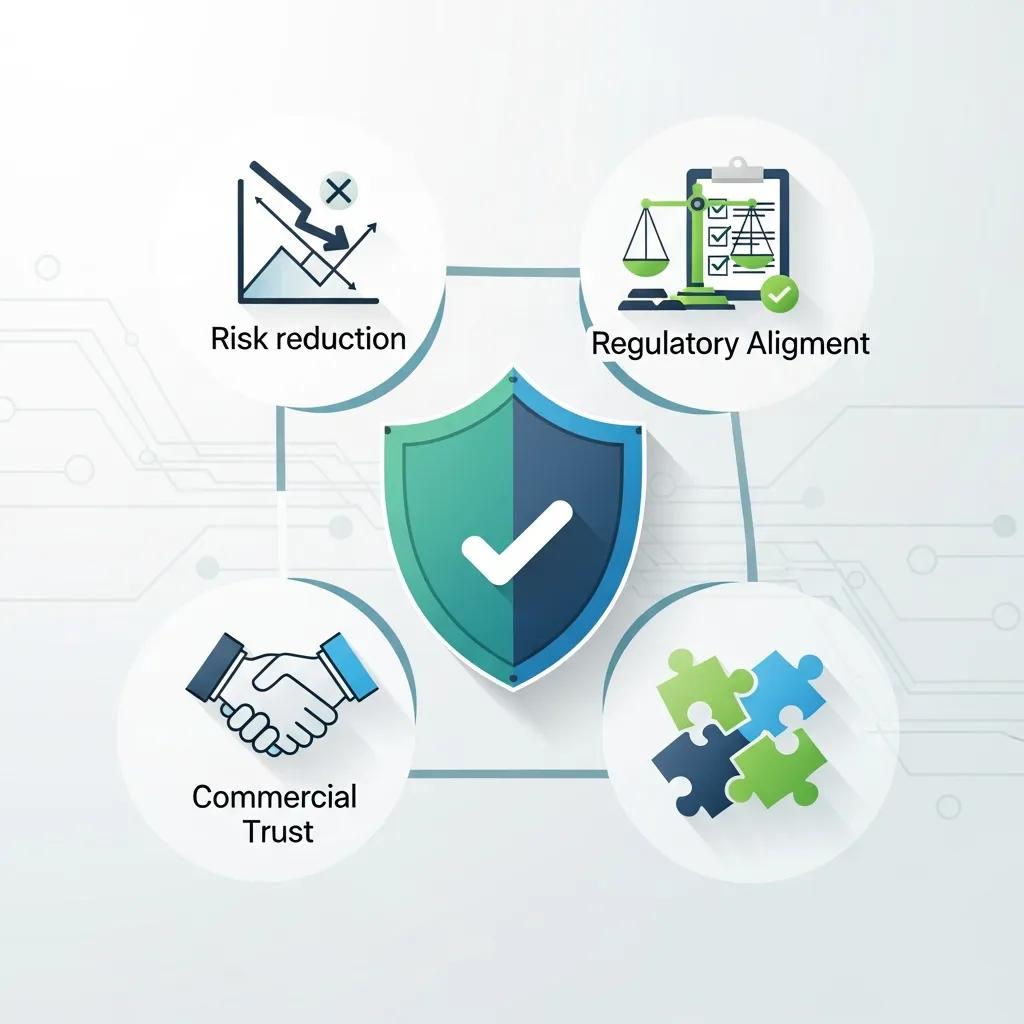
Certification delivers measurable risk reduction, clearer regulatory alignment and commercial advantage by providing independent assurance of your ISMS. It helps organisations reduce incident frequency and impact through documented risk treatment, evidence-based controls and a culture of continual improvement. The standard supports GDPR and NIS2 expectations by requiring documented controls, breach readiness and supplier oversight, which lowers regulatory exposure. Beyond compliance, certification can shorten procurement cycles, act as a trust signal in bids, and sometimes reduce cyber insurance costs when insurers accept an accredited certificate as proof of controls. The table below summarises these benefits to help decision-makers weigh the impact.
Each certification benefit ties to measurable business outcomes and practical examples for SMEs.
Benefit | Business impact | Example / metric |
|---|---|---|
Risk reduction | Fewer incidents and faster recovery | Incident response plan reduces outage time by measured SLA |
Regulatory alignment | Easier GDPR / NIS2 evidence collection | Documented DPIAs and PIs support audits |
Commercial trust | Better success in tenders and supplier checks | Accredited certificate included in RFP responses |
Operational resilience | Stronger continuity and monitoring | Internal audit cycle finds and corrects control gaps |
This table shows how controls translate into business outcomes, making the investment case for an ISMS and the documents auditors expect. The next section explains how ISO 27001 supports regulatory compliance and data protection duties.
How ISO 27001 certification strengthens regulatory compliance and data protection
ISO 27001 gives a control and evidence framework that aligns with GDPR principles — confidentiality, integrity and availability — by requiring documented risk assessment, access controls, encryption where appropriate and incident response processes. For SMEs, practical steps include mapping personal data flows, recording lawful bases for processing and noting technical controls that mitigate risks; these items become audit evidence during certification or regulatory review. Useful evidence includes the risk register, DPIA cross-references, access logs and management review minutes — all demonstrate a proactive compliance stance. A simple checklist helps teams focus on high-impact tasks before audit, which we cover next alongside the commercial benefits of certification.
How ISO 27001 builds client trust and competitive advantage
An accredited ISO 27001 certificate is a third-party assurance that your company manages information security to an international benchmark. That makes it easier to qualify for tenders and respond to supplier-assurance requests. Use certification status in proposals and security questionnaires to shorten due diligence and reduce repetitive evidence requests. In crowded markets, certification differentiates you where customers value secure data handling and supply-chain resilience. Pairing a certificate with concise supplier-security statements turns compliance into a visible commercial asset and supports stronger negotiation on contract terms. The following section provides a step-by-step roadmap to deliver these benefits.
Step-by-step phases to implement ISO 27001:2022 successfully
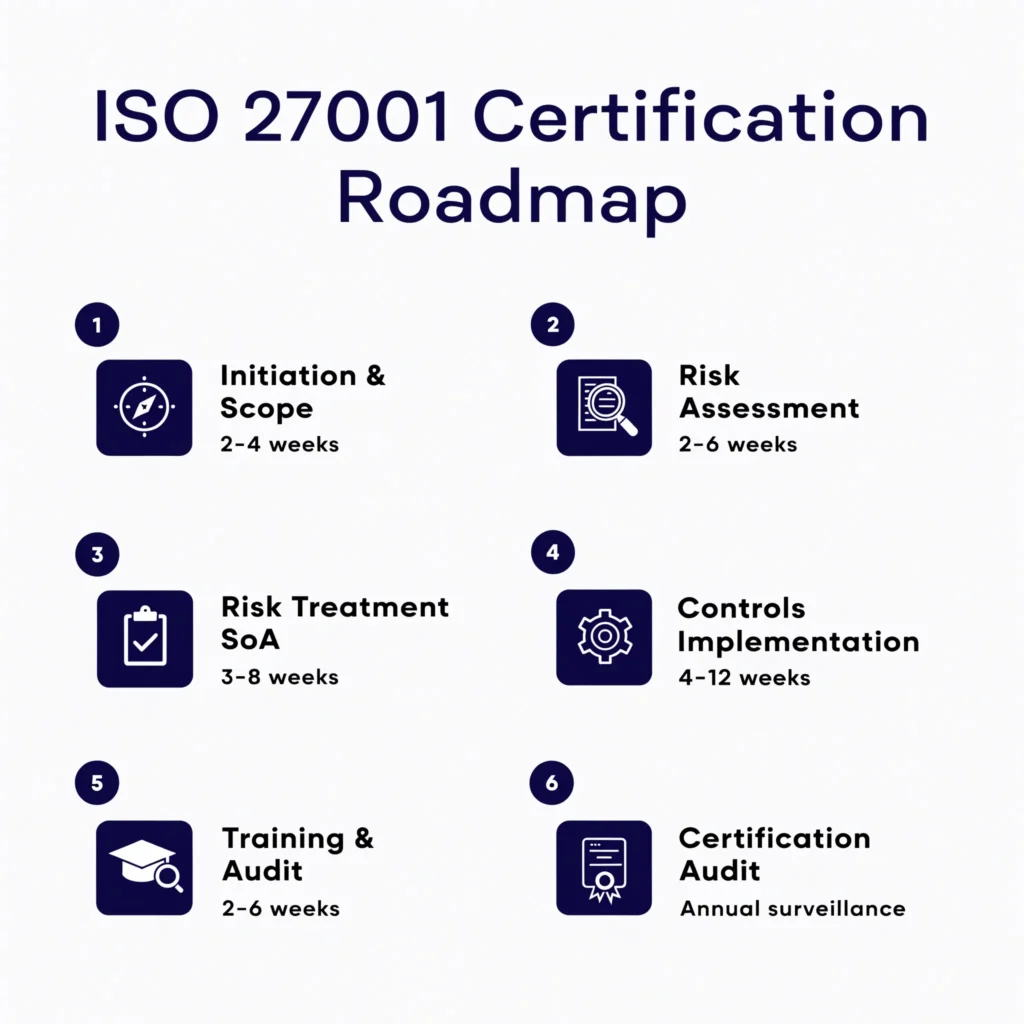
A practical ISO 27001 project follows six clear phases, from planning and scoping through risk treatment, controls implementation and certification readiness. This phased approach creates manageable workstreams and measurable deliverables at each stage, reducing audit surprises and allowing staged investment. Each phase should produce tangible outputs — scope statement, risk register, SoA, policies, evidence of controls and internal audit reports — so progress is auditable and defensible. Below is a concise roadmap commonly used by UK SMEs and organisations pursuing certification.
Use this roadmap to structure your ISMS project.
Initiation and Scope: Define context, interested parties and ISMS boundaries; appoint an ISMS lead.
Risk Assessment: Identify assets, threats and vulnerabilities; score likelihood and impact, then prioritise.
Risk Treatment and SoA: Select controls, create the Statement of Applicability and implement treatments.
Controls Implementation: Deploy policies, procedures and technical measures; record evidence.
Training and Internal Audit: Build competence, run internal audits and close nonconformities.
Certification Audit: Complete Stage 1 documentation review and Stage 2 on-site or remote evidence assessment, then enter surveillance cycle.
This roadmap gives a clear route to certification while supporting accountability and phased spending. The table below maps phases to common deliverables and timelines so teams can plan resources and expectations.
Phase | Key activities | Deliverables / timeline estimate |
|---|---|---|
Initiation & Scope | Stakeholder analysis, scope statement | Scope doc, ISMS charter — 2–4 weeks |
Risk Assessment | Asset register, scoring matrix | Risk register — 2–6 weeks |
Risk Treatment & SoA | Control selection, SoA population | SoA and treatment plans — 3–8 weeks |
Controls Implementation | Policies, technical controls, training | Policies, evidence logs — 4–12 weeks |
Internal Audit & Review | Audit schedule, corrective actions | Audit reports, management review — 2–6 weeks |
Certification Audit | Stage 1 & Stage 2 preparation and audit | Certification decision, then surveillance annually |
Use this phase table to align resourcing and timelines for small and medium organisations and create realistic project plans. The next sections explain how to define scope and run a robust risk assessment, with practical checklists.
How to define ISMS scope and organisational context effectively
Good scoping starts by mapping business processes and information flows to see where data is created, stored, processed or transmitted, then drawing boundaries that match your resources and risk appetite. Involve senior stakeholders, IT, legal and operations so the scope captures critical assets like cloud services, third-party processors and on-prem systems — this avoids common errors such as leaving out contracted services or remote devices. Keep a scoping checklist that records the scope rationale, excluded activities with justification, and interested parties; auditors often request this in Stage 1. For SMEs, a pragmatic scope focused on core services and critical data reduces complexity and speeds readiness.
What is the process for conducting a comprehensive ISO 27001 risk assessment?
A thorough risk assessment follows a clear sequence: identify assets, analyse threats and vulnerabilities, estimate likelihood and impact, calculate risk ratings, and choose treatments based on acceptance criteria. A simple scoring matrix (for example, 1–5 for likelihood and impact) creates prioritised risks that feed the risk treatment plan and the Statement of Applicability, linking controls to specific risks. Practical tools range from spreadsheet-based registers to lightweight GRC platforms; each risk entry should include an owner, treatment action and review date. Record the rationale for accepted residual risk and map it to controls so audit evidence is robust and defensible.
How to develop and implement ISO 27001:2022 controls and documentation
Converting Annex A controls into operational policies, procedures and evidence is where projects either move quickly or get held up. Clear templates and owned responsibilities reduce rework. Link each control to a policy or procedure, assign an owner and attach measurable evidence such as logs, change records or training completion. For SMEs, start with concise, role-focused documents (access control, asset management, backup, incident response) and use templates that create audit-ready artefacts without unnecessary complexity. The next section lists Annex A categories with practical examples to turn intent into daily practice.
Building a robust ISMS needs a systematic approach — structured methods can significantly speed up compliance and documentation work.
Structured method for ISO 27001 ISMS compliance This chapter presents ISMS-CORAS, an extension of the CORAS risk method that supports ISO 27001. ISMS-CORAS provides techniques and guidance for setting up an ISO 27001-compliant ISMS and the artefacts needed for required documentation.
Categories and practical applications of Annex A controls
Annex A in ISO 27001:2022 groups controls into four categories — organisational, people, physical and technological — each needing tailored measures. Organisational controls cover governance and supplier management and are implemented via policies and contract terms; people controls cover awareness, background checks and role definitions and are delivered through HR and training processes. Physical controls include facility access and environmental protections, evidenced by access logs and maintenance records. Technological controls cover encryption, logging, endpoint management and cloud configuration, verified by technical logs and monitoring dashboards. Below is a compact table showing control categories, tips and SME-friendly examples.
Use these implementation tips to convert Annex A categories into concrete actions your teams can follow.
Control category | Implementation tip | Practical example / tool |
|---|---|---|
Organisational | Assign ownership and document policies | Supplier checklist, governance register |
People | Make role-based access and awareness mandatory | Onboarding checklist, training records |
Physical | Record access and environmental controls | Visitor logs, CCTV retention policy |
Technological | Automate patching, logging and backups | SIEM logs, cloud configuration baselines |
Breaking Annex A into these workstreams helps teams own deliverables and collect clear evidence for auditors. The next section explains how to create and keep the Statement of Applicability (SoA) up to date.
How to create and maintain the Statement of Applicability
The Statement of Applicability (SoA) lists which Annex A controls you implement, which you exclude and the reason for each choice; it ties controls back to risk treatment and evidence. Populate the SoA by mapping each control to a risk or business need, add a short justification for inclusion or exclusion and reference the evidence (policy, procedure, log) that shows it operates. Keep version control and a review cadence — typically aligned with the annual management review or after major scope or infrastructure changes — so the SoA stays current. A clear SoA helps during certification and keeps operational responsibilities visible.
What to expect during the ISO 27001 certification audit and ongoing maintenance
Preparing for certification means compiling a concise set of documents and operational evidence so auditors can confirm the ISMS works as described. Stage 1 reviews documentation and readiness — scope, SoA, policies, risk register and internal audit results — while Stage 2 checks controls operate effectively through interviews, records review and evidence sampling. Common findings include missing evidence of control operation, weak risk acceptance rationale or gaps in training records; resolving these before Stage 2 reduces delays. After certification, surveillance audits verify continued compliance and drive continual improvement. The next section breaks down the audit stages and a pre-audit checklist.
Stages and requirements of the certification audit process
Certification usually starts with a Stage 1 readiness review followed by a Stage 2 on-site or remote assessment to confirm controls are implemented, then scheduled surveillance audits to confirm maintenance. Stage 1 checks documentation exists and that scope and SoA make sense; Stage 2 tests operational effectiveness by sampling logs, incident records and interviewing control owners. Typical pre-audit checklist items include a current risk register, SoA, evidence of internal audits, training records and an incident response example or table-top exercise. Preparing these items in an indexed evidence pack speeds the auditor’s work and cuts the chance of nonconformities.
Pre-Audit Checklist for Stage 1 and Stage 2
Current risk register: a live record of identified assets, threats, likelihood/impact scores and treatment decisions
Statement of Applicability (SoA): the full list of included and excluded Annex A controls with justifications and evidence references
Evidence of internal audits: completed audit reports showing scope, findings and corrective actions
Training records: documented completion of role-based security awareness and training sessions
Incident response example or table-top exercise: a worked incident scenario or rehearsal demonstrating the response process in practice
How to maintain compliance with internal audits and continual improvement
Ongoing compliance relies on an internal audit programme that samples control operation, a corrective-action process that tracks root causes and closure, and management reviews that set ISMS objectives based on performance data. Rotate audits across control domains so every area gets reviewed within the certification cycle; corrective actions should include owners, deadlines and verification steps. Continual improvement shows up as recorded improvements, updated risk assessments and follow-up audits that confirm remediation. Well-documented cycles are the core of surveillance evidence and show the ISMS is active, not just paperwork.
How does Stratlne Certification Ltd. support your ISO 27001:2022 journey?
Stratlne Certification Ltd. provides accredited ISO 27001:2022 certification audits with a service model designed to reduce administrative overhead for SMEs and larger organisations. Their UK-relevant benefits include accredited certification, local audit teams with global reach, an approach that combines AI tools with experienced auditors, and SME-focused programmes with transparent fixed-fee quotes and an assigned account manager to simplify the process. Organisations working with Stratlne usually get an account manager to coordinate scheduling and evidence, local auditors who understand UK regulation and fixed-fee quotes that aid budgeting. The following sections explain those SME features and how global and innovative capabilities translate into practical advantages.
What unique value does Stratlne offer UK SMEs?
Stratlne’s SME programmes reduce administrative burden through account-manager coordination, fixed-fee quotes for budgeting clarity, and tailored approaches that prioritise essential controls to shorten time-to-certification. An account manager centralises communications with auditors and helps assemble the evidence pack, cutting the time SMEs spend on audit logistics so internal teams can focus on controls. Fixed-fee quotes give pricing transparency for procurement and planning, while phased SME programmes match smaller organisations’ capacity. Together, these features help UK SMEs certify with less disruption and clearer timelines.
How Stratlne’s global reach and innovative audit approach benefit you
Stratlne combines local audit teams with global accreditation, giving consistent audit methods across jurisdictions while supporting multi-language audits and cross-border evidence collection for international operations. Their approach — using AI-assisted audit tools alongside experienced auditors — improves consistency of evidence collection and reduces time on routine checks, letting auditors focus on higher-risk areas. For organisations operating in multiple countries, this model reduces duplicated audit work and gives operational consistency; accreditation reassures clients and regulators the certificate meets recognised standards. These capabilities make audits more efficient and clearer to maintain.
Frequently Asked Questions
What are the costs associated with ISO 27001:2022 certification for SMEs?
Costs vary depending on organisation size, operational complexity and ISMS scope. SMEs should budget for consultancy, training, documentation work and the certification audit itself, plus ongoing costs for internal audits and continual improvement. We recommend getting fixed-fee quotes from certification bodies to manage budget and expectations more predictably.
How long does the ISO 27001 certification process take for SMEs?
Timeframes range from a few months to over a year, based on readiness and ISMS complexity. The process includes initiation, risk assessment, controls implementation and internal audits before the certification audit. SMEs that follow a structured roadmap and allocate resources to each phase can accelerate the timeline; organisations starting from scratch will typically need more time to produce the required documentation and evidence.
What are the common challenges SMEs face when implementing ISO 27001:2022?
Common challenges include limited resources, lack of in-house expertise and resistance to change. Scoping the ISMS effectively can be hard — teams may miss critical assets or risks — and translating Annex A controls into practical measures often causes delays. To overcome these issues, consider external consultancy, use SME-focused implementation models and engage staff through targeted training and awareness.
How can SMEs ensure ongoing compliance after certification?
To stay compliant, set up a solid internal audit programme that regularly checks control effectiveness, track corrective actions, hold management reviews and refresh risk assessments as needed. Continual staff training and awareness help maintain a security culture. Keep an eye on regulatory changes and best practice updates so your ISMS stays effective over time.
What role does employee training play in ISO 27001:2022 compliance?
Training is essential — it ensures staff understand their security responsibilities and reduces human error. Regular sessions raise awareness of risks, policies and procedures and keep teams updated on new threats and compliance changes. Investing in training improves ISMS effectiveness and reduces incident likelihood.
Can ISO 27001:2022 certification help with GDPR compliance?
Yes. ISO 27001:2022 offers a framework for managing information security risks that aligns with GDPR principles such as data protection by design and by default. Implementing ISO controls demonstrates proportionate measures to protect personal data and can serve as evidence of good practice during audits or regulatory reviews.
Conclusion
Implementing ISO 27001:2022 gives UK SMEs a clear, structured way to protect information, meet compliance obligations and build client trust. By following a phased roadmap and using practical templates and ownership, organisations can reduce risk and show they take security seriously. Working with experienced partners can smooth the certification journey and support ongoing compliance. Start your ISMS work today to realise the benefits of a robust, auditable information security system.