
ISO 9001 Audit Checklist: Practical Steps to Certification Success

Preparing for an ISO 9001 audit doesn’t have to be stressful. With a clear, repeatable audit checklist you turn the standard into verifiable actions — making certification achievable and less disruptive. This guide explains what an ISO 9001 audit checklist looks like, details the preparation stages, and supplies ready-to-use templates, sample audit questions and document-control tips so your internal audits produce certification-ready evidence. We also show how to map ISO clauses to verifiable checks, run effective internal audits and apply risk-based thinking to prioritise corrective actions. If you prefer outside help, Stratlne Certification Ltd. is presented here as an accredited partner offering AI-assisted audit tools and SME-focused services to request quotes or book audits. Read on for a step-by-step checklist, mandatory document lists, internal audit scripts and pragmatic next steps to achieve ISO 9001 readiness.
What is an ISO 9001 Audit Checklist and Why is it Essential?
An ISO 9001 audit checklist breaks the standard into concrete verification points: documents to show, records to inspect and interview prompts to use. In practice you convert each clause into one or more checklist items that state the expected evidence and acceptance criteria. For SMEs this clarity reduces preparation time, assigns responsibilities and makes surveillance audits predictable instead of disruptive. A good checklist also feeds continuous improvement by converting findings into tracked corrective actions, strengthening management review and operational resilience. Below are the primary benefits to keep front of mind when you design your checklist, followed by a practical example.
This checklist serves three main purposes:
Clause-to-Evidence Mapping: every requirement links to specific documents or records.
Faster Audits: auditors and staff follow the same evidence trail, reducing interview time.
Continuous Improvement: findings convert into tracked corrective actions and closure evidence.
Together these functions make the checklist both an operational tool and the backbone of audit readiness. Next we explain how to map clauses to verifiable QMS evidence.
How Does the Audit Checklist Ensure QMS Compliance?
An effective checklist maps ISO clauses to tangible evidence — procedures, records and observations — and it defines acceptance criteria for each check. For example, clause 7.2 (competence) becomes a checklist item asking for training records, competence assessments and evidence that training was effective; verification includes record review and brief interviews with managers. The typical mapping is clause → control point → evidence type → acceptance criteria. That approach removes ambiguity, makes audits reproducible across different auditors and clarifies what to collect before the audit day. The following section describes the practical, stage-by-stage preparation process.
What Are the Key Steps in ISO 9001 Audit Preparation?
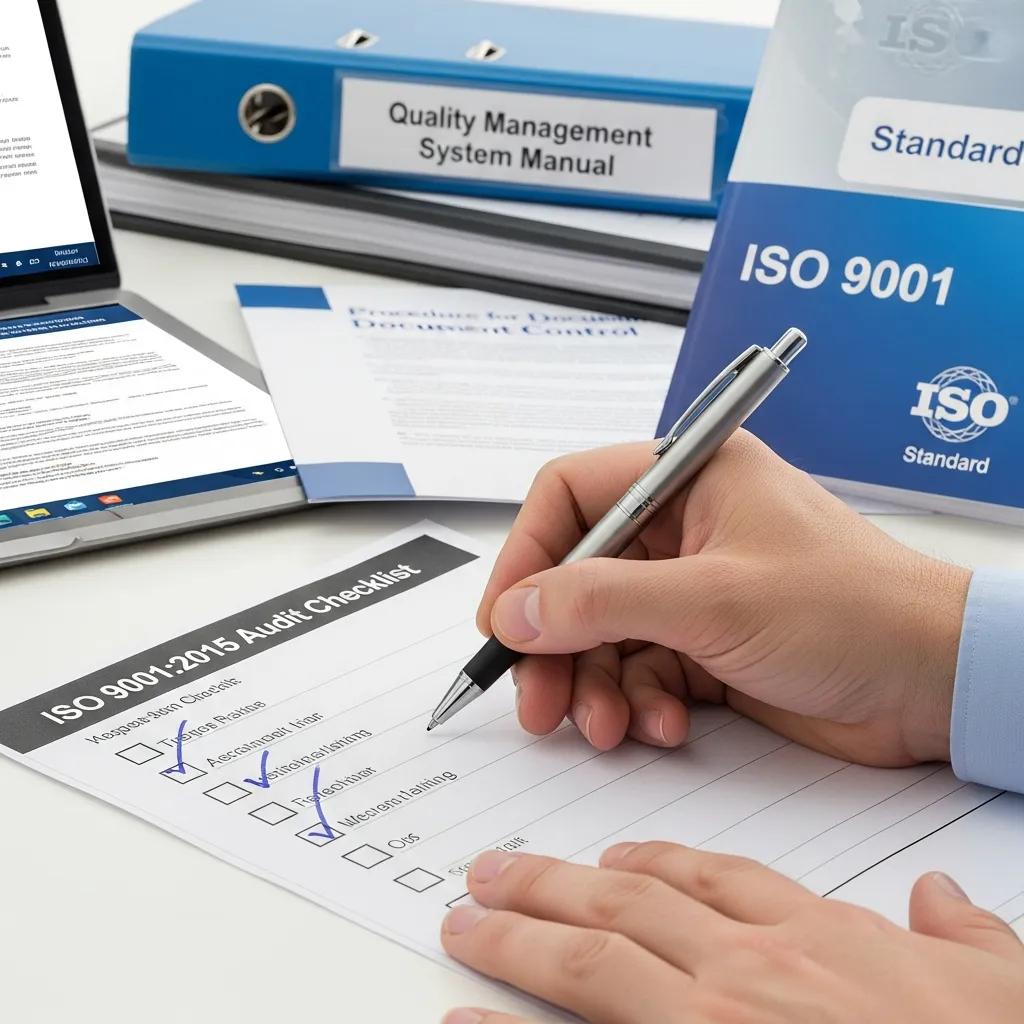
Audit preparation follows a straightforward sequence: understand the requirements, run a gap analysis, prepare documented information, complete internal audits and close actions through management review. Each phase produces deliverables that feed the next — gaps shape documentation, documents support internal audits, and audit results feed management review. This staged approach creates a controlled path to show conformity at certification or surveillance audits. Below is a short checklist of the core stages and an EAV-style table that helps plan outputs and timelines.
Follow these five core steps:
Understand Requirements: map clauses 4–10 to your processes.
Gap Analysis: compare your current state with ISO requirements and record the gaps.
Documented Information: create required and supporting documents and evidence.
Internal Audit: run audits to verify controls and log nonconformities.
Management Review & Closure: prioritise and close corrective actions with top management oversight.
Each step builds on the last and prepares the organisation for a smooth external audit. The table below summarises typical outputs and purposes by stage.
Preparation Stage | Purpose | Typical Output |
|---|---|---|
Understand Requirements | Turn ISO clauses into process-level checks | Clause mapping matrix and checklist draft |
Gap Analysis | Pinpoint nonconformities and documentation shortfalls | Gap report with prioritised findings |
Documented Information | Create the documents and records auditors expect | Policies, procedures, records and templates |
Internal Audit | Confirm controls work and identify corrective actions | Internal audit reports and recorded NCs |
Management Review & Closure | Secure top management oversight and close NCs | Management review minutes and corrective action logs |
This stage-by-stage view helps you assign owners and schedule tasks; the following sections cover clause mapping and practical gap analysis techniques.
How to Understand ISO 9001:2015 Requirements Clause-by-Clause?
Translate clauses 4–10 into plain-language responsibilities and short checklist items that match your organisation. For example: clause 4 (context) becomes checks for stakeholder analysis and scope definition; clause 5 (leadership) checks the quality policy and visible leadership involvement; clause 6 (planning) looks for risk registers and quality objectives; clause 7 (support) covers competence, infrastructure and documented information; clause 8 (operation) verifies operational controls; clause 9 (performance evaluation) checks monitoring, metrics and internal audits; clause 10 (improvement) examines nonconformity handling and corrective actions. Aim for 1–2 verifiable checklist items per clause so auditors can quickly confirm evidence. This translation reduces interview uncertainty and creates a reliable evidence trail.
That clause mapping naturally leads into a focused gap analysis to identify which clauses need attention.
How to Conduct a QMS Gap Analysis and Define Audit Scope?
Run a gap analysis in four practical steps: collect existing documents and records, map them to clause-specific checklist items, score conformity (conformant / partial / nonconformant) and prioritise fixes by risk and resource impact. Set a realistic scope for the certification type — define organisational boundaries, included processes and locations, and justify any exclusions. Common findings include missing procedures, incomplete records and inconsistent process controls; treat high-risk gaps (for example, uncontrolled operations or missing corrective actions) first. A simple scoring matrix helps focus resources on fixes that give the biggest compliance benefit before internal audits. Clear scope definition reduces surprises during the external audit and focuses evidence collection on what auditors will check.
Research supports gap analysis as an effective checklist-based method to assess readiness for ISO 9001:2015 certification.
ISO 9001:2015 Certification Readiness & Gap Analysis Checklist
This study uses a gap analysis checklist derived from ISO 9001:2015 requirements to assess a company’s readiness for certification. The checklist quantifies conformity and highlights areas needing improvement, providing a readiness score for JP-GRAHA (PT Jasaraharja Putera) ahead of certification.
Outputs from a clear gap analysis feed directly into the documentation phase, covered next.
How to Develop and Manage ISO 9001 Documentation for Audit Readiness?
Documentation for ISO 9001 readiness means producing the necessary documented information and controlling it so records are current, accessible and auditable. Practically, that means simple documented processes, versioned records, access control and retention rules so auditors find clear, traceable evidence of responsibilities and controls. For SMEs, keep documentation lean and process-focused rather than building oversized manuals — provide the minimum evidence needed to demonstrate conformity. The table below lists mandatory and recommended documents with examples to help you prioritise creation and retention.
Document | Required / Recommended | Typical Contents / Example |
|---|---|---|
Quality Policy | Required | Commitment statement and measurable intent |
Scope of QMS | Required | Boundaries, exclusions and rationale |
Quality Objectives | Required | Measurable targets, owners and review dates |
Procedures (e.g., Control of Documented Information) | Recommended | Process steps, responsibilities and version control |
Records (training, calibration, audit reports) | Required | Evidence of activity with dates and signatures |
Process Maps / Work Instructions | Recommended | Operational steps aligned with clause 8 controls |
Organised, version-controlled documents make evidence retrieval simple on audit day and reduce stress. The next subsections list mandatory records and document-control tactics.
What Are the Mandatory ISO 9001 Documents and Records?
Mandatory documented information includes the quality policy, the QMS scope, quality objectives and records that prove conformity and effective operation — for example internal audit reports, training records and corrective action logs. These items demonstrate leadership commitment, monitored performance and improvement activity. Auditors commonly request management review minutes, internal audit findings, objective monitoring data and records showing corrective action closure. SMEs often benefit from indexed folders or a simple digital index to speed evidence retrieval and meet retention expectations. Clear, concise records reduce ambiguity and speed up auditor verification.
These mandatory items form the backbone of your document control system, outlined next.
How to Maintain Effective Document Control During Audits?
Effective control relies on versioning, controlled distribution and a master index that maps documents to ISO clauses so auditors can quickly find evidence. Practical steps include a single source of truth for controlled documents, a change log for revisions, role-based access permissions and a straightforward folder and naming convention that includes version and date. On audit day present a short master index listing where each required record is held and who owns it — this often shortens auditor queries and shows systematic control. For digital files ensure backups and readable timestamps; for physical records keep originals or certified copies where necessary. Establish these controls well before the audit to avoid last-minute searches and to build confidence during interviews.
Well-managed documents make internal audits more reliable — the next section explains that process.
How to Conduct an Effective ISO 9001 Internal Audit?

Internal audits check that your QMS meets ISO 9001 requirements and that controls work in practice. The mechanism is a planned, objective assessment against your checklist with evidence-based findings and tracked corrective actions. The benefit is twofold: internal audits reveal issues before certification and provide objective inputs for management review to prioritise improvements. Competent internal auditors use sampling, document review and interviews to confirm conformity and test effectiveness. The cycle follows planning, execution, reporting and follow-up — the subsections below include sample questions and a lifecycle you can adopt.
Core internal audit lifecycle steps:
Plan audits by process and risk exposure.
Execute using checklists and collect evidence.
Report findings with clear nonconformity descriptions.
Track corrective actions to closure and verify effectiveness.
These steps make internal audits a proactive improvement tool rather than a tick-box exercise. The sample questions below show how to answer auditor queries confidently.
What Are Common QMS Audit Questions and How to Answer Them?
Auditors commonly ask about leadership involvement, risk-based planning, competence, operational controls and corrective actions. Answer succinctly and evidence-first: name the control, point to the supporting document or record (for example management review minutes, risk register or training record) and say how you measure effectiveness. Typical questions include: “How does top management show commitment to the QMS?”, “How are risks and opportunities identified and treated?”, and “Can you show recent internal audit findings and corrective actions?” Preparing concise, evidence-linked responses in advance helps staff stay calm and consistent during external audits.
How to Plan, Execute, and Report Internal Audits Successfully?
Start with a risk-based audit plan, clear checklists, trained auditors and a standard report template capturing objective evidence, findings and categorised nonconformities. During audits collect evidence against checklist items, note observations and interview process owners. Produce a report that states nonconformities, suggests root causes and sets timelines for corrective actions. Follow-up must verify implementation and effectiveness to close the loop of clause 10. For SMEs, use a concise audit calendar focused on high-risk processes and simple tracking tools to monitor corrective action progress. A reliable audit cycle turns compliance work into measurable improvement.
How Can Stratlne's AI-Driven Tools Enhance Your ISO 9001 Audit Preparation?
Stratlne’s AI-driven tools speed checklist creation, flag likely gaps and include a scheduler that aligns internal and external audits with your team’s availability. Behind the scenes the tools map clauses to controls and detect anomalies across records, saving time and surfacing trending nonconformities earlier. For SMEs with limited resources, this helps prioritise corrective actions where they matter most. The table below summarises core tools and the benefits teams typically see when they adopt automated audit assistance.
The table below summarises core AI-driven tools, what they do and the practical benefits they deliver for audit readiness.
Tool | Capability | Benefit |
|---|---|---|
Interactive Checklist Generator | Automatically maps clauses to process checks | Reduces time spent creating and updating checklists |
Predictive Readiness Engine | Analyses records to highlight likely nonconformities | Helps prioritise corrective actions before audits |
AI Audit Scheduler | Matches audit dates to resource availability | Prevents scheduling conflicts and audit delays |
These capabilities let teams focus on remediation rather than manual checklist maintenance. The sections that follow describe SME benefits and how to use Stratlne’s interactive tools in practice.
What Benefits Do AI-Powered Audit Tools Provide for SMEs?
AI tools free SMEs from repetitive tasks, improve detection of recurring issues and prioritise corrective actions by risk and impact. For example, a tool that flags recurring nonconformities across audits helps you address root causes rather than isolated problems. The result is less time preparing for audits, clearer corrective-action plans and stronger evidence for external auditors. Smaller teams can reach audit readiness more predictably and present a more compelling management review package, increasing the chances of a smooth certification or surveillance audit.
How to Use Stratlne's Interactive Audit Checklist and Scheduler?
Begin by uploading your clause mapping and a sample of key records. Let the tool generate checklist items, run the predictive readiness scan to highlight priorities, then use the scheduler to propose audit dates according to resource availability. Outputs typically include a prioritised list of nonconformities, suggested action owners and a calendar of audit milestones. Assign owners, set realistic due dates and track closure inside the tool to build an audit-ready evidence trail. If you plan external certification, schedule a pre-assessment to reduce the risk of last-minute findings. These steps turn AI insights into executed actions that improve readiness.
Why Choose Stratlne for ISO 9001 Certification in the UK?
Stratlne Certification Ltd. pairs accredited certification services with AI-assisted audit support, multilingual auditors and SME-focused programmes — offering a streamlined route to ISO 9001 certification across the UK, Ireland and mainland Europe. The twin strengths are accreditation and innovation: accreditation ensures impartial, internationally recognised certification; AI tools reduce prep time and improve readiness. For SMEs, Stratlne’s tailored programmes and clear scheduling reduce administrative load, offering straightforward quotes and focused audits for smaller scopes. The bullets below outline Stratlne’s core advantages and what they mean for organisations preparing for ISO 9001 audits.
Accredited certification that delivers recognised credentials.
AI-assisted audit tools to speed checklist creation and readiness checks.
SME-focused support and multilingual audit teams for wider coverage.
Clear quoting and scheduling to simplify audit logistics.
These strengths help reduce friction and make certification projects more predictable. The next section summarises Stratlne’s accreditation and innovation credentials.
What Makes Stratlne an Accredited and Innovative Certification Body?
Stratlne is an accredited certification body offering audits across ISO 9001, ISO 14001, ISO 27001 and ISO 45001, and it applies AI-driven tools to improve efficiency. Accreditation provides confidence that certification decisions are impartial and internationally recognised; the AI toolset speeds checklist assembly and flags likely findings ahead of audits. Operating across the UK, Ireland and mainland Europe, Stratlne’s teams include multilingual auditors to support diverse operations. Together, accreditation and innovation create a more efficient certification pathway for organisations.
How Does Stratlne Support UK SMEs Through the Certification Process?
Stratlne helps SMEs with simplified quoting, flexible scheduling and audit plans tailored to smaller operational scopes. Typical SME support includes a clear quote request process, optional pre-assessments and AI-enabled checklists that focus necessary corrective actions — shortening the time from initial contact to audit-ready status. To start, organisations can contact Stratlne Certification Ltd. for a tailored quote or to book an audit appointment. This practical support reduces administrative overhead and provides a straightforward path to certification for resource-constrained teams.
If you’re ready to proceed, use the contact details listed to request a quote or book an audit with Stratlne Certification Ltd.
Request a tailored quote via the published email address.
Book audit scheduling or ask about SME programmes by phone.
Enquire about AI-driven pre-assessment options to prioritise corrective actions.
These steps make it clear how to move from preparation to booking once you’ve completed the checklist and internal audits.
Frequently Asked Questions
What is the role of top management in the ISO 9001 audit process?
Top management must demonstrate visible leadership and commitment to the QMS. That includes setting and communicating the quality policy, ensuring objectives align with the organisation’s strategy, and providing the resources needed for effective implementation. Auditors look for evidence of this leadership in management review minutes, resource allocations and how quality is embedded in business decisions.
How often should internal audits be conducted for ISO 9001 compliance?
Internal audits should run at planned intervals, typically at least annually, but frequency depends on your organisation’s size, process complexity and past audit results. Use risk assessment to prioritise high-impact areas — higher-risk or changed processes may need more frequent audits to maintain readiness.
What are the common challenges faced during ISO 9001 audits?
Common challenges include incomplete documentation, limited employee awareness of the QMS and weak management engagement. Misaligned processes or resistance to change can also slow corrective actions. Address these by keeping documents concise, training staff on key QMS points and ensuring leadership visibly supports improvement efforts.
How can organisations ensure effective corrective actions after an audit?
Adopt a structured approach: identify the root cause, define a clear action plan with owners and deadlines, implement the actions and verify their effectiveness. Record each step and follow up with verification or re-audit where needed. Transparent records and measured verification prevent recurrence.
What is the significance of risk-based thinking in ISO 9001 audits?
Risk-based thinking helps you identify and prioritise issues that could affect quality objectives. By assessing likelihood and impact, you can allocate resources to controls that matter most. Integrating risk management into your QMS makes decision-making more robust and improves audit outcomes.
How can technology assist in ISO 9001 audit preparation?
Technology streamlines checklist creation, document management and evidence collection. AI-driven tools can flag likely nonconformities, suggest priorities and provide audit scheduling — saving time and improving accuracy. Digital platforms also make tracking corrective actions and audit calendars easier to manage in real time.
Conclusion
Using a structured checklist makes ISO 9001 preparation clearer, faster and less stressful. Follow the staged approach in this guide, use risk-based thinking and, where useful, adopt AI tools to reduce manual work. If you’d like help, Stratlne Certification Ltd. offers tailored support to get you audit-ready. Contact Stratlne today to streamline your preparation and move confidently towards certification.