
Elevate Workplace Organization Using 5S Methodology Today

Implementing 5S: A Guide to Operational Efficiency and ISO 9001
5S is a simple, structured way to organise the workplace so teams work faster, waste less and stay audit-ready. This guide walks through what 5S means in practice, how each of the five steps works on the shop floor or in an office, and why a solid 5S programme makes ISO 9001 preparation much easier. Many organisations lose time and money to cluttered spaces, inconsistent routines and the search for tools — 5S fixes those issues by standardising the physical and visual environment so performance becomes visible and measurable. You’ll find the five S steps, clear benefits for UK businesses, clause-level links to ISO 9001, a phased implementation plan with checkpoints and metrics, common pitfalls and pragmatic fixes, plus how an accredited certification partner can support audit readiness. Practical checklists, quick-reference tables and ready-to-use lists are included to help both small teams and larger operations get started straight away.
Research consistently supports 5S as an effective foundation for improving workplace efficiency and productivity.
5S System: Introduction to Workplace Efficiency & Productivity
This paper introduces the 5S system — a structured method for organising and sustaining an efficient workplace. The five pillars — Sort, Set in Order, Shine, Standardize and Sustain — reduce waste and boost productivity using clear visual controls and tidy workspaces. Implementing 5S can cut space use, improve process flow and raise quality. It also creates a platform for other lean methods such as TPM, cellular manufacturing, just-in-time and Six Sigma. In short, 5S is a practical tool for strengthening organisational performance and competitiveness.
Optimizing Workplace Efficiency and Productivity: An Introduction to the 5S System, 2023
What is 5S Methodology? The Five Principles of Workplace Organisation
5S is a Lean-derived approach built on five Japanese terms — Seiri, Seiton, Seiso, Seiketsu and Shitsuke — that together create a disciplined, repeatable workspace. The idea is straightforward: remove what’s unnecessary, put what’s left where it’s needed, keep the area clean, lock in the improvements with standards and build the habits to sustain them. The result is less time spent searching, clearer visual controls and a work environment that supports consistent performance.
Use the short list below as a roll-out checklist for a pilot area.
5S workplace organisation comprises five sequential practices:
- Sort (Seiri): Remove non-essential items and record disposals in a red-tag register.
- Set in Order (Seiton): Give every tool and material a defined place to cut motion and retrieval time.
- Shine (Seiso): Clean and inspect regularly so faults are spotted early.
- Standardise (Seiketsu): Create visual standards and SOPs to hold improvements in place.
- Sustain (Shitsuke): Build training, audits and governance so gains last.
This sequence offers a practical roadmap for teams running 5S audits or short pilot events. Starting with Sort makes subsequent decisions — like red-tagging and disposition rules — much easier.
What does Sort involve in 5S implementation?
Sort (Seiri) is the cleansing phase: identify and remove items that don’t add value. Teams typically use red-tags to mark candidates for retention, storage or disposal, then record decisions in a red-tag register (location, reason, disposition). Benefits include lower inventory, fewer obstructions during inspections and faster task cycles because people stop hunting for tools. Good sorting produces auditable records and clears the area for effective Set in Order work.
How does Set in Order optimise workplace efficiency?
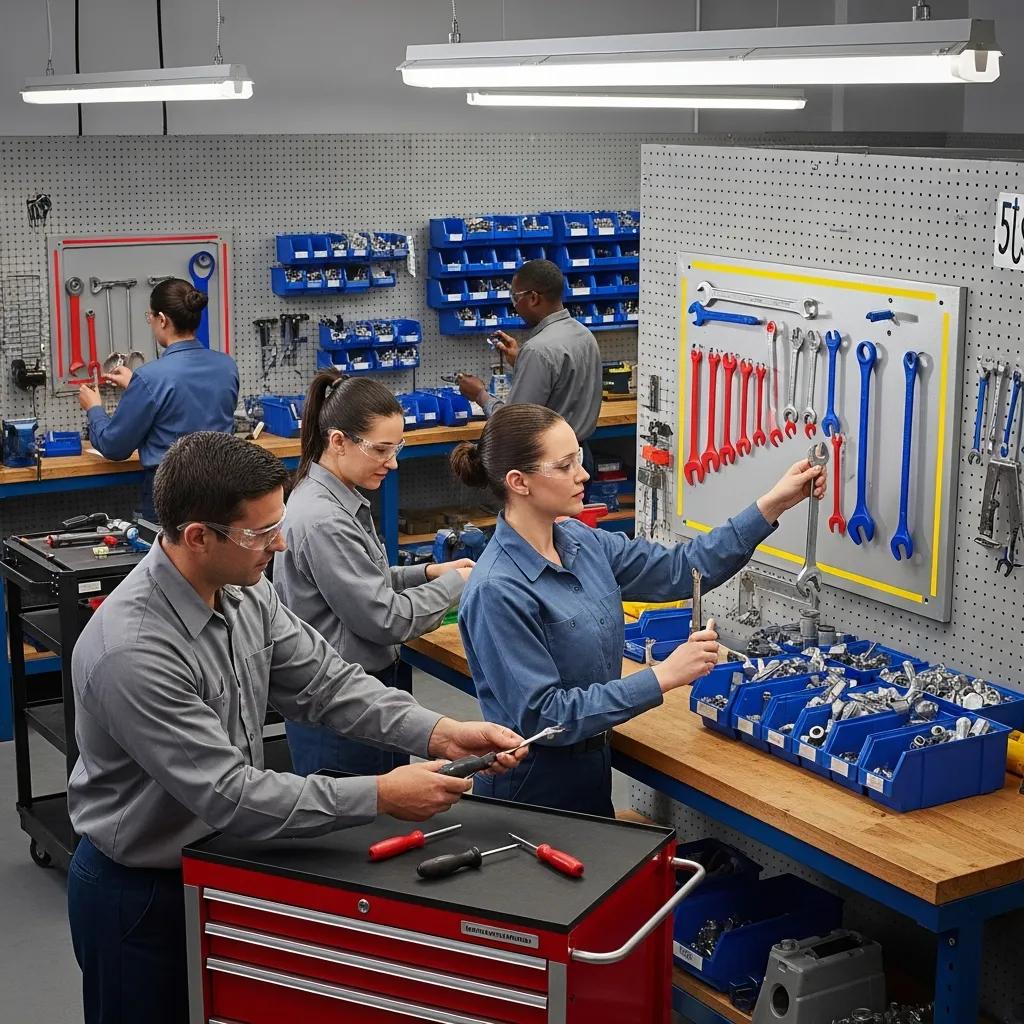
Set in Order (Seiton) means arranging retained items so each has a clear place and visual cue. Typical tools include shadowboards, labelled storage, floor markings and point-of-use inventory to reduce reach and strain. The tangible benefit is faster cycle times: a well-planned layout can cut search and motion significantly, boosting throughput and lowering error risk. Implementation actions include mapping frequent workflows, fixing locations for high-use items and trialling shadowboards while capturing time-savings during the pilot. Clear organisation reduces cognitive load and makes abnormalities visible during routine checks.
What are the Benefits of 5S for UK Businesses and Operational Excellence?
When embedded, 5S delivers measurable gains in productivity, safety, quality and staff engagement by turning the workplace into a controlled, auditable system that supports continuous improvement. Visual management, standard work and disciplined behaviours together reduce variability, improve inspection readiness and make defects easier to catch before they reach customers. UK organisations often report better use of floor space, quicker incident response and clearer audit evidence once 5S is in place.
Multiple studies show a consistent link between 5S implementation and measurable efficiency improvements.
5S Methodology and Workplace Efficiency
This study examines the relationship between 5S methodology and workplace efficiency in oil and gas firms in Rivers State. It considers 5S information management and office environments, with measures of workplace efficiency including resource and operational efficiency.
THE RELATIONSHIP BETWEEN 5
S METHODOLOGY AND WORKPLACE EFFICIENCY OF OIL AND GAS FIRMS IN RIVERS STATE, GO Okoro, 2024
The table below links each 5S principle to common benefits and measurable outcomes so teams can prioritise by expected impact.
This quick-reference table clarifies which areas to measure and establishes baselines for tracking improvement. Using these metrics helps teams quantify ROI and demonstrate operational excellence to stakeholders and auditors.
How does 5S improve efficiency, safety, and quality?
5S trims motion and search waste, removes hazards to improve safety, and makes defects visible through routine cleaning and inspection. Shine exposes leaks, wear or misalignment early; Standardise ensures corrective actions are recorded and repeated correctly. Trackable metrics include reduced downtime, fewer near-misses and improved first-pass yield. Capture before-and-after data during pilots and display results on performance boards to sustain momentum and win support to scale beyond the pilot area.
What cost reductions and employee engagement gains result from 5S?
Cost savings come from less scrap, lower rework, reduced inventory holding and less downtime. Engagement improves when staff take part in red-tag events and Kaizen workshops — involvement leads to ownership. Relevant KPIs include cost-per-unit, mean time to repair, inventory turns and employee suggestion rates. In many SMEs, a focused pilot shows payback within months where search time or defect rates were high. Framing gains as both financial and people-focused helps secure leadership backing for wider rollout.
How Does 5S Support ISO 9001 Certification and Quality Management Systems?
5S supports ISO 9001 by producing tangible, documented evidence of control over the work environment, standardised procedures and continual improvement. 5S generates artefacts — checklists, logs, photos and standards — that align with clauses on work environment, control of documented information and operational control. For auditors, visible standards and routine inspection records make it straightforward to verify effective process control and management review inputs.
Further analysis shows how 5S can be integrated with ISO 9001 requirements across diverse sectors, including education.
Integrating 5S Principles with ISO 9001 Requirements
This analysis examines the implementation of 5S principles alongside ISO 9001 requirements at the higher education level. It assesses how 5S supports ISO 9001 clauses and evaluates implementation performance.
The analysis of the implementation of 5-S principles integrated with ISO 9001 requirements at higher education level, R Nurcahyo, 2019
The table below maps typical ISO 9001 clauses to practical 5S activities so teams can align 5S evidence with auditor expectations.
This mapping gives a practical route to compliance: each 5S deliverable becomes evidence against the quality management system. Time-stamped photos and signed checklists from pilot phases strengthen the evidential chain for certification bodies.
Stratlane Certification Ltd. can review 5S artefacts and advise on audit-ready evidence. As an accredited certification body, we combine AI-driven audit tools with sector-experienced auditors to assess readiness and identify gaps. Our streamlined certification process and dedicated account managers help teams prioritise documentation and schedule corrective actions before formal assessment. Organisations can engage an accredited partner for an independent readiness check of their 5S implementation.
In what ways does 5S align with ISO 9001 requirements?
5S aligns with ISO 9001 by creating controlled, repeatable practices and traceable records that auditors expect. Standardise and Sustain produce written procedures, training records and audit logs that map to clauses on documented information and competence. Typical evidence includes visual standards, signed daily checklists and corrective action logs demonstrating problem detection and resolution. For audit readiness, collect representative artefacts from pilot areas and maintain a central folder mapped to clause numbers — that reduces auditor time and strengthens certification prospects.
How can 5S principles enhance ISO 27001 and ISO 42001 management systems?
Although focused on the physical workplace, 5S thinking translates well to information security and AI governance: organisation, labelling and standardisation improve secure document handling and dataset traceability. Set in Order and Standardise help create labelled storage and access rules that reduce information leakage and improve dataset provenance. Examples include secure, labelled storage for sensitive files and version-controlled datasets with clear ownership and access logs to meet ISO 27001 controls. Consistent documentation and dataset labelling also support ISO 42001 oversight and traceability. Applying 5S to information artefacts strengthens compliance across multiple standards.
What Are the Step-by-Step Phases to Implement 5S Methodology Successfully?
Use a phased approach — Plan, Pilot, Execute, Standardise and Sustain — to keep implementation manageable and measurable. Start with a baseline audit, pick a visible pilot area, run time-boxed Sort/Set/Shine events, document standards and then embed governance and KPI reviews. Define roles, responsibilities and training during planning so execution stays focused and accountable.
The implementation checklist maps phase, activity and deliverable:
This table gives a compact, audit-ready view of expectations and deliverables for each phase. Use the listed deliverables as acceptance criteria when moving between phases.
What are the key activities in Planning and Preparation for 5S?
Planning starts with a baseline assessment to capture the current state, stakeholder mapping to secure sponsorship and a training plan to equip the implementation team. Use evidence-driven planning: record cycle times, inventory levels and safety incidents to create a measurable baseline. Practical tasks include choosing a visible pilot area, scheduling red-tag events and naming a project sponsor and team leads. Clear planning lowers resistance and sets realistic, auditable timelines.
How to execute Sort, Set in Order, and Shine phases effectively?
Execution is hands-on: run structured red-tagging sessions with clear decision rules, implement Set in Order with visual controls and shadowboards, and embed Shine into daily cleaning and inspection routines. Clarify roles — assign owners for sorting, layout changes and cleaning — and capture evidence through photos, registers and checklists. Use time-boxed events to create urgency, trial layouts with quick A/B tests and put Shine inspections into start-of-shift routines. Before-and-after metrics collected during these events create strong evidence for stakeholders and feed the Standardise phase.
After practical implementation, many organisations benefit from a readiness review by an accredited assessor. Stratlane Certification Ltd. offers audit-readiness reviews using AI-driven tools to highlight documentation gaps and evidence shortfalls so teams can close issues before certification. A readiness review gives an independent view and a focused action plan to shorten the path to certification.
How to Standardise and Sustain 5S practices for continuous improvement?
Standardise by documenting SOPs, visual controls and a formal audit checklist. Sustain by setting a governance cadence with regular audits, performance boards and recognition schemes to keep behaviours consistent. Convert pilot learnings into repeatable artefacts — work instructions, training modules and visual KPI boards — that teams can replicate across sites. Effective sustainment techniques include monthly audits, a clear corrective action process and recognition for teams maintaining standards. A sample monthly review should cover evidence, KPI trends and Kaizen prioritisation to keep continuous improvement structured and measurable.
What Common Challenges Arise During 5S Implementation and How Can They Be Overcome?

Typical barriers include resistance to change, weak management sponsorship and slipping back into old habits after the pilot. Overcoming these requires early engagement, visible leadership and a data-driven governance model. The key is to involve people early, show quick wins and measure benefits that matter to stakeholders. Successful programmes combine clear communication, practical training and recognition so staff see real improvements in their day-to-day work. Below are practical approaches to keep the programme moving.
Common implementation challenges include:
- Resistance from staff who prefer established routines.
- Insufficient leadership sponsorship to resource ongoing audits.
- Loss of momentum after initial events when metrics are not tracked.
Calling out these issues helps teams focus mitigation efforts on communication and governance. Addressing them early increases the chance that improvements will stick.
How to manage resistance to change in 5S adoption?
Manage resistance by creating visible quick wins, involving frontline staff in pilot teams and linking 5S outcomes to everyday job simplicity and safety. Use participative change: involve operators in red-tag decisions, publish time-savings publicly and celebrate improvements. Practical tactics include short demonstration days, before-and-after metrics on performance boards and simple recognition for teams who maintain changes. Visible improvements in speed, ergonomics or safety turn sceptics into advocates and build momentum for wider rollout.
Why is management commitment crucial and how to sustain momentum?
Management commitment secures resources, enforces governance and keeps improvement work prioritised. Leaders who join audits, review metrics and allocate time for Kaizen signal priorities that teams follow. To sustain momentum, create a governance checklist, regular review meetings with KPI owners and a resourcing plan for audit cadence and training. When leadership stays visible and backs corrective actions, 5S moves from a project to everyday practice with lasting benefits.
How Can Stratlane Certification Ltd. Support Your 5S Journey Towards ISO Certification?
Stratlane Certification Ltd. is an accredited body offering ISO certification audits and readiness support, combining AI-driven audit tools with experienced industry auditors and wide geographic coverage. We audit to standards such as ISO 9001, ISO 27001 and ISO 42001, and we act as an information hub to help clients understand certification pathways. Our differentiators are AI-enabled evidence review, auditors with sector experience and a streamlined certification process supported by a dedicated account manager. Teams preparing 5S artefacts for certification can use our services to validate evidence and shorten the certification timeline.
What is Stratlane’s approach to quality and AI-driven audit services?
We use AI-driven tools alongside human auditors to improve efficiency and consistency while preserving accredited rigour. The blended approach lets AI surface documentation gaps and patterns across evidence, while auditors add professional judgement on context-specific risks and corrective actions. Our process emphasises clarity and coordination — an account manager supports logistics while local auditors bring sector knowledge. This mix helps organisations prepare 5S artefacts and quality management evidence in an audit-ready way.
How to request a quote or book an ISO certification audit with Stratlane?
To request a quote or book an ISO certification audit, contact Stratlane Certification Ltd. to arrange a readiness review that assesses 5S artefacts, documentation and audit evidence. Typical next steps are a readiness assessment, a prioritised action plan to close gaps and scheduling the formal certification audit with a dedicated account manager to coordinate logistics. Our streamlined process and AI-supported review help clients focus on corrective actions that matter and present demonstrable evidence to assessors. Organisations can request a quote and arrange a readiness review to move from a 5S pilot to certified quality management.
Frequently Asked Questions
What industries can benefit from implementing 5S methodology?
5S is versatile and applies across manufacturing, healthcare, education and service sectors. Each industry adapts the principles to its challenges — for example, cutting waste on production lines, improving patient safety in hospitals or organising administrative processes in education. The simplicity and flexibility of 5S make it valuable for any organisation focused on efficiency, safety and quality.
How long does it typically take to implement 5S in an organisation?
Timelines vary with organisation size, process complexity and employee engagement. A focused pilot can take a few weeks to a few months; rolling 5S out organisation-wide takes longer and needs ongoing training and reinforcement. Treat 5S as continuous improvement rather than a one-off project — practices evolve as teams learn.
What role does employee training play in the success of 5S implementation?
Training is essential. It ensures everyone understands the five steps and their role in sorting, organising, cleaning, standardising and sustaining. Well-trained teams contribute ideas, keep improvements alive and spot opportunities for further gains. Regular refreshers and practical coaching help embed the habits that make 5S stick.
Can 5S be integrated with other management systems beyond ISO 9001?
Yes. 5S complements systems such as ISO 27001 (information security) and ISO 42001 (AI governance). The core principles — organisation, labelling and standardisation — support secure document handling, dataset traceability and consistent processes across multiple standards, strengthening overall compliance.
What are some common mistakes to avoid during 5S implementation?
Avoid insufficient employee involvement, weak management support and failing to sustain gains after the initial rollout. Engage people from the start, secure visible leadership buy-in and set up governance to monitor progress. These steps help prevent a return to old habits.
How can organisations measure the success of their 5S implementation?
Measure with KPIs such as reductions in search time, improvements in safety incidents and increases in employee engagement. Track inventory levels, cycle times and defect rates before and after implementation. Regular audits and feedback sessions also show adherence to 5S and highlight areas for improvement, keeping continuous improvement on track.
Conclusion
5S is a practical, low-cost way to improve workplace efficiency, safety and quality. By organising the environment, standardising routines and building habits, organisations can unlock measurable productivity and engagement gains. If you’re preparing for ISO 9001 or simply want a more controlled, audit-ready operation, integrating 5S is a sensible first step. Contact our team at Stratlane Certification Ltd. to learn how we can support your 5S implementation and certification journey.