
Master Project Risk Management for Success

Implementing a Structured Framework for Project Risk Management
Project risk is any uncertain event or condition that can affect a project’s ability to meet its objectives. Managing those risks in a structured way reduces failures, cost overruns and exposure for stakeholders. This guide shows how a disciplined project risk approach — aligned to recognised frameworks and ISO standards — raises delivery confidence, supports compliance and produces measurable outcomes for complex programmes. You’ll get a concise project risk lifecycle (identify, analyse, respond, monitor), practical assessment techniques and response options, plus a clear explanation of how ISO standards such as ISO 31000, ISO 9001, ISO 27001 and ISO 42001 relate to project controls. We also cover sector-specific considerations for construction, IT and AI projects, and include templates and EAV comparisons to help with decisions. The focus is on practical steps, tools like risk registers and matrices, and the role certification plays in strengthening governance and stakeholder trust. Follow these frameworks and examples to move from reactive fixes to repeatable, auditable risk practice that improves outcomes and regulatory resilience.
What is project risk management and why it matters
Project risk management is the repeatable process of identifying, analysing, responding to and monitoring risks throughout the project lifecycle to protect scope, schedule, cost and quality. A clear cycle — identify, assess, plan responses and monitor — turns uncertainty into manageable decisions and measurable actions that preserve value. Good practice cuts unexpected delays, limits budget overruns and builds stakeholder confidence by making risk visible and owned. Repeating the process captures lessons and embeds controls, reducing the chance of the same problems recurring.
Stratlane Certification Ltd. acts as an external advisor and certification partner for organisations building ISO-aligned systems that embed these risk practices. As an accredited certification body using AI-assisted audit tools and experienced auditors, we help map management systems to project risk needs and provide independent certification that validates your controls. Once you’ve documented processes and gathered evidence, requesting a quote or booking an audit is a practical next step. The sections that follow define common risks and impacts so teams can prepare for that work.
How we define project risk and the main types
Project risk is an uncertain event or condition that can have a positive or negative effect on project objectives — though practice usually focuses on threats and on capturing opportunities. Common categories include technical risks (design faults, integration issues), financial risks (cost escalation, funding gaps), operational risks (resource shortages, supplier failure), regulatory/compliance risks, cyber and information security risks, and emerging AI-specific risks such as model bias or governance shortfalls. Risks can be expressed as conditions (ongoing environmental factors) or events (specific occurrences), which helps teams pick appropriate assessment and response methods. Clear categories ensure the right specialists review each risk and that controls are targeted.
Common impacts and typical challenges
When risks go unmanaged they often cause cost overruns, schedule slips, reduced scope or quality, regulatory breaches and reputational damage that affect future work. Teams commonly face late risk identification, weak stakeholder engagement, unclear ownership and insufficient contingency — issues that can turn small threats into major incidents. Evidence from industry studies shows proactive risk management reduces severe failures, improves on-time delivery and boosts return on investment, provided leadership supports early adoption. A short governance diagnostic (roles, reporting lines, contingency budgets) typically highlights where change will yield the fastest improvements.
Risk management delivers measurable value by reducing high-impact failures:
- Cost control: early mitigation cuts unplanned spend and rework.
- Schedule protection: proactive measures limit critical-path delays.
- Compliance assurance: consistent controls lower the risk of regulatory breaches.
That sets the scene for how ISO 31000 provides a principle-based foundation for project risk practice.
How ISO 31000 guides project risk management
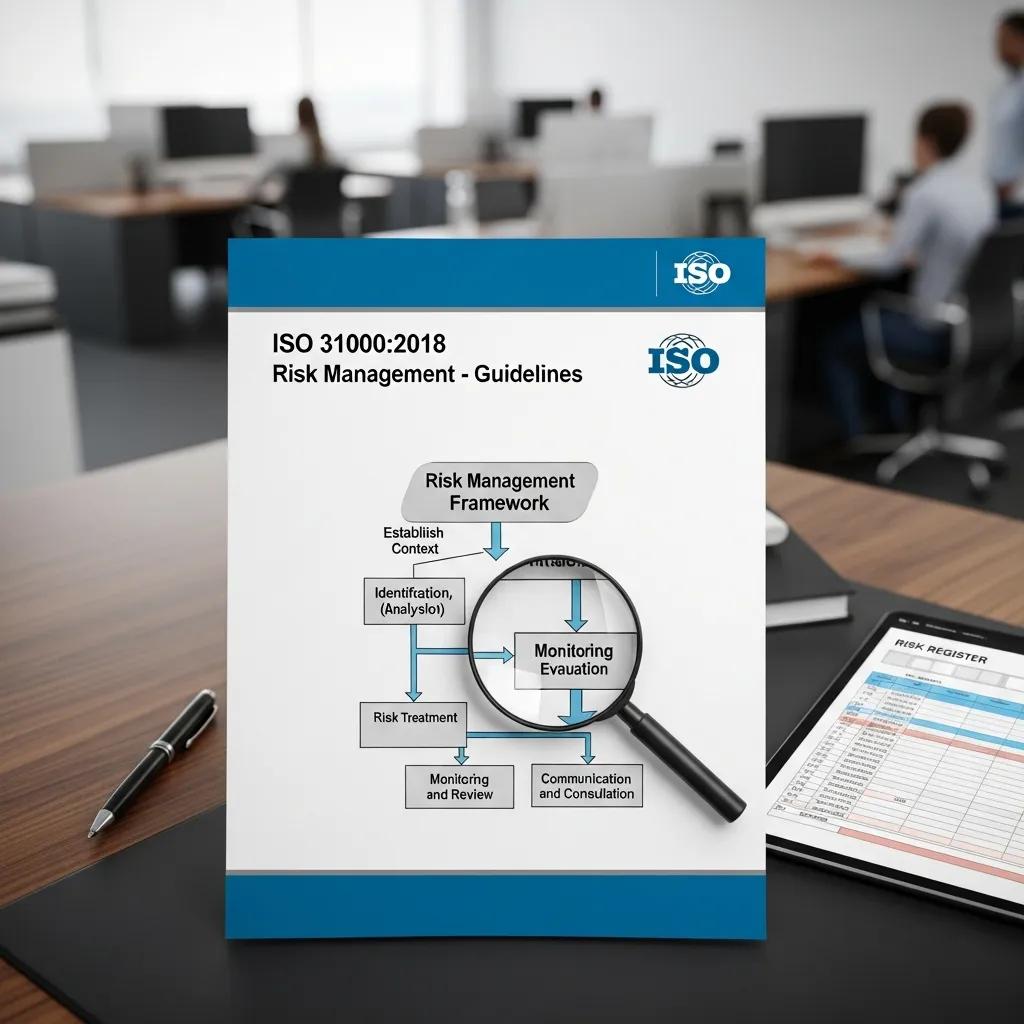
ISO 31000 is a principles-based standard that provides a common approach for integrating risk management into governance, strategy and operations. Its guidance helps project teams embed consistent risk thinking. The standard highlights core principles — integration, a structured and comprehensive approach, customisation to context, inclusive participation and dynamic treatment — which translate into steps for project-level identification, analysis, treatment and monitoring. Applying ISO 31000 at project level means defining clear roles, decision criteria and continual improvement loops so risk work happens as part of day-to-day delivery, not as a one-off task. Practical alignment uses simple templates, governance checkpoints and performance metrics that feed programme controls and executive reporting.
Practical application of ISO 31000 shows how the standard helps address frequent project problems such as scope creep and budget variance.
Implementing ISO 31000:2018 for project risk management
Designing and implementing an ISO 31000:2018 risk management framework supports consistent project and programme risk practice. Typical examples include variations in scope and budget that this framework helps to manage.
The standard’s framework elements — leadership and commitment, process design, implementation, evaluation and continual improvement — map directly to project governance tasks such as assigning risk owners, maintaining the risk register and capturing lessons learned. Practically, projects should document risk appetite, set thresholds and establish escalation routes, then use those definitions to prioritise actions and allocate contingency. Organisations that adopt ISO 31000 find documented principles and regular reviews reduce firefighting and improve auditability.
Core principles and the framework
ISO 31000 is built on principles that make risk management effective and repeatable: integrate risk into organisational processes, use a structured approach, tailor the design to context, involve relevant stakeholders and stay dynamic to respond to change. The framework covers leadership engagement, designing the process, implementing it, evaluating results and continuous improvement. On projects, integration means sponsors set appetite and authorise resources; a structured approach means consistent tools and reporting; inclusivity brings the right experts into assessment workshops; dynamism triggers reassessment after milestones or scope shifts. These principles make risk decisions traceable and defensible to sponsors and auditors.
How ISO 31000 links to project risk processes
ISO 31000 maps to the standard project risk lifecycle by providing governance and process scaffolding: leadership defines appetite and accountability, design sets roles and tools, implementation runs identification and assessment, and evaluation/improvement closes the loop through lessons and audits. Practically, link each ISO component to project artefacts: appetite → project charter, accountability → RACI for risk owners, process design → risk register template, implementation → regular risk workshops, evaluation → phase reviews and audits. These mappings turn abstract principles into day-to-day actions and keep escalation, reporting and audit evidence coherent across project, programme and enterprise levels. They also clarify what decisions sponsors must make versus what delivery teams can handle.
ISO 31000’s generic design makes it suitable across organisations and helps integrate risk management with other management system standards.
ISO 31000 guidance for generic risk management frameworks
ISO 31000 provides guidance applicable to any organisation, regardless of size or activity, and aligns with the principles and guidelines used by other management system standards.
Quick checklist to operationalise ISO 31000 on projects:
- Set appetite in the project charter: define thresholds.
- Establish a RACI: clarify ownership and escalation.
- Define register and metrics: ensure consistent assessment.
Effective project risk assessment techniques and tools
Good risk assessment blends qualitative and quantitative methods supported by structured tools that capture, score and prioritise risks for decisions. Qualitative techniques — structured brainstorming, Delphi panels and risk workshops — work well for early identification and stakeholder alignment, producing ranked lists and clear root causes. Quantitative methods — FMEA (Failure Modes and Effects Analysis), decision trees and Monte Carlo simulation — give probabilistic forecasts and sensitivity analysis that inform contingency sizing and cost-risk trade-offs. Core tools include a maintained risk register, a scoring matrix (3×3 or 5×5) and modelling software for simulations.
Planned comparison: the table below shows common techniques and the outputs you can expect so teams can choose the right approach for each phase.
Qualitative and quantitative analysis methods
Use qualitative methods (facilitated workshops, checklists, Delphi) when data are limited and stakeholder buy-in is needed; they produce ranked risks and highlight control gaps. Apply quantitative methods (FMEA, decision trees, Monte Carlo) when numerical data exist and decisions require probabilistic or cost-impact analysis — these are essential for contingency budgeting and scenario planning. Each approach has trade-offs: qualitative is quicker and cheaper but less precise; quantitative is rigorous but needs data and resources. A staged approach works well: screen risks qualitatively, then apply quantitative analysis to the top-tier items that materially affect objectives.
How risk registers and risk matrices support evaluation
A risk register organises findings into consistent fields (ID, description, category, owner, likelihood, impact, score, response, status) and serves as the authoritative record for monitoring and audits. A risk matrix converts likelihood and impact into a prioritised view, using a 3×3 or 5×5 scale to show where action is needed and where acceptance is appropriate. Modern registers link to action plans, budgets and milestone triggers so items can generate tasks, budget requests and escalation notices automatically. Using templates or software ensures consistency and the traceability required for governance reviews and certification evidence.
Recommended risk register fields:
- Risk ID & description: concise event statement.
- Owner & category: accountability and domain.
- Likelihood, impact, score: prioritisation metrics.
- Response & status: actions and progress indicators.
Project risk mitigation strategies that improve outcomes

Mitigation strategies fall into four standard categories — avoid, mitigate, transfer, accept — chosen based on impact, cost and feasibility. Avoidance changes scope or approach to remove the risk source, mitigation reduces likelihood or impact with controls, transfer shifts financial exposure to insurers or contractors, and acceptance acknowledges the risk while managing consequences. Good plans also specify owners, KPIs and triggers. Contingency and fallback arrangements prepare resources and governance for activation, ensuring teams can act quickly when triggers occur. The right mix increases certainty, lowers unplanned spend and keeps delivery on track.
Decision table: use the table below to match strategy to use-case and expected result.
Developing response plans
Start by estimating a risk’s expected impact and likelihood, then choose the strategy that delivers the best net benefit against defined KPIs and thresholds. For avoidance, document scope changes or alternative designs and seek sponsor approval. For mitigation, list controls, owners, timelines and verification steps. For transfer, capture contractual clauses or insurance terms and test enforceability. For acceptance, set monitoring cadence and clear trigger conditions. Each plan should include resource estimates, milestones and measurable KPIs (for example, % reduction in likelihood or time to mitigate). Assign a named owner and get sponsor sign-off to ensure accountability and timely execution.
Contingency and fallback planning
Contingency planning defines pre-authorised resources and actions to deploy when identified risks materialise; fallback planning defines secondary actions if the initial response fails. Contingency budgets are sized using quantitative methods (expected monetary value or Monte Carlo outputs) and controlled through governance gates to prevent misuse. Triggers should be objective (specific metric thresholds or event occurrences) and governance must specify who authorises drawdowns and how actions are reported. Well-defined contingency and fallback arrangements reduce decision delays and give teams the authority and resources to act decisively when incidents occur.
Typical contingency triggers:
- Schedule slip > X days on the critical path
- Cost variance exceeds Y% of baseline
- Supplier fails to deliver at a milestone
These triggers link planning to execution and lead into how ISO certification helps embed these practices across projects.
How ISO certifications strengthen enterprise risk management for projects
ISO certifications such as ISO 9001, ISO 27001 and ISO 42001 reinforce project risk management by formalising processes, controls and governance that reduce quality, information security and AI-governance risks. Certification provides an auditable way to show consistent practice, align controls with regulatory expectations and reassure customers and stakeholders. Independent validation from an accredited certification body demonstrates processes are implemented and maintained, which can improve procurement competitiveness and lower compliance risk. The table below summarises how these standards map to common project risks and controls.
EAV-style comparison: how each ISO standard targets project risk and what it delivers.
How ISO 9001, ISO 27001 and ISO 42001 address project risks
ISO 9001 tackles quality and process risks through documented procedures, competence controls, supplier management and corrective action cycles that reduce defects, rework and schedule impacts. ISO 27001 targets information security risks by requiring risk assessments, appropriate controls, incident response and continuous monitoring to protect confidentiality, integrity and availability of project data. ISO 42001 sets governance for AI systems, with controls for data quality, bias testing, transparency and accountability across model development and deployment. Together these standards provide overlapping controls that lower technical failures, security incidents and ethical or regulatory exposure on projects.
Benefits of ISO certification for risk reduction and compliance
Certification delivers measurable benefits: fewer defects and change requests, fewer security incidents, clearer accountability and demonstrable compliance for regulators and clients — all of which support better project success metrics. Useful KPIs include incident frequency, schedule slippage, number of corrective actions and time-to-resolution for security incidents. Certification also supports procurement by offering third-party evidence of mature processes and controls. Organisations should measure these KPIs before and after certification to quantify the return on their investment.
Suggested project KPIs linked to certification:
- Incident frequency per quarter
- Average days to resolve defects
- Number of audit non-conformities
Stratlane Certification Ltd. provides ISO certification services including ISO 9001, ISO 27001 and ISO 42001 and frames these services as directly relevant to managing project risks. As an accredited body using AI-assisted audit tools and experienced auditors, we emphasise efficiency and practical insight while delivering globally recognised accreditation that supports project governance and stakeholder confidence. Once your processes and evidence are in place, engage a certification partner to obtain external validation for procurement and compliance purposes.
How industry-specific risk management improves outcomes
Industry-specific risk management adapts the generic project risk process to sector realities — construction, IT and AI development each present distinct primary risks and control priorities that require tailored techniques. Construction must prioritise safety, supply-chain resilience and regulatory compliance. IT projects focus on cybersecurity, data integrity and controlled change. AI projects must manage model drift, data bias and governance. Applying the lifecycle with sector checklists, mandatory controls and specialised assessments improves relevance and the chance of successful mitigation.
Key considerations for construction, IT and AI projects
Construction projects face physical safety hazards, supplier delays and permitting risks that can stop work and create liabilities; practical controls include safety management systems, bonded suppliers and permit trackers. IT projects are vulnerable to cyber threats, data loss and rapid change risks; controls include ISO 27001-aligned security measures, robust backups and controlled releases. AI projects risk model drift, bias and unclear governance; controls include data governance, bias testing, explainability and accountable approval gates. Each sector benefits from tailored KPIs and testing protocols to confirm controls work in project conditions.
ISO 31000’s flexibility is evident when it’s adapted for sectors like construction, where a tailored framework is essential for practical risk management.
ISO 31000 risk management framework for construction
One useful application of ISO 31000 is a construction-focused risk management framework that oversees implementation of risk processes and accounts for the specific needs of construction firms and projects.
How ISO standards apply across these industries
ISO standards align cleanly with industry controls: ISO 9001 supports construction QA and supplier management, ISO 27001 underpins IT security and data integrity, and ISO 42001 provides governance for AI lifecycle risk. Quick-start actions include documenting core processes, appointing a risk owner, running targeted risk assessments and integrating controls into procurement and change control. A phased approach works well: stabilise processes with ISO 9001, secure systems with ISO 27001, then add AI governance where relevant.
Quick-start checklist for industry application:
- Document core processes and owners
- Run targeted risk assessments for sector threats
- Define KPIs and escalation thresholds
For organisations seeking independent validation, an accredited certification partner can provide audits and certification aligned to these mappings. Requesting a quote or booking an audit is a sensible next step once internal controls and evidence are prepared.
Stratlane Certification Ltd. is an accredited certification body that combines AI-assisted audit tools with experienced industry auditors. We offer ISO certification services including ISO 9001, ISO 27001 and ISO 42001, positioning these services as directly relevant to reducing project risk. Stratlane focuses on practical efficiency, innovation in audit delivery, and globally recognised accreditation. When you’re ready to show your project risk controls, request a quote or book an audit to gain third-party validation of your management systems.
Frequently asked questions
What are the key steps in the project risk management lifecycle?
The project risk lifecycle has four core steps: identification, analysis, response planning and monitoring. First, identify and document potential risks. Next, assess likelihood and impact with qualitative or quantitative methods. Then, plan responses and assign owners. Finally, monitor risks through the project and update actions as conditions change to keep objectives on track.
How can organisations ensure stakeholder engagement in risk management?
Get stakeholders involved early through workshops and structured discussions. Communicate risks regularly and clearly, assign responsibilities, and show how their input affects decisions. Training on basic risk principles helps stakeholders contribute effectively and ensures diverse perspectives are captured.
What role does a risk register play in project risk management?
A risk register is the central record of identified risks, owners, assessments and actions. It provides a single source of truth for tracking status, progress and accountability. Keeping the register current makes it easier to manage responses, report to governance and provide evidence for audits.
How do ISO certifications improve project risk management practices?
ISO certifications (for example ISO 9001 and ISO 31000) provide structured frameworks that standardise risk processes. Certification encourages consistent practice in identification, assessment and response, demonstrates commitment to quality and risk management, and gives stakeholders independent assurance through audits. The certification process also highlights improvement opportunities.
What are the common challenges faced in project risk management?
Frequent challenges include late risk detection, weak stakeholder involvement, unclear ownership, insufficient contingency and poor communication. These gaps increase costs, delays and quality issues. Address them by embedding structured processes, clarifying roles and encouraging open reporting of risks.
How can organisations measure the effectiveness of their risk management strategies?
Measure outcomes with KPIs such as incident frequency, average time to resolve issues and the number of risks that materialise versus those identified. Track impacts on cost and schedule too. Regular reviews and audits provide insight into process effectiveness and highlight where refinements are needed.
Conclusion
Adopting a structured project risk management framework, aligned with ISO standards, improves project outcomes by reducing failures and increasing stakeholder confidence. Use practical tools and repeatable processes to identify, assess and mitigate risks, and consider certification to provide independent assurance. If you’re ready to strengthen project governance, explore our ISO certification services and take the next step toward more resilient delivery.