
Understand ISO Consultant Fees: What to Expect in Costs

ISO Consultant Fees: What UK organisations pay, why it matters and how to budget
Knowing the iso consultant cost is essential for UK organisations planning certification. Consultant fees are a predictable slice of the overall investment and directly influence how quickly and smoothly you reach certification. This guide explains what consultant fees typically cover, how they differ from certification body charges, and how both feed into the total iso implementation cost and the cost of ISO audit you should budget for. You’ll get the main cost drivers — audit days, scope, complexity and travel — plus practical price ranges for ISO 9001, ISO 27001 and ISO 42001 to help estimate budgets and make procurement choices. We also show how to use cost calculators and formal audit offers to tighten estimates, highlight possible funding routes and point to transparent providers to request quotes. Start by defining consultant fees, then move through the factors that change price, standard-specific breakdowns, AI management-system considerations and practical estimation tools.
What Are ISO Consultant Fees and How Do They Impact Total Certification Costs?
ISO consultant fees pay for third‑party experts who support implementation and readiness activities — turning standard requirements into practical procedures and the evidence auditors need. Good consultants shorten the learning curve, shape documentation and deliver training, which often reduces project duration and can lower the certification body’s audit days by improving preparedness. Typical billing models include daily rates, fixed project fees and scoped packages; understanding these options helps you weigh short‑term spend against saved time and disruption. Consultant charges are separate from certification body fees: using consultants is a strategic choice that affects direct spend and indirect costs such as staff time and operational impact. When building a budget and requesting quotes, know how consultant activities alter audit‑day calculations and evidential readiness.
Stratlane Certification Ltd. positions itself as a transparent certification partner, offering AI‑assisted accredited audits and an audit offer calculator to clarify expected audit costs. That kind of pricing transparency helps procurement teams compare consultant‑led implementation paths against certification‑only budgets. Choosing providers who publish audit assumptions and give initial cost estimates makes cashflow and timing easier to predict — and keeps consultant support clearly separate from the independent audit charge. The sections that follow define consultant fees in practical terms and outline common billing models so you can compare options effectively.
Defining ISO Consultant Fees and Their Role in Certification
Consultant fees typically cover services that prepare an organisation for independent assessment: gap analysis, documentation support, risk assessments, training and pre‑assessment reviews. Consultants translate clauses into operational controls, map processes to requirements and often assemble the evidence packs auditors use — reducing the time auditors need to validate compliance. Billing is usually by daily rate for on‑site support, fixed fees for scoped projects (for example documentation or risk assessment) or retainers for ongoing advisory work. For a small SME, a three‑day gap analysis plus documentation support might be sold as a short project fee; that upfront cost can shorten the certification timeline and may reduce required audit days. Understanding these components helps you decide whether consultant spend is justified by faster certification and lower internal overheads.
How Consultant Fees Differ from Certification Body Charges
Consultant fees pay for advisory and implementation services. Certification body charges are independent fees for assessment, surveillance and recertification and are invoiced separately. Certification bodies allocate audit days to verify compliance, follow accreditation rules and issue certificates under a recognised scheme — activities that require auditor time, report writing and certificate administration. Consultants cannot act as the independent auditor or issue certificates; their role is readiness rather than formal assessment. A simple split: consultancy covers project setup and training, while certification body fees cover initial assessment and the surveillance cycle. Keeping the two budgets distinct prevents conflicts of interest and clarifies procurement and accounting treatment for compliance projects.
Which Factors Influence ISO Certification Costs in the UK?
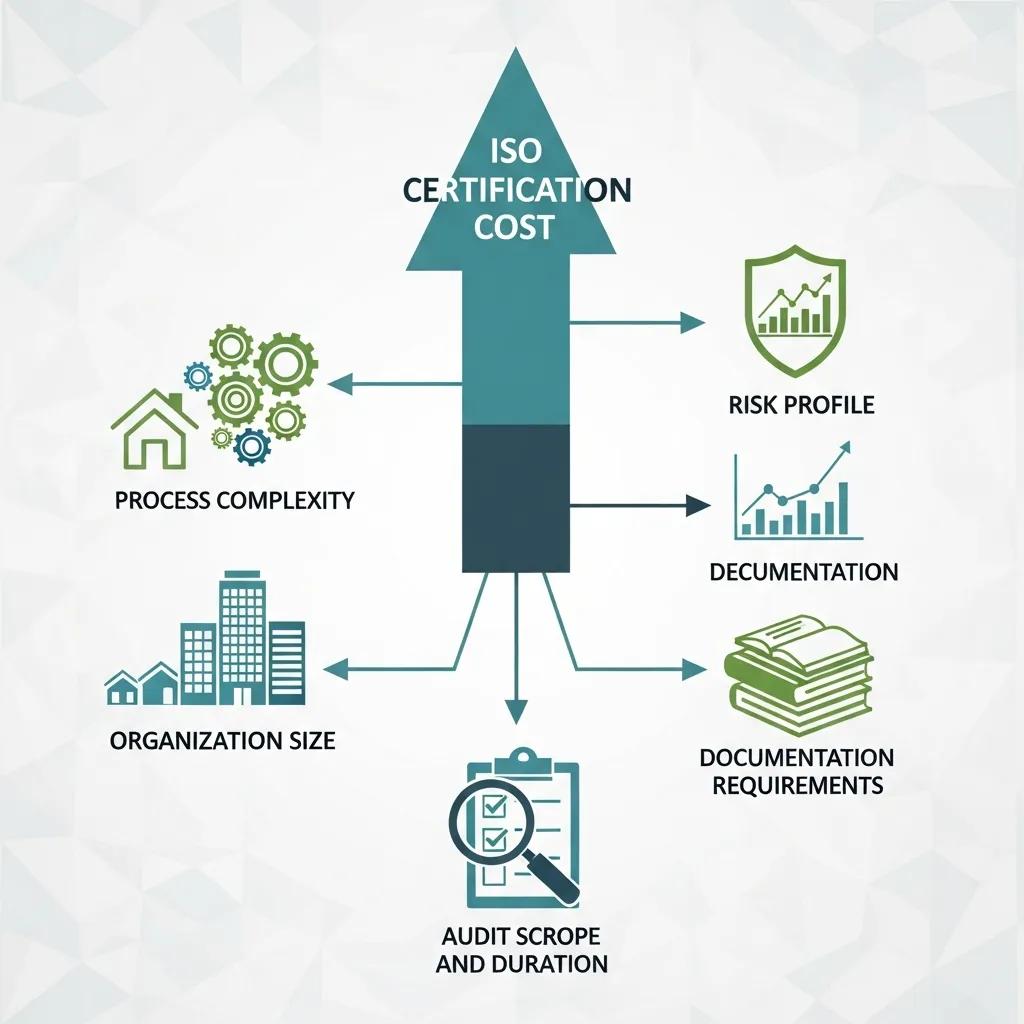
Certification costs in the UK vary because several interrelated factors determine audit days and consultant effort. Before budgeting, carry out a structured assessment of scope and complexity. Key drivers include organisation size (employees and sites), process complexity and outsourced activities, industry risk profile, geographic spread and whether audits are remote or on‑site. Each factor changes the auditor’s workload — and therefore the certification body fee — and can increase consultant days needed for readiness. The table below maps common drivers to their audit‑day implications and cost impact so procurement teams can see how scope changes translate into price.
The table below summarises typical relationships between common entities and attributes that most influence audit days and cost.
This EAV table shows how attribute changes influence audit effort and helps teams predict cost implications as scope grows. The next subsection maps employee bands to typical audit‑day estimates and gives practical examples for SMEs.
How Does Organisation Size and Complexity Affect Fees?
Organisation size and operational complexity directly affect both certification body audit days and the consultant days needed to prepare evidence and processes. Accreditation guidance typically scales audit days with employee bands and site counts: a single‑site SME with straightforward processes will usually need fewer audit days than a multi‑site manufacturer with complex supply chains. Complexity factors such as critical outsourced services, multiple shifts or intricate process controls increase sampling and documentary checks, driving both auditor and consultant time. For budgeting, map your employee bands and critical functions to expected audit days, then add consultant days for gap closure and documentation. This combined view produces a realistic iso implementation cost estimate and helps organisations prioritise scope to reduce costs.
What Role Do Industry Sector and Risk Profile Play in Pricing?
Industry sector and organisational risk profile matter because auditors allocate more time to sectors with higher regulatory scrutiny or sensitive data — which increases price. Healthcare, finance and critical infrastructure commonly demand deeper evidence of control design and operation, while less regulated sectors can expect leaner assessments. Risk profile also includes customer requirements and contractual obligations that expand scope — for example extra controls for personal data or supplier management — which auditors and consultants must validate. Identify sector‑specific controls and contractual drivers early: these elements typically add audit days and may require specialist consultant expertise, so accounting for them reduces surprises at quote stage.
How Much Does ISO 9001 Certification Cost for UK Businesses?

ISO 9001 certification cost for UK businesses depends on company size, audit days and whether consultant support is engaged, so typical ranges reflect combinations of these variables. Certification body fees normally cover initial assessment, surveillance visits and recertification cycles; consultant fees are added when organisations buy gap analysis, documentation and training. For SMEs, a modest initial certification fee combined with a focused consultancy package is often the most cost‑effective route, while larger firms should budget for broader audit sampling and ongoing surveillance. The table below maps organisation size to typical certification body and consultant fee ranges to aid planning.
This quick‑reference table combines audit days, travel and basic consultant support to show expected price bands. The next subsection breaks down audit stages and typical fees so you can see what each element includes.
Breakdown of ISO 9001 Audit Fees and Typical Price Ranges
ISO 9001 audit fees cover the initial assessment (often split into stage 1 and stage 2), periodic surveillance visits and recertification audits. Costs follow from allocated audit days: the initial assessment is usually the largest single cost, with surveillance visits spread across the three‑year cycle. Each stage includes auditor time, report writing and certificate administration. When estimating iso implementation cost, include both certification body charges and any consultant fees for gap closure — consultant involvement can shorten stage 2 and reduce assessment time.
Cost Considerations for Small and Medium-sized Enterprises
SMEs can manage ISO 9001 costs by scoping the management system pragmatically, focusing on core processes and using internal champions to reduce consultant days. Phased implementation — starting with a single site or core process — spreads consultancy and audit costs and eases cashflow. Consider remote audits and virtual document review where acceptable to cut travel and daily rate exposure, and compare quotes based on stated audit‑day assumptions. Useful cost‑saving tactics include a pre‑audit gap analysis to avoid rework, using internal training to reduce consultant‑led sessions, and choosing providers with transparent audit calculators and clear audit‑day assumptions. These steps help SMEs control the cost while still achieving certification.
What Are the Costs Associated with ISO 27001 Certification in the UK?
ISO 27001 certification costs are driven by the scope of information assets, number of locations and maturity of existing security controls, so pricing reflects audit complexity more than for general management standards. Information security audits require evidence of asset inventories, control implementation and monitoring, which can increase audit days — especially when technical testing or penetration evidence is needed. Consultant support often focuses on risk assessment, control selection and technical alignment; budget for specialist advisory time and possible third‑party testing or assurance. The table below gives typical audit‑day guidance and example scenarios to help tech firms and SMEs estimate likely certification body fees and consultant charges.
This table translates scope characteristics into expected audit days so teams can link days to fee estimates and consultant effort. Next, we explain the specific cost drivers for ISO 27001 audits and how to model them in a budget.
Understanding ISO 27001 Audit Fees and Certification Expenses
ISO 27001 audit fees hinge on how the scope is defined, the number and sensitivity of information assets and the level of outsourced dependencies — all factors that determine sample size and evidence checks. Assessors will review risk assessments, control implementation, policy frameworks and technical controls; where evidence requires technical testing or specialist review, both cost and auditor time increase. Small tech firms with a focused scope often land in the mid‑range because their asset inventories and access controls are straightforward, while organisations with complex third‑party ecosystems face higher verification needs. For budgeting, list systems in scope, identify outsourced services and estimate the documentation and technical evidence required to narrow down consultant and certification body costs.
Benefits of ISO 27001 Certification Relative to Its Cost
ISO 27001 certification can deliver tangible ROI through reduced incident impact, stronger tender performance and clearer trust with customers and insurers — making the initial cost an investment in risk reduction. Certified organisations can show standardised controls during procurement, which often shortens sales cycles and opens contracts where security assurance is required. Over time, mature controls reduce the likelihood and impact of breaches, offsetting up‑front costs through avoided incidents and potentially lower insurance premiums. Framing certification costs against these benefits helps procurement teams justify the investment and prioritise resources.
How Is ISO 42001 Certification Priced and Why Is It Increasingly Important?
ISO 42001 certification pricing is shaped by the technical complexity of AI systems, the breadth of datasets and the need for specialist auditor expertise, so costs reflect domain‑specific assessment work beyond general management systems. AI management systems require review of model governance, data governance, testing protocols and lifecycle controls — each area can add audit days, particularly where technical validation or model explainability evidence is required. Demand for AI compliance is rising as regulators and customers expect demonstrable governance, which can make specialist auditor time scarcer and push fees up. Budgeting for ISO 42001 should account for extra technical review, possible third‑party model assessments and the evolving market for AI audit expertise.
ISO 42001 Audit Fees and Cost Factors for AI Management Systems
Audit activities unique to ISO 42001 include checks on model governance frameworks, dataset provenance and bias mitigation processes — items that typically require additional auditor time and specialist evidence review. Technical tasks such as validating training pipelines, testing model behaviour and tracing data lineage deepen audit sampling and often need auditors with data‑science experience. Expect extra consultancy to prepare technical artefacts and to translate AI lifecycle activities into auditable controls. Mapping these AI‑specific items into the audit plan early helps estimate how many additional audit days and specialist consultant hours you’ll need.
The Growing Demand for AI Compliance and Its Impact on Certification Costs
Rising demand for AI governance and increased regulatory attention are putting pressure on the market for specialist auditors and consultants, which can raise rates and extend lead times. As organisations rush to show compliance with emerging AI frameworks, premium pricing for experienced AI auditors and technical reviewers becomes more likely, and early adopters may pay a scheduling premium. Despite higher near‑term costs, obtaining ISO 42001 early can be a competitive advantage by assuring customers and regulators of robust AI controls. Balance the timing of certification against market and regulatory trends to choose the right moment to invest.
How Can Businesses Estimate ISO Certification Costs Using Tools and Resources?
Estimating ISO certification costs begins with a clear scope definition, then narrows using online calculators, formal audit offers and comparative quotes. Steps to follow: first, define scope — standards, sites, employees and outsourced services. Second, use a certification cost calculator to generate an initial estimate and then request a formal audit offer that lists assumed audit days. Third, compare multiple audit offers and add consultant quotes for readiness work to build a consolidated budget. The table below compares tools and their best use cases to help you decide which to use at each stage.
This comparison helps teams pick the right method for each budgeting stage and decide when to ask for formal quotes. The next subsection explains how to use an online calculator effectively and which inputs produce the most accurate estimates.
Using Stratlane’s ISO Certification Cost Calculator for Accurate Estimates
An online calculator gives a useful initial audit‑day and fee estimate when you provide accurate inputs: number of employees, number of sites, standards in scope and process complexity. Stratlane Certification Ltd. provides an ISO Certification Cost Calculator and an audit offer tool that organisations can use to obtain a clearer view of certification body fees and assumed audit days; these are helpful for initial budgeting and preparing formal quote requests. Treat calculator outputs as a planning baseline, then request a formal audit offer to capture travel, remote vs on‑site splits and surveillance assumptions. Comparing calculator results and formal offers supports realistic budgeting and procurement decisions.
What Grants and Funding Are Available to Offset Certification Costs in the UK?
- Define scope and budget: Clarify standards, sites and staff to create a realistic funding request.
- Check regional business support: Search local authorities and growth hubs for SME grant schemes.
- Approach industry bodies: Ask trade associations about sector‑specific help or co‑funding.
- Use calculator outputs: Attach estimates from cost calculators and audit offers to support funding applications.
Following these steps helps organisations identify viable funding routes and assemble the evidence needed for applications, improving the chance of offsetting part of certification expenses.
Frequently Asked Questions
1. What is the typical duration for ISO certification processes?
Duration varies with organisation size, operational complexity and how prepared you are before the audit. Smaller organisations with straightforward processes can complete certification in a few months; many take three months as a realistic fast track. Larger, more complex organisations or multi‑site operations can take longer — often several months to over a year. Good planning and consultant support typically speed the process.
2. How can organisations ensure they choose the right ISO consultant?
Look for demonstrated experience in the specific ISO standard you need, plus references and client case studies. Assess their project approach and communication style — you want a consultant who manages stakeholders, sets clear milestones and hands over sustainable processes. Ask for detailed quotes and a clear billing structure so you understand what’s included and how costs are measured.
3. Are there any hidden costs associated with ISO certification?
Hidden costs can include extra staff time, additional training, documentation preparation and travel for consultants. If you’re underprepared, re‑audits or extra consultancy days can add expense. Mitigate surprises with a thorough pre‑assessment and by asking providers to itemise assumptions such as audit days, travel and remote vs on‑site splits.
4. What are the benefits of obtaining ISO certification beyond compliance?
Certification improves operational consistency and customer confidence, which can boost sales and access to contracts. It helps streamline processes, reduce waste and improve risk management, often delivering cost savings. Being certified also signals commitment to quality or security, giving you a competitive edge in tenders and partnerships.
5. How often do organisations need to renew their ISO certification?
Most ISO certifications require renewal every three years, with surveillance audits (usually annual) in between to ensure ongoing compliance. Stay on top of non‑conformities identified during surveillance audits to make renewal straightforward.
6. What role does employee training play in the ISO certification process?
Employee training is central: staff need to understand the standard and their role in maintaining compliance. Effective training embeds the system into daily work, helps spot improvement opportunities and reduces non‑conformities. Investing in training supports certification and builds a more competent workforce.
7. Can organisations pursue multiple ISO certifications simultaneously?
Yes — provided you have the resources and capacity. Many management‑system requirements overlap, so combined certification can be efficient for documentation and training. Work with an experienced consultant to align systems and avoid duplicated effort.
Conclusion
Understanding iso consultant cost is central to budgeting and executing a successful certification project in the UK. By recognising the key cost drivers and separating consultant fees from certification body charges, you can make smarter procurement choices and reduce surprises. Use transparent providers, cost calculators and formal audit offers to sharpen estimates and support decision‑making. Explore our tools and resources to plan a realistic budget and accelerate your certification journey.