
How ISO 27001 Certification Strengthens Data Security — Clear Benefits & Compliance

ISO 27001 is the international standard for building and running an Information Security Management System (ISMS). It uses a risk-based approach to protect information across people, processes and technology. Organisations that adopt the standard identify risks, choose proportionate controls and check effectiveness through audits — reducing both the chance of a breach and its impact. This article explains what ISO 27001 covers, how an ISMS supports the CIA triad (confidentiality, integrity, availability), and why certification brings legal, financial and reputational value — particularly for UK SMEs preparing for GDPR and procurement checks. You’ll find practical sections on the standard’s structure, threat-to-control mappings, regulatory alignment, commercial benefits, operational gains, and an overview of Stratlne Certification Ltd.’s AI-assisted certification service and how to request a quote.
What is ISO 27001 and How Does It Improve Data Security?
ISO 27001 sets out requirements for an ISMS — a repeatable way to manage and protect sensitive information. It requires organisations to apply a Plan–Do–Check–Act cycle to identify risks, treat them and continually improve controls. The result is documented policies, clear responsibilities, a risk register and controls drawn from Annex A. Together these measures reduce human error, technical misconfiguration and process gaps, and they give teams a clear path to prepare for independent certification audits. The sections that follow unpack the standard’s clauses and show how its controls map to practical security outcomes.
What makes up ISO 27001 and an ISMS?
Clauses 4 to 10 form the ISMS backbone: context, leadership, planning, support, operation, performance evaluation and improvement. An effective ISMS includes a scope statement, documented policies, a risk assessment and treatment process, an asset inventory, assigned roles and responsibilities, a set of technical and organisational controls (from Annex A) and evidence from internal audits and management review. Certification differs from simply claiming compliance: a third‑party audit must show the ISMS is implemented, maintained and improving. Organisations normally produce a Statement of Applicability that explains which controls were chosen and why, making the system auditable and consistent across teams.
How the CIA triad is realised in ISO 27001
The CIA triad — confidentiality, integrity and availability — sits at the heart of ISO 27001. Controls protect confidentiality through access controls, encryption and network segmentation; they preserve integrity via hashing, change control and audit trails; and they maintain availability with backups, resilience planning and incident response. Mapping Annex A controls to CIA outcomes makes risk treatment tangible: for example, access management and cryptography primarily protect confidentiality, while logging and versioning support integrity, and continuity measures ensure availability. That mapping helps leaders prioritise investments that reduce the biggest business risks.
Research shows ISO 27001 provides a strong framework for managing information security and aligns well with broader frameworks such as COBIT.
ISO 27001: ISMS, Risk Assessment and CIA Triad Alignment Studies compare COBIT and ISO 27001 as reference frameworks for information security. Both address confidentiality, integrity and availability and ISO/IEC 27001 is often presented as a practical standard organisations can adopt to meet information security needs identified by COBIT. Effectiveness of ISO 27001 as an information security management system: an analytical study of financial aspects, NK Sharma, 2012
How Does ISO 27001 Certification Reduce Cyber Risk and Breach Impact?
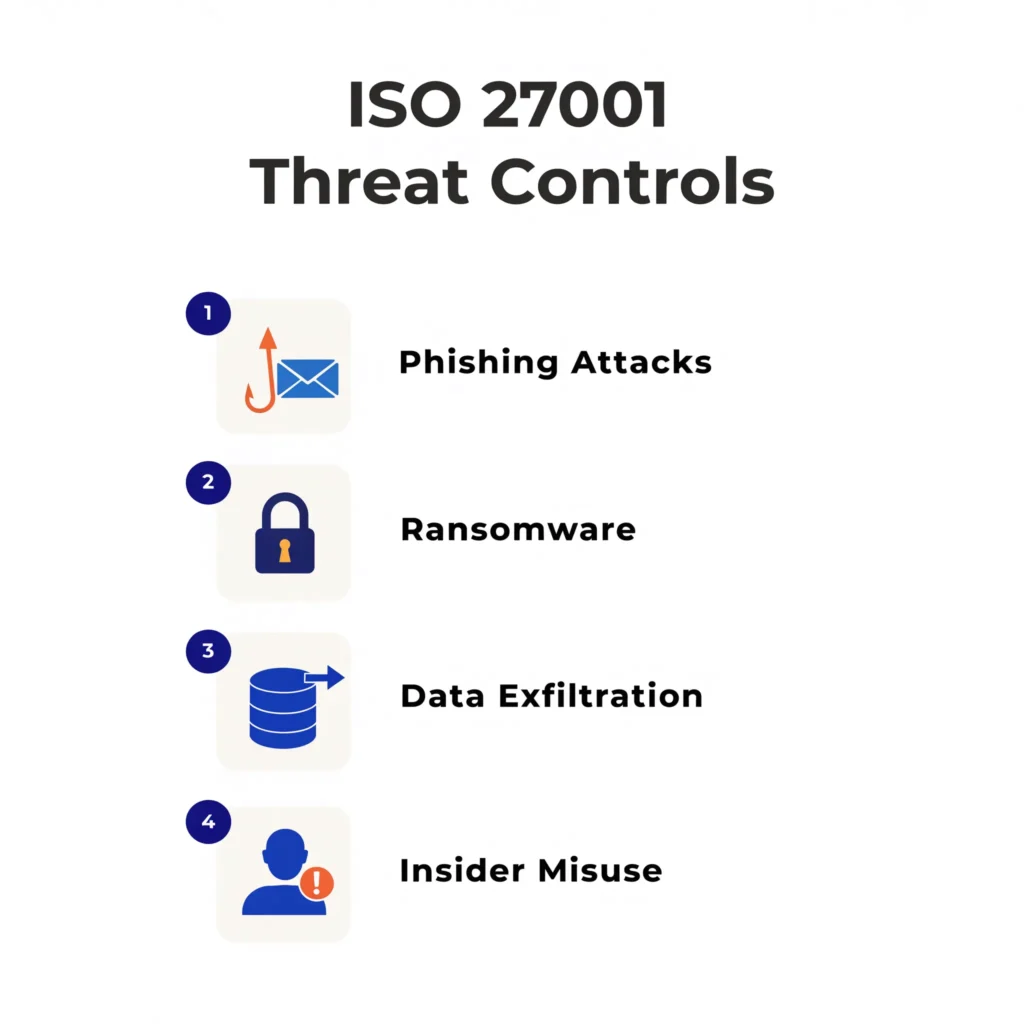
ISO 27001 reduces cyber risk through a structured risk assessment and treatment lifecycle: identify threats, assess likelihood and impact, select controls, and monitor effectiveness via internal audit and management review. Formal incident response plans and regular testing speed detection and recovery, limiting operational damage. Organisations with an ISMS improve threat visibility, raise control hygiene and can demonstrate security to customers and insurers. Below is a practical mapping of common threats to typical ISO controls and the expected impact reduction to help prioritise treatments.
| Threat type | Relevant ISO 27001 control/measure | Impact reduced |
|---|---|---|
| Phishing and social engineering | Security awareness training, access controls, multi-factor authentication | Lower risk of account compromise and credential theft |
| Ransomware | Patch management, backups, network segmentation | Less downtime and data loss; faster recovery |
| Data exfiltration | Encryption, DLP policies, privileged access management | Reduced likelihood of sensitive data leaving the organisation |
| Insider misuse | User activity logging, least privilege, HR controls | Faster detection and reduced internal data misuse |
This mapping helps security teams choose treatments that deliver measurable risk reductions. The following sections look at threat trends and how certification changes breach economics and recovery times.
Which cyber threats does ISO 27001 address most effectively?
ISO 27001 tackles threats such as phishing, ransomware, unauthorised access, misconfiguration and supply‑chain risk by requiring processes for risk identification, control selection and ongoing monitoring. The standard blends technical measures (patching, segmentation, authentication) with organisational steps (policies, training, supplier checks) to reduce attack surface and improve human resilience. Industry analysis shows organisations with documented incident response and backup plans recover faster and face lower average breach costs — outcomes ISO 27001 encourages through its continuity and incident management requirements.
How does certification lower financial and operational breach costs?
Certification helps reduce costs in two ways: it lowers incident frequency through preventive controls, and it shortens detection and remediation times through tested processes. Both effects reduce direct breach costs and indirect losses such as downtime and reputational harm. Insurers often treat ISO 27001 as evidence of mature risk management, which can improve underwriting terms or premiums. Operationally, the ISMS clarifies roles, playbooks and escalation paths so incidents are handled consistently, shortening mean time to recovery and limiting business interruption. Measuring the benefit requires tracking incident metrics before and after implementation, but organisations routinely report faster recovery and clearer cost attribution that supports ROI for security spending.
Evidence suggests pursuing and maintaining ISO 27001 certification can materially affect a company’s financial performance.
Financial Effects of ISO 27001 Certification Decisions Research examines how corporate decisions to obtain and retain information security certifications influence financial outcomes. Studies indicate certification and transparency around security practices can affect performance metrics and stakeholder perceptions. Research on the impact of information security certification and concealment on financial performance: Impact of ISO 27001 and concealment on performance, 2021
How Does ISO 27001 Help Meet Regulatory and Legal Requirements?
ISO 27001 supports regulatory compliance by formalising processes and technical measures that align with legal data‑protection obligations. Certification doesn’t replace duties under GDPR or the UK Data Protection Act, but it helps demonstrate appropriate technical and organisational measures, maintain records of processing and prepare for incident notification. Using ISO 27001 as a compliance backbone reduces the burden of evidence collection for regulators and data protection officers because key policies, risk assessments and controls are already documented and independently audited.
| Compliance area | ISO 27001 element | Covered areas |
|---|---|---|
| Data processing records | Risk assessment, asset inventory, procedures | Identifying and documenting processing activities |
| Data protection impact assessments (DPIAs) | Risk treatment planning and assessment process | Structured risk evaluation to inform DPIAs |
| Technical security measures | Annex A controls (access, encryption, logging) | Ensuring appropriate technical safeguards are in place |
| Incident notification | Incident management and monitoring | Supporting timely detection and reporting of breaches |
The mapping above shows how ISO 27001 creates the operational evidence regulators expect and reduces the administrative load of proving ongoing security practices. The next sections explain GDPR alignment and the specific advantages for UK SMEs.
How does ISO 27001 align with GDPR and UK data law?
ISO 27001 complements GDPR by embedding risk‑based security measures and documentation practices that support data‑protection principles such as integrity and confidentiality. Annex A controls map to many of the technical measures GDPR expects, while the ISMS’s risk assessment and treatment records help data controllers and processors prepare DPIAs and keep processing records. Certification does not replace legal obligations — organisations still need lawful bases for processing, handle data subject rights and appoint a DPO where required — but the standard reduces friction when responding to regulatory audits because evidence is formalised and independently checked.
Why ISO 27001 matters for UK SMEs dealing with regulation
For UK SMEs, ISO 27001 provides a scalable ISMS that can be tailored to size and complexity, helping small teams demonstrate robust security without unnecessary overhead. Certification streamlines responses to regulator queries and procurement checks by providing standard documents like policies, risk registers and internal audit reports that buyers and regulators expect. This makes tendering simpler, improves competitiveness and reduces the time spent preparing bespoke evidence. Practical gains include clearer role definitions, repeatable processes and demonstrable controls that lower the risk of fines and strengthen negotiating positions with customers and insurers.
Despite these benefits, many UK SMEs still lag in adopting formal information security certification while cyber threats rise.
SME Cyber Threats and the Certification Gap The UK has millions of small and medium enterprises, which contribute a large share of private‑sector activity. Yet many face rising cyber threats — with a substantial proportion reporting attacks in recent years — and most SMEs have not pursued formal certification despite government guidance. Research explores this disconnect and proposes ways to improve SME security posture, including practical rating schemes tailored to smaller organisations. Defining a new composite cybersecurity rating scheme for SMEs in the UK, A Patel, 2019
How Can ISO 27001 Certification Boost Reputation and Win Business?

ISO 27001 certification is a visible trust signal that shows customers, partners and regulators you follow independently audited security practices. That third‑party assurance often becomes a procurement differentiator. Certification helps marketing and sales by enabling concise, verifiable security claims, speeding supplier assurance questionnaires and shortening due‑diligence cycles. Certified organisations typically score higher on security criteria and can win contracts where certification is preferred or mandatory.
Use this short checklist to present certification benefits clearly in RFPs and client conversations.
- State the certification clearly : List the certified scope and the issuing body.
- Include concise policy summaries : Offer short descriptions of key ISMS policies relevant to the buyer.
- Provide a high‑level audit overview : Share summary outcomes of internal audits and management review without exposing sensitive detail.
Presenting these items upfront reduces back‑and‑forth and shows you’re ready to meet client security expectations. The sections below explain how certification builds trust and creates specific tender advantages.
How does certification build trust with customers and stakeholders?
Independent certification shows your security claims have been validated by an external auditor, which increases stakeholder confidence. Customers and partners see certification as shorthand for consistent policies, tested incident response and continual improvement — all of which lower supplier risk. For insurers and large buyers, certification simplifies vendor assessments because standard audit evidence answers many due‑diligence questions, reducing the need for bespoke questionnaires. Less uncertainty helps sustain long‑term commercial relationships and smooth contractual negotiation.
How does ISO 27001 help win tenders and new business?
Many tenders include security and data‑protection criteria where ISO 27001 certification scores well or is required. Certified organisations can reuse documentation — controls, policies and audit statements — to complete pre‑qualification questionnaires quickly, improving turnaround and professionalism. Including certification in RFP responses boosts evaluator confidence and provides tangible proof of risk‑management maturity that can influence scoring. A simple procurement pack — certificate scope, key policies and a short audit summary — helps sales teams turn certification into measurable tender advantage. For tailored support translating certification into commercial wins, Stratlne Certification Ltd. offers advisory help with audit preparation and evidence packaging for bids.
Operational Improvements and Cost Savings from ISO 27001
Implementing ISO 27001 delivers clearer governance, defined roles, standardised procedures and stronger supplier controls — all of which reduce friction in security processes. The ISMS promotes continual improvement through internal audits and management review, highlighting inefficiencies and driving process refinement. Cost savings come from fewer incidents, reduced downtime, better insurance negotiations and avoided regulatory fines thanks to improved evidence. The table below outlines common operational and financial impacts organisations can expect once ISMS practices are in place.
| Operational area | Attribute measured | Expected change/value |
|---|---|---|
| Security incidents | Likely frequency after ISMS | Fewer incidents and reduced severity |
| Incident response time | Mean time to detect and recover | Shorter detection and recovery windows |
| Insurance negotiation | Evidence for underwriting | Stronger position to seek premium review |
| Operational downtime | Business hours lost per incident | Reduced downtime through preparedness |
These measurable changes support ROI assessments and help leadership prioritise security investments that deliver real operational benefits. The next sections explain governance improvements and cost‑saving mechanisms in more detail.
How does an ISMS improve structure and efficiency?
An ISMS formalises responsibility by defining security roles, escalation paths and asset ownership, which reduces ambiguity and speeds decision‑making during incidents. Standardised procedures and playbooks replace ad‑hoc responses with tested workflows, producing faster, more consistent results and clearer audit trails. Supplier management improves because the ISMS requires ongoing assessment and monitoring of third‑party risk, reducing downstream exposure. Together these governance changes boost resilience and help teams act quickly and coherently when security events occur.
What cost savings come from fewer incidents and better insurance terms?
Cost savings come mainly from preventing incidents and from faster recovery when problems occur, leading to lower remediation costs and less business interruption. Certification also supplies documented evidence of controls that insurers value during underwriting, creating opportunities to renegotiate premiums or policy terms. Practical steps — sharing audit evidence, incident metrics and control maps with insurers — demonstrate reduced exposure and help with premium discussions. Maintain post‑certification metrics to build a case for long‑term premium reductions and to quantify the ISMS’s financial return.
What sets Stratlne’s AI‑assisted ISO 27001 certification apart?
Stratlne Certification Ltd. combines accredited certification processes, experienced auditors and AI‑assisted tools to streamline audit planning, evidence analysis and sampling while keeping human oversight. AI helps collate evidence faster, surface anomalies and highlight high‑risk findings for auditors to review, which shortens audit time and focuses resource on the most important controls. Stratlne delivers global services and SME‑scaled programmes, guiding clients through onboarding, audit preparation and post‑certification improvement. For organisations seeking an efficient certification route and help with tender readiness, Stratlne can provide a quote or discuss audit timing using the contact details below.
How do AI tools improve audit quality and speed?
AI tools automate routine evidence collection, perform preliminary consistency checks and flag anomalies that need human judgement. They augment auditors rather than replace them: auditors validate AI findings, apply context and make the final call. This human‑plus‑AI model shortens evidence review phases and lets auditors concentrate on control effectiveness and risk treatment. The result is sharper, actionable audit reports organisations can use immediately to improve security.
What tailored options does Stratlne offer for SMEs and international clients?
Stratlne offers SME‑friendly packages that scale the ISMS scope and documentation to organisational needs, helping smaller teams implement ISO 27001 pragmatically without unnecessary burden. For international clients, Stratlne supports multi‑jurisdiction delivery with language‑capable auditor teams and approaches that reflect local regulatory contexts while keeping consistent certification standards. Post‑certification support includes continuous improvement advice, evidence maintenance for renewals and help preparing procurement‑ready assurance packs. To request a tailored proposal or an audit timeline, contact Stratlne Certification Ltd. at info@stratlane.co.uk or by phone at +44 20 4572 7402 to arrange an initial scoping call or quote.
- How Stratlne integrates with your business : Stratlne combines accredited certification, AI‑assisted tooling and SME‑scaled programmes to speed certification while keeping audit rigour.
- How to get a quote : Contact the team by email or phone above to request a scoping call and cost estimate.
- Quick next steps : Prepare a concise ISMS scope and an asset inventory to accelerate the scoping conversation and get a more accurate proposal.
This commercial summary shows how Stratlne maps its services to the technical benefits discussed earlier and gives a clear path for organisations ready to pursue ISO 27001 certification.
Frequently Asked Questions
What is the process for obtaining ISO 27001 certification?
The process starts with establishing an ISMS that meets the standard: perform a risk assessment, apply necessary controls and document policies and procedures. A pre‑assessment can find gaps before a formal audit. The final step is a formal assessment by an accredited certification body. If successful, you receive certification, which must be maintained through ongoing surveillance audits and continual improvement.
How long does it take to achieve ISO 27001 certification?
Time to certification varies with organisation size, complexity and existing practices. For some smaller organisations it can take a few months; for larger or more complex businesses it may take a year or longer. Staff training, documentation and ISMS readiness are common factors that influence the timeline.
What are the costs associated with ISO 27001 certification?
Costs depend on factors such as organisation size, scope of the ISMS and choice of certification body. Typical expenses include consultancy, training and audit fees, plus ongoing costs for internal audits and continual improvement. While initial costs exist, many organisations find the long‑term benefits outweigh the investment.
Can ISO 27001 be integrated with other management systems?
Yes. ISO 27001 can be integrated with other systems such as ISO 9001 (quality) or ISO 14001 (environment). Integration reduces duplication, streamlines processes and creates a unified approach to governance and risk.
What role does employee training play in ISO 27001 compliance?
Employee training is essential. It ensures staff understand their information‑security responsibilities, recognises threats like phishing and social engineering, and reinforces policies and procedures. Regular training helps build a security‑aware culture and strengthens the ISMS.
How often must organisations renew ISO 27001 certification?
ISO 27001 certification typically lasts three years. Organisations undergo regular surveillance audits (usually annually) to confirm the ISMS remains effective. After three years a full re‑certification audit is required. Continuous improvement and regular internal audits help ensure readiness for surveillance and re‑certification.
Conclusion
ISO 27001 certification delivers clear benefits: stronger data security, better regulatory evidence and improved operational efficiency. By managing information risk in a structured, repeatable way you protect sensitive data and strengthen commercial credibility. If you’re ready to explore how ISO 27001 could benefit your organisation, contact Stratlne Certification Ltd. to discuss a pragmatic route to certification.