
Mastering the Certification Process: Key Steps to Compliance

ISO certification is an independent confirmation that your management system meets an internationally recognised standard. In the UK and beyond it builds credibility, reduces operational risk and makes you more competitive when bidding for work. This guide walks you through the practical path from gap analysis to surveillance audits and explains how certifications such as ISO 9001, ISO 27001 and ISO 42001 help with tendering, supply‑chain assurance and risk reduction. We focus on straightforward, actionable steps — timelines, required documentation and audit readiness — so you can set realistic resource plans and avoid common pitfalls. Inside you’ll find a five‑step certification workflow, targeted advice for quality and information‑security standards, SME efficiency tactics and a post‑certification maintenance roadmap, plus checklists and concise EAV tables to help you plan and deliver a successful project.
This article is written for both project leads and executive sponsors who want a compact roadmap with the right level of tactical detail. We start with a standard‑agnostic overview of the certification journey, followed by an EAV summary of deliverables and durations. Later sections go into the specifics for ISO 9001 and ISO 27001 — what auditors expect at each stage and what evidence you should gather. There’s a dedicated SME section with time‑saving approaches, including AI‑assisted auditing and tailored support options. Finally, we cover surveillance, re‑certification cycles and how to measure the commercial value of certification. Each H2 includes checklist‑style items and tables designed to make the next steps practical and repeatable.
What Are the Essential Steps in the ISO Certification Process?
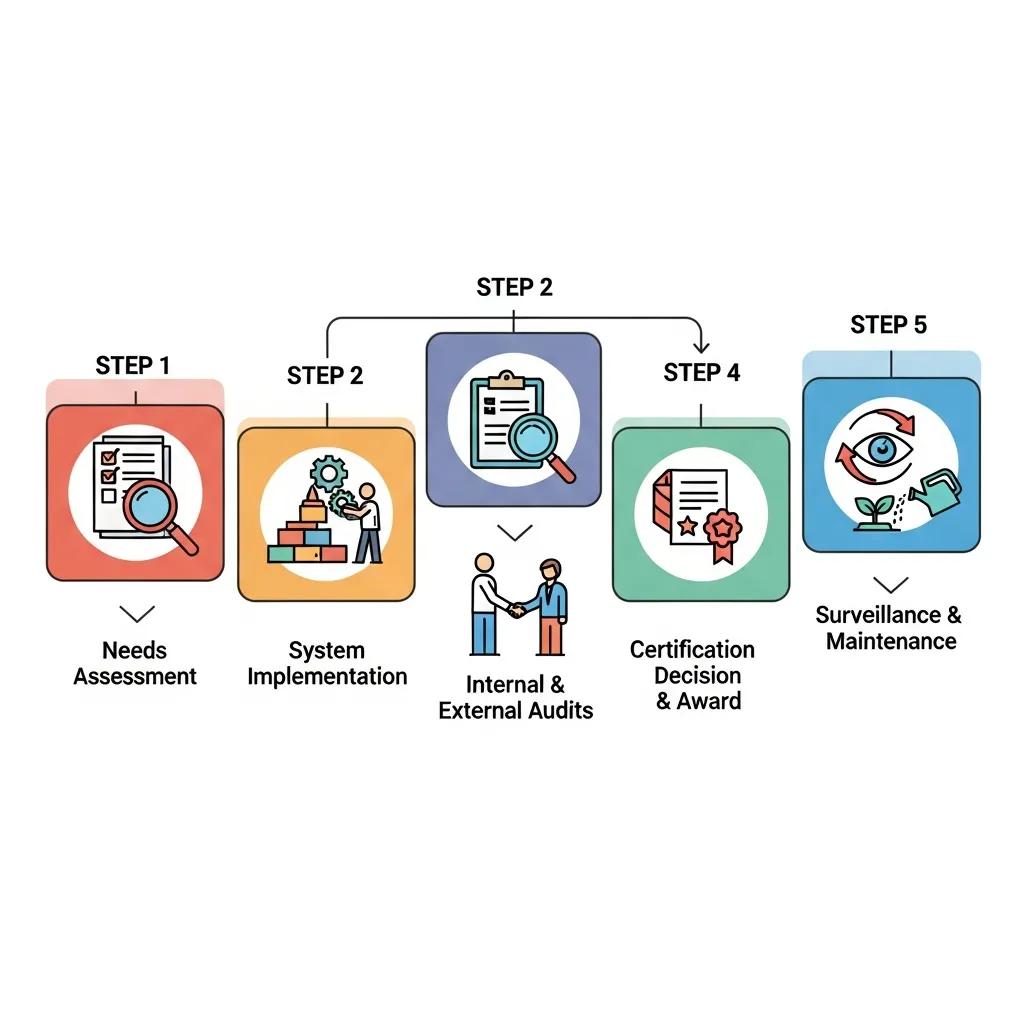
The ISO certification journey follows a clear sequence: assess, implement, verify internally, undergo external audit and then maintain the system through surveillance. Knowing each step’s purpose, likely duration and expected outputs helps you plan resources, reduce surprises in Stage 1 and Stage 2 audits, and close out findings efficiently. Below is a concise five‑step summary, with a short implementation checklist and an EAV table that captures the core attributes of each phase.
The typical five-step certification workflow is:
- Initial assessment and gap analysis: Map your current state against the chosen ISO standard to identify gaps and define scope.
- Management system design and implementation: Produce policies, procedures and controls and begin collecting objective evidence.
- Internal audits and management review: Test conformance, resolve internal findings and show leadership oversight.
- External certification audit (Stage 1 & Stage 2): An independent auditor reviews documentation (Stage 1) then verifies implementation and effectiveness (Stage 2).
- Surveillance and re-certification: Regular audits keep the certificate valid and drive continual improvement.
These steps form a practical path from diagnosis to a maintained, auditable management system. The next section explains how a focused gap analysis sets the project up for success.
How Does the Initial Assessment and Gap Analysis Prepare Your Business?
A gap analysis benchmarks your current practices against the ISO requirements and highlights exactly where documentation, controls or behaviours fall short. It usually combines document review, stakeholder interviews and short process observations to identify non‑conformities and risks that affect scope, schedule and cost. Typical findings are missing policy statements, incomplete risk registers, absent process maps and gaps in training records. Each item becomes an action in the implementation plan with an owner and target date. A well‑written gap report also produces the documents auditors expect early on: a clear scope statement, a risk register, an action plan and an evidence log — all of which speed up the Stage 1 review.
Academic research further underscores the value of gap analysis when preparing for ISO 9001 certification.
ISO 9001 Certification Readiness & Gap Analysis
This study evaluates a company’s preparedness for ISO 9001:2015 certification and recommends improvements. It uses gap analysis to compare current practices with the standard and to identify steps needed to meet certification requirements.
Analysis of ISO 9001: 2015 certification readiness of JP-Graha product of Jasaraharja Putera using gap analysis, B Purwanggono, 2015
Practical checklist after a gap analysis:
- Assign an owner, target date and corrective action for each non‑conformity.
- Update the management system scope and boundaries based on the findings.
- Prioritise high‑risk controls and map the specific evidence auditors will want to see.
With those actions assigned, you move into implementation where documented controls are embedded into day‑to‑day operations.
What Is Involved in Management System Implementation for ISO Compliance?
Implementation turns the gap analysis into practical, retained evidence: policies, process maps, operating controls and training that demonstrate consistent outcomes. Typical tasks include drafting or updating a quality or information security policy, mapping critical processes, setting up record‑keeping routines, applying technical or procedural controls and delivering focused training. Evidence collection is central — retained records, completed checklists, procedure copies and measurable data form the audit trail sampled in Stage 2. To speed delivery, teams often use templates, cross‑functional workshops and pilot tests to validate controls before a full rollout.
Mini implementation checklist:
- Create or revise core policies and the scope statement.
- Map key processes and assign control owners.
- Set up monitoring, measurement and record retention routines.
Good implementation produces the management review inputs and internal audit outputs that confirm readiness for the external audit.
| Step | Purpose | Typical Duration |
|---|---|---|
| Gap analysis | Identify non‑conformities and agree scope | 1–4 weeks |
| Implementation | Establish policies, procedures and controls | 4–16 weeks |
| Internal audit & management review | Validate system effectiveness and close findings | 1–4 weeks |
| External certification audits | Stage 1: document review; Stage 2: implementation verification | 1–2 weeks (staged) |
| Surveillance & re-certification | Maintain certification and drive improvement | Ongoing (annual surveillance; 3‑year re‑certification) |
This EAV table helps you set realistic timelines for planning conversations. The note below explains how an accredited provider can help if you choose external support.
How Stratlane supports these steps
Stratlane Certification Ltd. offers end‑to‑end audit services aligned to the five‑step workflow above. We combine experienced lead auditors with AI‑assisted tools to reduce review cycles and administrative effort. As an accredited certification body for ISO 9001, ISO 27001 and ISO 42001, we assign a single account manager and a lead auditor to guide scope, schedule and evidence collection. Organisations can request support for gap analysis, implementation workshops and managed audit delivery to accelerate Stage 1 and Stage 2 readiness.
How to Navigate the ISO 9001 Certification Steps for Quality Management Systems?
ISO 9001 certification requires a documented Quality Management System (QMS) that reliably delivers products or services through leadership, planning, operational control, performance evaluation and continual improvement. The standard stresses risk‑based thinking, customer focus and visible leadership. Auditors will look for policies, process maps, objective metrics and records that show consistent application. This section gives a clause‑oriented overview, a practical internal‑audit readiness checklist and a short comparison of Stage 1 and Stage 2 expectations to help you prioritise evidence collection.
ISO 9001 readiness checklist — key focus areas:
- Context and scope: A clear statement of the QMS boundary and relevant interested parties.
- Leadership and policy: A documented quality policy, defined roles and visible top‑team commitment.
- Planning and risk: Risk‑based planning, measurable objectives and allocated resources.
- Support and operation: Documented processes, competence records and controlled procedures.
- Performance evaluation and improvement: Internal audits, management review and corrective action records.
This checklist feeds your internal audit programme and helps you prepare for the different aims of Stage 1 and Stage 2 audits, explained next.
What Are the Key Requirements of ISO 9001:2015?
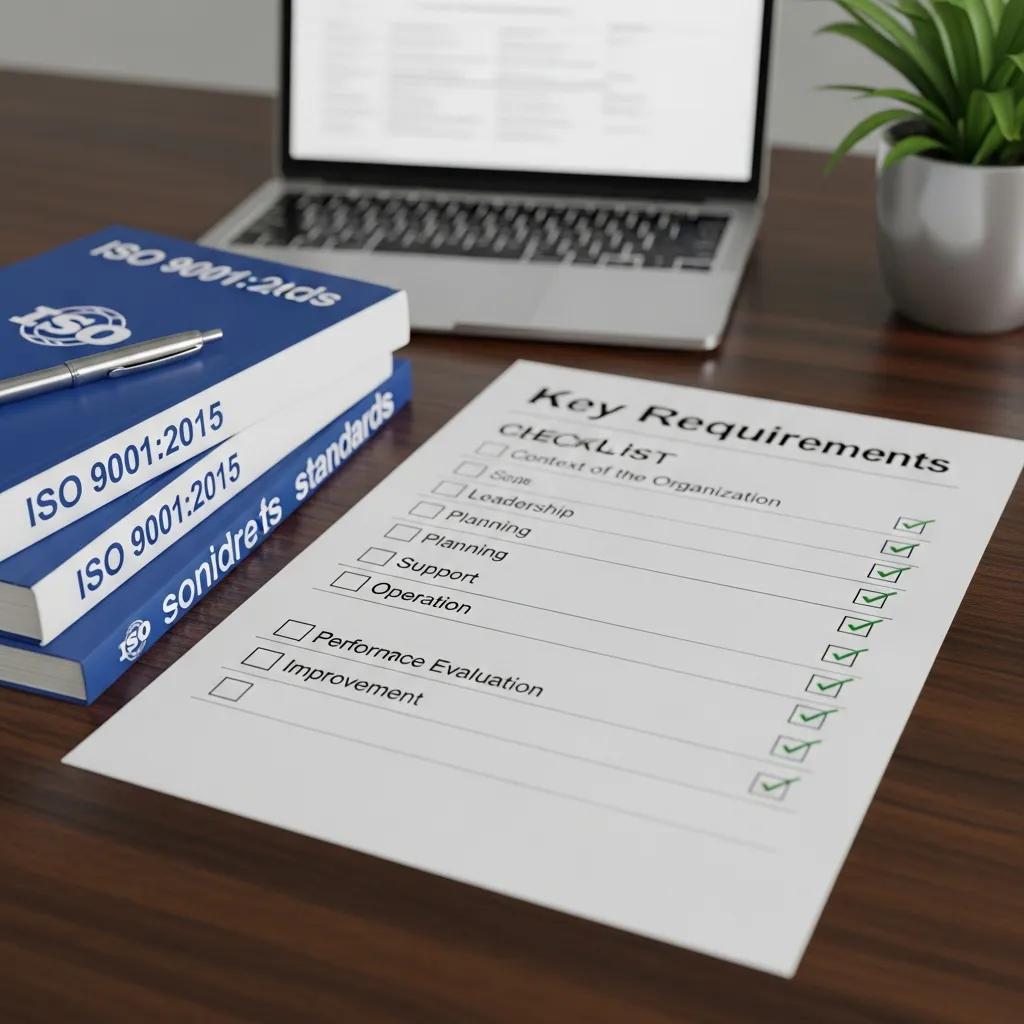
ISO 9001:2015 is organised into clauses that require documented proof you understand context, show leadership involvement, apply risk‑based planning, operate controls, monitor performance and pursue continual improvement. Auditors expect a defined scope, a quality policy, process maps, relevant procedures, training and competence records, internal audit reports and management‑review minutes that demonstrate objectives and actions. Common SME gaps are unclear scope, incomplete competence records, limited internal audit coverage and weak links between findings and management review. Practical SME tips: keep process maps brief, use standard record templates and run auditor‑led workshops to generate compliant evidence quickly.
A compact clause‑to‑evidence table summarises what auditors typically expect:
| Clause / Requirement | What it requires | Example evidence |
|---|---|---|
| Context of the organisation | Define scope and interested parties | Scope statement, stakeholder list |
| Leadership | Top management commitment and roles | Signed quality policy, responsibility matrix |
| Planning | Objectives and risk treatment | Objectives dashboard, risk register |
| Support | Resources and competence | Training records, resource plans |
| Operation | Controlled processes and outputs | Process maps, work instructions |
| Operation | Controlled processes and outputs | Process maps, work instructions |
| Performance evaluation | Monitoring and review | Internal audit reports, management review minutes |
Knowing these links helps teams focus evidence collection on what auditors will sample during Stage 1 documentation review and Stage 2 verification.
How to Prepare for Internal and External Audits in ISO 9001 Certification?
Effective audit preparation organises evidence clearly, schedules internal audits with defined scope and confirms corrective actions address root causes. Your internal audit plan should cover higher‑risk processes and ensure each clause has at least one sampled process and corresponding records. Auditors want traceability from inputs through controls to outputs and performance metrics. For external audits, prepare a concise evidence pack: policies, scope, key process maps, record examples, recent internal audit reports and management‑review outputs, and make sure staff who run core processes are available to explain daily practices. When non‑conformities arise, document root cause analyses, corrective action plans and proof of closure to show continual improvement.
Pre‑audit checklist:
- Assemble a concise evidence pack mapped to relevant clauses.
- Hold a management review to confirm objectives and current actions.
- Complete at least one internal audit cycle and close corrective actions.
These steps position you for the external certification audit where documentation and implementation are verified.
| Requirement Area | What auditors look for | Practical tip |
|---|---|---|
| Documentation | Policies, procedures and records | Provide an indexed evidence pack |
| Personnel | Knowledge of roles and processes | Schedule operator availability for interviews |
| Improvement | Closed corrective actions and learning | Keep dated action logs |
What Is the ISO 27001 Certification Guide for Information Security Management?
ISO 27001 certification establishes an Information Security Management System (ISMS) that protects the confidentiality, integrity and availability of information through a risk‑led set of controls and documented processes. The ISMS depends on a clear risk assessment, a Statement of Applicability (SoA), an asset and risk register, policies for access and incident management, and demonstrable evidence that controls operate as intended. This section outlines the ISMS essentials, gives a simple risk‑assessment example and explains what auditors sample in Stage 1 and Stage 2.
Key ISMS elements to prioritise:
- Scope and asset inventory: Identify assets and critical data flows inside the ISMS boundary.
- Risk assessment and treatment: Record your methodology, identified risks and chosen controls.
- Policies and SoA: Keep a current Statement of Applicability showing applied controls.
- Technical and organisational controls: Access rules, encryption, backups and incident response.
- Monitoring and continual improvement: Internal audits, corrective actions and management review.
These elements help the ISMS stand up to supplier checks and procurement due diligence where information security matters.
How Does ISO 27001 Protect Your Information Assets?
ISO 27001 protects information assets through a systematic, risk‑based approach: identify threats and vulnerabilities, select proportionate controls and monitor effectiveness with audits and metrics. Typical controls include least‑privilege access management, encryption for data at rest and in transit, secure backups with tested recovery plans to preserve availability, and incident‑response procedures that capture lessons learned. For example, restricting administrative access and enforcing multi‑factor authentication significantly reduces credential compromise risk. The business benefits are lower breach likelihood, stronger supplier confidence and better readiness for regulatory and supply‑chain security checks.
The practical value of ISO 27001 is measurable: it reduces exposure to real‑world security incidents and helps organisations meet their objectives for information protection.
Measuring ISO 27001 Effectiveness for Information Security
This paper examines how ISO 27001 performs as an information security management system by comparing organisational expectations before implementation with actual outcomes after certification. It argues that effectiveness should be judged by results — reductions in incidents and improved protection — rather than by process alone.
Effectiveness of ISO 27001, as an information security management system: an analytical study of financial aspects, NK Sharma, 2012
Those control examples form part of the Stage 2 evidence pack auditors use to confirm controls operate as designed.
What Are the Audit Stages and Compliance Requirements for ISO 27001?
ISO 27001 certification follows a Stage 1 — Stage 2 model. Stage 1 assesses documentation, scope and readiness; Stage 2 verifies implementation, operation and control effectiveness in practice. In Stage 1 auditors review your ISMS scope, SoA, risk assessment, policies and plans — common findings are incomplete SoAs or unclear scopes. Stage 2 requires objective evidence that controls are working: logs, access records, incident reports, backup test results, internal audit outcomes and management‑review minutes. Typical non‑conformities relate to weak monitoring, ineffective corrective actions or missing records; remediation should include root cause analysis, documented corrective plans and verification evidence.
Audit evidence checklist:
- Up‑to‑date risk register and Statement of Applicability (SoA).
- Access logs, change‑management records and incident records.
- Internal audit reports, corrective action logs and management‑review minutes.
Meeting these checkpoints positions your organisation for successful certification and ongoing surveillance.
How Can Small Businesses Achieve ISO Certification Efficiently?
Small businesses can reach certification faster by scoping narrowly, prioritising high‑impact controls, using simple documentation formats and taking advantage of remote and template‑driven approaches. Focus your management system on critical products or services, re‑use existing records where they meet requirements and run short workshops to produce documentation in‑session. Below we offer a problem‑solution checklist, time‑saving tips such as remote audits and templates, and practical steps to build internal capability with limited resource. Tailored external support can further reduce admin and speed delivery.
SME problem‑solution checklist:
- Problem: Limited time for documentation → Solution: Use concise templates and process maps.
- Problem: Low internal audit capacity → Solution: Time‑boxed auditor‑led internal audits and targeted training.
- Problem: Travel and cost constraints → Solution: Remote audits and sample‑based evidence collection.
These approaches narrow scope, cut unnecessary paperwork and keep the team focused on the controls auditors will examine.
What Tailored Support Does Stratlane Offer for UK SMEs?
Stratlane Certification Ltd. runs a programme for UK small businesses (under 15 employees) that pairs a dedicated account manager with lead auditor support to shorten project timelines and reduce admin. The programme includes focused workshops, accelerated routes and managed audit scheduling so small teams can prepare evidence efficiently and, where appropriate, use remote audits. The service prioritises outcome‑focused documentation and rapid closure of high‑priority findings so you achieve compliance with minimal disruption. Contact Stratlane to request a tailored quote or a scoped proposal aligned to your needs.
How Does AI-Driven Auditing Streamline Certification for Small Businesses?
AI‑assisted auditing speeds up routine checks, improves consistency and highlights priority gaps so auditors and teams can focus on judgement and remediation. Examples include automated document comparison to spot version mismatches, intelligent sampling of logs to flag anomalies and NLP summaries that reduce time reviewing large evidence sets. For SMEs this often means fewer onsite days, lower travel costs and quicker closure of findings because automation surfaces issues early. When combined with experienced lead auditors, AI handles repetitive checks while humans handle context, risk judgement and corrective guidance.
Benefits for SMEs:
- Shorter audit time through automated sampling and checks.
- Lower admin effort with pre‑filled evidence summaries.
- Faster resolution of findings via prioritised action lists produced by the tools.
| Support Service | Characteristic | Application |
|---|---|---|
| Dedicated account management | Single point of contact | Streamlines scheduling and evidence collection |
| Lead auditor workshops | Practitioner‑led sessions | Rapid documentation and control validation |
| AI-driven audit tools | Automated evidence checks | Faster sampling and prioritised findings |
What Are the Benefits and Maintenance Steps After ISO Certification?
Achieving ISO certification brings tangible business advantages: stronger credibility with customers and buyers, improved operational efficiency from standardised processes, and broader market access through recognised third‑party assurance. Certification supports tendering and supplier onboarding where buyers require accredited credentials and provides a framework for continual improvement that reduces risk and variability. Below we list the main benefits, a maintenance roadmap and an EAV comparison to help you balance benefits against ongoing activities.
Primary benefits of certification include:
- Credibility and trust: Independent verification increases buyer confidence.
- Market access: Certification can unlock procurement and international opportunities.
- Operational improvement: Standardised processes reduce defects and variation.
Understanding these benefits helps you measure return on the certification investment and justify ongoing commitment to surveillance and improvement.
How Does Certification Enhance Business Credibility and Market Access?
Certification signals to customers, partners and procurement teams that your management system meets an independently audited standard — which often improves tender success and eases supplier onboarding. For many buyers, ISO certification lowers perceived supplier risk and simplifies due diligence because certificates and audit summaries demonstrate controls and processes. Operationally, the discipline of documented processes and regular performance reviews usually improves delivery reliability and reduces rework. Over time these changes support better customer retention, lower costs and smoother supply‑chain relationships — all outcomes that help commercial growth.
Research has specifically examined how ISO 9001 certification can influence supply chain performance and relationships.
ISO 9001 Impact on Supply Chain Relationships
This study analyses the effects of ISO 9001 certification on lean manufacturing and supply chain relationships, exploring how certification changes operational and relational performance within supply networks.
Investigating the impacts of ISO 9001 certification on lean manufacturing and supply chain relationship: an empirical analysis, 2022
These commercial benefits are a strong reason to invest in the maintenance activities summarised next.
What Is Involved in Surveillance Audits and Re-Certification?
Surveillance audits are periodic checks — commonly annual — where auditors confirm your management system still meets the standard and that previous corrective actions remain effective. Re‑certification, usually every three years, is a fuller cycle check of system effectiveness. Surveillance focuses on sampled processes, corrective‑action closure and evidence of continual improvement; typical findings include incomplete corrective closures, weak monitoring or gaps in records. To stay audit‑ready, maintain an internal audit schedule, keep management‑review minutes current, log corrective‑action evidence clearly and retain key records for auditor sampling. Major non‑conformities need significant remediation and may threaten certification; minor non‑conformities require corrective action and follow‑up verification.
| Benefit / Activity | Business impact | Frequency |
|---|---|---|
| Surveillance audits | Maintains certification and stakeholder confidence | Annually or per scheme |
| Internal audits | Finds issues early and supports compliance | At least annually or as risk dictates |
| Management review | Provides strategic oversight and resources | At least annually |
| Re-certification | Full verification of system effectiveness | Typically every 3 years |
- Practical maintenance tips: Keep an indexed evidence repository, assign owners for corrective actions and run internal audits well before external surveillance so you can resolve issues in advance.
- Administrative savings: Templates and AI‑assisted evidence summaries cut prep time for surveillance audits and speed responses to auditor queries.
- Value focus: Prioritise controls that protect core services and contractual obligations to maximise commercial benefit from certification.
Following these steps closes the loop from initial gap analysis to sustained compliance and measurable business advantage.
Frequently Asked Questions
What is the cost of ISO certification in the UK?
Costs vary depending on organisation size, system complexity and the ISO standard you choose. Typical budgets range from a few thousand to tens of thousands of pounds — covering consultancy, training and the certification audit. Ask multiple certification bodies for tailored quotes so you can compare services and prices that match your needs.
How long does the ISO certification process take?
Timing depends on how ready you are and the complexity of your systems. A common range is three to six months from initial assessment to certificate issue. Smaller organisations with simple scopes often finish sooner; larger or more complex organisations will need more time to implement controls and gather evidence.
What are the common challenges faced during ISO certification?
Frequent challenges include unclear understanding of the standard, limited resources for documentation and training, and resistance to change. Many organisations also struggle to maintain consistent evidence of compliance and get full staff engagement. Address these by investing in targeted training, seeking practical guidance and embedding a culture of continual improvement.
Can ISO certification be achieved without external consultants?
Yes. Smaller organisations with strong internal capability can reach certification without consultants. That said, experienced advisers can speed the process, help avoid common mistakes and provide confidence during audits. If you go it alone, ensure you fully understand the standard, allocate enough time for documentation and run regular internal audits.
What happens if an organisation fails to achieve certification?
If certification is not granted, the auditor will report non‑conformities and recommend corrective steps. You can address those findings and reapply. Treat the feedback as a roadmap to strengthen processes — resolving those issues improves systems and increases your chances of success on the next attempt.
How often do organisations need to undergo surveillance audits?
Organisations typically have surveillance audits annually to keep their certificate valid. These audits confirm the system still meets requirements and that corrective actions are effective. Regular surveillance encourages continual improvement, which is central to ISO standards.
What are the benefits of ISO certification for small businesses?
For small businesses, ISO certification boosts credibility, streamlines operations and opens market opportunities. It helps you stand out in tenders, reduces process variation and can improve customer satisfaction. Those operational gains often translate into lower costs and better commercial outcomes over time.
Conclusion
ISO certification in the UK gives organisations independent assurance of their management systems, with clear benefits for credibility, efficiency and market access. By following a structured approach — from gap analysis through implementation, internal verification and external audit to ongoing surveillance — you can manage the effort and measure value. Expert support can shorten timelines and reduce administrative burden, but a focused internal programme will also work. If you’re ready to move forward, consider a scoped plan that fits your organisation and priorities.