
Mastering Environmental Management: Your Guide to ISO 14001

ISO 14001 Certification UK — Practical Guide to EMS Benefits and Requirements
ISO 14001:2015 gives organisations a clear, practical framework to reduce their environmental footprint while tightening compliance and improving efficiency. This guide explains what ISO 14001 requires, how an Environmental Management System (EMS) uses the Plan‑Do‑Check‑Act (PDCA) cycle, and why UK businesses choose EMS certification to meet legal duties and procurement expectations. With rising regulatory complexity from the Environment Act 2021, reporting regimes such as SECR, and growing buyer scrutiny on sustainability, ISO 14001 offers a coherent approach to manage environmental aspects and drive continuous improvement. Read on for a walk‑through of the standard’s clauses, practical steps SMEs should take to prepare, the audit lifecycle (Stage 1 and Stage 2), and typical UK cost drivers and ranges. You’ll also find checklists, comparison tables and implementation tips to help teams plan, implement and maintain an EMS that supports resource efficiency, waste reduction and market access.
What is ISO 14001 — and why certification matters
ISO 14001 is an international management standard that sets out the requirements for an Environmental Management System (EMS). It uses the PDCA cycle to embed continual environmental improvement: organisations identify environmental aspects and impacts, set objectives and put operational controls in place, monitor performance and apply corrective actions. Third‑party certification verifies that an EMS is working in practice and can reduce regulatory risk, lower operating costs through efficiency gains and strengthen tender eligibility. For UK businesses, certification helps demonstrate alignment with national frameworks such as the Environment Act 2021 and reporting regimes like SECR, as well as wider corporate climate commitments. The sections below break down the standard’s structure and show how it maps to UK regulatory and commercial drivers.
Understanding the ISO 14001:2015 structure and EMS framework
ISO 14001:2015 is organised into clauses that cover context, leadership, planning, support, operation, performance evaluation and improvement — commonly summarised as clauses 4–10. The EMS focuses on identifying environmental aspects and applicable legal obligations, then putting in place an environmental policy, measurable objectives and operational controls for significant impacts. PDCA underpins the standard: Plan (identify aspects and set objectives), Do (implement controls and training), Check (monitor, measure and audit) and Act (management review and corrective action). This clause‑based layout makes it straightforward to integrate ISO 14001 with other management standards and to convert high‑level requirements into practical procedures and KPIs for continuous improvement.
External sources similarly note that an EMS built on PDCA proactively reduces risk and strengthens operational control.
EMS: PDCA, Compliance and Operational Benefits
An Environmental Management System provides a proactive route to reduce risks of non‑compliance and improve operational practices. An effective EMS identifies significant environmental aspects, ensures staff competence, controls documentation and implements corrective actions to meet legal obligations and progress environmental goals. ISO 14000 series standards — used widely around the world — are founded on the Plan‑Do‑Check‑Act model to drive continual improvement.
How ISO 14001 helps UK businesses meet sustainability and compliance goals
ISO 14001 requires organisations to identify and control the environmental legislation that applies to their operations and to demonstrate formal processes for compliance. The standard supports sustainability targets by requiring measurable objectives, monitoring of resource use and actions to reduce waste and improve energy efficiency. In procurement, many public and private tenders now expect demonstrable EMS controls, so certification can improve market access and competitiveness. For SMEs, aligning EMS objectives with national commitments — for example net‑zero strategies or the Climate Change Act 2008 (2050 Target Amendment) Order 2019 — creates a clearer stakeholder narrative. In short, an EMS is both an environmental tool and a practical risk‑management and opportunity framework for business.
Key benefits of ISO 14001 certification for UK organisations
ISO 14001 certification delivers measurable benefits through established mechanisms that improve performance, reduce risk and protect reputation. Core benefits include operational cost savings from resource efficiency, stronger regulatory compliance, better procurement prospects and a structured route to continual improvement. Below is a concise list of the main benefits and how they typically show up in business outcomes.
ISO 14001 typically delivers:
- Cost savings through efficiency: Systematic monitoring of energy and materials reduces waste and lowers utility bills.
- Regulatory confidence: A maintained legal register and operational controls reduce the risk of breaches and enforcement.
- Improved market access and reputation: Certification signals environmental credibility to customers, partners and tender boards.
- Risk reduction and resilience: Proactive control of environmental aspects reduces incident risk and potential liabilities.
These benefits translate into measurable outcomes such as lower energy spend, fewer incidents and stronger procurement success. The table below compares benefit mechanisms with typical business outcomes to help decision‑makers assess likely impact.
Delivering cost savings through resource efficiency and waste reduction
An EMS helps organisations find high‑use areas for energy, water and materials, then apply straightforward operational controls and staff engagement to cut consumption. Typical mechanisms include energy monitoring, preventive maintenance, process optimisation and supplier engagement to reduce embodied carbon and raw material waste. Common SME quick wins are lighting upgrades, thermostat adjustments, leak detection and basic waste segregation — measures that often need little capital and deliver fast payback. Sector variation exists, but many firms report single‑digit to low‑double‑digit percentage savings in energy and waste after focused EMS actions. Capturing these gains in objectives and management review reinforces continuous improvement and further savings over time.
Using certification to enhance reputation and meet legal obligations
Certification provides verifiable evidence of governance and environmental stewardship, helping organisations win contracts and meet investor or buyer due‑diligence checks. A certified EMS documents policies, objectives and controls that reassure stakeholders about how environmental risks are managed. In public procurement and corporate supply chains, certification can be a competitive advantage or a mandatory criterion, opening access to opportunities. Maintaining clear processes and audit trails also simplifies regulatory reporting and inspections, reducing administrative effort and the risk of non‑compliance findings. Effectively communicating certification in bids and stakeholder materials converts operational work into tangible reputation value.
Research further shows that implementing management systems can boost business performance, market access and company image.
ISO 14001:2015 — Impact on Business Performance and Market Access
Analyses indicate that implementing integrated management systems (including ISO 14001) can positively influence business performance, raise employee awareness, improve corporate image, and help access new customers and markets.
ISO 14001 requirements — how to prepare for certification
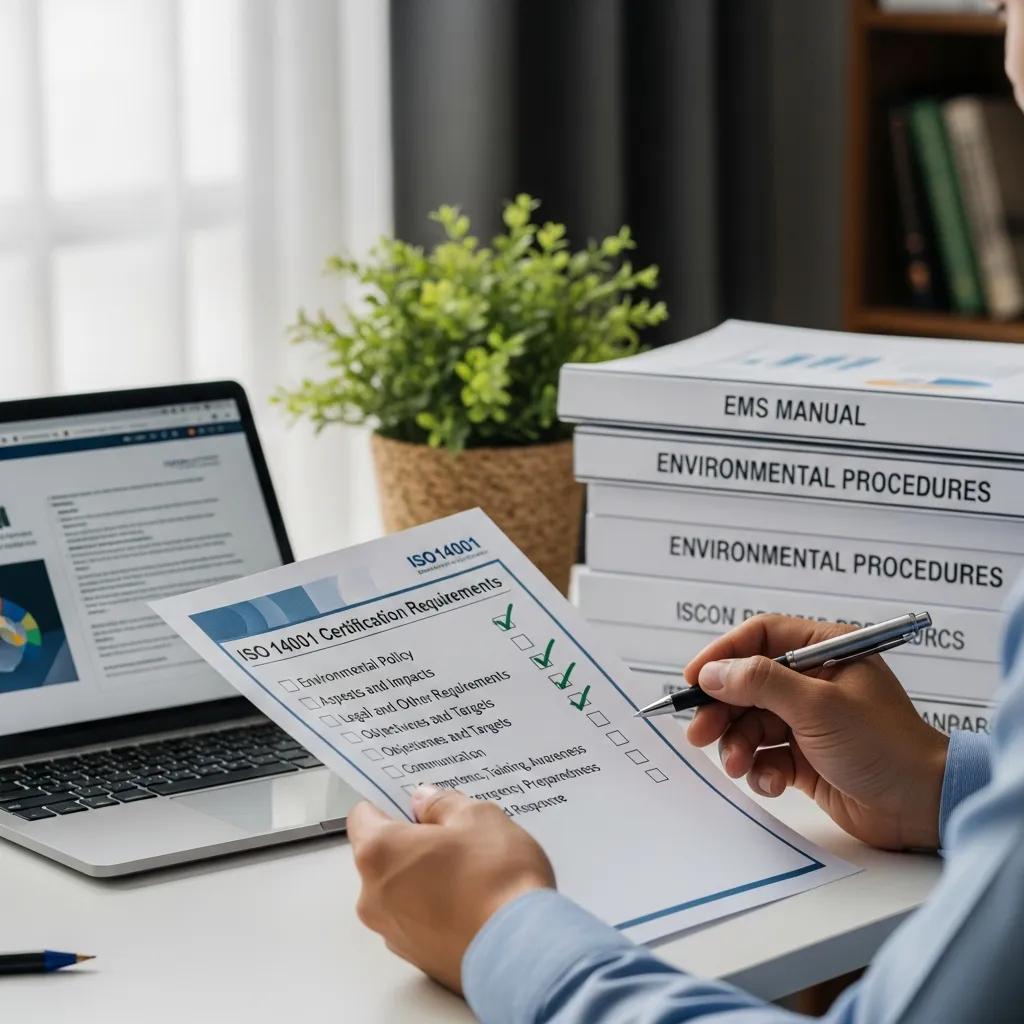
ISO 14001 requires organisations to demonstrate documented policies, objectives, operational controls, competence, monitoring and continual improvement. Preparing for certification means translating clauses into practical evidence and controls. Start with a gap analysis against clauses 4–10, create an environmental policy, map environmental aspects and legal requirements, set measurable objectives, and establish monitoring, internal audit and management review processes. SMEs should focus on proportionate documentation, a clear legal register and effective operational controls to show implementation. The checklist below summarises the practical actions teams should complete to be audit‑ready.
Follow these core preparation steps:
- Conduct a gap analysis: Compare current practice against clauses and record any non‑conformities.
- Develop an environmental policy and objectives: Secure leadership sign‑off and set measurable targets.
- Establish operational controls and procedures: Document the processes that control significant aspects.
- Implement monitoring and internal audits: Track performance and resolve issues before the external audit.
- Hold management review: Use review outcomes to allocate resources and update objectives.
These steps create the foundation for audit evidence and continuous improvement. The table below translates clauses into practical SME actions to make requirements tangible.
ISO 14001 requirements checklist for SMEs
A focused checklist helps SMEs break the standard into manageable tasks and keep documentation proportionate. Start with a clear scope and an environmental policy signed by leadership, then identify significant aspects using a simple scoring method to prioritise controls. Draft basic procedures for high‑risk activities, keep a documented legal register, schedule internal audits and collect monitoring data for key indicators such as energy use, waste volumes and emissions. Evidence auditors commonly review includes training records, calibration logs, internal audit reports and management review minutes; maintaining these items reduces surprises in Stage 1 and Stage 2 audits and speeds certification.
Steps to implement an effective EMS
Implementation follows a phased roadmap: gap analysis and planning, policy and objective development, controls and training, monitoring and internal audit, then management review and corrective actions. In planning, assign roles, set measurable targets and schedule activities with clear timelines. During rollout, focus on high‑impact controls and engage staff with concise, role‑specific training so procedures are applied consistently. Regular monitoring, equipment calibration and internal audits generate the data needed for management review and continual improvement, closing the PDCA loop. Milestones such as a completed gap analysis, documented operational controls and two internal audit cycles often indicate readiness for a Stage 1 assessment.
How the ISO 14001 certification audit process works

The audit lifecycle typically includes pre‑audit preparation, a Stage 1 documentation review, a Stage 2 on‑site audit to verify implementation, and then ongoing surveillance audits and periodic recertification. Auditors check that the EMS meets clause requirements and that the organisation can demonstrate effective controls over its significant environmental aspects. They review documents, interview staff, observe operations and sample records; common non‑conformities relate to missing monitoring evidence, incomplete legal registers or weak internal audit programmes. The numbered summary below provides a quick reference to each audit stage.
Key audit stages — summary:
- Pre‑audit preparation: Complete gap analysis, carry out internal audits and assemble the documentation package.
- Stage 1 (documentation review): Auditor reviews scope, policy, legal register and readiness for on‑site assessment.
- Stage 2 (on‑site assessment): Auditor verifies implementation, interviews staff and inspects records and operations.
- Surveillance and recertification: Annual surveillance audits confirm continued conformity; full recertification usually every three years.
Organisations that keep records up to date, maintain consistent monitoring data and run at least one internal audit before Stage 1 tend to have fewer findings and a smoother Stage 2. Next, we explain what to expect in Stage 1 and Stage 2 in more detail and how modern tools can improve audit efficiency.
Stage 1 and Stage 2 audits — what to expect
Stage 1 focuses on documentary evidence and readiness: auditors check the EMS scope, policy, objectives, legal obligations and internal audit results to confirm the organisation is prepared for a full assessment. Stage 2 is an in‑depth, on‑site verification where auditors sample records, inspect operational controls and interview personnel to assess competence and effectiveness. Audit sampling scales with organisational size, number of sites and the range of environmental aspects, so SME sampling is proportionate. Preparing concise, well‑organised records and assigning experienced staff for auditor interviews reduces non‑conformities and speeds certification decisions.
(Integration note) Some certification bodies combine traditional audit expertise with AI‑driven tools to improve planning and evidence review. For organisations seeking a streamlined route to certification, Stratlane Certification Ltd. positions itself as an innovative UK body that pairs experienced industry auditors with AI‑assisted audit planning. This approach is designed to cut routine audit time while keeping professional judgement central; contact the provider to request a quotation or discuss booking Stage 1 and Stage 2 audits.
Surveillance audits and continual improvement
After certification, organisations enter a cycle of surveillance audits — typically annual — to confirm ongoing conformity and progress against objectives. Internal monitoring and management review are key to staying audit‑ready. Continual improvement shows up as positive KPI trends such as reduced energy intensity, lower waste generation or fewer non‑conformities year‑on‑year; demonstrating progress at surveillance reassures auditors and stakeholders. Prepare for surveillance by keeping records current, tracking objectives and closing corrective actions from previous audits. Performance dashboards and an annual audit schedule help management keep focus on EMS outcomes and long‑term sustainability goals.
What does ISO 14001 certification cost in the UK?
Certification cost depends on scope, number of sites, workforce size, operational complexity and any specialist audit requirements; typical ranges for SMEs vary accordingly. Key pricing drivers are auditor days, preparatory gap analysis, surveillance frequency and multi‑site complexity. The table below gives an at‑a‑glance reference to help SMEs estimate budgets for common business profiles.
Certification cost ranges by business size:
Factors that influence certification pricing for SMEs
Primary cost drivers include the number of audit days, geographic spread of sites, operational complexity (for example resource‑intensive processes), need for specialist auditor expertise and any pre‑audit support. Travel and logistics increase costs for multiple locations, and organisations without documented monitoring data may require extra audit time to demonstrate compliance. To control costs, consider consolidating sites under one scope where appropriate, prepare documentation thoroughly before audits, and resolve internal audit findings ahead of the external Stage 2 visit. Understanding these drivers helps teams budget realistically and invest where it reduces recurring audit time.
Stratlane’s transparent quotation and pricing approach
Stratlane Certification Ltd. offers transparent quotations that clearly set out audit days, scope, travel allowances and surveillance schedules so organisations know what to expect. Typical quotes itemise required audit time and any scope inclusions to avoid hidden costs and simplify budgeting. The provider combines experienced auditors with AI‑assisted audit planning to streamline evidence collection and reduce unnecessary auditor time — which can lower fees for well‑prepared clients. Organisations can request a tailored quotation to understand timelines, deliverables and budgets before committing.
Integrating ISO 14001 with other management systems
ISO 14001 shares its structural framework with standards such as ISO 9001 (quality) and ISO 45001 (health and safety), making an integrated management system (IMS) an efficient way to reduce duplication and improve oversight. Integration leverages shared clauses — context, leadership, planning, support, operation, performance evaluation and improvement — allowing common documentation for policy, risk assessments, objectives and management review. The result is fewer audits, streamlined controls and shared KPIs that support holistic governance. Practical integration benefits include the following.
Integration delivers these practical benefits:
- Reduced audit duplication through combined surveillance and internal audits.
- Shared processes such as document control, training and management review.
- Consolidated objectives and KPIs for cross‑functional improvement.
- Better resource allocation by aligning responsibilities and budgets.
Many organisations also choose to pair environmental management with information security. Achieving ISO 27001 certification strengthens data protection and cyber security, which can be managed alongside environmental risks for a comprehensive compliance strategy.
Combining ISO 14001 with ISO 9001 and ISO 45001 for joined‑up governance
A practical integration roadmap starts by aligning scopes and identifying overlapping controls — for example document control, internal audit, competence and management review — then consolidating procedures where it makes sense. Common tactics include unified manuals for shared clauses, mapping processes to multiple objectives and joint training for combined responsibilities. Often the simplest route is to add environmental requirements to an existing ISO 9001 system, leveraging existing structures and minimising extra work. Coordinating audit schedules and internal reviews reduces time spent on compliance while strengthening governance across quality, environment and safety.
Benefits of integrating environmental and quality management
Integrated systems cut administrative burden by consolidating controls, reducing paperwork and enabling single audits that cover multiple standards; this saves management time and reduces external auditor days. Shared objectives and KPIs clarify priorities and create a harmonised improvement programme that benefits quality, environmental performance and employee safety together. An SME that integrates systems can often reduce annual audit days, centralise training and document control, and realise measurable administrative savings — making integration an effective route to streamlined compliance and stronger oversight.
As technology evolves, organisations are beginning to link environmental systems with emerging standards like AI management. Pursuing ISO 42001 certification for AI management can help ensure responsible, sustainable use of artificial intelligence alongside broader environmental and ethical goals.
Frequently Asked Questions
Who can benefit from ISO 14001 certification?
ISO 14001 suits a wide range of organisations — from SMEs to large corporations, non‑profits and public bodies. Any organisation aiming to improve environmental performance, meet regulatory obligations and strengthen reputation can benefit. Sectors such as manufacturing, construction and services often gain particular value because of their material environmental impacts and regulatory requirements.
How long does certification usually take?
The timeline varies with size, complexity and current maturity of the organisation’s systems. Small organisations with straightforward operations can complete preparation and certification in a few months; larger or multi‑site organisations may take a year or more. Key phases include gap analysis, EMS development, implementation and the audit cycle. Good planning and resourcing help accelerate the process.
What are common challenges during implementation?
Typical challenges include staff resistance to change, limited leadership engagement and insufficient time or budget for training and documentation. Organisations may also find it hard to identify significant aspects or set measurable objectives. Overcome these issues by securing leadership buy‑in, focusing on proportionate documentation, providing clear role‑based training and communicating the business benefits of the EMS.
Will ISO 14001 help with legal compliance?
Yes. ISO 14001 requires organisations to identify applicable environmental legislation and set up controls to manage compliance. An effective EMS provides documented evidence, monitoring and corrective actions that reduce the risk of breach and make regulatory reporting and inspections simpler.
How often are surveillance audits after certification?
Surveillance audits are typically annual to confirm ongoing conformity and progress against objectives. A full recertification audit usually occurs every three years. Regular internal audits help keep the organisation prepared for external surveillance and recertification.
What role does employee training play?
Training is essential. Staff need to understand their EMS responsibilities, recognise significant environmental aspects and apply operational controls. Regular, focused training increases engagement, improves compliance and supports continual improvement.
Conclusion
ISO 14001 certification gives UK businesses a structured, proven way to improve environmental performance, meet regulatory requirements and strengthen market position. Implementing an effective EMS can deliver cost savings, reduce operational risks and enhance reputation — all while supporting long‑term sustainability goals. If you’d like to explore how ISO 14001 could work for your organisation, discover our tailored solutions and next steps today.