
Transform Your Business: Get Started with Kaizen Events

Continuous improvement with Kaizen — practical steps to lift business performance
Kaizen is a Japanese management approach built on many small, practical improvements to processes, people and performance. This guide shows how Kaizen works in practice: how frontline engagement, simple tools and the PDCA cycle cut waste, raise quality and speed organisational learning. You’ll find Kaizen’s origins and core principles, hands‑on techniques like 5S and Gemba walks, a step‑by‑step on running Kaizen events, and how ISO standards help make improvement repeatable. Many organisations struggle to turn one‑off projects into lasting change; this article lays out the metrics, routines and cultural habits needed to embed Kaizen so gains endure. We also cover related practices — Lean, waste reduction and process improvement — to help you turn Kaizen into measurable business results.
What is Kaizen methodology and how does it drive continuous improvement?
Kaizen is both a philosophy and a practical system for steady, incremental improvement that involves everyone in the organisation. It works by creating lots of small, repeatable experiments: people closest to the work spot problems, propose fixes, test changes and then standardise what works. That creates a continuous feedback loop that reduces muda (waste) and smooths process flow. Unlike large, disruptive transformations, Kaizen favours many low‑cost, quick experiments — which makes sustained improvement more likely. Seeing how Kaizen operates in practice lets you apply its core principles day to day and use PDCA to turn ideas into measurable outcomes.
What are the core principles of Kaizen?
The core Kaizen principles are continuous incremental improvement, broad employee involvement, clear standardisation and iterative learning. Applied consistently these principles produce practical gains. Breaking big problems into small, time‑boxed experiments lowers risk and keeps momentum. Empowering frontline staff to try fixes increases buy‑in and surfaces practical solutions managers might miss. Standardise–improve–repeat turns successful experiments into standard work, creating a stable base for the next improvement cycle.
- Make many small, frequent experiments to accelerate learning and reduce risk.
- Empower those who do the work to propose and test practical fixes.
- Standardise successful changes so improvements stick and become the new norm.
These principles feed directly into PDCA — the operational engine that makes continuous improvement systematic rather than ad hoc.
How does the PDCA cycle facilitate ongoing process enhancement?
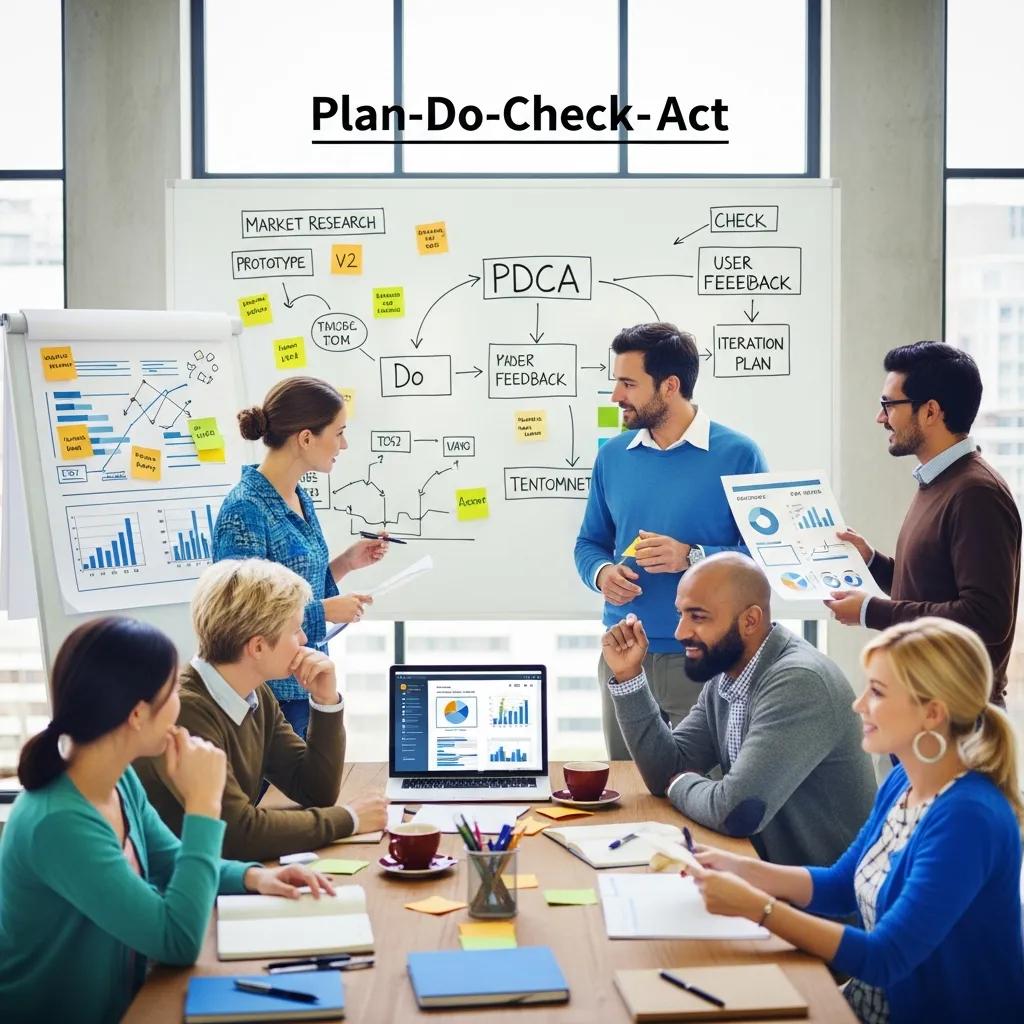
PDCA (Plan–Do–Check–Act) provides a simple structure for turning Kaizen ideas into measurable change. In Plan you define a focused problem, map the current state and set clear targets. Do runs a short pilot or Kaizen event to try countermeasures. Check compares results with the targets and explores root causes. Act either standardises the successful change or prepares the next iteration. When teams make PDCA part of daily routines, each Act becomes the starting point for the next Plan — creating a steady upward cycle of improvement.
Across industries, PDCA is a recognised tool for practical, evidence‑based quality improvement.
PDCA cycle for continuous quality improvement
Quality management in agribusiness can benefit from the Deming Cycle. As part of the business cycle, PDCA is an effective tool for continuous quality improvement in that sector.
The Deming Cycle (PDCA) concept as an efficient tool for continuous quality improvement in the agribusiness, E Frolova, 2015
A small Kaizen example: reduce cycle time. Plan by mapping each step, Do by trying a rearranged workflow on one shift, Check by measuring cycle time and defects, Act by updating the standard work if the trial meets targets. Making PDCA routine ensures each Act becomes the baseline for the next Plan, driving steady gains in effectiveness and efficiency.
What are the key benefits of implementing Kaizen for your business?
Kaizen delivers measurable operational gains and a cultural shift toward continuous improvement. Through incremental change and frontline problem solving, Kaizen reduces variation and defects, shortens cycle times and improves customer outcomes — all while lowering operating cost over predictable timeframes. Its structured approach supports clear KPIs, faster detection of problems and a repeatable process for sustaining gains through standardisation and review. The table below summarises common benefit categories, how Kaizen produces them, suitable KPIs and typical timeframes to expect visible results.
Benchmarking Kaizen benefits with a small set of KPIs helps leadership focus resources where improvement compounds fastest. The table outlines typical outcomes and how to measure them.
This comparison shows Kaizen typically delivers quicker wins in efficiency and engagement, while quality and cost benefits compound over a longer period. Next we look at the tools Kaizen uses to cut waste and streamline operations.
How does Kaizen improve operational efficiency and reduce waste?
Kaizen improves efficiency by identifying and eliminating the three common sources of process friction — muda (waste), mura (unevenness) and muri (overburden) — using techniques such as 5S, value stream mapping and visual management. Teams classify wastes (transport, inventory, motion, waiting, overproduction, defects, overprocessing) and apply targeted countermeasures: 5S to tidy and standardise the workspace, poka‑yoke to prevent errors, layout changes to cut motion, and clearer handoffs to reduce waiting. Typical outcomes are lower cycle times, reduced work‑in‑progress and higher throughput, which you can track weekly to confirm progress. These quick, visible wins build trust for larger improvements.
- Start with observation and mapping to expose non‑value steps.
- Use tools like 5S and value stream mapping to tackle physical and process inefficiencies.
- Early wins in throughput and cycle time create momentum for broader redesign.
Those efficiency improvements naturally link to better quality and stronger customer delivery through standardisation and routine checks.
In what ways does Kaizen enhance quality and customer satisfaction?
Kaizen improves quality by introducing small, repeatable changes that reduce variation and defects, and by building regular checks into day‑to‑day work so issues are caught early. Techniques such as 5 Whys and fishbone diagrams help teams find systemic causes and design targeted fixes that cut defect rates. As defects fall and delivery becomes more reliable, customer metrics — on‑time delivery, complaint rates and Net Promoter Score — typically improve. For example, a supplier that standardises processes and adds visual controls can reduce rework and deliver more consistently, which customers notice.
- Quality improvements rely on standard work and frequent checks, not episodic inspections.
- Continuous improvement reduces rework and costly corrective actions.
- Customer satisfaction improves as reliability and defect rates get better.
Those quality gains feed back into the organisation’s Kaizen practice and help sustain improvements over time.
How can businesses effectively implement Kaizen and continuous improvement?
Implementing Kaizen needs a practical plan: visible leadership sponsorship, frontline engagement, accessible training, simple measurement and regular Kaizen events. Start with leaders setting priorities and creating a safe space for experimentation. Train teams in core Kaizen tools and PDCA, then establish a short list of KPIs reviewed regularly. Plan Kaizen events by selecting a clear problem, bringing together a small cross‑functional team, mapping the current state, testing countermeasures and standardising successful changes. Regular follow‑up — audits, visual management and short improvement huddles — keeps momentum. Organisations that pair structured events with daily Kaizen habits (quick huddles, suggestion schemes) create a steady pipeline of small projects that add up.
It’s important to distinguish Kaizen as a culture from Kaizen events as execution mechanisms — both are needed for lasting improvement.
Kaizen philosophy and event implementation
The distinction between Kaizen as an ongoing philosophy and Kaizen events as the practical implementation mechanism is important: events translate strategy into focused action driven by a steering committee.
Kaizen and Kaizen Event Implementation: Kaizen Kaizen Event Impleme, 2009
What are the steps to plan and execute successful Kaizen events?
A focused Kaizen event follows a short sequence that keeps the team outcome‑oriented and learning fast. Start by choosing a priority area with a clear problem and baseline metrics. Form a small team led by a facilitator who guides mapping, root cause analysis and solution design. Run a short pilot during Do, collect data in Check to compare against targets, and in Act update standard work or plan the next iteration. Events can be as brief as a half‑day quick Kaizen or run several days for more complex processes. Clear roles — facilitator, process owner, data analyst — keep accountability and ensure improvements are standardised.
- Select a focused problem: agree scope and baseline metrics.
- Assemble a cross‑functional team: include people who actually do the work.
- Map, test and measure: run a short experiment and capture data.
- Standardise and follow up: update procedures and check sustainment.
Successful events create measurable improvements and showcase results that encourage wider participation. The next section explains how to make events routine through culture change.
How do you cultivate a culture of continuous improvement?

Building a Kaizen culture takes visible leadership, regular training, simple recognition and embedding improvement into daily management so change becomes habitual. Leaders should sponsor projects, remove obstacles and clearly communicate priorities; managers coach teams on PDCA and celebrate small wins to reinforce the right behaviours. Training should include facilitator coaching and hands‑on workshops that teach Gemba walks and 5S. Recognition can be as straightforward as public acknowledgement of a suggestion put into practice. Daily huddles, visual metrics and a steady flow of suggestions make improvement part of the normal workday, spreading capability across the organisation.
- Leaders must show commitment by attending improvement reviews.
- Training and coaching turn principles into repeatable practices.
- Recognition and visible metrics reinforce engagement and accountability.
When SMEs need extra support, practical external help and focused audits can accelerate adoption while keeping interventions proportionate and outcome‑driven.
Use this comparison to pick the right format for urgency, complexity and resource availability. Next we explain how ISO certification can formalise and support continuous improvement.
How does ISO certification support continuous improvement with Kaizen?
ISO standards offer a formal framework that complements Kaizen by requiring systematic planning, monitoring and improvement. ISO 9001 maps closely to PDCA and contains clauses on continual improvement and corrective action. Certification audits check that an organisation has controls in place, measures performance and acts on nonconformities — providing external accountability and helping prioritise Kaizen work. ISO 27001 and ISO 42001 extend the same iterative improvement approach to information security and AI governance, respectively. Mapping standards to improvement activities helps you see where Kaizen tools support compliance and where audits surface further improvement opportunities.
Why is ISO 9001 the foundation for quality management and Kaizen?
ISO 9001 embeds PDCA‑style improvement through requirements such as Clause 10 (Improvement), which calls for corrective action, continual improvement and performance evaluation — all of which align with Kaizen’s daily cycles. By linking documented processes, measurement and management review, ISO 9001 creates the governance that lets Kaizen experiments be captured, evaluated and scaled. Audits highlight nonconformities and opportunities that feed directly into Kaizen events and standardisation work. For organisations seeking certification support, Stratlane Certification Ltd. provides ISO 9001 certification audits using AI‑driven audit tools and experienced auditors, plus tailored programmes for startups and SMEs — request a quote or book an audit to discuss how certification can accelerate your Kaizen roadmap.
This mapping shows how each standard reinforces continuous improvement in its area and where Kaizen activities create audit‑ready evidence and corrective actions. The next section explains how security and AI standards complement wider improvement systems.
How do ISO 27001 and ISO 42001 complement continuous improvement efforts?
ISO 27001 and ISO 42001 apply the same iterative improvement logic to their domains, using risk‑based review cycles and evidence‑based corrective actions that mirror PDCA. ISO 27001 focuses on continuous risk assessment and control evaluation; Kaizen techniques can support rapid testing of control changes and measurement of impact. ISO 42001 addresses AI governance and requires iterative oversight of models and decision processes — where documented small experiments and continuous checks reduce governance gaps and build trust. Aligning quality, security and AI governance around common KPIs and schedules reduces duplication and strengthens organisational controls.
For organisations extending these principles to AI, understanding ISO 42001 certification is essential to establish robust AI management systems and responsible deployment.
- ISO standards formalise improvement cycles and provide auditable evidence of progress.
- Kaizen delivers the rapid experiment‑and‑learn capability that supplies audit‑ready evidence.
- Aligning standards reduces duplication and strengthens controls across the organisation.
Practical integration of audits and Kaizen events helps organisations target the most impactful improvements while maintaining compliance and resilience.
What are common challenges in Kaizen implementation and how to overcome them?
Typical barriers include limited resources, cultural resistance, weak measurement and lack of leadership follow‑through. Overcoming them requires pragmatic scaling, visible sponsorship and practical tools. SMEs often worry about capacity and ROI, so begin with focused pilot events that deliver quick wins and build credibility. Measurement issues arise when metrics are missing or overly complex — pick a small set of meaningful KPIs and use visual boards so teams can see progress. Technology, including AI‑driven audit tools, can cut the time spent on data collection and highlight priority opportunities via risk heatmaps and anomaly detection.
What barriers do SMEs face in adopting Kaizen and how can they be addressed?
SMEs commonly lack dedicated improvement resources, formal training and time for long events, so adopt a scaled Kaizen approach focused on low‑cost, high‑impact activities. Practical tactics: run short Kaizen workshops, train internal facilitators, use simple visual metrics and pick problems with clear ROI to free up capacity. External support can be tailored — coach a single event, provide facilitator training or run targeted audits that turn findings into actionable Kaizen projects. Several providers specialise in scalable programmes for startups and SMEs, balancing rigour with resource constraints so improvements are achievable and sustainable.
Academic and industry research highlights the specific challenges SMEs face in sustaining Kaizen activities and suggests targeted responses.
Kaizen implementation challenges & sustainability for SMEs
This paper reviews the factors and challenges Malaysian SMEs face in implementing Kaizen, and offers approaches for sustaining Kaizen activities within those organisations.
A review of contributing factors and challenges in implementing kaizen in small and medium enterprises, MG Maarof, 2016
- Start with pilot events that minimise disruption.
- Target high‑impact bottlenecks with measurable outcomes.
- Use external coaching selectively to build internal capability quickly.
These SME‑focused approaches lead naturally into how AI and automation can speed measurement and insight generation for continuous improvement.
How can AI‑driven audit tools enhance continuous improvement processes?
AI‑driven audit tools speed up improvement by automating analysis, surfacing patterns and prioritising opportunities that merit Kaizen events. Useful outputs include risk heatmaps showing where variance is highest, anomaly detection that flags unusual incidents for root cause work, and trend analysis that spots slow declines before they become problems. Feed these insights into PDCA cycles so teams can target experiments with the best expected value and track impact on frequently refreshed dashboards. AI doesn’t replace frontline knowledge — it amplifies it by surfacing evidence that makes Kaizen more focused and effective.
- AI reduces audit preparation time and increases the cadence of reliable measurements.
- Pattern detection helps prioritise improvement projects with the greatest ROI.
- Combining AI with Gemba observations delivers faster, more accurate interventions.
The table summarises common obstacles and practical mitigations. Next we point to resources for training, case studies and structured support to speed adoption.
Where can you find resources and support for continuous improvement with Kaizen?
To accelerate Kaizen adoption, use case studies that show baseline metrics and outcomes, targeted facilitator training, and hands‑on workshops that convert learning into immediate Kaizen events. High‑quality case studies follow a clear format — challenge, intervention (Kaizen plus any audit), and results with specific KPIs — so others can replicate what worked. Training ranges from introductory Kaizen courses to facilitator certification and workshop coaching; follow‑up coaching helps teams standardise and sustain improvements. For external support, look for providers that combine practical Kaizen coaching with audit insight so compliance findings become a prioritised improvement backlog.
What case studies demonstrate successful Kaizen and ISO certification integration?
Good case studies show how a baseline assessment led to targeted Kaizen interventions, which were reinforced by certification audits and follow‑up standardisation to lock in gains. They report concrete KPIs such as cycle time reduction, defect rate improvements and cost savings. A useful case study template includes: baseline diagnosis with metrics, the Kaizen plan and tools used, measured outcomes after implementation, and the sustainment plan that institutionalised the change. Organisations that publish these examples often show how audit findings helped prioritise projects and how certification provided governance that sustained improvement. Stratlane Certification Ltd. keeps case studies and training resources that blend certification audits with tailored programmes for startups and SMEs, and can help convert audit outcomes into practical Kaizen plans — request a quote or book an audit to explore bespoke options.
- Case studies should report baseline, intervention and quantified results.
- Templates improve comparability and replicability of approaches.
- Combining Kaizen with certification often speeds sustainment of gains.
How can training and workshops accelerate Kaizen adoption?
Training and workshops turn theory into action by giving teams practical tools, a structured agenda and coaching that supports live experiments. A short workshop agenda might include a Gemba walk, problem mapping, quick root cause analysis, a Do trial of a countermeasure and a Check review with data — finished with an Act plan to standardise. Effective workshops deliver a clear improvement plan, updated standard work and team members able to run follow‑up Kaizen events independently. Providers who pair facilitator training with audit‑led prioritisation help organisations focus on the highest‑impact projects and build capability faster, making Kaizen adoption more sustainable and measurable.
- Workshops should emphasise hands‑on practice and immediate experiments.
- Follow‑up coaching ensures lessons become durable standard work.
- Align training with audit findings to focus on the highest‑value problems.
Stratlane Certification Ltd., an accredited certification body at 2 Grosvenor Gardens, SW1W 0AU, offers tailored training and audit programmes that help organisations link certification outcomes to Kaizen projects and continuous improvement plans; contact Stratlane Certification Ltd. to request a quote or book an audit and explore tailored support for your improvement roadmap.
Frequently asked questions
What is the role of leadership in implementing Kaizen?
Leadership is essential. Leaders set the vision and priorities, remove barriers and create a safe environment for experimentation. Their visible sponsorship motivates people to take part and signals that improvement matters. Leaders also need to provide resources and training so teams can run experiments and embed improvements into everyday work.
How can organisations measure the success of Kaizen initiatives?
Measure success with a small set of KPIs tied to each project: cycle time, defect rates, cost savings and employee participation are common examples. Track these regularly and use visual dashboards so teams can see progress. Frequent measurement lets you learn quickly and make data‑driven decisions that sustain gains.
What are some common misconceptions about Kaizen?
Common myths: that Kaizen requires big resources or long timelines, that it’s only about cutting cost, or that it only suits manufacturing. In reality, Kaizen focuses on small, fast experiments that need little disruption, aims to improve processes and quality as much as cost, and applies across industries and functions.
How can technology support Kaizen practices?
Technology helps with data collection, analysis and collaboration. AI‑driven audit tools can surface patterns and priorities, while project tools keep teams aligned during events. Technology speeds up insight and reduces the administrative burden so teams can focus on practical experiments.
What training options are available for teams looking to adopt Kaizen?
Options range from short introductions to facilitator certification. Practical workshops that include Gemba walks and live root cause exercises are particularly effective. External coaching can support first events and help embed the capability internally for ongoing uptake.
How can organisations overcome resistance to change when implementing Kaizen?
Overcome resistance by communicating clearly, involving employees in improvements, and showing quick wins. Visible leader support and training ease concerns, while recognising and celebrating small successes reinforces the behaviour change needed for a continuous improvement culture.
Conclusion
Kaizen creates a practical, repeatable route to better efficiency, quality and engagement. By committing to small, regular improvements and the PDCA rhythm, organisations can achieve measurable results that add up to long‑term benefits. If you’re ready to get started, consider tailored training or certification support to accelerate adoption and lock in the gains. Start small, measure often and build momentum — the cumulative effect is what delivers lasting performance improvement.