
The Evolution of ISO Standards: A Historical Overview

The Evolution of ISO Standards: History, Revisions, and Future Trends
ISO develops voluntary technical and management standards that harmonise how organisations operate across industries. Knowing how those standards have changed helps organisations stay compliant, reduce friction with suppliers and customers, and plan for future risks. This guide traces ISO’s origins, the major revisions to standards such as ISO 9001 and ISO 14001, how the ISO 27000 series evolved for information security, and the arrival of ISO 42001 for AI governance. Along the way we map timelines, highlight practical implications and offer concise guidance so you can connect historical changes with today’s compliance choices. By the end, you’ll have a clear view of why key revisions happened and what practical steps organisations can take to keep pace.
What is the history and founding of the International Organization for Standardization?
The International Organization for Standardization (ISO) was created to bring national standards bodies together so they could agree common references that reduce technical barriers to trade. Experts from member bodies form technical committees to draft consensus standards that industries can adopt internationally. Early ISO activity focused on measurements, materials and test methods — work that established the formal development process and laid the groundwork for later management system standards centred on process control and conformity. That founding approach explains why ISO combines technical detail, committee consensus and broad applicability across jurisdictions. The sections that follow outline the organisation’s 1947 founding and the first committees and standards that set its direction.
When and why was ISO established in 1947?
ISO began in 1947 when representatives from national standards organisations met to create an international forum for aligning technical specifications and easing trade. The post‑war rebuilding of supply chains and expanding global commerce created an urgent need for common references for measurements, products and processes. ISO’s membership model — national bodies contributing technical experts to committees — produced standards by consensus, giving them legitimacy and practical relevance. That model later enabled the development of management system standards built on multi‑stakeholder input and technical expertise.
What were the first ISO standards and early technical committees?
In its early years ISO prioritised measurement standards, test methods and product specifications to support cross‑border manufacturing and calibration. Technical committees were organised by subject area — mechanical engineering, materials, electrical measurements and similar domains — bringing together national experts to draft documents that could gain international acceptance. Those first outputs also established the procedural steps for creating standards: drafting, balloting and systematic review. Those mechanisms remain central to ISO’s work and later enabled the creation of broad management system standards such as ISO 9001 and ISO 14001.
How has the ISO 9001 Quality Management System evolved over time?
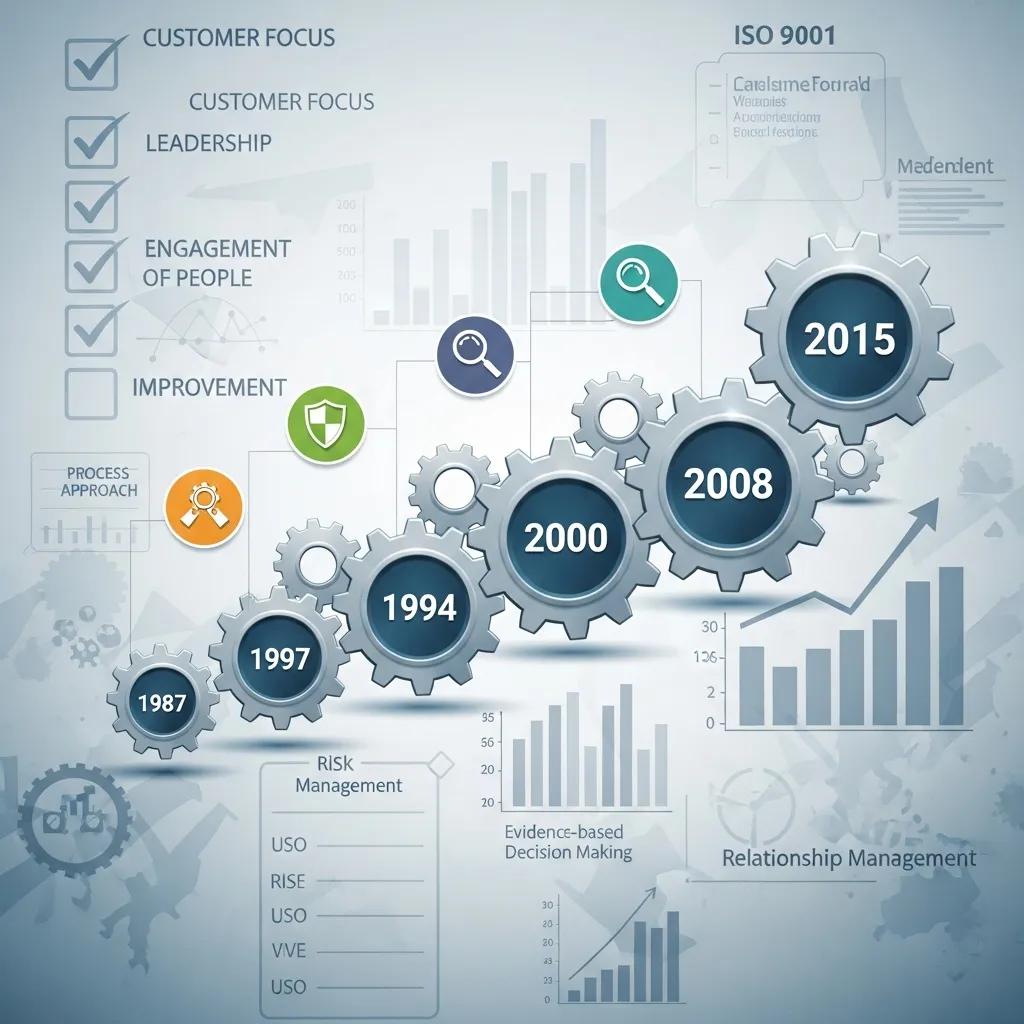
ISO 9001 has moved from a prescriptive, inspection‑led checklist to a flexible, process‑driven Quality Management System (QMS) that foregrounds risk‑based thinking and continual improvement. Revisions changed the structure and clauses over time and aligned the standard with Annex SL to make integration with other management standards easier. For businesses, that means stronger integration, greater resilience and clearer assurance for customers and suppliers.
The table below summarises the main ISO 9001 revisions in a quick, scannable format.
This progression shows how ISO 9001 moved from checklist compliance to strategic quality management, making it easier to integrate with environmental, security and other management systems and improving organisational agility.
- The 1987 and 1994 editions prioritised documented procedures and inspection as the core compliance mechanism.
- The 2000 revision introduced process thinking and PDCA, enabling performance‑driven process design rather than checklist activity.
- The 2015 update embedded risk‑based thinking and leadership responsibilities, connecting QMS to enterprise governance and strategy.
Those changes shifted audits toward assessing outcomes and continual improvement instead of only checking documents, and opened the door to integrated management systems that combine quality, environment and information security controls.
What are the key revisions of ISO 9001 from 1987 to 2015?
ISO 9001’s revisions trace a clear trajectory: from prescriptive requirements to process and risk orientation. The standard began with documented procedures and inspection (1987), moved to prevention and supplier controls (1994), embraced process thinking and PDCA (2000), and culminated in 2015 with risk‑based planning, leadership engagement and Annex SL alignment. In practice, organisations shifted from lengthy manuals to mapped processes, measurable performance indicators and continuous improvement embedded in strategic planning. Examples include replacing rigid checklists with process KPIs, using leadership reviews to set quality targets, and tying risk registers into QMS planning.
The evolution also changed certification and audit practice: auditors now look for effective implementation and results, not just evidence of documented procedures. That outcome focus encourages organisations to keep systems live and effective, and it supports integration with other management disciplines such as environment and information security.
How did ISO 9001 shift focus towards risk-based thinking and continuous improvement?
ISO 9001:2015 introduced risk‑based thinking to make prevention an integral part of planning. Organisations are expected to identify, assess and treat risks that could affect quality objectives, and to embed those actions in core clauses backed by leadership accountability. The practical benefits include fewer nonconformities, stronger supply‑chain resilience and better alignment between quality objectives and business strategy. Typical practices include using risk registers linked to process maps, setting KPIs to track residual risk and applying PDCA cycles to test mitigation measures. Continuous improvement is driven by objective measurement, corrective actions and management reviews that feed back into planning.
Auditors now verify that risk management is active and effective, which encourages organisations to treat their QMS as a living system rather than a static compliance artefact. Seeing the shift in this way helps organisations prioritise investments that reduce likely failure modes and boost customer confidence.
Further research explores how risk‑based thinking was introduced in the 2015 update and what it means in practice for organisations.
ISO 9001:2015 & risk‑based thinking — research perspective
The 2015 revision of ISO 9001 formally introduced risk‑based thinking (RBT) as a core requirement. This paper reviews the literature on ISO 9001:2015 and approaches to risk, critically analysing past studies and offering fresh perspectives for researchers and practitioners.
ISO 9001: 2015 and risk‑based thinking: scientific research insights, YS Martins, 2015
What is the development timeline of environmental and social responsibility ISO standards?
How did ISO 14001 shape environmental management since 1996?
ISO 14001 established a practical Environmental Management System (EMS) framework that asks organisations to identify environmental aspects, meet legal obligations, set measurable objectives and track performance using Plan‑Do‑Check‑Act. Its structured clauses and operational controls help organisations reduce waste, energy use and emissions while improving compliance and stakeholder trust. Many organisations report cost savings and clearer environmental targets after implementing EMS practices. Increasing integration of environmental targets into corporate strategy and stronger stakeholder expectations make ISO 14001 a credible way to show sound environmental management.
Adopting EMS practices often leads organisations to consider broader social responsibility guidance, such as ISO 26000, which the next section examines.
What role does ISO 26000 play in corporate social responsibility?
ISO 26000 offers guidance on social responsibility — covering human rights, labour practices, community engagement and ethics — but it is not a certifiable standard. That distinction is important: ISO 26000 is descriptive guidance organisations use to shape policy, set priorities and benchmark CSR activities rather than obtain certification. It’s useful for drafting stakeholder engagement processes, supply‑chain due diligence and governance practices that complement certifiable systems like ISO 14001. Organisations typically tailor ISO 26000 to their context, using it as a strategic roadmap rather than a prescriptive compliance checklist.
How have information security standards like ISO 27001 evolved to meet digital challenges?
What are the milestones and updates in the ISO 27000 series?
The ISO 27000 family started as broad guidance and evolved into a certifiable Information Security Management System (ISMS) with an expanding set of controls and a risk‑based approach. Key milestones include the formalisation of ISO 27001 as a certifiable standard, periodic updates to Annex A to address new threats, and closer alignment with enterprise risk management. Recent updates focus on cloud security, supply‑chain risks and more dynamic threat landscapes, pushing organisations toward continuous monitoring and adaptive risk assessments. The series reflects a move from static control checklists to security programmes scaled to business context and residual risk.
Those changes encourage proportionate control selection, the use of security metrics to track posture, and closer alignment of information security with overall corporate risk appetite. Companion standards address privacy and cloud‑specific practices to round out an organisation’s approach.
- Use ISO 27001 for baseline information security governance.
- Adopt ISO 27018 for cloud provider practices around PII.
- Apply ISO 27701 to demonstrate structured privacy management on top of an ISMS.
How do related standards like ISO 27018 and ISO 27701 enhance data privacy and cloud security?
ISO 27018 sets practical controls to protect personally identifiable information in cloud environments, clarifying responsibilities and transparency for cloud providers and customers. ISO 27701 turns an ISMS into a Privacy Information Management System (PIMS) by adding privacy roles, processes and documentation aligned with legal obligations and privacy risk assessments. The approach is modular: organisations implement ISO 27001, then layer on ISO 27701 for privacy controls or reference ISO 27018 for cloud PII practices. The benefits include clearer contractual expectations with cloud suppliers, stronger evidence for regulators and improved customer trust through documented privacy controls.
Academic and industry research further emphasises the value of privacy management systems as extensions of information security.
ISO 27701: strengthening privacy through ISMS extensions
Information privacy is a central ethical and operational challenge in the information age. Managing personal information properly is critical because almost every organisation stores and processes such data. ISO/IEC 27701 frames privacy management as an extension of information security (ISO/IEC 27001). This paper proposes a process‑based reference model for an Information Privacy Management System (IPMS) drawing on standards such as ISO/IEC 27701, ISO/IEC 29100 and others.
Information Privacy Management—A Process Reference Model, 2024
These companion standards act as pragmatic extensions to ISO 27001, letting organisations tailor controls for cloud and privacy while keeping a single management system foundation.
Why was ISO 42001 introduced and what does it mean for AI governance?
What are the requirements and benefits of ISO 42001:2023 for AI management?
ISO 42001 defines the core elements of an Artificial Intelligence Management System (AIMS): governance arrangements, AI‑specific risk assessments, data quality controls and procedures for human oversight and transparency. Organisations are expected to document AI lifecycle controls — from data collection and model training to deployment and monitoring — and to tie each control to performance indicators and mitigation steps. Benefits include lower model risk, stronger stakeholder confidence, clearer supplier assurance and evidence of due diligence to regulators and partners. Certification to ISO 42001 signals a structured approach to managing ethical, safety and compliance risks in AI.
For organisations that want practical help, Stratlane Certification Ltd. offers certification audits and implementation support using AI‑enabled audit tools and subject‑matter expertise to integrate ISO 42001 into existing governance — shortening implementation time and providing independent assurance of AIMS maturity.
How does ISO 42001 align with global AI regulations like the European AI Act?
ISO 42001 maps closely to regulatory themes such as transparency, risk management, human oversight and accountability, translating those principles into auditable management system clauses. This harmonisation makes it easier to map ISO 42001 controls to the European AI Act’s requirements for high‑risk systems, providing documentary evidence of organisational processes, supplier assurance and ongoing monitoring that regulators and buyers can recognise. In practice, ISO 42001 certification can form part of a compliance dossier and help reduce regulatory friction by demonstrating systematic measures and governance for AI systems.
Ongoing analysis is exploring how ISO 42001 can help organisations navigate overlapping AI guidelines and emerging regulations.
ISO 42001: aligning AI governance with regulation
Organisations face the challenge of conforming to multiple and sometimes conflicting AI guidelines, standards and laws. Early-stage development of both AI standards and regulation makes it important to avoid fragmentation and market confusion by identifying gaps and reconciling differences. This paper compares ISO/IEC 42001 with the EU’s ALTAI assessment list and the proposed AI Act, using an ontology for semantic interoperability between trustworthy AI documents.
Comparison and analysis of 3 key ai documents: EU’s proposed ai act, assessment list for trustworthy AI (ALTAI), and iso/iec 42001
AI management system, D Golpayegani, 2022
Organisations considering certification can work with Stratlane Certification Ltd., which combines AI‑driven audit tools and tailored audit services to assess AIMS maturity and readiness for ISO 42001, helping align practical controls with regulatory expectations.
What is the global impact and future outlook of evolving ISO standards?
How do ISO standards facilitate international trade and innovation?
ISO standards reduce trade friction by offering harmonised technical and management requirements that trading partners recognise as evidence of competence and conformity. The mechanism includes technical harmonisation, mutual recognition and third‑party certification as market signals — together these lower transaction costs and speed procurement across borders. For innovators, standards provide common interfaces and measurement norms that accelerate adoption — standards for data formats or APIs create ecosystems that scale. Aligning development and management practices with ISO norms gives organisations clearer paths into export markets and supplier networks.
These benefits explain why businesses invest in standards‑based certification: it’s not only compliance but a strategic enabler for market access and collaborative innovation.
- Digital and remote auditing will become commonplace, enabling more continuous assurance.
- Sustainability measures will be embedded across management standards rather than siloed.
- Standards for AI, IoT and machine learning will multiply, requiring cross‑functional governance.
- Integrated management systems combining quality, environment, security and AI will be favoured.
What are the future trends in ISO standards including digitalisation, sustainability, and emerging technologies?
Future ISO work will push digitalisation of normative content — machine‑readable standards, automated compliance checks and remote audits — to improve scalability and reduce audit burden. Sustainability will be mainstreamed, with environmental and social criteria woven into quality and security frameworks to meet regulatory and investor expectations. Standards for emerging technologies will target governance, interoperability and safety, encouraging organisations to adopt multidisciplinary controls spanning legal, technical and ethical concerns. Practically, organisations should watch revisions closely, build integrated management systems, train multidisciplinary teams and adopt automated tools to translate standards into measurable controls and indicators.
- Monitor standard revisions: Keep a maintained register of standards that matter to your operations.
- Integrate management systems: Align QMS, EMS, ISMS and AIMS to reduce duplication and improve oversight.
- Invest in digital assurance: Use audit platforms and continuous monitoring to meet near‑real‑time compliance needs.
These steps will help organisations turn the evolution of ISO standards into operational advantage and long‑term resilience.
Frequently asked questions
What is the significance of ISO standards for small and medium-sized enterprises (SMEs)?
ISO standards give SMEs a practical framework to improve operations, quality and customer confidence. Certification can open doors: larger customers and public tenders often require suppliers to meet specific standards, so certification can increase market access and credibility. Over time many SMEs find the efficiency gains and new business opportunities outweigh the initial investment.
How can organisations prepare for ISO certification audits?
Start with an internal audit to identify gaps, then implement corrective actions and document changes. Train staff on the standard and what auditors will look for. Keep records clear and accessible, and engage a certification body early for guidance. Using a gap analysis and a staged implementation plan makes the process more predictable.
What are the costs associated with obtaining ISO certification?
Costs vary by organisation size, complexity and the chosen standard. Typical expenses include certification body fees, internal resource time, training and possible consultancy. While there’s an upfront cost, many organisations recoup it through efficiency improvements, new contracts and reduced risk.
How often do ISO standards need to be updated or revised?
ISO standards are generally reviewed every five years to keep them current with industry practice and technology. Stakeholders can propose changes during reviews, and significant updates may result in a new edition. Organisations should track relevant revisions to maintain compliance and take advantage of improvements.
What role do ISO standards play in risk management?
ISO standards provide structured frameworks to identify, assess and manage risk. ISO 9001 embeds risk‑based thinking for quality, while ISO 27001 focuses on information security risk. Implementing these standards helps organisations adopt proactive, systematic risk practices that align with business objectives and strengthen stakeholder confidence.
Can ISO certification be beneficial for non-profit organisations?
Yes. ISO certification helps non‑profits demonstrate accountability to donors and beneficiaries, improve efficiency and comply with legal requirements. Certification can support better resource management, clearer governance and stronger impact delivery — all useful for sustaining mission work.
Conclusion
Knowing how ISO standards have evolved helps organisations manage compliance, improve operations and support innovation. Aligning with these international frameworks reduces risk, strengthens stakeholder trust and can open new markets. Treat standards as strategic tools: monitor changes, integrate systems, and use digital assurance to stay ahead. If you’re ready to take the next step, explore our resources and certification services to move from planning to certified practice.