
Unlock Your Creativity: Effective Brainstorming Techniques

Techniques for Generating Ideas: Practical Innovation Methods to Drive Business Growth
Idea generation is a repeatable, structured approach for surfacing, developing and communicating new concepts that accelerate growth, improve processes and support compliance. This guide outlines hands‑on techniques—from mind mapping and SCAMPER to design thinking and blue‑sky workshops—and explains how to turn those methods into measurable outcomes such as faster product iteration, clearer risk treatment and improved customer experience. You’ll learn when to use each method, how to run facilitated sessions that produce auditable outputs, and how to map ideation into ISO management systems to embed continuous improvement. The guide also covers AI governance ideation aligned to ISO/IEC 42001 and provides stepwise practices for turning ideas into controls, policies and audit evidence. Sections cover core techniques, creative problem‑solving frameworks, ISO integration, responsible AI ideation, strategic brainstorming and practical routes from ideas to competitive advantage using measurement and prioritisation.
What Are the Most Effective Techniques for Generating Business Ideas?
Effective idea generation blends divergent and convergent thinking: divergent techniques expand the range of possibilities, while convergent tools help teams select and refine options that map back to business objectives. Used consistently, these methods shorten innovation cycles, clarify risk‑treatment choices and improve process flows that feed directly into management systems. Below we set out core techniques, when to use them and the outcomes you can expect.
The most impactful idea‑generation techniques include:
- Mind mapping to visualise complex processes and reveal clusters of opportunity across services or operations.
- SCAMPER prompts to rework existing products, controls or services into practical, testable variants.
- Brainwriting sessions to capture input from quieter stakeholders and reduce groupthink during ideation.
These approaches balance creativity with pragmatism: pairing a visual organiser with structured prompts speeds up selection and implementation. The following subsections explain two high‑utility methods and how to apply them in business contexts.
How Does Mind Mapping Enhance Business Idea Generation?
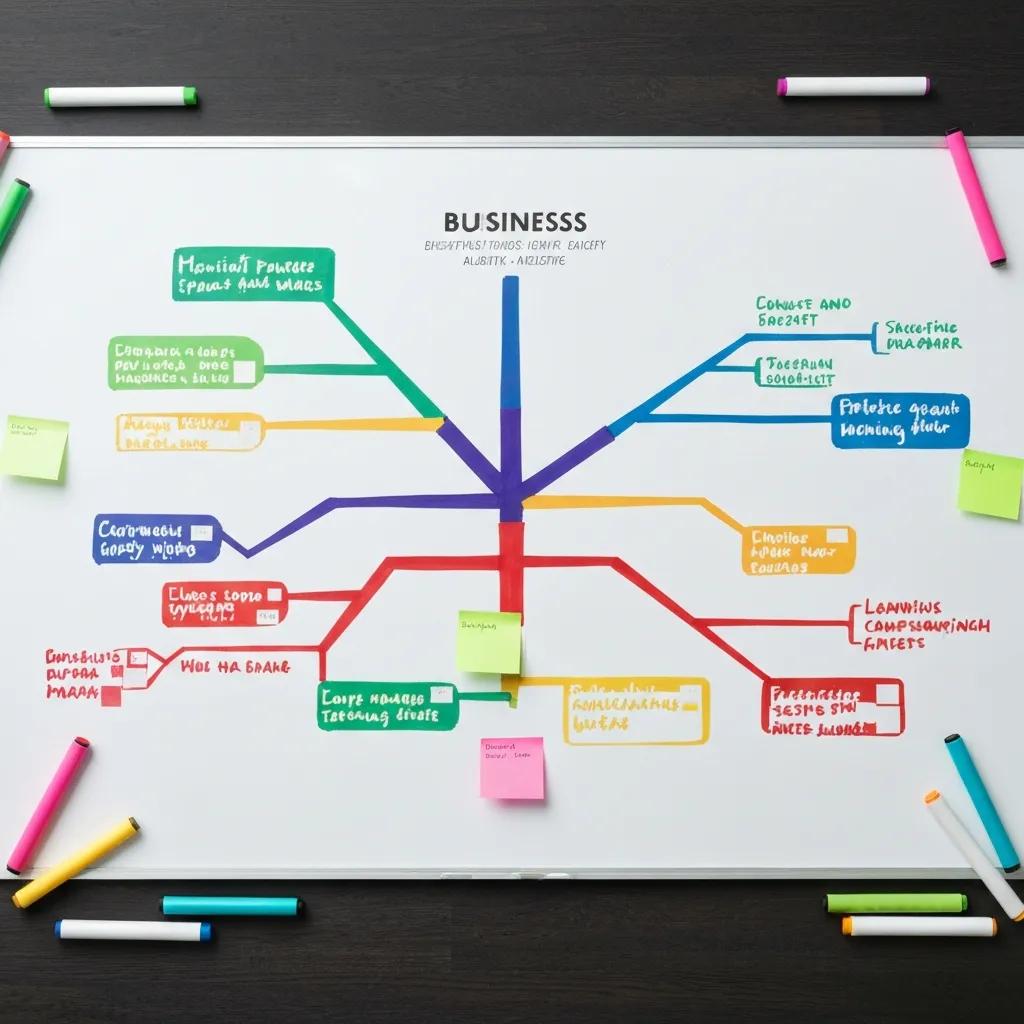
Mind mapping organises ideas visually, linking process steps, stakeholders and pain points in a single diagram that reveals clusters and practical improvement paths. Start with a central challenge and branch into sub‑processes, risks and opportunities to clarify dependencies and uncover low‑effort, high‑impact solutions. Common uses include mapping quality processes to spot waste, visualising customer journeys to find feature gaps, and linking controls to assets for ISMS planning. When you add metrics—cycle time, defect rates or risk scores—a mind map becomes traceable from idea to measurement and simplifies inclusion in management reviews.
Mind maps pair well with other ideation tools because their structure makes relationships explicit and supports fast prioritisation. From there, prompt‑driven methods like SCAMPER turn the clusters on the map into concrete change options.
What Is the SCAMPER Method and How Does It Drive Innovation?

SCAMPER uses seven prompts—Substitute, Combine, Adapt, Modify, Put to another use, Eliminate, Reverse—to force a systematic rethink of existing products, services and processes. Applying one prompt at a time to a target element generates multiple, distinct options that teams can prototype and test quickly. For example, SCAMPER can help adapt a legacy ISMS control into a secure‑by‑design alternative or combine product features to create bundled offers that reduce churn. Facilitators typically use timed rounds and rotate prompt ownership to keep momentum and ensure balanced participation.
By turning freeform creativity into structured iterations, SCAMPER helps organisations progress from broad idea lists to focused experiments with measurable success criteria—essential when ideation must produce auditable improvements within a management system.
How Can Creative Problem Solving Methods Boost Innovation in Business?
Creative problem‑solving (CPS) frameworks formalise the path from insight to implementation with repeatable stages—understand the problem, generate options, evaluate alternatives and implement solutions. They work because they combine user‑centred inquiry with disciplined evaluation, producing ideas that are desirable for customers and feasible for operations. Properly applied, CPS creates a steady pipeline of validated concepts that feed continuous improvement cycles and strategic roadmaps. Below is an overview of common CPS variants and practical steps for running them in teams.
Common creative problem‑solving frameworks include:
- Classic CPS: a five‑step model that moves teams from clarifying issues to implementing tested solutions.
- Lateral Thinking: provocative prompts and exercises that challenge assumptions and free the team from entrenched patterns.
- Synectics: analogy and metaphor techniques that surface unfamiliar but useful perspectives.
These methods expand the solution space and then apply disciplined evaluation to reduce risk and prioritise high‑value work. Moving from method selection to effective session design requires practical facilitation: time‑boxed ideation, silent idea capture and rapid prototyping are common best practices.
What Role Does Brainstorming Play in Generating Innovative Solutions?
Brainstorming remains effective when it’s properly structured: a clear problem statement, a strict time box and rules that separate idea generation from evaluation to protect creative flow. Variants such as brainwriting and timed rounds raise participation equality, while online whiteboards replicate visual clustering for remote teams. Convert raw idea lists into concept cards with owners, success metrics and prototype steps to avoid idea attrition. A simple funnel—capture, cluster, score, pilot—keeps brainstorming outputs focused and implementable rather than becoming an unprioritised backlog.
Well‑run brainstorming sessions prepare teams for rapid prototyping and testing, positioning ideas for validation and eventual integration into ISO‑aligned processes or product backlogs. That naturally leads into blue‑sky techniques for more radical innovation.
How Does Blue Sky Thinking Encourage Breakthrough Ideas?
Blue‑sky thinking deliberately suspends constraints to surface radical, out‑of‑the‑box options that conventional sessions can miss. Effective facilitation builds psychological safety, uses provocative prompts and reframes constraints as creative levers to expand idea horizons. After divergent exploration, teams apply feasibility filters and run small experiments to avoid letting impractical concepts stagnate. The funneling stage—assessing feasibility, desirability and viability—turns bold ideas into testable hypotheses with clear success criteria.
Blue‑sky sessions deliver best results when followed by disciplined evaluation and small pilots so high‑potential breakthroughs can be iteratively matured into organisational capability and measurable improvement.
How Do Structured Ideation Processes Integrate with ISO Certification for Business Improvement?
Structured ideation fits into ISO management systems by formalising idea capture, evaluation, implementation and review within Plan‑Do‑Check‑Act cycles, converting creativity into certified continual improvement. Mapping ideation outputs to relevant ISO clauses creates audit trails that show systematic improvement, risk‑aware innovation and documented decision‑making. This demonstrates to auditors that idea generation is embedded in processes such as corrective action, risk treatment and management review rather than being ad hoc. The table below compares common techniques, where they map into ISO frameworks and the practical benefits they deliver.
These mappings show how ideation methods provide traceable inputs to management system activities and audit evidence. Embedding ideation workflows into document control and corrective action registers ensures ideas move from concept to implemented control or updated procedure.
Stratlane Certification Ltd. helps organisations institutionalise ideation within management systems. We provide accredited certification for ISO 9001, ISO 27001 and ISO 42001 and position innovation as a certifiable outcome. Our auditors help translate ideation outputs into auditable records and practical improvements, with SME‑focused programmes and facilitation. Combining auditor‑led guidance with internal ownership creates a sustainable cycle from idea capture to verified improvement, helping attract organisations seeking certification to request quotes or book audits.
How Does ISO 9001 Support Continuous Improvement Through Idea Generation?
ISO 9001 requires documented processes for capturing improvement opportunities and evidence of continual improvement through performance metrics and corrective action records. Idea generation supplies candidate improvements for process changes, root‑cause analysis of nonconformities and management review inputs. Techniques such as 5 Whys and Ishikawa diagrams convert symptoms into actionable corrective actions tied to measurable outcomes like defect reduction or shorter cycle times. Keeping traceability—who proposed the idea, evaluation notes, pilot results and implementation evidence—creates a clear audit trail and demonstrates a functioning continual improvement system.
Embedding idea capture into QMS artefacts—change requests and improvement registers—closes the loop between creativity and certified quality outcomes, making innovation auditable and repeatable.
What Idea Generation Techniques Align with ISO 27001 for Information Security Innovation?
Under ISO 27001, ideation supports risk assessment, risk‑treatment planning and incident response by generating practical control options and secure‑by‑design improvements. Brainstorm secure architecture patterns, use SCAMPER to adapt legacy controls and run threat‑modelling sessions to produce risk‑treatment alternatives that feed into the Statement of Applicability. Red‑teaming and tabletop exercises surface gaps and prompt creative mitigations that improve detection and response. Capture outcomes as risk‑treatment decisions with owners and timelines so the ISMS retains a documented rationale for chosen controls.
Mapping ideation outputs to risk registers and treatment plans lets organisations show proactive security innovation and clear audit evidence.
How Does ISO 42001 Foster Ethical AI Development Through Innovative Idea Generation?
ISO 42001’s AIMS framework benefits when organisations apply structured ideation—scenario planning, red‑teaming and impact mapping—to identify ethical risks, governance gaps and practical mitigations. These methods reveal non‑obvious harms, user‑impact scenarios and failure modes, enabling teams to design controls, monitoring and policies that meet ethical requirements. Documenting ideation outcomes as governance artefacts provides traceability from risk identification through mitigation and monitoring, supporting audit evidence and continuous improvement of AI systems. The table below maps ideation approaches to AIMS use and ethical outcomes.
This mapping shows how each ideation method generates governance‑ready outputs that feed into AIMS documentation and monitoring, helping organisations demonstrate due diligence in ethical AI development. The next subsection outlines practical ways to organise these ideation activities.
Stratlane Certification Ltd. offers specialist support for ISO 42001, helping organisations turn ethical ideation into certifiable governance artefacts and actionable improvements. We combine accredited certification with auditor guidance to embed responsible AI practices across the lifecycle. Short, auditor‑led engagements can convert workshop outputs into documented policies and audit evidence without stifling innovation, helping attract businesses seeking certification to request quotes or book audits.
What Structured Ideation Methods Support Responsible AI Management?
Scenario planning, red‑teaming and impact mapping systematically uncover ethical risks by simulating misuse, adversarial behaviour and stakeholder harm pathways, which enables targeted mitigations and testing plans. Small cross‑functional groups—product, security, legal and user research—bring multidisciplinary perspectives and reduce blind spots. Each session should finish with a traceable artefact: risk description, mitigation option, metric and owner, which becomes evidence for governance artefacts and audit trails. A regular cadence, for example quarterly red‑team sprints, ensures evolving systems receive continual scrutiny and improvement.
These methods convert abstract ethical concerns into concrete, testable countermeasures that auditors can review, linking ideation to compliance and operational monitoring.
How Can Businesses Use Idea Generation to Comply with AI Governance Standards?
To turn ideation into compliance, map outputs to AIMS requirements: document identified risks, record chosen treatments, implement monitoring controls and retain evidence for reviews and audits. A practical workflow moves from workshop outputs to a policy draft, pilot control, monitoring metric and inclusion in management review. Maintain traceability by linking workshop notes to versioned policies, test logs and monitoring dashboards to create an audit‑ready structure that demonstrates governance maturity. Regular measurement of impact metrics and periodic reevaluation keep controls effective as models and threat landscapes change.
This traceable workflow gives auditors clear evidence linking creative mitigation ideas to implemented governance and monitoring activities.
What Are Strategic Brainstorming and Design Thinking Techniques for ISO Management System Implementation?
Strategic brainstorming and design thinking bring user‑centred innovation into management systems by combining empathy, prototyping and iterative testing with process and control design. Design thinking maps user needs to system requirements, while strategic brainstorming generates improvement portfolios prioritised by value, risk and ease of implementation. Together these approaches produce documented prototypes—process pilots, control trials or policy drafts—that provide auditors with evidence of testing and stakeholder validation. The paragraphs below outline how to run these activities and facilitation best practices for producing auditable outputs.
Design thinking stages—Empathise, Define, Ideate, Prototype, Test—translate directly into management system design by using user and stakeholder research to shape procedures and controls. Piloting a workflow or control at small scale creates evidence of effectiveness before widescale rollout. Iterative testing with defined success metrics—task success rate, time‑to‑complete—creates objective evidence for management review and corrective action systems. Workshops with clear success criteria help pilots transition into permanent system updates when metrics meet predefined thresholds.
Stratlane Certification Ltd. offers auditor‑led facilitation and SME programmes to guide organisations through design thinking pilots and the documentation required for audit readiness. Our accredited auditors support facilitation and record keeping so user‑centred improvements are embedded into management systems. This approach attracts organisations seeking ISO certification, leading to quote requests or audit bookings; auditor involvement during piloting helps ensure the right artefacts and traceability for a successful audit.
How Does Design Thinking Facilitate User-Centric Innovation for ISO Compliance?
Design thinking’s empathy and prototyping stages help organisations identify real user needs and test process changes before formalising procedures, reducing the risk of nonconformity after rollout. User interviews and journey mapping feed into requirement definitions and control objectives, while low‑fidelity prototypes or pilots provide evidence of effectiveness that auditors can inspect. Measurable pilot criteria—task success rates or time‑to‑complete—create objective evidence for management review and corrective action. The iterative loop ensures policies are grounded in evidence and deliver measurable improvements.
This approach narrows the gap between user insight and documented compliance, turning audits into validation opportunities rather than purely compliance checks.
What Are Best Practices for Team Collaboration in Strategic Brainstorming?
Good collaboration relies on clear roles—facilitator, scribe, timekeeper and decision owner—and structured outputs such as action registers, responsibility assignments and success metrics to prevent idea attrition. Brainwriting rounds and anonymous idea capture broaden input and limit dominance by louder voices. Use tools that visualise clusters, link ideas to metrics and assign owners so brainstorming outputs become documented actions suitable for audits. A firm follow‑up cadence with owners and pilot timelines keeps ideas moving from concept to controlled implementation.
These practices create a disciplined ideation pipeline that yields documented, measurable improvements ready for inclusion in management system records and audit evidence.
How Can Businesses Apply Idea Generation Techniques to Gain Competitive Advantage?
When applied systematically, idea generation reduces waste, speeds product and process innovation and builds trust through documented improvements and certified processes. Prioritisation tools such as effort‑impact matrices and risk‑adjusted ROI help teams pick ideas that deliver the quickest measurable returns. Organisations that tie ideation to ISO certification can promote certified processes and ethical AI governance as market differentiators—turning internal improvement into external trust. The table below shows how specific techniques map to operational areas and the metrics that indicate competitive advantage.
These mappings demonstrate how ideation techniques deliver measurable business outcomes you can track and improve through management systems. Typical, direct benefits organisations report include:
- Faster iteration: Structured ideation and prototyping shorten time‑to‑market for new features and processes.
- Risk reduction: Scenario planning and red‑teaming lower the chance of costly failures and compliance lapses.
- Operational efficiency: Process‑focused ideation identifies waste and drives down cycle times and defect rates.
Combining measurement with prioritisation turns creative output into competitive advantage by focusing resources on high‑impact initiatives. Organisations that institutionalise ideation within certified management systems typically show stronger performance and clearer evidence for customers and regulators.
What Are the Benefits of Using Mind Mapping and SCAMPER for Business Innovation?
Pairing mind mapping to visualise systems with SCAMPER to generate targeted modifications creates a rapid refinement loop from discovery to actionable options. Mind maps reveal bottlenecks and stakeholders to involve; SCAMPER supplies focused prompts to adapt controls or features. Together they shorten the route from insight to pilot and produce traceable documentation—decision rationale, pilot data and updated procedures—that auditors and customers value. This combined approach accelerates proof‑of‑concept cycles and improves implementation quality.
The paired method helps organisations prioritise ideas with clear business impact and documented evidence suitable for management review and continual improvement records.
How Do Structured Idea Generation Processes Improve Operational Efficiency?
Structured idea generation improves operational efficiency by identifying root causes of waste and mapping solutions to measurable metrics such as defect rate, throughput and cost‑per‑transaction. Techniques like 5 Whys and Ishikawa diagrams support deep problem analysis, while prioritisation matrices focus resources on changes with the highest ROI. Running metric‑based pilots and documenting outcomes ensures improvements are validated and sustained through updated procedures and training. Over time, institutionalising these practices reduces rework, shortens cycle times and lowers operating costs.
Reporting these improvements in management reviews creates a virtuous cycle where ideation becomes the engine of continuous, auditable performance gains.
Stratlane Certification Ltd. is well placed to help organisations convert ideation practices into certifiable improvements and marketable trust signals through accredited ISO certification, expert auditors and SME programmes. If your organisation needs support embedding ideation into QMS, ISMS or AIMS, Stratlane Certification Ltd. can provide auditor‑led facilitation and certification pathways that protect innovation while ensuring compliance—helping attract quote requests and audit bookings.
Frequently Asked Questions
What are the key benefits of using creative problem‑solving frameworks in business?
Creative problem‑solving frameworks provide a clear, repeatable path from issue to implementation. They combine user insight with rigorous evaluation to produce ideas that are both desirable and feasible. By making innovation repeatable, CPS helps teams generate validated concepts that align with strategic priorities, reduce risk and deliver measurable business outcomes.
How can businesses ensure effective participation during brainstorming sessions?
Maximise participation by setting clear roles—facilitator, scribe, timekeeper—and straightforward rules. Use brainwriting or anonymous idea capture to include quieter contributors and time‑box idea generation to protect creative flow. Separating ideation from evaluation and using visual tools to cluster ideas helps ensure all voices are heard and improves the quality of outcomes.
What role does documentation play in the idea generation process?
Documentation is essential: it creates a traceable record of concepts, evaluations and decisions, supports accountability and supplies audit evidence for management systems. Capturing rationales, metrics and pilot results ensures valuable insights aren’t lost and makes continuous improvement repeatable and verifiable.
How can organisations measure the success of their idea generation techniques?
Define KPIs that link to strategic goals—time‑to‑market, idea‑to‑pilot conversion rates, customer satisfaction and process metrics like cycle time or defect rate. Regularly review these measures to assess impact, spot improvement opportunities and adjust your ideation approach to increase value and competitiveness.
What are some common challenges faced during the ideation process?
Common challenges include groupthink, lack of clarity around objectives and resistance to change. Overcome these by fostering psychological safety, encouraging diverse perspectives and using structured methodologies that guide ideation. Clear roles, anonymity options and disciplined follow‑up also reduce barriers to effective creativity.
How can idea generation techniques be aligned with ISO standards?
Align ideation with ISO by embedding structured workflows into the Plan‑Do‑Check‑Act cycle: capture ideas, evaluate them, pilot approved changes and review outcomes. Map outputs to relevant ISO clauses to create audit trails that demonstrate systematic improvement and compliance. This makes innovation robust, traceable and easier to evidence during audits.
Conclusion
Structured idea generation strengthens innovation, reduces waste and makes improvements auditable. Methods such as mind mapping and SCAMPER convert creative insights into practical, measurable changes that align with ISO standards and strengthen organisational resilience. If you want help embedding these practices into your management systems, our team can provide auditor‑led facilitation, pilot design and certification pathways to keep innovation moving while meeting compliance requirements.